
 Open Access
ISSN:1584-8663 (online)
Publication Frequency:Monthly



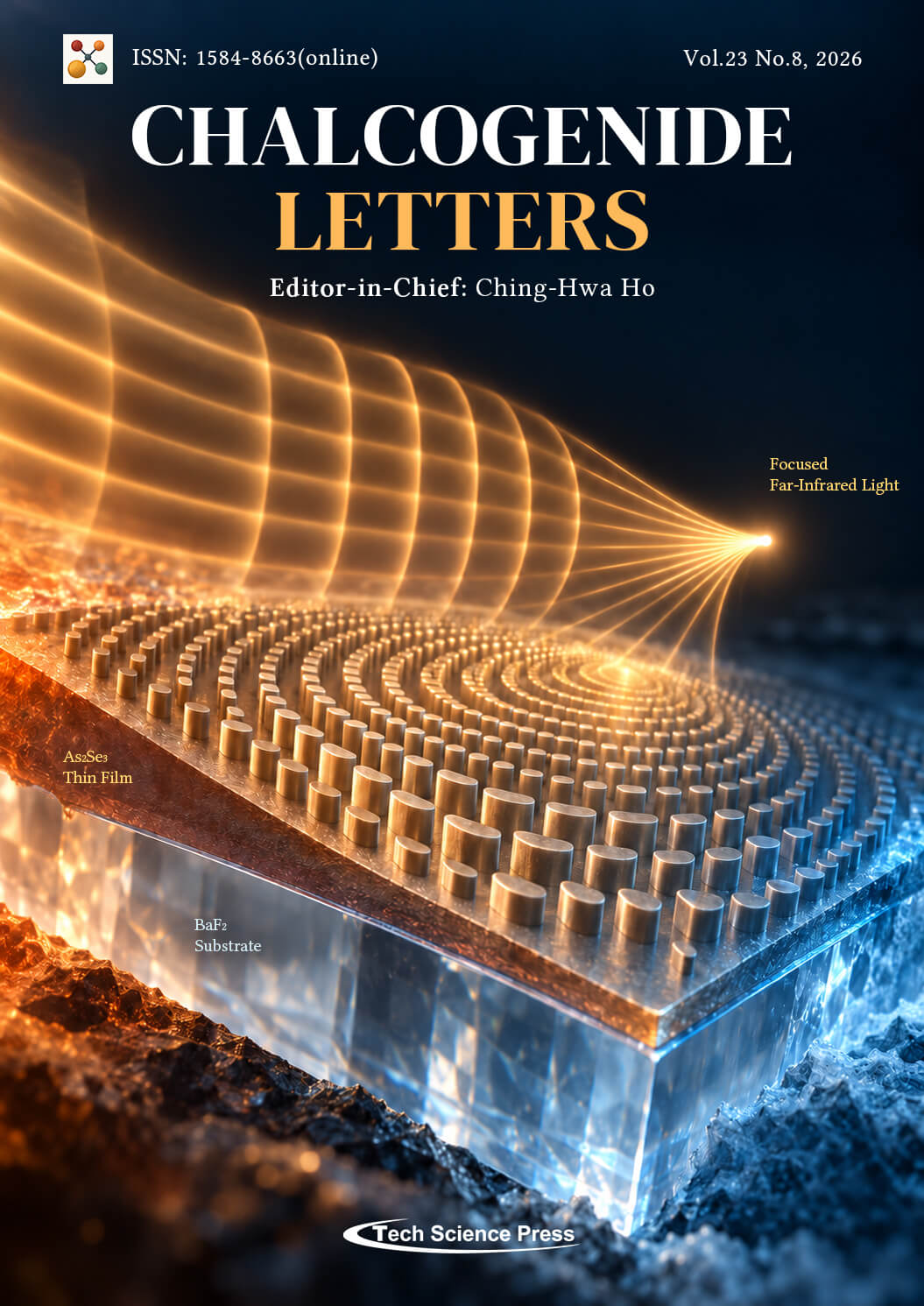
Chalcogenide Letters is published monthly (12 issues per year), covering a wide range of fundamental and applied research in the field of chalcogenide materials. The journal is open to letters, short communications and breakings news inserted as Short Notes, in the field of chalcogenide materials either amorphous or crystalline. Short papers in structure, properties and applications, as well as those covering special properties in nano-structured chalcogenides are admitted. Papers based on chalcogenide advanced nanomaterials with possible applications in electronics, optoelectronics, and photonics are encouraged. Also, articles on alternative and renewable energy sources in the field of chalcogenides are accepted for submission. Cross-fertilization of both crystalline and amorphous field in this special class of materials is one of the purposes of this Journal.
Science Citation Index Expanded (SCIE): 2025 Impact Factor 1.6; Web of Science; Journal Citation Reports (JCR); Google Scholar; CROSSREF; ROAD; OPENALEX.
Effective starting from the first issue of 2026, the Chalcogenide Letters (CL) will be published by Tech Science Press (TSP). This transition is designed to enhance the journal’s academic impact and global visibility while ensuring an improved publishing experience for researchers. The journal's aims, scope, and formatting guidelines will remain unchanged. The journal's Editor-in-Chief, Prof. Ching-Hwa Ho, and the editorial board will continue to lead the iournal toward an even more successful future.
We appreciate the ongoing support of our authors, reviewers, and readers as we embark on this exciting new chapter.
 Open Access
Chalcogenide Letters, Vol.23, No.8, 2026, DOI:10.32604/cl.2026.087654 - 18 September 2026
(This article belongs to the Special Issue: Research and Application of Chalcogenide Semiconductor Materials in Gas Sensors)
Abstract SF6 is the primary insulating and arc extinction medium in gas-insulated switchgear (GIS). Sulfur hexafluoride (SF6) decomposes to create diagnostic markers, such as sulfur dioxide (SO2), thionyl fluoride (SOF2), and hydrogen sulfide (H2S) when electrical problems occur, such as partial discharge and local overheating. Accurate quantification of these fault-marker gases is important for the early identification of insulation defects and the condition assessment of SF6-insulated equipment. Molybdenum disulfide (MoS2) is a well-known and atomically thin van der Waals semiconductor that has attracted considerable attention as a platform for gas-sensing applications. This is due to its large accessible surface area,… More >
Open Access
Chalcogenide Letters, Vol.23, No.8, 2026, DOI:10.32604/cl.2026.086712 - 18 September 2026
(This article belongs to the Special Issue: Advances in Sulfur-based Two-dimensional Materials)
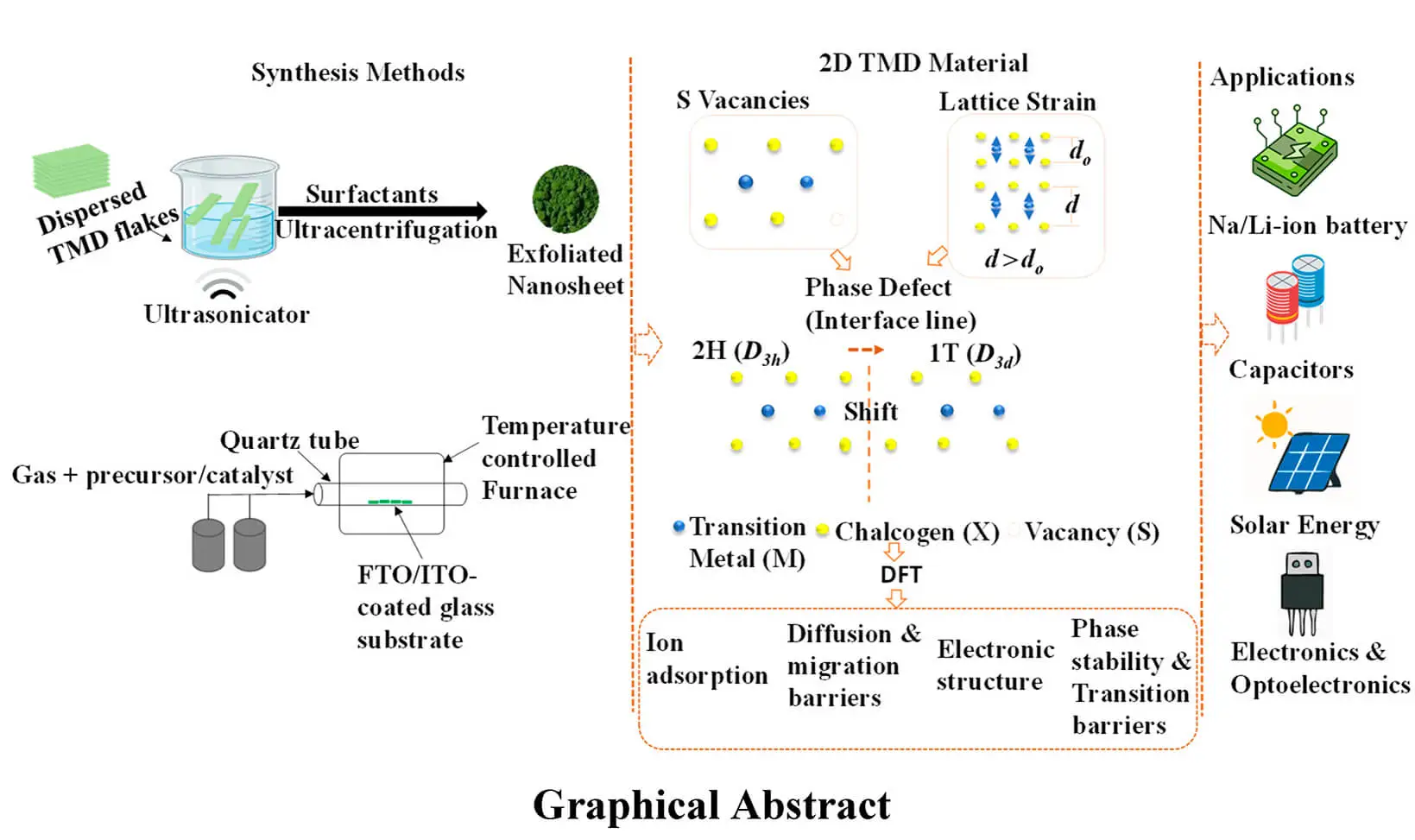
Abstract Several studies have reported a growing interest in nanomaterials beyond conventional graphite, driven by the rapid global demand for sustainable, high-performance energy storage. Among these materials, two-dimensional (2D) transition metal chalcogenides (TMCs), molybdenum- and tin-based systems such as molybdenum disulfide (MoS2) and tin (IV) disulfide (SnS2) in particular, have emerged as promising candidates for next-generation electrochemical energy storage devices (EESDs). This is owing to their unique X-M-X sandwich architectures, tunable electronic properties, and versatile intercalation chemistry. Despite several studies on 2D TMCs and their applications in EESDs, a gap still exists, as there is no comprehensive… More >
Graphic Abstract
Open Access
Chalcogenide Letters, Vol.23, No.8, 2026, DOI:10.32604/cl.2026.088891 - 18 September 2026
(This article belongs to the Special Issue: New Horizons in Structural Design and Experimental Synthesis of Chalcogenide-based Materials for Energy Storage and Conversion)
Abstract Li/Na/K-ion batteries show huge potential in next-generation energy storage systems, but the limited theoretical capacity of commercial graphite anodes and the relatively large radius of Na/K ions seriously restrict further development, making it urgent to develop new high-performance anode materials. This article begins with the research hotspots of selenide anode materials and systematically reviews the applications of DFT calculations in the field of Li/Na/K-ion battery selenide anodes, covering transition metal dichalcogenides (MoSe2, TiSe2), Janus structures (VSeTe, WSSe), transition metal carboselenides (Zr2Se2C, Sc2Se2C), multi-anion bridged phosphoselenides (MoScP2Se6), main-group element layered selenides (Si2Se2, SiSe2, β-GeSe, γ-GeSe, β-CSe, GeSeNS, SnS2(1−x)Se2x), as well… More >
Open Access
ARTICLE
Chalcogenide Letters, Vol.23, No.8, 2026, DOI:10.32604/cl.2026.089518 - 18 September 2026
Abstract This study presents electron-beam evaporated As2Se3 films tailored for far-infrared heterogeneous metalenses. Characterization via X-ray diffraction and Raman spectroscopy reveals a structurally relaxed network in the films compared to bulk glass, resulting in enhanced infrared transmittance, a reduced refractive index, and a lower glass transition temperature. However, thermal expansion mismatch is found to induce cracking in thick films subjected to thermal cycling. The As2Se3/BaF2 system demonstrates superior adhesion, attributed to a minimal thermal expansion mismatch (Δα < 2.5 × 10⁻⁶°C−1). Notably, an 8 μm thick film endures over thirty rapid heating and liquid nitrogen quenching cycles without More >

 Login
Login Register
 Submit a Paper
 Propose a Special lssue
