
 Login
Login Register
 Submit a Paper
 Propose a Special lssue
 Open Access
2D Chalcogenide Nanomaterial for Energy Storage Devices: Synthesis, Characterization and DFT Approach
1 Nano Research Group, University of Nigeria, Nsukka, Enugu, Nigeria
2 Department of Physics, Miami University, Oxford, OH, USA
3 Department of Physics, College of Science, King Faisal University, Al Ahsa, Saudi Arabia
4 Department of Physics, Sefako Makgatho Health Sciences University, Medunsa, South Africa
* Corresponding Author: Fabian I. Ezema. Email:
(This article belongs to the Special Issue: Advances in Sulfur-based Two-dimensional Materials)
Chalcogenide Letters 2026, 23(8), 2 https://doi.org/10.32604/cl.2026.086712
Received 04 June 2026; Accepted 28 August 2026; Issue published 18 September 2026
 View Full Text
 Download PDF
Abstract
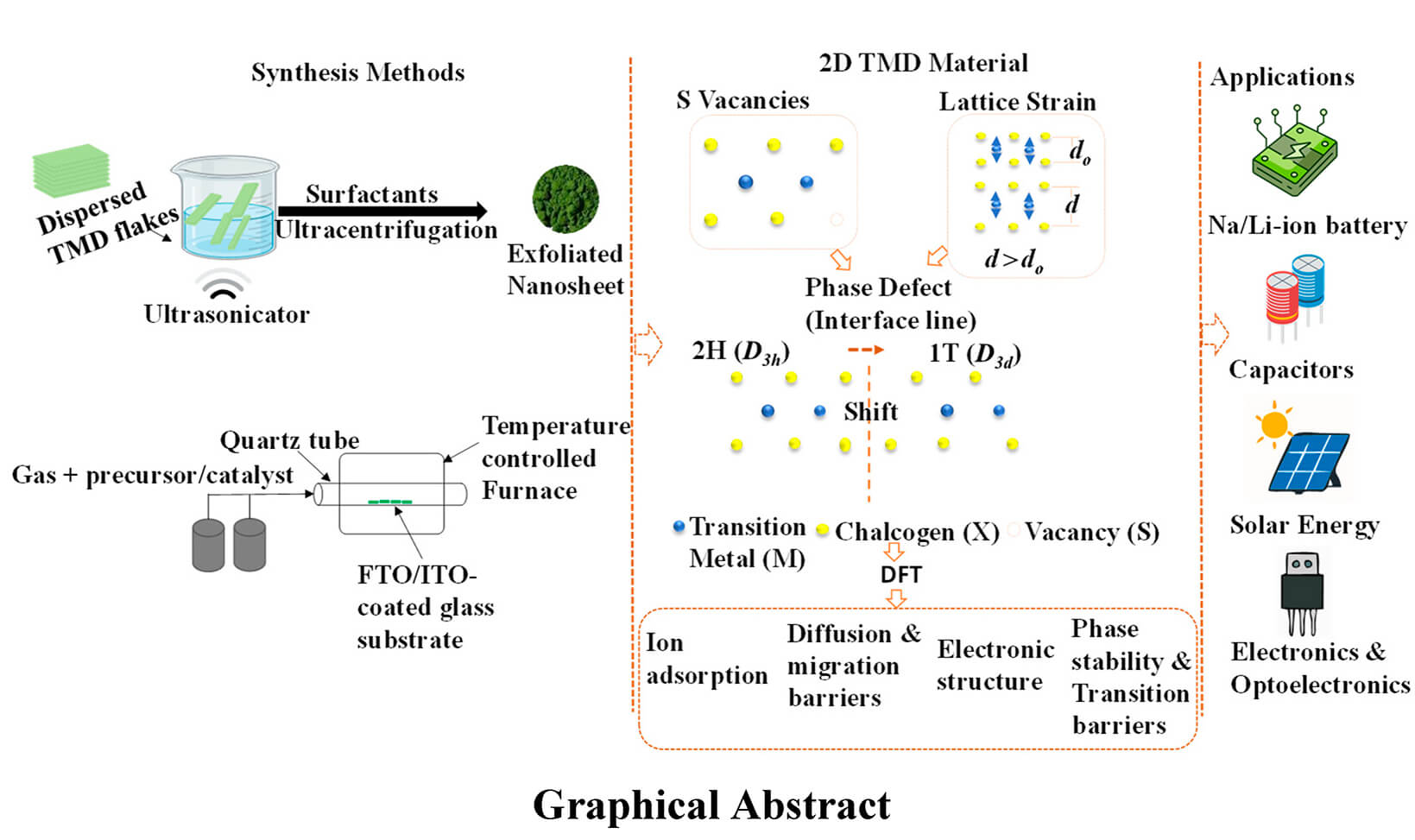
Several studies have reported a growing interest in nanomaterials beyond conventional graphite, driven by the rapid global demand for sustainable, high-performance energy storage. Among these materials, two-dimensional (2D) transition metal chalcogenides (TMCs), molybdenum- and tin-based systems such as molybdenum disulfide (MoS2) and tin (IV) disulfide (SnS2) in particular, have emerged as promising candidates for next-generation electrochemical energy storage devices (EESDs). This is owing to their unique X-M-X sandwich architectures, tunable electronic properties, and versatile intercalation chemistry. Despite several studies on 2D TMCs and their applications in EESDs, a gap still exists, as there is no comprehensive review that integrates advanced synthesis routes and multi-scale characterization with phase engineering (particularly the 2H-to-1T transition) and defect engineering strategies, not just for MoS2 and SnS2 but also for other 2D TMCs (e.g., WS2 and ReS2), while taking advantage of Density Functional Theory (DFT) as a predictive tool for electronic structure, ion adsorption energies, and diffusion barriers. Additionally, the review examines the sustainable utilization of local mineral precursors, such as Nigerian lithium-bearing ores, for the production of 2D TMCs. Overall, this review provides a comprehensive framework for the rational design and optimization of 2D chalcogenide-based nanomaterials for high-capacity lithium-, sodium-, and potassium-ion storage devices.Graphic Abstract
Keywords
Cite This Article
 Copyright © 2026 The Author(s). Published by Tech Science Press.
This work is licensed under a Creative Commons Attribution 4.0 International License , which permits unrestricted use, distribution, and reproduction in any medium, provided the original work is properly cited.
 Downloads
 Citation Tools
