Home / Journals / CL / Vol.23, No.8, 2026
Special Issues
cover

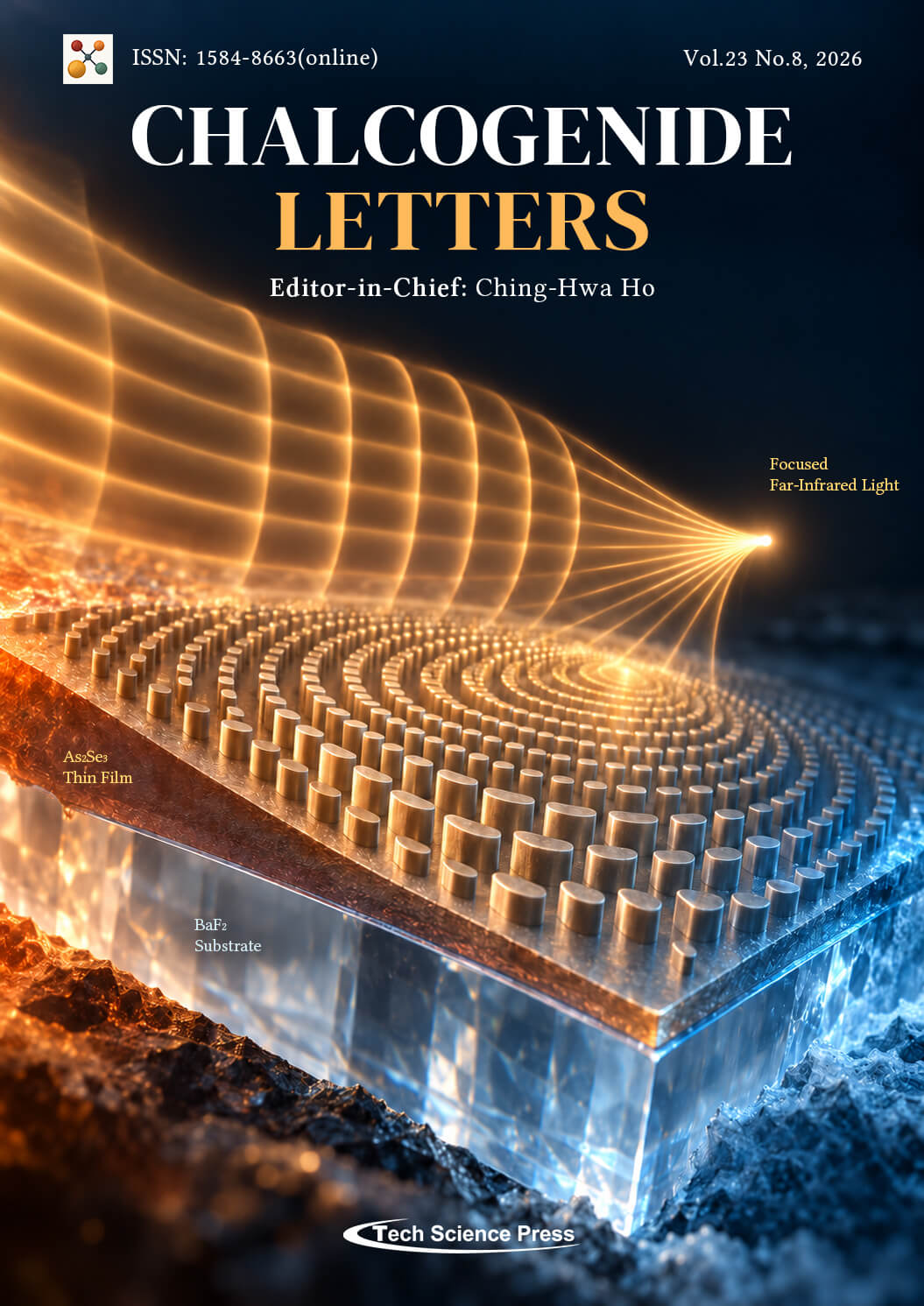
On the Cover

This study presents electron-beam evaporated As₂Se₃ thin films for far-infrared heterogeneous metalenses. Structural characterization reveals a relaxed film network compared with bulk glass, leading to enhanced infrared transmittance, a reduced refractive index, and a lower glass transition temperature. The study further demonstrates that the As₂Se₃/BaF₂ platform offers superior adhesion and thermal robustness, with an 8 μm-thick film surviving more than thirty rapid heating and liquid-nitrogen quenching cycles without degradation. These findings highlight As₂Se₃/BaF₂ as a promising platform for robust, environmentally stable far-infrared metalenses and heterogeneous metasurfaces.
The cover image was created by Chatgpt and contains no copyrighted elements or misleading representations.

View this paper

  • Open AccessOpen Access

    Emerging MoS2-Based Composite Approaches for the Detection of SF6 Decomposition Gases: A Review

    Huo Ye1, Jiantong Li2, Lingna Xu3,*
    Chalcogenide Letters, Vol.23, No.8, 2026, DOI:10.32604/cl.2026.087654 - 18 September 2026
    (This article belongs to the Special Issue: Research and Application of Chalcogenide Semiconductor Materials in Gas Sensors)
    Abstract SF6 is the primary insulating and arc extinction medium in gas-insulated switchgear (GIS). Sulfur hexafluoride (SF6) decomposes to create diagnostic markers, such as sulfur dioxide (SO2), thionyl fluoride (SOF2), and hydrogen sulfide (H2S) when electrical problems occur, such as partial discharge and local overheating. Accurate quantification of these fault-marker gases is important for the early identification of insulation defects and the condition assessment of SF6-insulated equipment. Molybdenum disulfide (MoS2) is a well-known and atomically thin van der Waals semiconductor that has attracted considerable attention as a platform for gas-sensing applications. This is due to its large accessible surface area,… More >

  • Open AccessOpen Access

    2D Chalcogenide Nanomaterial for Energy Storage Devices: Synthesis, Characterization and DFT Approach

    Holy Oghenewona Ovwiurhobo1, Marius O. Eji2, Adil Alshoaibi3, Ndanduleni Lethole4, Chawki Awada3, Shumaila Islam3, Nisrin Alnaim3, Fabian I. Ezema1,4,*
    Chalcogenide Letters, Vol.23, No.8, 2026, DOI:10.32604/cl.2026.086712 - 18 September 2026
    (This article belongs to the Special Issue: Advances in Sulfur-based Two-dimensional Materials)
    Abstract Several studies have reported a growing interest in nanomaterials beyond conventional graphite, driven by the rapid global demand for sustainable, high-performance energy storage. Among these materials, two-dimensional (2D) transition metal chalcogenides (TMCs), molybdenum- and tin-based systems such as molybdenum disulfide (MoS2) and tin (IV) disulfide (SnS2) in particular, have emerged as promising candidates for next-generation electrochemical energy storage devices (EESDs). This is owing to their unique X-M-X sandwich architectures, tunable electronic properties, and versatile intercalation chemistry. Despite several studies on 2D TMCs and their applications in EESDs, a gap still exists, as there is no comprehensive… More >

    Graphic Abstract

    2D Chalcogenide Nanomaterial for Energy Storage Devices: Synthesis, Characterization and DFT Approach

  • Open AccessOpen Access

    Research on Selenide Anode Materials for Alkali Metal Ion Batteries Based on First Principles

    Minghui Tan1,2, Fei Wang2,*, Shan Yuan1,2, Xinli Li1, Jingxia Gao2, Jinping Zhang2,*, Yong Zhang2, Lei Shi3
    Chalcogenide Letters, Vol.23, No.8, 2026, DOI:10.32604/cl.2026.088891 - 18 September 2026
    (This article belongs to the Special Issue: New Horizons in Structural Design and Experimental Synthesis of Chalcogenide-based Materials for Energy Storage and Conversion)
    Abstract Li/Na/K-ion batteries show huge potential in next-generation energy storage systems, but the limited theoretical capacity of commercial graphite anodes and the relatively large radius of Na/K ions seriously restrict further development, making it urgent to develop new high-performance anode materials. This article begins with the research hotspots of selenide anode materials and systematically reviews the applications of DFT calculations in the field of Li/Na/K-ion battery selenide anodes, covering transition metal dichalcogenides (MoSe2, TiSe2), Janus structures (VSeTe, WSSe), transition metal carboselenides (Zr2Se2C, Sc2Se2C), multi-anion bridged phosphoselenides (MoScP2Se6), main-group element layered selenides (Si2Se2, SiSe2, β-GeSe, γ-GeSe, β-CSe, GeSeNS, SnS2(1−x)Se2x), as well… More >

  • Open AccessOpen Access

    ARTICLE

    Structural Relaxation and Thermal Robustness of Electron-Beam Evaporated As2Se3 Films for Far-Infrared Heterogeneous Metalenses

    Weihang Qiu1, Bo Zhang2, Zhaofeng Gu2,*, Zijun Liu2, Xiang Shen2, Yimin Chen1,2,*
    Chalcogenide Letters, Vol.23, No.8, 2026, DOI:10.32604/cl.2026.089518 - 18 September 2026
    Abstract This study presents electron-beam evaporated As2Se3 films tailored for far-infrared heterogeneous metalenses. Characterization via X-ray diffraction and Raman spectroscopy reveals a structurally relaxed network in the films compared to bulk glass, resulting in enhanced infrared transmittance, a reduced refractive index, and a lower glass transition temperature. However, thermal expansion mismatch is found to induce cracking in thick films subjected to thermal cycling. The As2Se3/BaF2 system demonstrates superior adhesion, attributed to a minimal thermal expansion mismatch (Δα < 2.5 × 10⁻⁶°C−1). Notably, an 8 μm thick film endures over thirty rapid heating and liquid nitrogen quenching cycles without More >

Per Page:

Share Link