
 Login
Login Register
 Submit a Paper
 Propose a Special lssue
 Open Access
ARTICLE

Implementation of Rapid Code Transformation Process Using Deep Learning Approaches
1 Department of Computer Science and Information Engineering, National University of Kaohsiung, Kaohsiung, 811, Taiwan
2 Department of Fragrance and Cosmetic Science, Kaohsiung Medical University, Kaohsiung, 811, Taiwan
* Corresponding Author: Hsiu-Fen Tsai. Email:
Computer Modeling in Engineering & Sciences 2023, 136(1), 107-134. https://doi.org/10.32604/cmes.2023.024018
Received 21 May 2022; Accepted 05 September 2022; Issue published 05 January 2023
 View Full Text
 Download PDF
Abstract
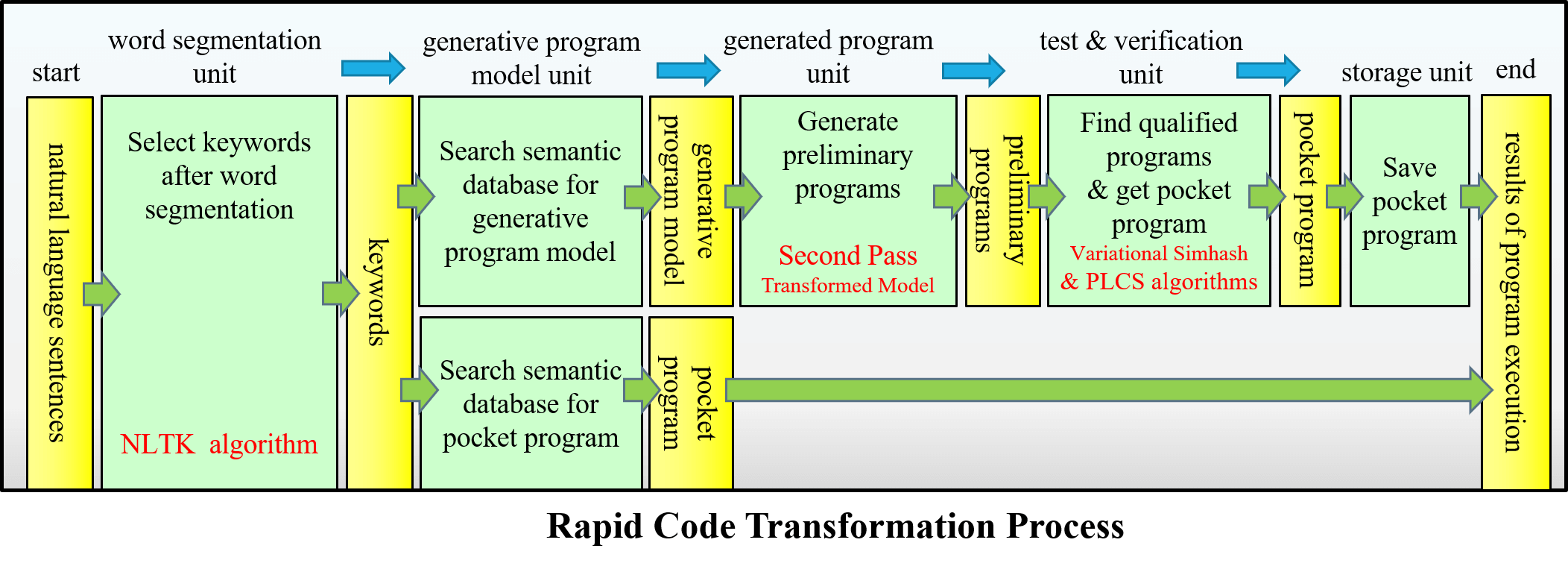
Our previous work has introduced the newly generated program using the code transformation model GPT-2, verifying the generated programming codes through simhash (SH) and longest common subsequence (LCS) algorithms. However, the entire code transformation process has encountered a time-consuming problem. Therefore, the objective of this study is to speed up the code transformation process significantly. This paper has proposed deep learning approaches for modifying SH using a variational simhash (VSH) algorithm and replacing LCS with a piecewise longest common subsequence (PLCS) algorithm to faster the verification process in the test phase. Besides the code transformation model GPT-2, this study has also introduced Microsoft MASS and Facebook BART for a comparative analysis of their performance. Meanwhile, the explainable AI technique using local interpretable model-agnostic explanations (LIME) can also interpret the decision-making of AI models. The experimental results show that VSH can reduce the number of qualified programs by 22.11%, and PLCS can reduce the execution time of selected pocket programs by 32.39%. As a result, the proposed approaches can significantly speed up the entire code transformation process by 1.38 times on average compared with our previous work.Graphic Abstract
Keywords
Code transformation model; variational simhash; piecewise longest common subsequence; explainable AI; LIME
Cite This Article
APA Style
Rong Chang, B., Tsai, H., Chou, H. (2023). Implementation of Rapid Code Transformation Process Using Deep Learning Approaches. Computer Modeling in Engineering & Sciences, 136(1), 107–134. https://doi.org/10.32604/cmes.2023.024018
Vancouver Style
Rong Chang B, Tsai H, Chou H. Implementation of Rapid Code Transformation Process Using Deep Learning Approaches. Comput Model Eng Sci. 2023;136(1):107–134. https://doi.org/10.32604/cmes.2023.024018
IEEE Style
B. Rong Chang, H. Tsai, and H. Chou, “Implementation of Rapid Code Transformation Process Using Deep Learning Approaches,” Comput. Model. Eng. Sci., vol. 136, no. 1, pp. 107–134, 2023. https://doi.org/10.32604/cmes.2023.024018
 Copyright © 2023 The Author(s). Published by Tech Science Press.
This work is licensed under a Creative Commons Attribution 4.0 International License , which permits unrestricted use, distribution, and reproduction in any medium, provided the original work is properly cited.
 Downloads
 Citation Tools
