
 Login
Login Register
 Submit a Paper
 Propose a Special lssue
 Open Access
ARTICLE

Rapid Seismic Damage Quantification for Reinforced Concrete Frames using Minimal Strain Inputs and Neural Networks Trained via Pushover Analysis
1 Faculty of Civil Engineering, Universiti Teknologi Malaysia, Johor Bahru, Malaysia
2 Institute of Noise and Vibration, Faculty of Civil Engineering, Universiti Teknologi Malaysia, Johor Bahru, Malaysia
* Corresponding Author: Mohammadreza Vafaei. Email:
(This article belongs to the Special Issue: Machine Learning Applications in Earthquake Engineering: Advances, Challenges, and Future Directions)
Computer Modeling in Engineering & Sciences 2026, 146(3), 18 https://doi.org/10.32604/cmes.2026.078250
Received 27 December 2025; Accepted 08 March 2026; Issue published 30 March 2026
 View Full Text
 Download PDF
Abstract
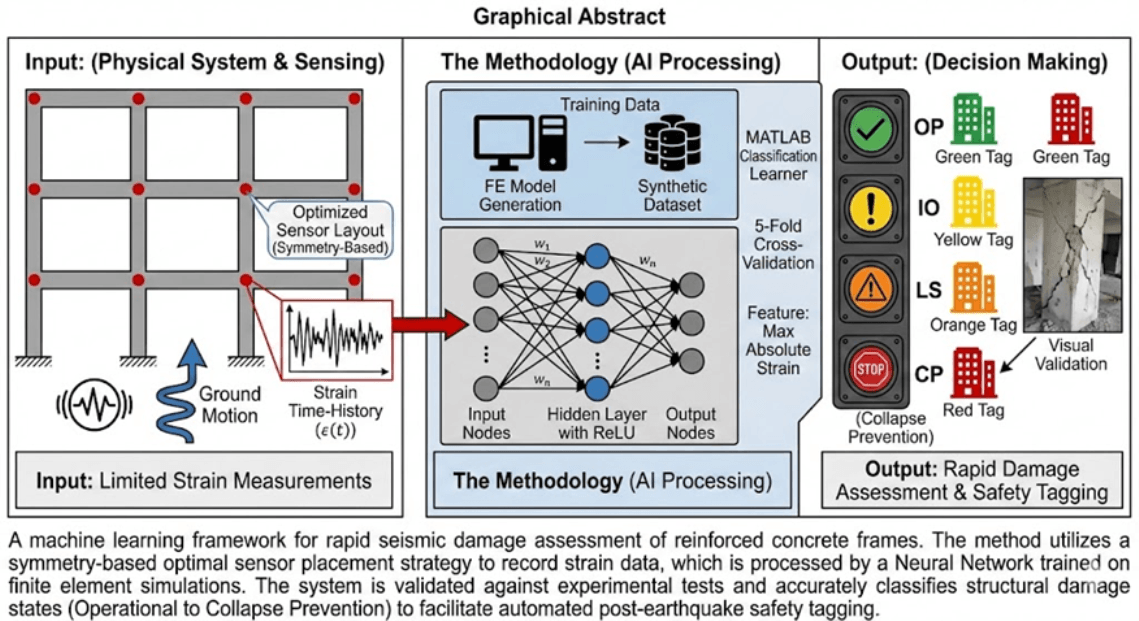
Rapid quantification of seismic-induced damage immediately following an earthquake is critical for determining whether a structure is safe for continued occupation or requires evacuation. This study proposes a novel damage identification method that utilizes limited strain data points, significantly reducing installation, maintenance, and data analysis costs compared to traditional distributed sensor networks. The approach integrates finite element (FE) modeling to generate capacity curves through pushover analysis, incorporates noise-augmented datasets for Artificial Neural Network (ANN) training, and classifies structural conditions into four damage levels: Operational (OP), Immediate Occupancy (IO), Life Safety (LS), and Collapse Prevention (CP). To evaluate the method’s accuracy and efficiency, it was applied to two reinforced concrete (RC) frames; a single-story frame tested experimentally under cyclic loading and a three-story frame analyzed under various lateral load patterns. Strain data from selected beam and column ends were used as ANN inputs, while the corresponding damage classes served as outputs. Confusion matrix results demonstrated high true positive rates (>85% for the single-story and >90% for the three-story frame), even with a reduced number of sensors. The model also exhibited strong robustness to White Gaussian Noise (SNR = 2.5–5 dB) and generalized effectively to nonlinear time-history analyses under scaled ground motions (PGA = 0.1–1.0 g). Feature selection using the MRMR and ANOVA algorithms further enhanced computational efficiency. Overall, the proposed ANN-based framework has strong potential for real-time structural health monitoring applications.Graphic Abstract
Keywords
Cite This Article
 Copyright © 2026 The Author(s). Published by Tech Science Press.
This work is licensed under a Creative Commons Attribution 4.0 International License , which permits unrestricted use, distribution, and reproduction in any medium, provided the original work is properly cited.
 Downloads
 Citation Tools
