
 Login
Login Register
 Submit a Paper
 Propose a Special lssue
 Open Access
REVIEW

A Review on Emerging Unified Information–Physics Frameworks for Structural Design: Toward Topology Optimization Informatics
1 School of Mechanical and Automotive Engineering, South China University of Technology, Guangzhou, China
2 National Engineering Research Center of Novel Equipment for Polymer Processing, Key Laboratory of Advanced Manufacturing Technology for Polymers (South China University of Technology), Ministry of Education, South China University of Technology, Guangzhou, China
3 Duy Tan Research Institute for Computational Engineering (DTRICE), Duy Tan University, 6 Tran Nhat Duat, Tan Dinh ward, Ho Chi Minh City, Vietnam
4 Faculty of Civil Engineering, Duy Tan University, Da Nang City, Vietnam
5 Meituan Academy of Robotics Shenzhen, Shenzhen, China
* Corresponding Authors: Weihua Li. Email: ; Yingjun Wang. Email:
(This article belongs to the Special Issue: Topology Optimization: Theory, Methods, and Engineering Applications)
Computer Modeling in Engineering & Sciences 2026, 147(1), 4 https://doi.org/10.32604/cmes.2026.079830
Received 05 February 2026; Accepted 23 March 2026; Issue published 27 April 2026
 View Full Text
 Download PDF
Abstract
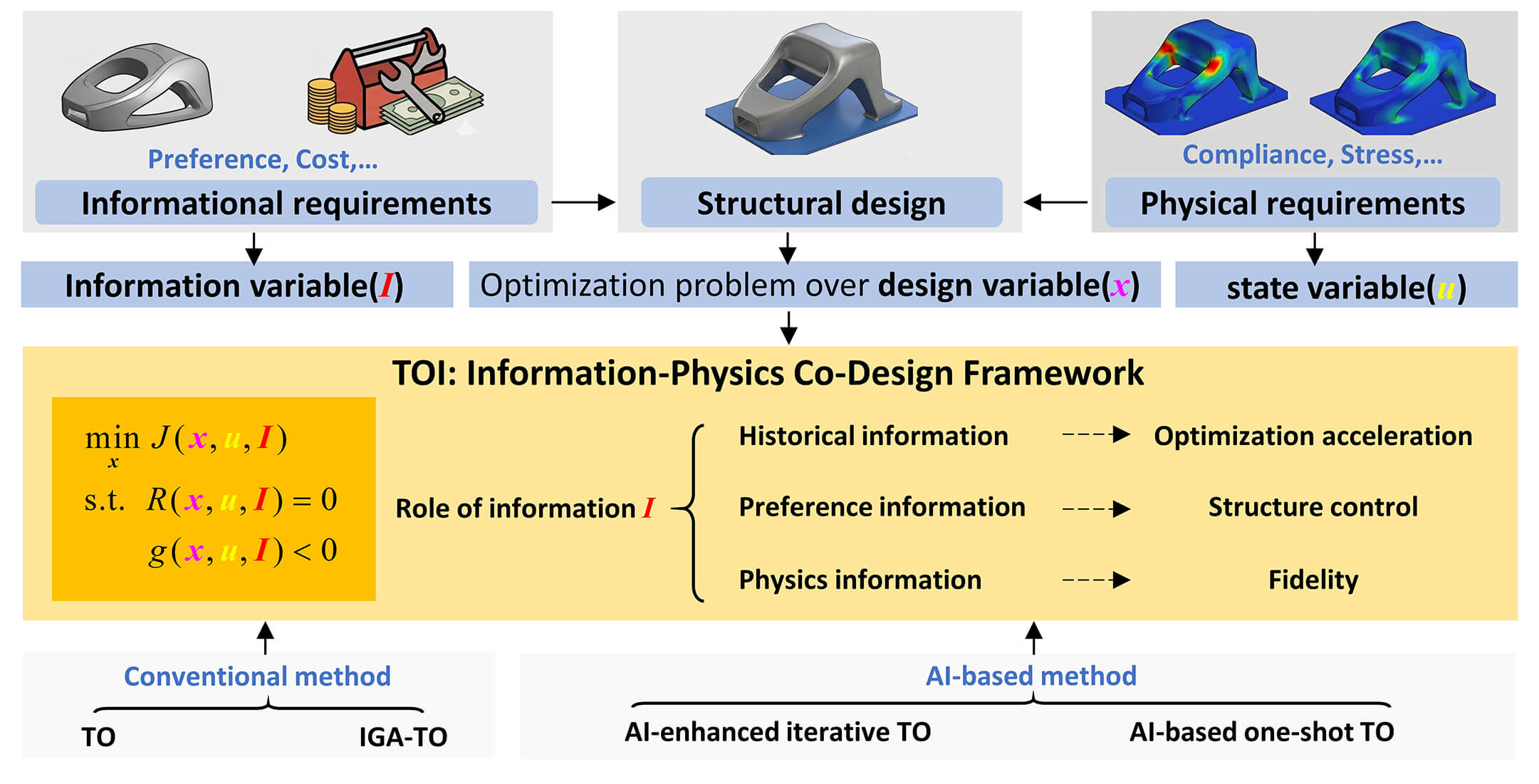
Topology optimization (TO) has become a core computational paradigm for structural design by defining optimality through physics-based objectives and constraints. However, practical engineering design often involves incomplete and imperfect physical modeling due to multi-physics coupling, manufacturing uncertainty, and computational constraints, leaving critical design factors insufficiently captured in purely physics-driven formulations. In parallel, data-driven and generative methods have enabled rapid topology generation and intent-aware design exploration, yet often weaken explicit optimality guarantees. This review argues that these seemingly divergent developments can be organized under a unified information–physics perspective. We term this emerging field Topology Optimization Informatics (TOI): optimal structural design is obtained through the joint modeling and optimization of physical laws and design-relevant information. We first summarize the integration of artificial intelligence (AI) and TO into two major paradigms: AI-based one-shot TO, which learns mappings or distributions of near-optimal designs from data and prioritizes fast generation and diversity, and AI-enhanced iterative TO, which embeds learning-based modules into the classical solver-in-the-loop pipeline while keeping the underlying governing equations unchanged. Finally, we show that traditionally separate tasks—design control, computational acceleration, and fidelity enhancement—can be interpreted as different manifestations of information–physics co-modeling within a single optimization framework, thereby clarifying their connections and design implications and outlining opportunities for semantic- and data-enabled next-generation structural design.Graphic Abstract
Keywords
Cite This Article
 Copyright © 2026 The Author(s). Published by Tech Science Press.
This work is licensed under a Creative Commons Attribution 4.0 International License , which permits unrestricted use, distribution, and reproduction in any medium, provided the original work is properly cited.
 Downloads
 Citation Tools
