
 Login
Login Register
 Submit a Paper
 Propose a Special lssue
 Open Access
ARTICLE

Dynamic Graph Multi-Scale Network for Breast Cancer Classification Using eXplainable Artificial Intelligence with Class Imbalance Mitigation in Medical and Healthcare Systems
1 Artificial Intelligence & Data Analytics Lab, College of Computer Science and Information System (CCIS), Prince Sultan University, Riyadh, Saudi Arabia
2 Department of Mathematical Sciences, College of Science, Princess Nourah Bint Abdulrahman University, Riyadh, Saudi Arabia
3 College of Sciences and Humanities (CSH), Prince Sultan University, Riyadh, Saudi Arabia
* Corresponding Author: Faten S. Alamri. Email:
(This article belongs to the Special Issue: Machine Learning and Deep Learning-Based Pattern Recognition, 2nd Edition)
Computer Modeling in Engineering & Sciences 2026, 148(1), 43 https://doi.org/10.32604/cmes.2026.084816
Received 29 April 2026; Accepted 11 June 2026; Issue published 27 July 2026
 View Full Text
 Download PDF
Abstract
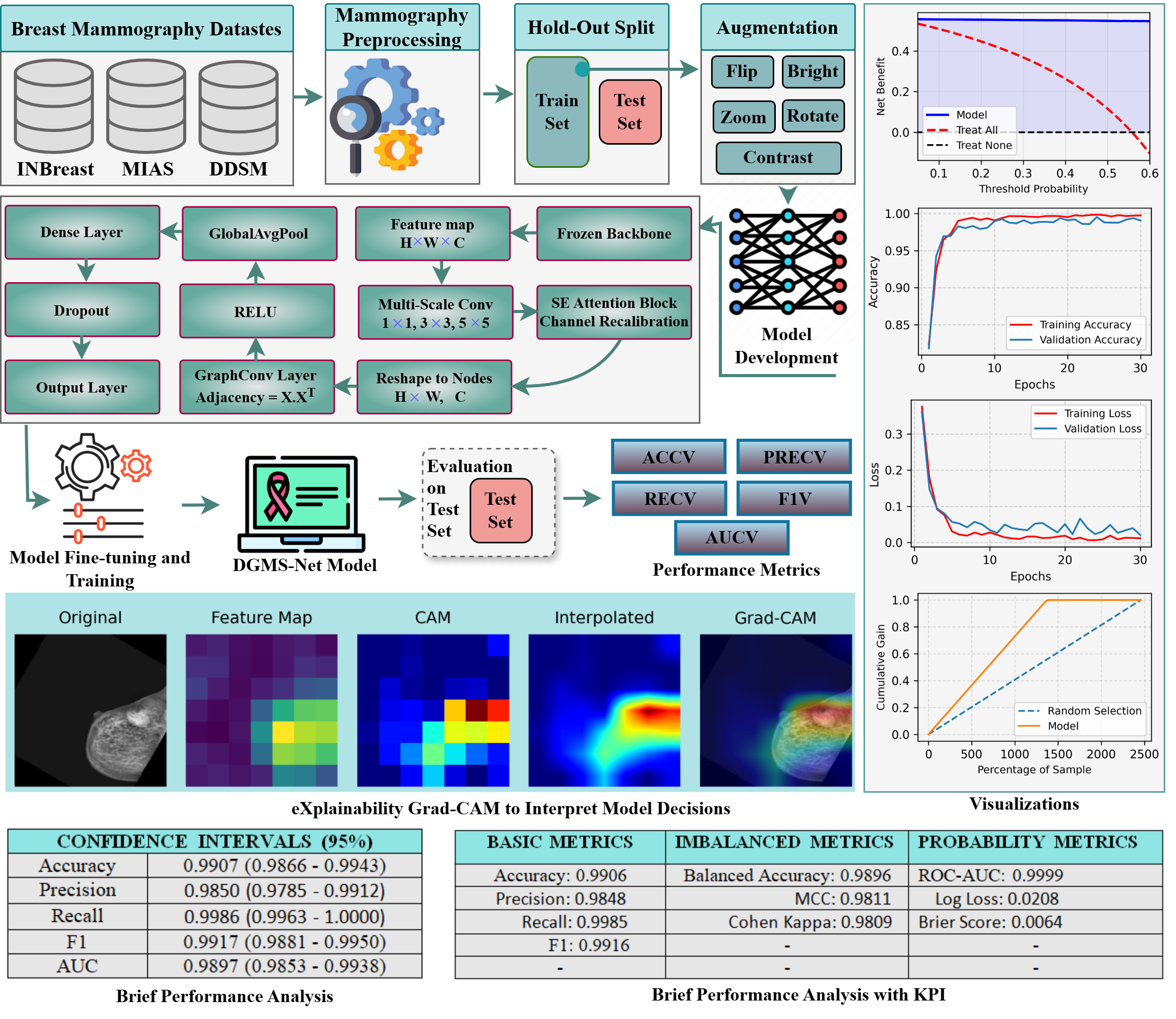
In the era of artificial intelligence, pattern recognition techniques have become fundamental in advancing medical image processing, diagnosis, and automated disease classification systems. Among various clinical challenges, breast cancer is the second most dangerous leading cause of death in women worldwide. Early and accurate detection of breast cancer is crucial to develop advanced diagnostic methods to control further loss or reduce mortality rates. This study proposes a dynamic graph multi-scale network for breast cancer diagnosis, integrated with multi-scale convolutional feature extraction, a squeeze-and-excitation block, and a graph convolutional network to jointly model local spatial features and global contextual dependencies. To mitigate the limitations of the dataset, this work incorporated mammography-based augmentation techniques to enhance the datasets and also a synthetic minority oversampling technique to generate samples to balance the class and enhance model generalization. Several experiments are performed using large MIAS, INbreast, and DDSM mammogram datasets with an RTX-3080 GPU with hold-out split and cross-validation methods. Experimental results demonstrate that the proposed model achieves a 3.99% improvement compared to pretrained models, indicating its effectiveness in handling complex mammographic patterns. The approach achieves (0.9866–0.9943) accuracy with a confidence interval of 0.95 andGraphic Abstract
Keywords
Cite This Article
 Copyright © 2026 The Author(s). Published by Tech Science Press.
This work is licensed under a Creative Commons Attribution 4.0 International License , which permits unrestricted use, distribution, and reproduction in any medium, provided the original work is properly cited.
 Downloads
 Citation Tools
