
 Login
Login Register
 Submit a Paper
 Propose a Special lssue
 Open Access
REVIEW
Sparse-View CT Reconstruction with Deep Learning: A Comprehensive Survey
1 School of Automation Engineering, University of Electronic Science and Technology of China, Chengdu, China
2 Glasgow College, University of Electronic Science and Technology of China, Chengdu, China
3 Future Tech Institute, Guangzhou Huashang University, Guangzhou, China
4 School of the Environment, The University of Queensland, Brisbane St Lucia, QLD, Australia
5 LIRMM, University of Montpellier-CNRS, Montpellier, France
* Corresponding Author: Bo Yang. Email:
(This article belongs to the Special Issue: The Collection of the Latest Reviews on Advances and Challenges in AI)
Computer Modeling in Engineering & Sciences 2026, 148(3), 4 https://doi.org/10.32604/cmes.2026.085787
Received 18 May 2026; Accepted 28 July 2026; Issue published 28 September 2026
 View Full Text
 Download PDF
Abstract
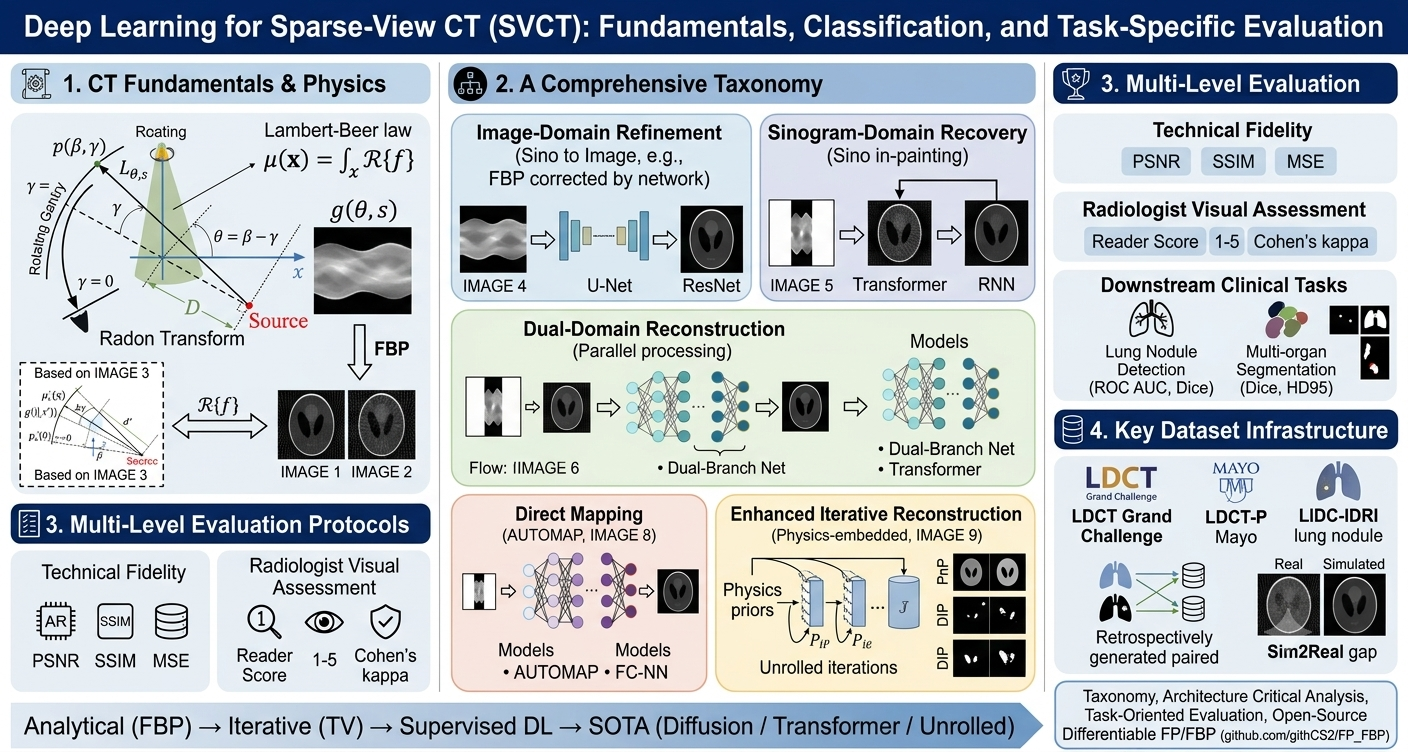
Computed tomography (CT) is an essential medical imaging technique that produces high-resolution cross-sectional images, but delivers substantial radiation dose to patients. Sparse-view CT (SVCT) reduces radiation dose by decreasing projection views, but causes streak artifacts that degrade image quality. Deep learning has emerged as a powerful tool to address this challenge. Although prospective paired acquisitions for low-current/voltage CT may be constrained by radiation-dose management and clinical workflow considerations, SVCT provides a practical way to construct paired training data through retrospective angular downsampling of full-view projections. This survey provides a systematic review of deep learning–based SVCT, analyzing nearly 70 articles published since 2017. We describe CT imaging fundamentals with differentiable back-projection, propose a taxonomy of reconstruction frameworks (image-domain, sinogram-domain, dual-domain, direct mapping, and enhanced iterative), and review neural network architectures, loss functions and datasets. We further provide open-source implementations of fan-beam forward projection and filtered back projection for dual-domain training. Finally, we discuss future directions and key remaining challenges.Graphic Abstract
Keywords
Cite This Article
 Copyright © 2026 The Author(s). Published by Tech Science Press.
This work is licensed under a Creative Commons Attribution 4.0 International License , which permits unrestricted use, distribution, and reproduction in any medium, provided the original work is properly cited.
 Downloads
 Citation Tools
