
 Login
Login Register
 Submit a Paper
 Propose a Special lssue
 Open Access
REVIEW
Short-chain fatty acids regulate cytokine programs in tumor immunity: mechanisms and translational opportunities
1 Department of Gastroenterology, Renmin Hospital of Wuhan University, Wuhan, China
2 Key Laboratory of Hubei Province for Digestive System Diseases, Renmin Hospital of Wuhan University, Wuhan, China
3 Central Laboratory, Renmin Hospital of Wuhan University, Wuhan, China
4 Department of Oncology, The Second Clinical Medical College, Yangtze University, Jingzhou, China
* Corresponding Authors: Haisen Yin. Email: ; Shiyun Tan. Email:
; Baoping Yu. Email:
(This article belongs to the Special Issue: Inflammation in Disease: When Cytokine Conversations Tell the Whole Story)
European Cytokine Network 2026, 37(3), 259-280. https://doi.org/10.32604/ecn.2026.084574
Received 25 April 2026; Accepted 05 June 2026; Issue published 28 September 2026
 View Full Text
 Download PDF
Abstract
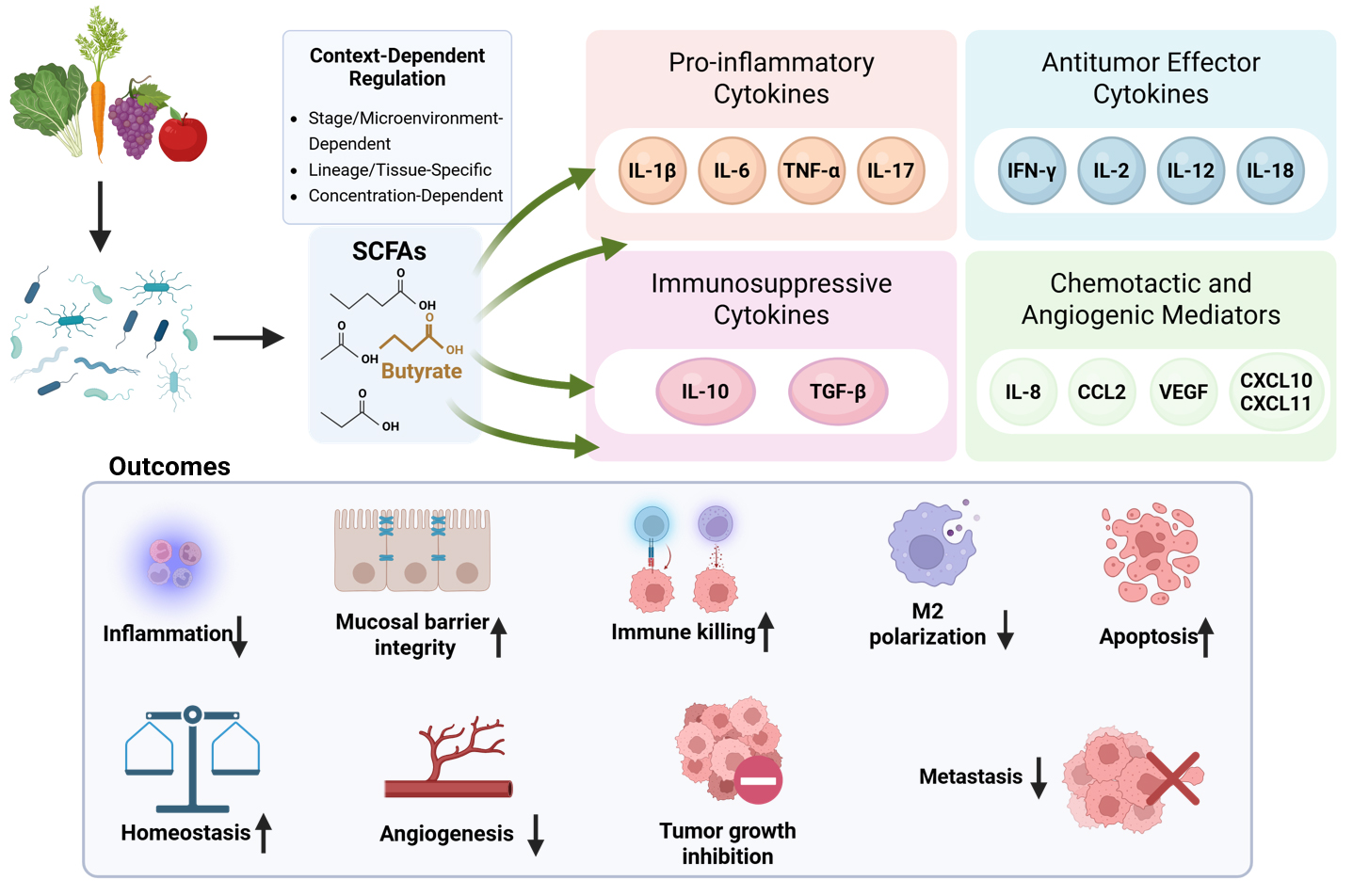
Short-chain fatty acids (SCFAs) are increasingly recognized as active modulators of tumor immunity. However, organizing evidence only by tumor type, metabolite species, or individual pathway may not fully explain their context-dependent effects. This Review clarifies how SCFAs regulate tumor immunity by remodeling cytokine and chemokine networks within the tumor microenvironment and defines the contextual factors that determine whether these effects support or restrain antitumor responses. We organize SCFA-driven effects into four functional cytokine domains: pro-inflammatory, antitumor effector, immunosuppressive, and chemotactic/angiogenic mediators. Across these domains, SCFAs act through inflammasome modulation, receptor-mediated signaling, epigenetic regulation, and metabolic reprogramming. We propose that the translational potential of SCFAs depends on context-aware application, given that their immunological effects are shaped by SCFA subtype, exposure compartment, dose, tumor stage, cellular lineage, tissue environment, and therapeutic context. Importantly, current mechanistic insights remain largely butyrate-based, with limited evidence for other SCFAs or clinically relevant exposure settings. We further discuss the implications of these patterns for immune checkpoint blockade, cell- and virus-based therapies, radiotherapy, and chemotherapy. Overall, SCFA-mediated modulation of cytokine networks provides a useful framework for understanding metabolic regulation of tumor immunity and its translational potential.Graphic Abstract
Keywords
Cite This Article
 Copyright © 2026 The Author(s). Published by Tech Science Press.
This work is licensed under a Creative Commons Attribution 4.0 International License , which permits unrestricted use, distribution, and reproduction in any medium, provided the original work is properly cited.
 Downloads
 Citation Tools
