
 Login
Login Register
 Submit a Paper
 Propose a Special lssue
 Open Access
REVIEW
Senescence-associated secretory phenotype in urological cancers: molecular mechanisms, tumor microenvironment modulation, and therapeutic targeting
Department of Urology, The First Affiliated Hospital of Zhejiang Chinese Medical University (Zhejiang Provincial Hospital of Chinese Medicine), Hangzhou, China
* Corresponding Author: Yunqiu Gao. Email:
(This article belongs to the Special Issue: Targeting Non-Canonical Cytokine Sources in the Tumor Microenvironment: From Biology to Novel Antitumor Strategies)
European Cytokine Network 2026, 37(3), 281-292. https://doi.org/10.32604/ecn.2026.087229
Received 12 June 2026; Accepted 07 September 2026; Issue published 28 September 2026
 View Full Text
 Download PDF
Abstract
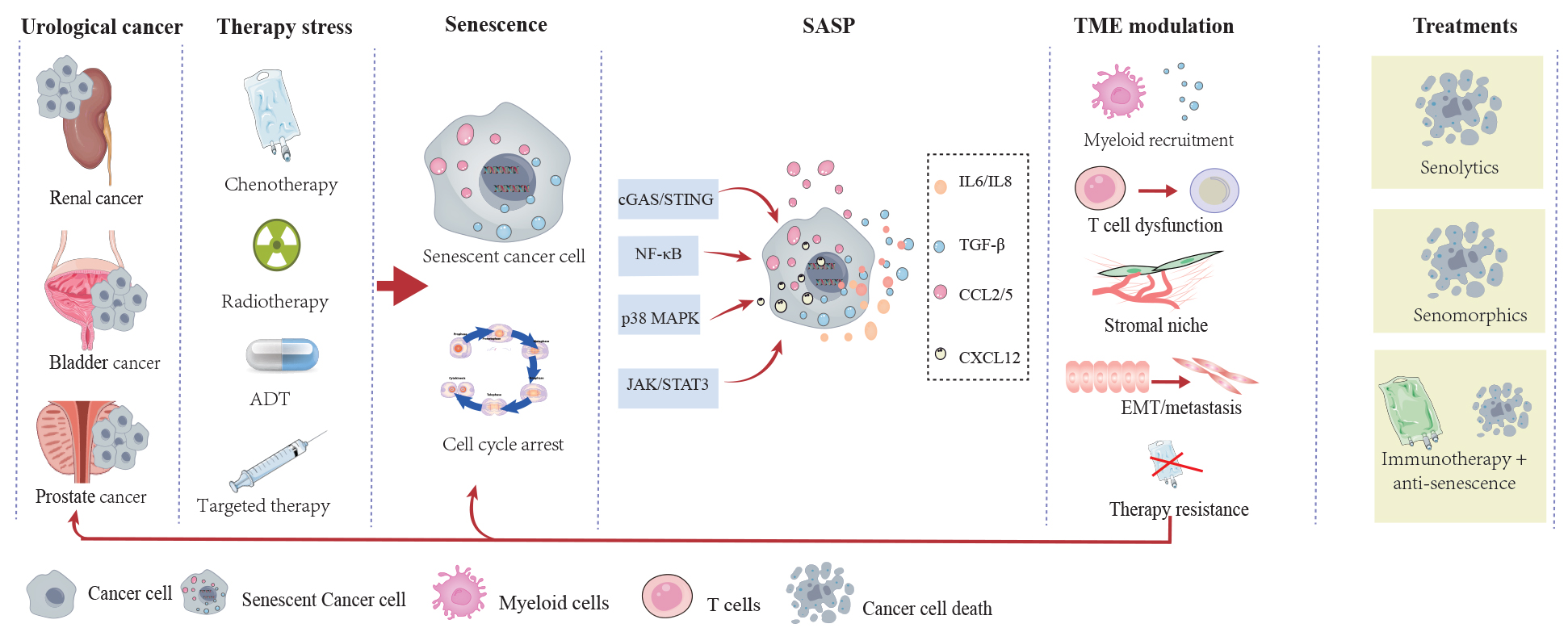
Cellular senescence is a durable stress response with double effects on cancer. Although stable cell-cycle arrest may initially restrict tumor growth, senescent tumor and stromal cells remain metabolically active and can remodel the tumor microenvironment through the senescence-associated secretory phenotype (SASP). This review synthesizes current evidence on therapy-induced and tumor-intrinsic senescence in prostate, bladder, and kidney cancers, focusing on molecular regulation and context-dependent SASP effects. We discuss how NF-κB, JAK/STAT3, cGAS-STING, and p38 MAPK regulate SASP composition. These pathways help determine the composition of the SASP, including the cytokines, chemokines, growth factors, and matrix-remodeling enzymes released by senescent cells. These SASP factors can recruit immunosuppressive myeloid cells, impair T-cell function, alter extracellular matrix organization, and support invasion, metastasis, and treatment response. The available evidence indicates that outcome depends on the inducing stimulus, cellular source, immune context, and duration of the response. Senolytics, senomorphics, and combinations with immunotherapy are promising, but evidence in urological cancers remains largely preclinical. Clinical translation will require validated multi-marker assays, longitudinal sampling, and prospective trials that distinguish transient immunogenic senescence from persistent immunosuppressive senescence.Graphic Abstract
Keywords
Cite This Article
 Copyright © 2026 The Author(s). Published by Tech Science Press.
This work is licensed under a Creative Commons Attribution 4.0 International License , which permits unrestricted use, distribution, and reproduction in any medium, provided the original work is properly cited.
 Downloads
 Citation Tools
