
 Login
Login Register
 Submit a Paper
 Propose a Special lssue
 Open Access
REVIEW
Gut microbiota-driven epigenetic regulation of cytokine gene expression: microbial metabolites, chromatin mechanisms, and clinical perspectives
1 Department of Medical-Surgical and Prophylactic Disciplines, Faculty of Medicine, Titu Maiorescu University of Bucharest, Bucharest, Romania
2 Department of Hematology, Colentina Clinical Hospital, Bucharest, Romania
3 Department of Hematology, Carol Davila University of Medicine and Pharmacy, Bucharest, Romania
4 Department of Hematology and Bone Marrow Transplantation, Fundeni Clinical Institute, Bucharest, Romania
5 Department of General Surgery, Witting Clinical Hospital, Bucharest, Romania
6 Department of Preclinical Disciplines, Faculty of Medicine, Titu Maiorescu University of Bucharest, Bucharest, Romania
7 Department of General Surgery, Monza Clinical Hospital, Bucharest, Romania
8 Medical Doctoral School, Titu Maiorescu University of Bucharest, Bucharest, Romania
9 Research Centre in the Medical-Pharmaceutical Field, Faculty of Medicine and Pharmacy “Dunarea de Jos” University, Galati, Romania
10 Department of Hematology, “Sf. Apostol Andrei” County Emergency Clinical Hospital, Galati, Romania
* Corresponding Author: Cosmin Alec Moldovan. Email:
European Cytokine Network 2026, 37(3), 207-223. https://doi.org/10.32604/ecn.2026.086087
Received 24 May 2026; Accepted 31 August 2026; Issue published 28 September 2026
 View Full Text
 Download PDF
Abstract
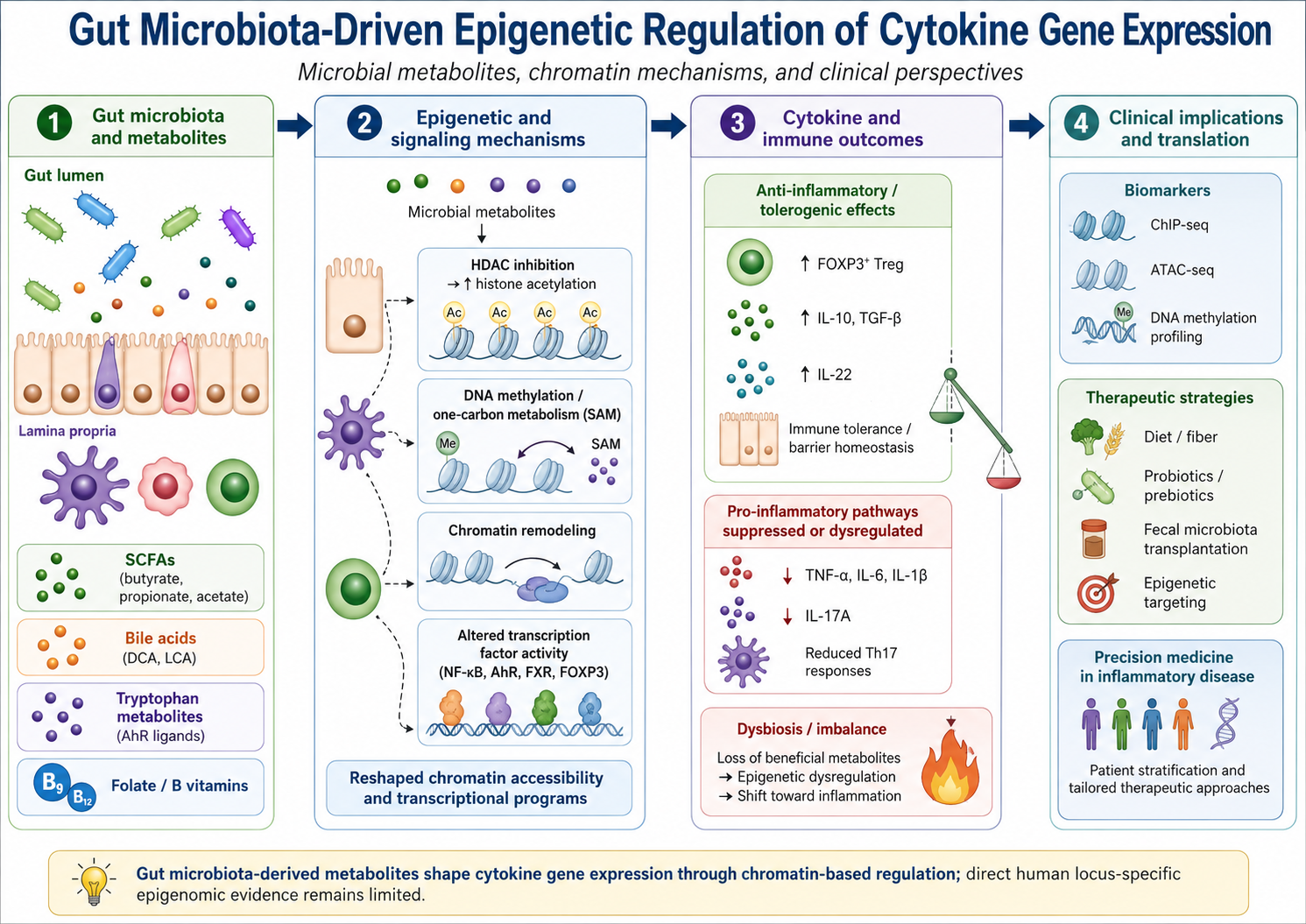
Accumulating evidence suggests that the gut microbiota regulates cytokine gene expression through multiple epigenetic mechanisms that shape chromatin states in response to microbial metabolites. Alterations in the gut microbiota have been implicated in the pathogenesis of numerous inflammatory, autoimmune, and metabolic disorders. Key mediators including short-chain fatty acids, bile acids, and tryptophan derivatives modulate histone modifications and DNA methylation at cytokine gene loci, influencing the balance between pro-inflammatory and tolerogenic immune responses. Experimental evidence, including ChIP-seq studies, indicates that microbial colonization promotes regulatory chromatin configurations, while dysbiosis is associated with epigenetic patterns favoring inflammatory cytokine programs. Short-chain fatty acid–mediated histone deacetylase inhibition represents a central mechanism supporting regulatory T cell differentiation and anti-inflammatory cytokine expression. This review summarizes the current evidence linking microbial metabolites, epigenetic regulation, and cytokine expression, while critically discussing the strengths and limitations of the available experimental and translational studies. Although these findings highlight a mechanistic link between the microbiota and cytokine epigenetic regulation, direct evidence in human immune cells remains limited. Further integrative studies are required to support the development of microbiome-informed biomarkers and therapeutic strategies.Graphic Abstract
Keywords
Cite This Article
 Copyright © 2026 The Author(s). Published by Tech Science Press.
This work is licensed under a Creative Commons Attribution 4.0 International License , which permits unrestricted use, distribution, and reproduction in any medium, provided the original work is properly cited.
 Downloads
 Citation Tools
