
 Login
Login Register
 Submit a Paper
 Propose a Special lssue
 Open Access
ARTICLE

The Influence of Discrimination Perception on the Psychological Resilience among Vocational High School Students: Longitudinal Mediating Effect of Vocational Identity
Department of Applied Psychology, School of Educational Science, Guangdong Polytechnic Normal University, Guangzhou, 510665, China
* Corresponding Author: Lingyan Zhang. Email:
(This article belongs to the Special Issue: Determinants and Subsequences of Subjective Well-being as a Microcosm of Social Change)
International Journal of Mental Health Promotion 2026, 28(2), 7 https://doi.org/10.32604/ijmhp.2025.073988
Received 29 September 2025; Accepted 02 December 2025; Issue published 27 February 2026
 View Full Text
 Download PDF
Abstract
Objectives: Psychological resilience is a critical resource for vocational high school students navigating social biases and fostering mental well-being. This six-month longitudinal study investigated the developmental trajectories of discrimination perception, vocational identity, and psychological resilience in this population. It further examined the longitudinal mediating role of vocational identity in the relationship between discrimination perception and psychological resilience. Methods: A total of 526 students from five vocational high schools in Guangdong, China, were assessed via convenience sampling at two time points: baseline (T1, September 2023) and six-month follow-up (T2, March 2024). Measures of discrimination perception, psychological resilience, and vocational identity were administered. Data were analyzed using a cross-lagged panel model to test for bidirectional relationships. Results: Over the six-month period, students showed significant decreases in discrimination perception and vocational identity, but a significant increase in psychological resilience. The cross-lagged model revealed significant bidirectional relationships: discrimination perception and psychological resilience negatively predicted each other over time (β = −0.124, p < 0.01; β = −0.200, p < 0.001), while psychological resilience and vocational identity positively predicted each other (β = 0.084, p < 0.05; β = 0.076, p < 0.05). The mediation analysis revealed a dual-pathway mechanism. T1 discrimination perception exerted both a significant direct negative effect on T2 psychological resilience (β = −0.332, p < 0.001) and a significant indirect positive effect via T1 vocational identity (indirect effect = 0.020, 95% CI [0.001, 0.046]). This confirms a partial mediating role, indicating that vocational identity functions as a compensatory mechanism, transforming the experience of discrimination perception into a potential source of psychological resilience. Conclusions: For vocational high school students, perception of discrimination directly undermines psychological resilience, but also indirectly fosters it through the positive development of vocational identity. These findings highlight vocational identity as a pivotal mechanism in the complex relationship between social adversity and mental resilience.Keywords
Recent studies indicate a growing prevalence of mental health challenges among Chinese adolescents [1]. This issue is particularly acute within vocational high schools, where the detection rate for psychological health problems reaches 37% [2]. In response, China’s Ministry of Education has emphasized the need to cultivate positive psychological qualities and enhance mental health in this population through comprehensive education [3]. Psychological resilience—defined as the capacity to recover from adversity, adapt to change, and respond positively to challenges—represents a crucial form of psychological capital [4]. Extensive research has established resilience as a positive psychological resource that correlates strongly with adaptive coping styles [5], and negatively with depression and other internalizing and externalizing problems [6]. Ultimately, it functions as a pivotal mechanism for enhancing adolescents’ psychological well-being. Therefore, investigating the developmental trajectory of psychological resilience among vocational high school students and its underlying influencing mechanisms is critical for developing effective mental health education and interventions for this vulnerable group.
1.1 The Relationship between Discrimination Perception and Psychological Resilience
Discrimination perception, defined as an individual’s awareness of negative attitudes, prejudice, and unfair treatment directed toward themselves or their group, is a primary risk factor for psychological resilience [7]. Vocational high school students are a population particularly susceptible to such perceptions. As they often enter vocational schools due to unsatisfactory performance on the secondary school entrance examination, they confront a public stigma that positions them as academically disengaged, less capable, and socially devalued. Studies indicate that over 90% of vocational high school students are cognizant of this discrimination [8].
The well-established association between discrimination perception and adverse mental health outcomes is particularly pronounced among disadvantaged student populations [9]. The Cumulative Risk and Protective Factors Model offers a framework for understanding this association, proposing that significant risk factors negatively impact well-being by depleting key protective resources [10]. Accordingly, we hypothesize that discrimination perception—a potent risk factor—undermines mental health by eroding psychological resilience, a critical protective factor. This pathway is further supported by evidence indicating that discrimination perception activates an individual’s threat system, initiating cycles of self-doubt and self-criticism [11].
Therefore, this study proposes Hypothesis 1: Discrimination perception negatively predicts the psychological resilience of vocational high school students.
1.2 The Relationship of Discrimination Perception, Vocational Identity, and Psychological Resilience
Symbolic Interaction Theory posits that individuals may internalize pervasive social prejudices, leading to diminished self-evaluation [12]. In the context of vocational education, which is often publicly stigmatized as inferior, students who perceive this discrimination are at risk of experiencing reduced self-worth [13]. This raises a critical question: how can this negative cycle be mitigated?
Rejection-Identification Theory offers a potential pathway, suggesting that individuals facing discrimination may strengthen their in-group identification as a buffer against its adverse effects [14]. For vocational high school students, discrimination perception may thus catalyze a deeper engagement with their professional group, thereby fostering a stronger vocational identity. Vocational identity—defined as a student’s comprehension of the value and significance of their future career, as well as an exploration of its intrinsic worth and ideals [15]—can thus be strengthened by external social pressures. Consequently, this study proposes Hypothesis 2: Discrimination perception positively predicts vocational identity among vocational high school students.
Furthermore, a robust vocational identity is posited to confer significant psychological benefits. Research consistently demonstrates a positive correlation between vocational identity and psychological resilience, as evidenced in studies of nursing students [16]. As a key protective factor, vocational identity facilitates intentional self-regulation, whereby individuals enhance goal commitment and optimize personal resources, thereby directly bolstering psychological resilience [17,18]. Supporting this mechanism, individuals with a well-defined vocational identity report higher levels of hope and stronger resilience capacities [19,20]. It is therefore hypothesized that a stronger vocational identity contributes directly to enhanced psychological resilience. This leads to Hypothesis 3: Vocational identity positively predicts psychological resilience among vocational high school students.
1.3 The Mediation Effect of Vocational Identity on the Relationship between Discrimination Perception and Psychological Resilience
A longitudinal perspective reveals a more complex relationship between discrimination perception, vocational identity, and psychological resilience. The Rejection-Identification Model suggests that discrimination perception can exert dual opposing effects on individuals: when individuals internalize a disadvantaged status, they experience negative psychological consequences; however, when they strengthen their identification with a meaningful in-group, this identification can buffer against the detrimental effects of discrimination [21,22]. For vocational high school students, this framework suggests a paradoxical pathway in which perceived discrimination may indirectly enhance psychological resilience by strengthening vocational identity. Rather than solely constituting a risk factor, perceived discrimination may simultaneously motivate students to strengthen their connection to their vocational identity—a meaningful in-group affiliation. This enhanced identification, in turn, may develop into a psychological resource that supports psychological resilience. Thus, we propose that vocational identity serves as a mediating mechanism that transforms the experience of discrimination perception into potentially adaptive outcomes. This leads to Hypothesis 4: Vocational identity serves as a mediator in the relationship between discrimination perception and psychological resilience. Specifically, higher initial discrimination perception predicts a stronger subsequent vocational identity, which in turn longitudinally predicts greater psychological resilience.
A longitudinal design was implemented to investigate a cohort of Chinese vocational high school students, who are enrolled in a three-year upper-secondary track operating alongside general academic high schools. The research focused exclusively on first- and second-year students. This sampling frame was selected for two primary reasons: first, these students have completed foundational vocational curricula, providing a stable basis for assessing mental constructs like vocational identity and discrimination perception; second, third-year students were excluded as they undertake mandatory off-campus internships, resulting in a dispersed population that is methodologically challenging to track and would introduce significant environmental heterogeneity.
Data were collected via convenience sampling from five vocational high schools in Guangdong Province. The baseline assessment (T1) was administered in September 2023, yielding 1158 responses. A six-month follow-up (T2) was conducted in March 2024, resulting in 886 responses. After merging datasets and removing cases with single-time participation, careless responses (e.g., straight-line answering), and other invalid data, the final matched sample comprised 526 participants, representing a 45.4% retention rate from T1 to T2. The final sample consisted of 358 females (68.1%) and 168 males (31.9%), with 292 first-year students (55.5%) and 234 second-year students (44.5%). The mean age of participants was 15.78 years (SD = 0.74).
2.2.1 Discrimination Perception Scale
The discrimination perception Scale developed by Dong et al. [23] was used in this study. This scale comprises six items, divided into two dimensions: individual discrimination perception and group discrimination perception. It employs a 5-point rating scale, with higher scores indicating a higher level of discrimination perception. In this study, the Cronbach’s α coefficients for this scale at T1 and T2 were 0.93 and 0.94, respectively.
2.2.2 Adolescent Psychological Resilience Scale
The Adolescent Psychological Resilience Scale revised by Hu et al. [24] was utilized. The scale consists of 27 items across two dimensions: personal strength and support strength. It uses a 5-point rating scale, with items 1, 2, 5, 6, 9, 12, 15, 16, 17, 21, 26, and 27 scored in reverse. Higher total scores indicate higher levels of psychological resilience. In this study, the Cronbach’s α coefficients for this scale at T1 and T2 were 0.82 and 0.86, respectively.
2.2.3 Vocational Identity Scale
Based on the vocational identity Scale developed by Zhang [25], this questionnaire was modified according to the future expected occupations of the study participants to investigate vocational identity among vocational high school students. The questionnaire includes 20 items across four dimensions: vocational belonging and identification, practical exploration, in-depth exploration, and commitment reconsideration. It uses a 5-point rating scale, with higher scores indicating higher levels of vocational identity. In this study, the Cronbach’s α coefficients for this scale at T1 and T2 were 0.95 and 0.96, respectively.
Data for the first wave were collected in September 2023 using an online questionnaire platform, while data for the second wave were gathered offline in March 2024. This study was conducted according to the Helsinki Declaration and approved by the Non-Clinical College Human Research Ethics Committee of School of Education Science, Guangdong Polytechnic Normal University (Approval No. GPNU-PSY-2022-007). Informed consent was obtained from the participants and their guardians.
Data analysis was conducted using Mplus 8.3 (Muthén & Muthén, Los Angeles, CA, USA) and SPSS 26.0 (IBM Corp., Armonk, NY, USA) in a sequential analytical procedure. The process began with an assessment of common method bias via Harman’s single-factor test, following the approach proposed by Zhou and Long [26]. Subsequently, longitudinal measurement invariance for the key constructs—discrimination perception, vocational identity, and psychological resilience—was established through confirmatory factor analysis in Mplus 8.3. A 2 × 2 × 2 repeated-measures MANOVA was then performed to examine the main and interactive effects of time (T1 vs. T2), gender and grade level on the dependent variables. Following these preliminary analyses, descriptive statistics and bivariate correlations were computed to evaluate baseline relationships among the variables. The core analysis involved estimating the reciprocal longitudinal relationships among the constructs. Model fit was considered acceptable with CFI/TLI > 0.90, RMSEA < 0.08 and SRMR < 0.10. Finally, the longitudinal mediating effect of psychological resilience on the relationship between discrimination perception and vocational identity was tested using the SPSS macro PROCESS (Model 4) with bias-corrected bootstrapping based on 5000 samples. The indirect effect of T1 discrimination perception on T2 vocational identity through T1 psychological resilience was considered statistically significant if the 95% bias-corrected confidence interval did not include zero.
The results indicated that at T1, there were 10 common factors with eigenvalues greater than 1, with the first factor explaining 23.24% of the variance; at T2, there were 9 common factors with eigenvalues greater than 1, with the first factor explaining 29.40% of the variance. Given that these percentages are well below 40%, common method bias is not a significant concern in this study.
3.2 Longitudinal Measurement Invariance of Discrimination Perception, Psychological Resilience and Vocational Identity
To evaluate whether the constructs of discrimination perception, psychological resilience, and vocational identity maintained equivalent conceptual meaning and measurement properties across the six-month study period, a series of longitudinal measurement invariance tests were performed. As summarized in Table 1, the results supported full measurement invariance for all three scales, confirming that the factor structures, loadings and intercepts remained equivalent across time.
Table 1: Results of longitudinal measurement invariance tests for each scale across two time points.
| Variable | Model | χ2 | df | CFI | TLI | RMSEA (90% CI) | ΔCFI |
|---|---|---|---|---|---|---|---|
| Discrimination Perception | Model 1: Configural Invariance | 255.99 | 18 | 0.93 | 0.88 | 0.16 [0.14, 0.18] | |
| Model 2: Metric Invariance | 293.66 | 23 | 0.92 | 0.89 | 0.15 [0.14, 0.17] | 0.01 | |
| Model 3: Scalar Invariance | 334.45 | 28 | 0.91 | 0.90 | 0.14 [0.13, 0.16] | 0.01 | |
| Psychological Resilience | Model 1: Configural Invariance | 7050.28 | 648 | 0.39 | 0.34 | 0.14 [0.13, 0.14] | |
| Model 2: Metric Invariance | 7139.66 | 674 | 0.38 | 0.36 | 0.14 [0.13, 0.14] | 0.01 | |
| Model 3: Scalar Invariance | 7313.89 | 700 | 0.37 | 0.37 | 0.13 [0.13, 0.14] | 0.01 | |
| Vocational Identity | Model 1: Configural Invariance | 1743.38 | 340 | 0.84 | 0.83 | 0.09 [0.08, 0.09] | |
| Model 2: Metric Invariance | 1806.93 | 359 | 0.84 | 0.83 | 0.09 [0.08, 0.09] | 0.00 | |
| Model 3: Scalar Invariance | 1871.58 | 378 | 0.83 | 0.83 | 0.09 [0.08, 0.09] | 0.01 |
3.3 Descriptive Statistics of Discrimination Perception, Psychological Resilience and Vocational Identity among Vocational High School Students
The results of the 2 × 2 × 2 repeated-measures MANOVA are presented in Table 2. In terms of psychological resilience, the main effect of gender was significant (F(1, 522) = 5.85, p < 0.05, η2p = 0.01), with males having a higher level of psychological resilience than females. Regarding vocational identity, the main effect of grade was significant (F(1, 522) = 6.84, p < 0.01, η2p = 0.01), with second-year students having a higher level of vocational identity than first-year students. For discrimination perception, neither the main effects of gender nor grade were significant, but the interaction effect between discrimination perception and grade was significant (F(1, 522) = 4.97, p < 0.05, η2p = 0.01). Simple effect analysis revealed that at T1, there was no significant difference in discrimination perception between grades. However, at T2, first-year students had a significantly higher score in discrimination perception than second-year students. No other main effects or interaction effects were significant.
Table 2: Descriptive Statistics and ANOVA Results for Key Variables by Gender and Grade.
| Variable | Male (n = 168) | Female (n = 358) | 1st-Year Students (n = 292) | 2nd-Year Students (n = 234) | F (1522) | η2p |
|---|---|---|---|---|---|---|
| T1 Psychological Resilience | 89.52 (14.86) | 85.75 (14.61) | 86.29 (15.57) | 87.79 (13.71) | Gender: 5.85* | 0.01 |
| T2 Psychological Resilience | 91.46 (14.51) | 88.52 (15.20) | 88.32 (15.13) | 90.88 (14.82) | ||
| T1 Vocational Identity | 69.67 (16.27) | 69.80 (12.77) | 68.33 (13.34) | 71.54 (14.54) | Grade: 6.84** | 0.01 |
| T2 Vocational Identity | 67.93 (16.88) | 67.93 (16.88) | 66.27 (13.17) | 69.34 (16.57) | ||
| T1 Discrimination Perception | 13.85 (6.66) | 13.14 (5.16) | 13.33 (5.44) | 13.41 (5.99) | Time*Grade: 4.97* | 0.01 |
| T2 Discrimination Perception | 12.40 (5.82) | 12.36 (5.12) | 12.97 (5.20) | 11.63 (5.45) |
3.4 Relationships among Discrimination Perception, Psychological Resilience and Vocational Identity
3.4.1 Correlation Analysis of Discrimination Perception, Psychological Resilience and Vocational Identity
The results of the correlation analysis are shown in Table 3. At the same time point, psychological resilience was significantly positively correlated with vocational identity and significantly negatively correlated with discrimination perception. However, at T1, discrimination perception was significantly positively correlated with vocational identity, while at T2, the correlation between discrimination perception and vocational identity was not significant. Across different time points, T1 discrimination perception was significantly negatively correlated with T2 psychological resilience, T1 vocational identity was significantly positively correlated with T2 psychological resilience, T1 psychological resilience was significantly negatively correlated with T2 discrimination perception and significantly positively correlated with T2 vocational identity.
Table 3: Correlations among Discrimination Perception, Psychological Resilience and Vocational Identity.
| Variable | 1 | 2 | 3 | 4 | 5 | 6 |
|---|---|---|---|---|---|---|
| T1 Discrimination Perception | 1 | |||||
| T2 Discrimination Perception | 0.41*** | 1 | ||||
| T1 Psychological Resilience | −0.47*** | −0.35*** | 1 | |||
| T2 Psychological Resilience | −0.31*** | −0.54*** | 0.50*** | 1 | ||
| T1 Vocational Identity | 0.11** | −0.04 | 0.15*** | 0.14*** | 1 | |
| T2 Vocational Identity | 0.02 | −0.01 | 0.14** | 0.37*** | 0.36*** | 1 |
3.4.2 Cross-Lagged Analysis of Discrimination Perception, Psychological Resilience and Vocational Identity
Based on the correlation analysis, a cross-lagged model was constructed to examine the longitudinal relationships among discrimination perception, psychological resilience, and vocational identity (Fig. 1). The cross-lagged panel model was tested and showed excellent fit to the data, χ2/df = 0.834, CFI = 1, TLI = 1, standardized root mean square residual [SRMR] = 0.010 and RMSEA = 0.010. The CFI and TLI reached their ceiling values, which is common for parsimonious models with outstanding fit [27]. The results showed that: (1) The auto-regressive predictive coefficients of discrimination perception, psychological resilience, and vocational identity were all significant (p < 0.001). (2) T1 discrimination perception significantly negatively predicted T2 psychological resilience (β = −0.124, standard error [SE] = 0.040, p < 0.01); T1 psychological resilience significantly negatively predicted T2 discrimination perception (β = −0.200, SE = 0.044, p < 0.001); T1 psychological resilience significantly positively predicted T2 vocational identity (β = 0.084, SE = 0.041, p < 0.05); T1 vocational identity significantly positively predicted T2 psychological resilience (β = 0.076, SE = 0.035, p < 0.05).
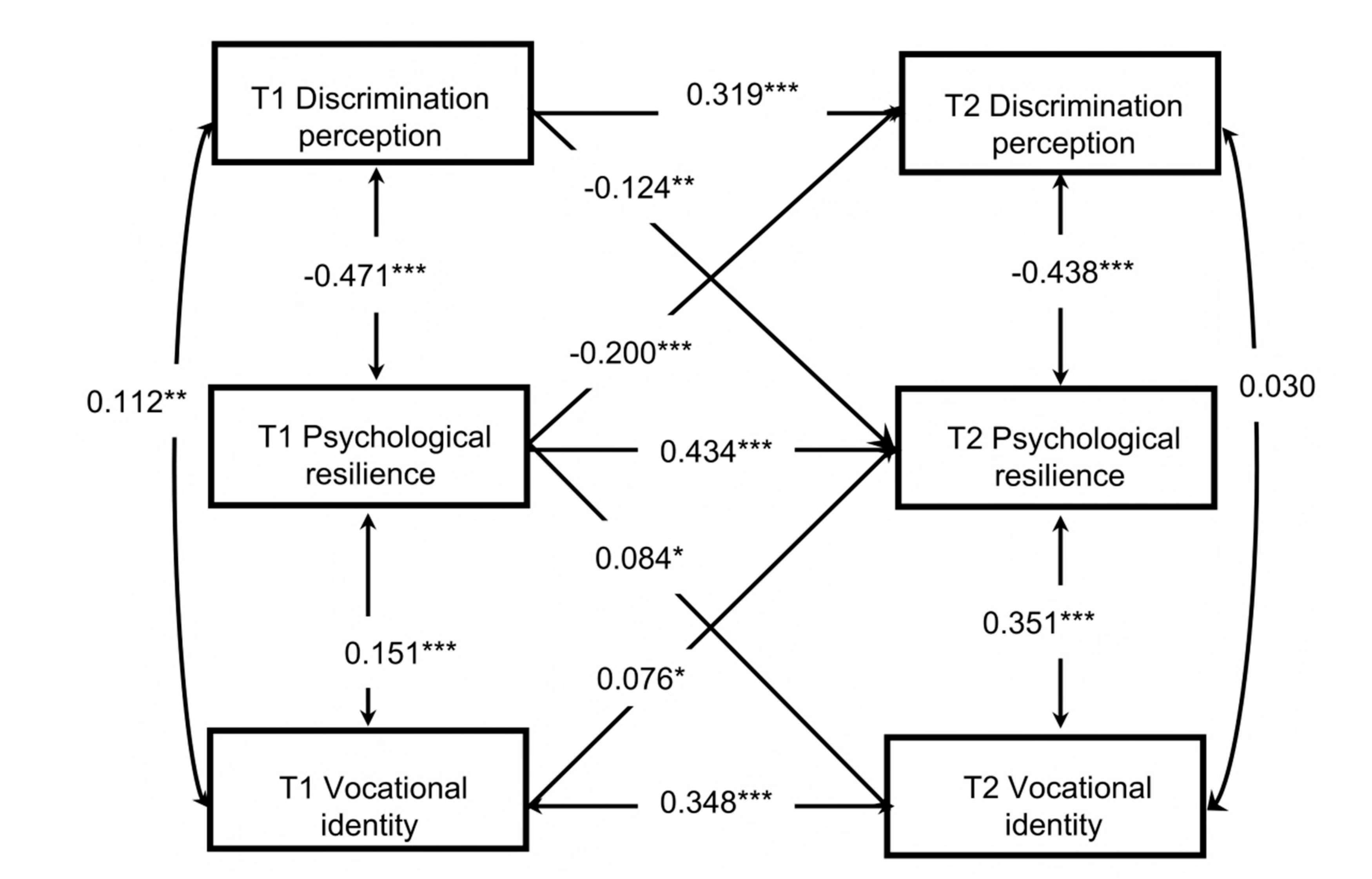
Figure 1: Cross-Lagged Panel Model among Discrimination Perception, Psychological Resilience, and Vocational Identity. Note: Standardized results are shown in the figure; *p < 0.05, **p < 0.01, ***p < 0.001.
3.4.3 Longitudinal Mediating Effect of Vocational Identity on the Relationship between Discrimination Perception and Psychological Resilience
The longitudinal mediating effect of vocational identity on the relationship between discrimination perception and psychological resilience was examined using the SPSS macro program PROCESS Model 4 (Fig. 2). The results showed that T1 discrimination perception significantly predicted T1 vocational identity (β = 0.112, p < 0.05), T1 vocational identity significantly predicted T2 psychological resilience (β = 0.182, p < 0.001), and the direct effect of T1 discrimination perception on T2 psychological resilience was also significant (β = −0.332, p < 0.001, 95% CI [−0.412, −0.251]). Therefore, T1 vocational identity played a partial mediating role between T1 discrimination perception and T2 psychological resilience, with a mediating effect size of 0.182 × 0.112 = 0.020 (95% CI [0.001, 0.046]).
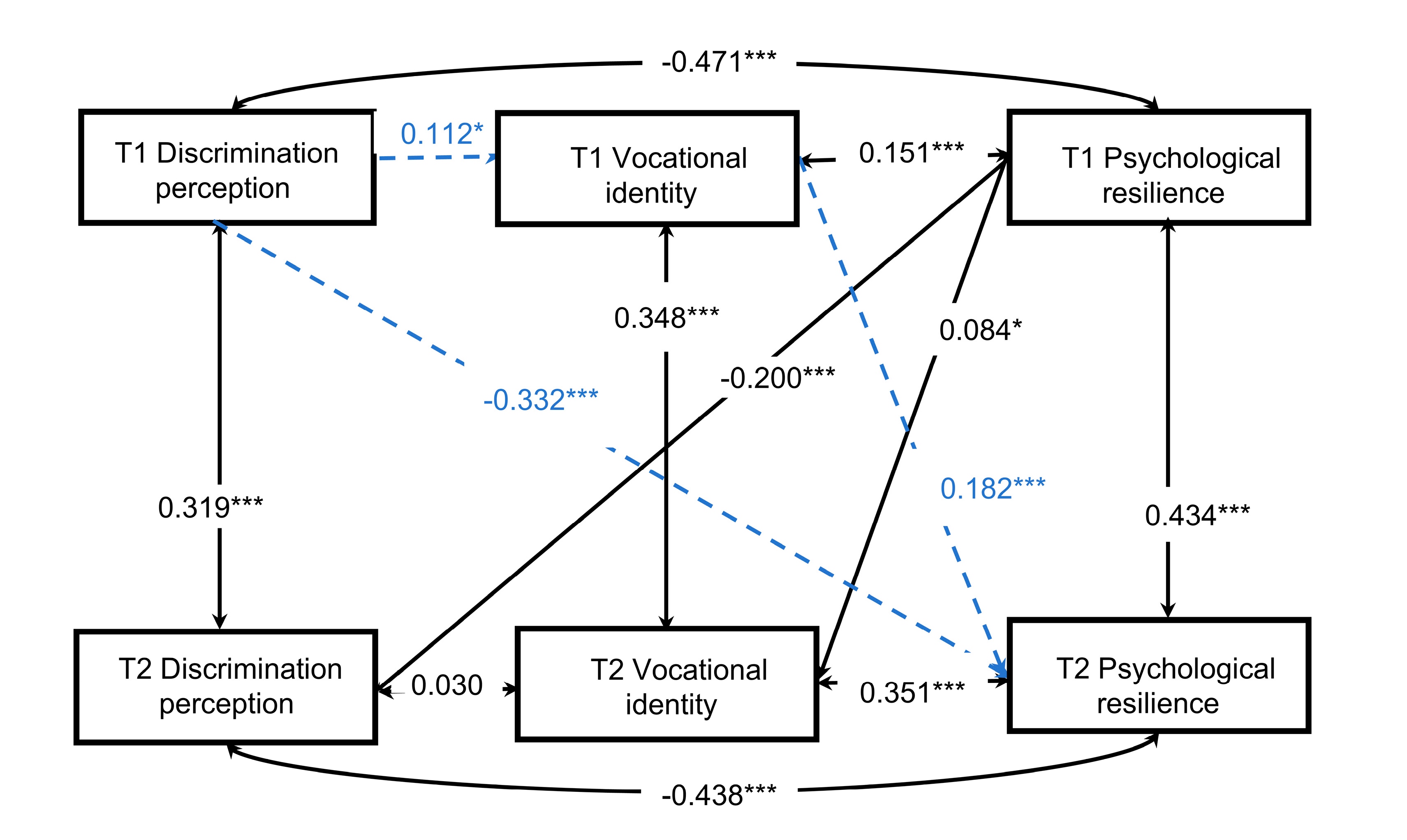
Figure 2: Longitudinal Mediating Model of Vocational Identity on the Relationship between Discrimination Perception and Psychological Resilience. Note: Standardized results are shown in the figure; Solid lines represent cross-lagged paths, and dashed lines indicate the longitudinal mediation path. *p < 0.05, ***p < 0.001.
Against the backdrop of China’s ongoing initiatives to strengthen its vocational education system, supporting the psychological well-being of vocational high school students has emerged as a critical priority. This longitudinal study contributes to this effort by examining psychological resilience as a core protective factor for mental health within this population. Specifically, we investigated the longitudinal relationship between discrimination perception and psychological resilience, while also elucidating the mediating role of vocational identity in this dynamic.
4.1 Development Trajectories of Discrimination Perception, Psychological Resilience and Vocational Identity
The longitudinal data revealed distinct developmental patterns across the core constructs. Both first- and second-year students began the academic year with comparable levels of discrimination perception, which decreased significantly over the subsequent six months. This decline was more pronounced among second-year students (p < 0.05). The higher initial levels at T1 could reflect accumulated exposure to stigmatizing experiences during the summer break, when students increased contact with a public that holds widely held pejorative views toward vocational tracks. The subsequent decrease may be attributed to the protective school environment, where interaction with peers reduces these social threats. The steeper decline among second-year students suggests a developmental progression, potentially reflecting their more advanced cognitive maturity and refined coping strategies, enabling more effective management of discriminatory experiences.
Contrary to the pattern for discrimination perception, psychological resilience demonstrated a significant increase across the six-month period. This positive trajectory aligns with current educational reforms emphasizing student mental health, suggesting that structured interventions—such as group counseling and dedicated mental health curricula—may be effectively fostering this crucial capacity. However, a persistent gender gap emerged, with female students reporting consistently lower psychological resilience than males, corroborating previous findings [28]. Grounded in Individual-Environment Interaction Theory [29], this discrepancy may be explained by the unique psycho-social challenges faced by adolescent females, including more complex physiological changes, social expectations, and adaptation pressures [30]. These compounded stressors can impede their ability to mobilize psychological resources effectively, resulting in lower observed psychological resilience.
Contrary to expectations, levels of vocational identity decreased significantly between the two time points. This suggests that initial, often idealized, perceptions of one’s chosen career path undergo a process of reality testing and realignment as academic engagement deepens. Encountering the inherent challenges of their coursework may lead students to recalibrate their professional expectations, temporarily lowering identity consolidation. Despite this overall decline, second-year students maintained a significantly higher level of vocational identity than their first-year peers. This underscores a positive developmental trend, likely driven by increased practical exposure and accumulated domain-specific knowledge, which gradually builds a more robust and realistic professional self-concept over time.
4.2 Longitudinal Relationships among Discrimination Perception, Psychological Resilience and Vocational Identity
The cross-lagged analyses revealed stable, reciprocal relationships between core constructs over time. Consistent with Hypothesis 1, discrimination perception and psychological resilience demonstrated significant bidirectional negative prediction, confirming a vicious cycle wherein each factor exacerbates the other. This aligns with existing literature documenting the erosive effects of chronic discrimination on mental resources [11,31].
The negative impact of discrimination perception on psychological resilience can be understood through several interlinked mechanisms. First, persistent exposure to stigma depletes key psychological resources, which in turn compromises emotional regulation and hinders adaptive recovery from adversity [32]. This process aligns with conservation of resources theory, wherein chronic demands gradually erode an individual’s capacity to cope. Second, discrimination directly activates neurocognitive threat systems, triggering cycles of self-doubt and self-criticism. This response undermines foundational psychological capitals—such as self-esteem and self-efficacy—that are essential for resilient functioning. Together, these pathways illustrate how discrimination not only drains emotional and cognitive reserves but also actively damages the core psychological foundations upon which resilience is built.
The protective function of psychological resilience was further evidenced by its negative prediction of subsequent discrimination perception. According to the Psychological Resilience Protection Model [33], resilience acts as a stable personal trait that moderates the impact of risk factors. Applied to this context, students with higher resilience more effectively mobilize coping resources when facing social challenges, which helps mitigate negative emotional responses and reduces their subjective sensitivity to stigma [31].
Notably, Hypothesis 2 received only partial support. Although T1 discrimination perception was positively correlated with vocational identity—potentially indicating initial rejection-identification processes—this relationship became non-significant by T2. This temporal pattern suggests developmental asynchrony between these constructs. The initial positive correlation may reflect a protective identification mechanism, wherein early discrimination experiences strengthen in-group identity. However, as students adapt to the school environment and reported discrimination decreases, the salience of this protective mechanism may diminish, ultimately decoupling the variables over time. Furthermore, the parallel decrease in vocational identity suggests that without ongoing discrimination pressure, this specific identity pathway may not be sufficiently maintained to preserve the initial correlation.
Supporting Hypothesis 3, vocational identity and psychological resilience demonstrated positive reciprocal relationships. Students with higher resilience developed stronger vocational identities over time, likely due to their tendency to maintain positive career-related cognitive schemas [34,35] and selectively attend to positive professional information [36]. Conversely, established vocational identity predicted subsequent resilience gains, consistent with Relational Systems Development Theory. Vocational identity facilitates intentional self-regulation, enhances goal commitment, and promotes resource optimization [18]. Furthermore, the hope associated with clear vocational goals [19] provides positive motivation during challenges, directing attention toward solutions rather than negative emotions [17], thereby strengthening psychological resilience [20].
4.3 The Longitudinal Mediating Role of Vocational Identity
The mediation analysis confirmed Hypothesis 4, revealing that T1 vocational identity partially mediated the relationship between T1 discrimination perception and T2 psychological resilience. This finding demonstrates a theoretically significant dual-pathway model: while discrimination perception directly undermines psychological resilience, it simultaneously fosters psychological resilience indirectly through strengthening vocational identity.
The direct negative pathway aligns with established theoretical frameworks. Consistent with the Cumulative Risk and Protective Factors Model, discrimination perception functions as a chronic stressor that activates threat responses, eroding self-efficacy and depleting psychological resources [11,32]. Individuals with diminished self-efficacy tend to amplify negative emotional states, further exhausting cognitive resources and impairing their capacity to mobilize protective factors when confronting adversity [37].
More remarkably, the indirect positive pathway reveals an adaptive mechanism through which discrimination perception ultimately enhances psychological resilience. Vocational high school students primarily encounter two forms of public stigma: stereotypes regarding their academic capabilities (e.g., “poor learning ability”) and prejudices concerning their professional futures (e.g., being relegated to “menial tasks”) [38,39]. Rather than passively internalizing these negative labels, students actively resist them through identity reconstruction processes. When confronting discrimination, they strengthen in-group identification and engage in career exploration to contest stigmatizing narratives. This identity work fosters vocational commitment, which subsequently enhances hope and goal-directed persistence—core components of psychological resilience [19,20,31]. This compensatory mechanism aligns with the Dual-Effect View of Rejection-Identification Theory and represents a promising avenue for mental health intervention.
4.4 Limitations and Future Research
Several limitations warrant acknowledgment. First, the exclusive reliance on self-report measures introduces potential common method variance. Future studies would benefit from multi-method assessments incorporating observational data, interviews and informant reports (e.g., from teachers or parents) to enhance measurement validity. Second, the sampling frame excluded third-year students, who face unique developmental challenges during the transition from school to work. Including this cohort would permit examination of these constructs across the entire vocational education trajectory. Third, the two-wave design constrains our ability to model non-linear developmental patterns. Future research should implement three or more measurement waves over extended periods to better capture dynamic relationships among these variables. Finally, future investigations should examine potential moderating factors (e.g., social support, school climate) that might condition the observed relationships, thereby providing a more comprehensive understanding of the psychological resilience development in this population.
This longitudinal investigation demonstrates the complex, dynamic relationships among discrimination perception, vocational identity, and psychological resilience in Chinese vocational high school students. The findings reveal a robust reciprocal relationship between discrimination perception and psychological resilience, with each construct negatively reinforcing the other over time. Simultaneously, psychological resilience and vocational identity exhibited positive bidirectional reinforcement, highlighting their synergistic relationship.
The study’s most significant contribution lies in identifying the dual-pathway mechanism through which discrimination perception influences psychological resilience. While directly corrosive to resilience, discrimination perception also indirectly enhances it through the mediating role of vocational identity. This compensatory pathway aligns with rejection-identification processes, wherein students transform discriminatory experiences into motivation for identity consolidation.
These findings offer actionable insights for enhancing mental support within vocational education. Practically, they advocate for dual-focused interventions that concurrently mitigate experiences of discrimination and actively cultivate psychological resilience. More pivotally, the central role of vocational identity points to a powerful avenue for intervention. Structured programs that foster career exploration, deepen professional commitment, and nurture a positive future orientation can equip students to reframe social adversity into a catalyst for identity consolidation and psychological growth. Consequently, this study provides an empirical foundation for developing integrated mental support systems that synchronize psychosocial well-being with career development in vocational educational settings.
Acknowledgement:
Funding Statement: This work was supported by the Guangdong Provincial Philosophy and Social Science “14th Five-Year Plan” Discipline Co-Construction Project (Grant No. GD22XJY14), the 2022 Guangdong Provincial Higher Education Teaching Reform Project (Grant No. Yue Jiao Gao [2023] 4), and Guangdong Polytechnic Normal University’s Project for Enhancing the Research Capacity of Doctoral Application Institution (Grant No. 22GPNUZDJS48).
Author Contributions: Lingyan Zhang: Conceptualization, Funding acquisition, Project administration, Supervision, Writing—review & editing. Yuying Yang: Data curation, Investigation, Methodology, Formal analysis, Writing—original draft. Zhuoxuan Huang: Formal analysis, Validation, Visualization, Writing—review & editing. All authors reviewed the results and approved the final version of the manuscript.
Availability of Data and Materials: The datasets generated and analyzed during this study are available from the corresponding author [Lingyan Zhang] upon reasonable request.
Ethics Approval: This study was approved by the Non-Clinical College Human Research Ethics Committee of School of Education Science, Guangdong Polytechnic Normal University (Approval No. GPNU-PSY-2022-007). Informed consent was obtained from all participants.
Conflicts of Interest: The authors declare no conflicts of interest to report regarding the present study.
References
1. Zhou J, Liu Y, Ma J, Feng Z, Hu J, Hu J, et al. Prevalence of depressive symptoms among children and adolescents in China: a systematic review and meta-analysis. Child Adolesc Psychiatry Ment Health. 2024;18(1):150. doi:10.1186/s13034-024-00841-w. [Google Scholar] [CrossRef]
2. Yao X, Hu G. Comparative study on the mental health status of left-behind secondary vocational school students and left-behind general high school students. Front Educ Res. 2024;7(8):49–55. doi:10.25236/FER.2024.070808. [Google Scholar] [CrossRef]
3. Chmitorz A, Kunzler A, Helmreich I, Tüscher O, Kalisch R, Kubiak T, et al. Intervention studies to foster resilience—a systematic review and proposal for a resilience framework in future intervention studies. Clin Psychol Rev. 2018;59:78–100. doi:10.1016/j.cpr.2017.11.002. [Google Scholar] [CrossRef]
4. Liu Y, Han Y, Xiong L, Ma Q, Mei L, Chong MC, et al. The mediating role of psychological capital in the relationship between job stress and professional identity in Chinese medical interns. Work. 2023;76(4):1597–604. doi:10.3233/wor-230022. [Google Scholar] [CrossRef]
5. Song S, Yang X, Yang H, Zhou P, Ma H, Teng C, et al. Psychological resilience as a protective factor for depression and anxiety among the public during the outbreak of COVID-19. Front Psychol. 2021;11:618509. doi:10.3389/fpsyg.2020.618509. [Google Scholar] [CrossRef]
6. Chuning AE, Durham MR, Killgore WDS, Smith R. Psychological resilience and hardiness as protective factors in the relationship between depression/anxiety and well-being: exploratory and confirmatory evidence. Pers Individ Dif. 2024;225:112664. doi:10.1016/j.paid.2024.112664. [Google Scholar] [CrossRef]
7. Banks KH, Kohn-Wood LP, Spencer M. An examination of the African American experience of everyday discrimination and symptoms of psychological distress. Community Ment Health J. 2006;42(6):555–70. doi:10.1007/s10597-006-9052-9. [Google Scholar] [CrossRef]
8. Deng D. The relationship between discrimination perception, general self-efficacy, and social adaptation among vocational students [master’s thesis]. Chengdu, China: Sichuan Normal University; 2019. [Google Scholar]
9. Brance K, Chatzimpyros V, Bentall RP. Perceived discrimination and mental health: the role of immigrant social connectedness during the COVID-19 pandemic. J Migr Health. 2022;6:100127. doi:10.1016/j.jmh.2022.100127. [Google Scholar] [CrossRef]
10. Jin CC, Zou H, Li XW. Social adaptation in adolescents: protective and risk factors and their cumulative effects. J Beijing Norm Univ. 2011;1:12–20. (In Chinese). [Google Scholar]
11. Aruta JJBR, Antazo BG, Paceño JL. Self-stigma is associated with depression and anxiety in a collectivistic context: the adaptive cultural function of self-criticism. J Psychol. 2021;155(2):238–56. doi:10.1080/00223980.2021.1876620. [Google Scholar] [CrossRef]
12. Brownfield D, Thompson K. Self-concept and delinquency: the effects of reflected appraisals by parent and peers. West Criminol Rev. 2005;6(1):22–9. [Google Scholar]
13. Liu X, Sun X, Hao Q. Influence of discrimination perception on career exploration of higher vocational students: chain mediating effect test. Front Psychol. 2022;13:968032. doi:10.3389/fpsyg.2022.968032. [Google Scholar] [CrossRef]
14. Branscombe NR, Schmitt MT, Harvey RD. Perceiving pervasive discrimination among African Americans: implications for group identification and well-being. J Pers Soc Psychol. 1999;77(1):135–49. doi:10.1037/0022-3514.77.1.135. [Google Scholar] [CrossRef]
15. Liu QY, Su YJ. A case study of career identity development. Chin J Clin Psychol. 2006;14(1):49–54. (In Chinese). doi:10.16128/j.cnki.1005-3611.2006.01.017. [Google Scholar] [CrossRef]
16. Fan LH, Wang GH, Lei JM, Shi C, Yi LJ. The role of professional identity, psychological resilience, and coping styles in mitigating compassion fatigue among geriatric services and management interns. Geriatr Nurs. 2025;64:103372. doi:10.1016/j.gerinurse.2025.05.011. [Google Scholar] [CrossRef]
17. Creed PA, Hennessy DA. Evaluation of a goal orientation model of vocational identity. Career Dev Q. 2016;64(4):345–59. doi:10.1002/cdq.12070. [Google Scholar] [CrossRef]
18. Nakhostin-Khayyat M, Borjali M, Zeinali M, Fardi D, Montazeri A. The relationship between self-regulation, cognitive flexibility, and resilience among students: a structural equation modeling. BMC Psychol. 2024;12(1):337. doi:10.1186/s40359-024-01843-1. [Google Scholar] [CrossRef]
19. Hu H, Wang C, Lan Y, Wu X. Nurses’ turnover intention, hope and career identity: the mediating role of job satisfaction. BMC Nurs. 2022;21(1):43. doi:10.1186/s12912-022-00821-5. [Google Scholar] [CrossRef]
20. Akyil Y. Hope and loneliness between social support and resilience: parallel mediator model. J Ration Emotive Cogn Behav Ther. 2024;43(1):12. doi:10.1007/s10942-024-00575-w. [Google Scholar] [CrossRef]
21. Chan RCH. Effects of minority stress on group identification and collective action among sexual minorities: a longitudinal test of the rejection-identification model. Sex Roles. 2022;87(5):237–50. doi:10.1007/s11199-022-01304-2. [Google Scholar] [CrossRef]
22. Bogart KR, Lund EM, Rottenstein A. Disability pride protects self-esteem through the rejection-identification model. Rehabil Psychol. 2018;63(1):155–9. doi:10.1037/rep0000166. [Google Scholar] [CrossRef]
23. Dong JM, Liu WJ, Zhou C, Sun YH, Chen GX. The relationship between perceived discrimination and learning burnout of secondary vocational students: the mediating effect of professional identity and psychological capital. Chin J Spec Educ. 2020;4:76–80. (In Chinese). doi:10.3969/j.issn.1007-3728.2020.04.012. [Google Scholar] [CrossRef]
24. Hu YQ, Gan YQ. Development and psychometric validity of the resilience scale for Chinese adolescents. Acta Psychol Sin. 2008;40(8):902–12. (In Chinese). doi:10.3724/SP.J.1041.2008.00902. [Google Scholar] [CrossRef]
25. Zhang LY. Validity and reliability of the professional identity status questionnaire in college students. Chin J Clin Psychol. 2017;25(3):462–6. (In Chinese). doi:10.16128/j.cnki.1005-3611.2017.03.014. [Google Scholar] [CrossRef]
26. Zhou H, Long LR. Statistical remedies for common method biases. Adv Psychol Sci. 2004;12(6):942–50. (In Chinese). [Google Scholar]
27. Kline RB. Principles and practice of structural equation modeling. 2nd ed. New York, NY, USA: Guilford Press; 2005. [Google Scholar]
28. Gil SV. The influence of gender on academic performance and psychological resilience, and the relationship between both: understanding the differences through gender stereotypes. Trends Psychol. 2024:1–20. doi:10.1007/s43076-024-00370-7. [Google Scholar] [CrossRef]
29. Lerner RM, Tirrell JM, Dowling EM, Geldhof GJ, Gestsdóttir S, Lerner JV, et al. The end of the beginning: evidence and absences studying positive youth development in a global context. Adolesc Res Rev. 2019;4(1):1–14. doi:10.1007/s40894-018-0093-4. [Google Scholar] [CrossRef]
30. Han M, Shi X, Xiong D, Zhang X, Shen X, Wu N, et al. The status and influencing factors of adolescents’ mental health in a province of China: a cross-sectional study. J Affect Disord. 2023;321:41–6. doi:10.1016/j.jad.2022.10.024. [Google Scholar] [CrossRef]
31. Zhou N, Chen Z. The chain mediation effects of psychological resilience and active coping style between discrimination perceptions and subjective well being among college students with disability. Sci Rep. 2024;14(1):29790. doi:10.1038/s41598-024-81702-6. [Google Scholar] [CrossRef]
32. Xu J, Xu Y. The impact of self-efficacy on psychological resilience in EFL learners: a serial mediation model. BMC Psychol. 2025;13(1):858. doi:10.1186/s40359-025-03236-4. [Google Scholar] [CrossRef]
33. Luthar SS, Cicchetti D, Becker B. The construct of resilience: a critical evaluation and guidelines for future work. Child Dev. 2000;71(3):543–62. doi:10.1111/1467-8624.00164. [Google Scholar] [CrossRef]
34. Zhou J, Li T, Li S, Yang P, Gong X. Bidirectional relations between belief in a just world and internalizing and externalizing problems among Chinese secondary vocational students. J Youth Adolesc. 2025;54(10):2644–59. doi:10.1007/s10964-025-02259-9. [Google Scholar] [CrossRef]
35. Cordeiro P, Paixão P, Rijo D. Mind the gap! Cognitive-motivational determinants of career decision-making in postsecondary school transitions. Br J Guid Couns. 2023;51(6):936–47. doi:10.1080/03069885.2022.2040004. [Google Scholar] [CrossRef]
36. Kiral Ucar G, Hasta D, Kaynak Malatyali M. The mediating role of perceived control and hopelessness in the relation between personal belief in a just world and life satisfaction. Pers Individ Differ. 2019;143:68–73. doi:10.1016/j.paid.2019.02.021. [Google Scholar] [CrossRef]
37. Weinberg D, Stevens GWJM, Peeters M, Visser K, Tigchelaar J, Finkenauer C. The social gradient in adolescent mental health: mediated or moderated by belief in a just world? Eur Child Adolesc Psychiatry. 2023;32(5):773–82. doi:10.1007/s00787-021-01905-4. [Google Scholar] [CrossRef]
38. Guo D, Wang A. Is vocational education a good alternative to low-performing students in China. Int J Educ Dev. 2020;75:102187. doi:10.1016/j.ijedudev.2020.102187. [Google Scholar] [CrossRef]
39. Zhao F, Zhang ZH, Bi L, Wu XS, Wang WJ, Li YF, et al. The association between life events and Internet addiction among Chinese vocational school students: the mediating role of depression. Comput Hum Behav. 2017;70:30–8. doi:10.1016/j.chb.2016.12.057. [Google Scholar] [CrossRef]
Cite This Article
 Copyright © 2026 The Author(s). Published by Tech Science Press.
This work is licensed under a Creative Commons Attribution 4.0 International License , which permits unrestricted use, distribution, and reproduction in any medium, provided the original work is properly cited.
 Downloads
 Citation Tools
