
 Login
Login Register
 Submit a Paper
 Propose a Special lssue
 Open Access
ARTICLE

Self-Presentation on WeChat Moments and Ego Identity in Emerging Adults: The Role of Online Positive Feedback and Gender
1 School of Education and Psychology, University of Jinan, Jinan, 250022, China
2 Department of Ideological and Political Theory Teaching, Shanxi Vocational & Technical College of Finance & Trade, Taiyuan, 030031, China
3 Tourism Department, Nanchong Vocational College of Culture and Tourism, Nanchong, 637400, China
* Corresponding Author: Xiumei Yan. Email:
(This article belongs to the Special Issue: Psychological and Neural Foundations of Adolescent Mental Health)
International Journal of Mental Health Promotion 2026, 28(3), 12 https://doi.org/10.32604/ijmhp.2026.075412
Received 31 October 2025; Accepted 07 January 2026; Issue published 31 March 2026
 View Full Text
 Download PDF
Abstract
Background: Emerging adulthood is a critical period for ego identity exploration and consolidation, and self-presentation on social media constitutes a salient online context for this developmental process. However, limited research has explored the associations between self-presentation on WeChat Moments and ego identity. This study aims to examine these associations, focusing on the mediating role of online positive feedback and the moderating role of gender. Methods: Using a three-wave longitudinal design, this study followed 767 Chinese college students (Mean age = 18.96 years) through cluster sampling. Participants completed self-report questionnaires assessing self-presentation on WeChat Moments, online positive feedback, and ego identity status. Data analyses were conducted using mediation modeling and multi-group structural equation modeling. Results: Authentic self-presentation was positively associated with identity achievement and negatively associated with identity diffusion, whereas positive self-presentation was linked to higher levels of identity foreclosure. Online positive feedback played a significant mediating role in the associations between self-presentation strategies and identity statuses, and gender differences were observed in this mediating pathway. For both males and females, authentic self-presentation was associated with higher identity achievement through online positive feedback. However, indirect associations with identity foreclosure and diffusion were observed only among females: authentic self-presentation was linked to lower levels, whereas positive self-presentation was linked to higher levels of foreclosure and diffusion through online positive feedback. No comparable indirect associations were detected among males. Conclusions: Online positive feedback is closely linked to self-presentation strategies and ego identity statuses, with these associations varying by gender.Keywords
Emerging adulthood is a developmental period in which individuals face the critical psychosocial task of forming a coherent ego identity [1,2]. Although identity development begins in adolescence, a consolidated and stable sense of identity typically emerges after age 18 [3]. During this stage, individuals experience substantial transitions in identity, often moving from diffusion or moratorium toward the more mature status of identity achievement [4]. In the digital age, these developmental processes increasingly unfold within online environments. Recent research highlights that social media have become a crucial ecological context in which emerging adults explore, express, and construct their sense of self [5].
Among the various digital platforms used by emerging adults, WeChat stands out as one of the most prevalent, with over 1.4 billion monthly active users. As a multifunctional social media application, WeChat facilitates communication, media sharing, and social connection within a semi-private, acquaintance-based network. A defining feature of this platform is WeChat Moments, where users post updates, share photos, express emotions, and interact with others’ content. Prior studies suggest that such interpersonal and expressive activities create meaningful opportunities for self-presentation, emotional expression, and social connection [6] for emerging adults, who are in a peak period of identity exploration, the ways they present themselves and the feedback they receive from peers carry heightened developmental significance [7]. Increased sensitivity to social evaluations makes online interactions especially influential in shaping ongoing identity exploration, negotiation, and consolidation [8]. The strong-tie nature of WeChat Moments further amplifies these dynamics: self-presentation is directed not at distant audiences but at close peers, classmates, and family members [9], whose feedback holds substantial emotional and developmental weight. Through repeated acts of crafting photos, captions, and narratives, individuals engage in ongoing identity work, which may affect their emerging sense of self through the social feedback they receive [8,10].
Despite theoretical advances suggesting that digital media constitute a key developmental ecology for identity formation [7] and that online interpersonal interactions play a crucial role in self-concept and identity development [11,12], empirical research has yet to fully examine how self-presentation on WeChat Moments contributes to ego identity development among emerging adults, particularly with regard to the psychological mechanisms underlying this process [13]. Addressing this gap is critical, not only for advancing theoretical understanding but also for informing educational and developmental interventions aimed at supporting identity formation in the digital age. The present study therefore investigates how different forms of self-presentation on WeChat Moments relate to ego identity statuses and whether online positive feedback functions as a key mechanism linking digital self-expression to identity development.
Emerging adulthood (ages 18–25) represents a transitional period between adolescence and adulthood [1]. During this stage, individuals reach biological maturity while gradually disengaging from parental oversight. Many are enrolled in higher education or entering the workforce, encountering substantial changes in social contexts, interpersonal relationships, and life roles. These transitions bring both opportunities and pressures to explore alternatives in domains such as career goals, values, belief systems, and intimate relationships, making emerging adulthood a critical period for the formation and transformation of ego identity [4,10]. As they navigate competing pathways, emerging adults experience heightened uncertainty regarding who they are and who they want to become, prompting active exploration and social interaction.
Ego identity refers to an individual’s subjective sense of internal consistency and continuity over time [1,2]. According to Marcia’s framework [14], identity development is structured around two core processes of exploration and commitment, which give rise to four identity statuses: achievement (high exploration and high commitment), moratorium (high exploration and low commitment), foreclosure (low exploration and high commitment), and diffusion (low exploration and low commitment). A substantial body of research has documented distinct psychological and developmental correlates of the four identity statuses [15,16,17,18]. Identity achievement is the most mature identity status. Individuals in this category are characterized by higher levels of self-esteem and autonomy, more positive psychosocial functioning, while showing the lowest levels of anxiety and depressive symptoms [17,19]. In contrast, individuals with an identity diffusion status display the most psychological, interpersonal, and adjustment difficulties, including anxiety, depression, an avoidant cognitive style, low levels of self-esteem and autonomy, and a greater likelihood of engaging in antisocial behaviors [15,16,17,18]. Individuals in identity moratorium show higher openness to experience, active exploration of personal goals and values, greater cognitive flexibility, and a positive information-processing style, but they also tend to report higher levels of anxiety [17,18,19]. Those characterized by identity foreclosure show strong goal commitment, lower levels of anxiety, and higher life satisfaction, but they often rely on external control, use rigid and dogmatic cognitive styles, and show poorer adaptability to environmental demands [16,17,19].
In emerging adulthood, ego identity development is particularly dynamic. As individuals explore diverse roles and life trajectories, they may shift among different identity statuses that vary in their levels of exploration and commitment. Through the ongoing interplay between these two processes, they gradually develop a more coherent and integrated sense of self [4]. These statuses are closely associated with personality development and social adjustment [20] and exert a profound influence on overall psychosocial functioning.
1.2 Self-Presentation on WeChat Moments and Ego Identity
Self-presentation is a primary motivation for social media use and refers to individuals’ attempts to manage how they are perceived by others [21]. Increasing evidence suggests that self-presentation can function as an exploratory self-related behavior through which individuals experiment with different aspects of the self, reflect on their characteristics, and refine their self-understanding, processes that are central to identity development [12,22]. Although identity-relevant self-presentation traditionally occurred in offline interpersonal contexts, emerging adults in the digital era increasingly turn to social media to express and explore who they are. Compared to offline settings, social media provide greater editability, visibility, and audience control, enabling users to curate, organize, and selectively reveal aspects of the self. Within this landscape, WeChat Moments functions as a semi-private, acquaintance-based platform where emerging adults frequently post photos, write captions, and share life updates. Such activities inherently involve impression management and, consequently, become an important arena for ongoing identity work [6,23].
Research on social media commonly distinguishes between two forms of self-presentation: authentic self-presentation and positive self-presentation [21]. Drawing on Kim and Lee’s definition of self-presentation on social networking sites [21], authentic self-presentation on WeChat Moments can be understood as displaying one’s unembellished and genuine aspects, whereas positive self-presentation refers to the selective sharing of information that helps construct a favorable and positive personal image. Authentic self-presentation reflects the “actual self” characterized by spontaneous and minimally edited posts that capture everyday experiences and subtle emotional expressions, with natural and unembellished captions [21,24]. In contrast, positive self-presentation involves efforts to construct an “idealized self,” emphasizing highlight moments such as achievements, travel, or celebrations through carefully curated content and polished captions [25,26]. Such differences in content selection and curation reflect distinct pathways of identity exploration [12,22].
Different self-presentation styles have been shown to influence individuals’ self-concept and identity development [27]. Authentic self-presentation facilitates individuals’ exploration of ego identity [12,28,29]. When individuals reveal themselves truthfully and remain faithful to their genuine experiences and feelings, they engage in self-reflection and integrate their past experiences, emotions, and thoughts [30]. This process promotes self-exploration and self-construction, enabling individuals to gain a more objective and accurate understanding of themselves [31,32], thereby supporting their progression from identity moratorium toward identity achievement. Moreover, Rogers’s self-consistency theory [33] posits that individuals have a fundamental psychological drive to pursue and maintain consistency, unity, and integrity within their self-concept, and that psychological well-being depends on the congruence between one’s self-concept and actual experiences, authentic self-presentation provides a unique context in which such congruence can be practiced and strengthened [34,35]. According to this perspective, each instance of authentic sharing constitutes a meaningful test of self-acceptance—“Am I willing to show my true self to others?” [36]. Accumulated over time, these experiences foster self-exploration, reinforce a coherent and stable sense of self, and reduce self-concept confusion [36], thereby supporting the autonomous exploration characteristic of identity moratorium and facilitating identity achievement [37]. Furthermore, reflective processes elicited by authentic expression may challenge unexamined external commitments, reducing the likelihood of identity foreclosure [38].
However, in contrast to authentic self-presentation, existing research presents inconsistent findings regarding the impact of positive self-presentation on WeChat Moments on emerging adults’ ego identity. Some studies suggest that positive self-presentation may direct attention toward desirable self-aspects, reinforce favorable self-evaluations, and be associated with higher self-worth and self-esteem [21,27], which have been linked to more adaptive identity outcomes [39]. Nevertheless, a growing body of research cautions that positive self-presentation functions as a cognitive filter that does not reflect one’s true situation, and may even hinder self-integration and self-acceptance [40]. According to self-discrepancy theory [41], excessive reliance on positive self-presentation on social networking sites amplifies the discrepancy between individuals’ actual self and ideal self. The intentionally crafted “ideal self” continuously highlights the shortcomings of the “real self” thereby intensifying psychological stress and conflicts in identity formation [42]. Prolonged exposure to this discrepancy may activate different identity-related coping strategies, leading individuals toward divergent identity statuses [22]. Specifically, such discrepancies may undermine self-acceptance and self-integration, hindering identity achievement [43]. Moreover, fear of damaging a carefully curated positive image may inhibit deeper exploration, resulting in prolonged moratorium or externally defined foreclosure [38]. In more severe cases, internal fragmentation may impair basic self-understanding and result in identity confusion and diffusion [44,45]. Accordingly, drawing on self-discrepancy theory, the present study focuses on the potentially inhibiting role of positive self-presentation on WeChat Moments, proposing that greater engagement in positive self-presentation is negatively associated with adaptive ego identity development among emerging adults.
Importantly, the influence of self-presentation on ego identity may not occur directly. Micro-level social experiences, such as online positive feedback, often mediate these processes. Positive feedback provides social validation and constitutes an essential source of information about how one is perceived by others, thereby shaping self-concept clarity, exploration motivation, and identity consolidation [7]. For emerging adults navigating identity issues in a close-tie environment like WeChat Moments, such interpersonal feedback may be especially influential.
1.3 The Mediation of Online Positive Feedback
Online positive feedback refers to the likes, positive comments, and other affirming responses individuals receive on social networking sites through self-presentation activities such as status updates or content sharing [46]. Such feedback functions as a form of social information that reinforces users’ self-perceptions and sense of social connectedness. Recent research further demonstrates that social connectivity and platform interactivity significantly enhance users’ feelings of interpersonal connection, thereby motivating continued engagement and self-expression on social media [47]. In the context of WeChat, network externalities, particularly interactions and responses from close acquaintances, play a pivotal role in shaping users’ willingness to share content; when individuals receive more peer feedback and social gratifications, they become more motivated to engage in self-presentation activities [48].
A substantial body of empirical studies show that authentic self-presentation on social networking sites is directly associated with a higher frequency of online positive feedback [31,49]. Authentic disclosure and timely sharing of personal updates foster reciprocal interactions among friends, thereby increasing online positive feedback [31] and strengthening perceived social support [21]. In contrast, evidence regarding the association between positive self-presentation and online feedback remains mixed. Although some studies suggest that positive self-presentation facilitates favorable impression formation and is associated with increased positive feedback [50], other research suggests that highly idealized posts, such as frequent selfies or conspicuous displays of happiness, may evoke aversion or rejection from peers, reducing positive feedback [51]. These inconsistent findings underscore the importance of considering contextual features of specific platforms. In acquaintance-based social networking environments such as WeChat Moments, where online interactions are embedded in relatively stable offline relationships, highly positive self-presentation may be more salient and subject to social evaluation [52]. Under such conditions, excessive positivity may be perceived as inauthentic or normatively inappropriate, potentially undermining favorable peer responses. Accordingly, the present study advances the hypothesis that positive self-presentation on WeChat Moments is negatively associated with online positive feedback among emerging adults.
Online positive feedback also plays a crucial role in identity development. According to the main-effect and buffering-effect models of social support [53], higher levels of social support promote psychological well-being and help individuals cope with stress. As a specific form of social support, online positive feedback can encourage individuals to explore possibilities for self-development, buffer negative experiences, enhance general self-concept [31], reduce confusion during identity exploration, and facilitate self-concept integration [54,55]. Research further shows that platforms composed primarily of offline acquaintances tend to provide more positive feedback, which supports identity development [27]. Recent longitudinal findings also indicate that positive self-presentation on Instagram fosters identity development over time and that peer feedback is central to shaping this process [39]. In addition, Granic et al. [7] emphasizes that peer feedback on digital platforms serves as a key mechanism through which media use shapes identity development, strengthening self-concept clarity and facilitating identity exploration and integration. Taken together, these studies suggest that online positive feedback functions as a key social mechanism through which self-presentation behaviors on WeChat Moments influence individuals’ identity development.
There may be gender differences not only in the levels of self-presentation, online feedback, and identity statuses, but more importantly in the ways these variables are interrelated. Prior work indicates that identity processes tend to be organized differently for men and women. For example, women are more likely to show foreclosure and achievement, whereas men more often fall into moratorium and diffusion statuses [56]. Such differences may reflect gendered patterns of interpersonal orientation, emotional expressiveness, and social role expectations, which shape how self-presentation becomes linked to identity outcomes.
Moreover, gender may moderate the pathway from self-presentation to feedback and ultimately to identity outcomes by influencing individuals’ motives and strategies for online self-presentation. Research shows that women’s self-presentation on social media is more relationally oriented, aimed at seeking emotional support, validation, and connection [56]. As a result, women may be more sensitive to online feedback, and positive peer responses may more strongly reinforce authentic identity exploration and stabilize identity commitments. In contrast, men’s online self-presentation tends to be more instrumental and performance-oriented. Men are more likely to highlight social status, competence, or achievements [57,58,59], and may sometimes engage in self-enhancing exaggeration [60,61]. These strategies can elicit different audience reactions, such as competitiveness or reduced emotional support, which may weaken the developmental implications of positive feedback. Men also tend to view social networking sites as spaces for status signaling rather than relational connection, reducing the extent to which online feedback informs their evolving sense of self.
Finally, according to self-construal theory [62], identity is not predetermined but is continuously constructed through social interactions and cultural contexts. Women typically exhibit a more interdependent self-construal, characterized by heightened interpersonal sensitivity, greater attunement to social cues, and a stronger need for social approval. This suggests that positive feedback may more substantially facilitate identity reflection and consolidation for women. In contrast, men tend to hold a more independent self-construal and place greater emphasis on autonomy, competence, and social status, which may be associated with a reduced tendency to incorporate external feedback into identity-related self-evaluations [63,64].
Taken together, although empirical research on gender differences in the relationships among self-presentation on WeChat Moments, online positive feedback, and ego identity remains limited, existing theory provides a clear rationale for expecting gender to moderate the indirect associations between self-presentation on WeChat Moments and ego identity outcomes via online positive feedback. Accordingly, this study hypothesized that these indirect associations would be stronger for women than for men.
Recent studies have begun to explore the relationship between social media use and adolescent ego identity development. However, research on how prototypical acquaintance-based social media platforms such as WeChat Moments influence the ego identity of college students remains limited. To address this gap, the present study, using a longitudinal design, investigates the association between self-presentation on WeChat Moments and ego identity and its mechanisms among Chinese emerging adults. Gender differences were also examined. This study offers insights that may inform targeted interventions to support ego identity development among college students.
The hypotheses under consideration are as follows (See Fig. 1). First, we hypothesized that positive self-presentation on WeChat Moments would later be negatively associated with identity achievement and positively associated with identity moratorium, foreclosure, and diffusion (Hypothesis 1). Conversely, authentic self-presentation on WeChat Moments would later be positively associated with identity achievement and negatively associated with identity diffusion, foreclosure, and moratorium (Hypothesis 2). Furthermore, the relationship between self-presentation on WeChat Moments and ego identity statuses would be mediated by online positive feedback (Hypothesis 3). Specifically, authentic self-presentation on WeChat Moments would be positively associated with online positive feedback, which in turn would be positively associated with identity achievement and negatively associated with identity moratorium, foreclosure, and diffusion (Hypothesis 3a). In contrast, positive self-presentation on WeChat Moments would be negatively associated with online positive feedback, which in turn would be negatively associated with identity achievement and positively associated with identity moratorium, foreclosure, and diffusion (Hypothesis 3b). Finally, we hypothesized that gender would moderate the overall model linking self-presentation on WeChat Moments to ego identity statuses through online positive feedback (Hypothesis 4). Specifically, based on theoretical perspectives concerning gendered interpersonal orientations and self-construals, the pattern of associations among authentic/positive self-presentation, online positive feedback, and ego identity outcomes is expected to be significantly stronger in women than in men.
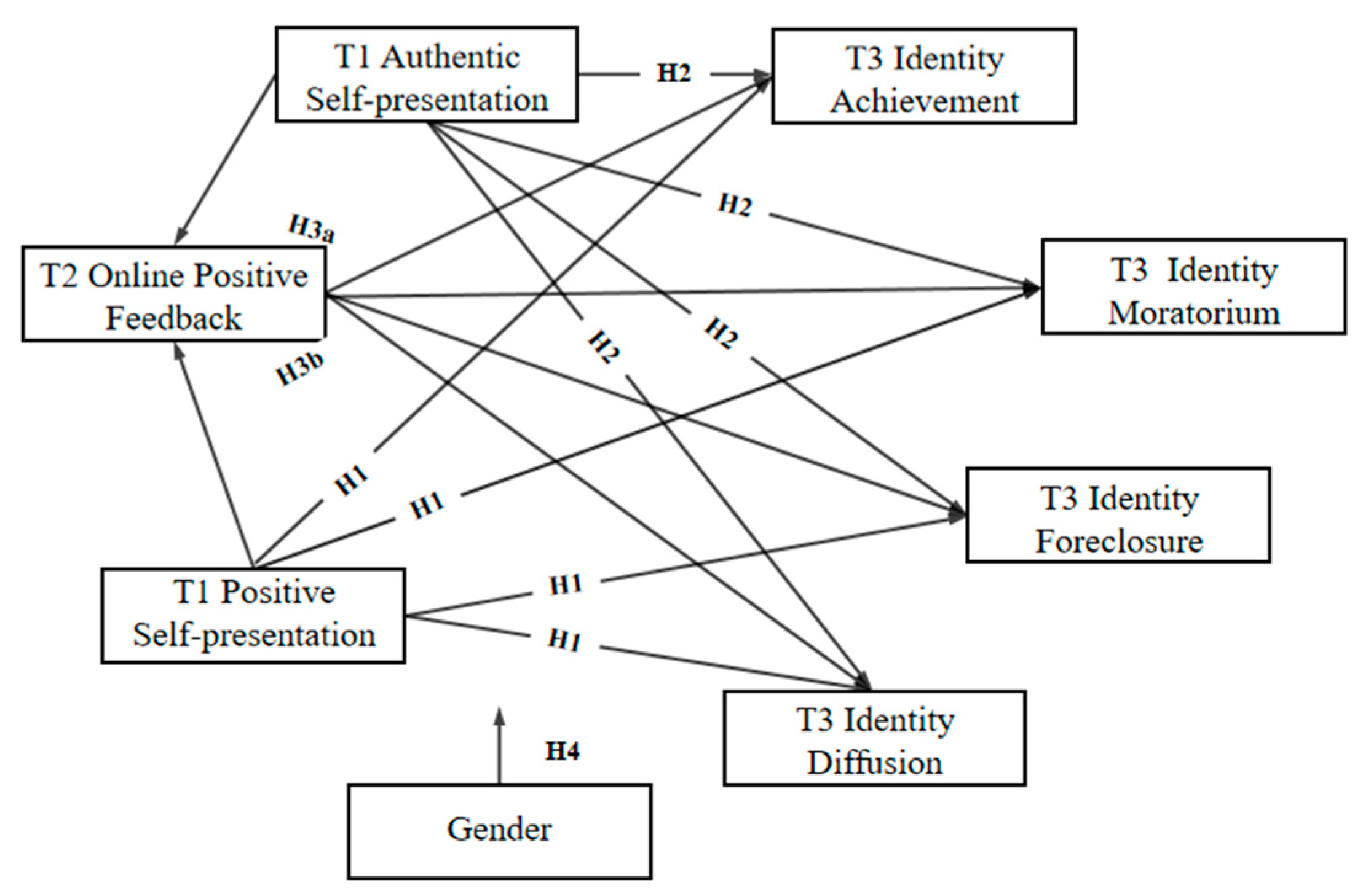
Figure 1: Hypothesized model.
The present study employed a cluster sampling method to recruit participants from two public universities in China, namely University of Jinan and Qingdao University of Technology. Participants were asked to complete the survey at different time points: December 2020 (Time 1, T1), June 2021 (Time 2, T2), and December 2021 (Time 3, T3). This study employed a three-wave design with six-month intervals to provide a more stable assessment of the cumulative effects of online positive feedback and changes in ego identity among college students. Emerging adults’ changes in ego identity status typically unfold over several months, influenced by academic tasks, internships, and extracurricular activities. In addition, students’ self-presentation on social media adjusts across academic cycles, and positive feedback exerts its effects gradually through long-term social comparison and self-reconstruction, making a six-month interval suitable for capturing these incremental processes. Based on existing theories and the design of the present study, self-presentation on WeChat Moments was assessed at the first time point (T1), online positive feedback at the second time point (T2), and ego identity at the third time point (T3).
After excluding invalid data from participants who were absent due to leave requests, a total of 767 participants (Meanage = 18.96, SD = 1.03; 74.10% females) completed all three waves of the survey. 380 participants of them (49.54%) majored in humanities, and 387 (50.46%) majored in STEM fields. An MCAR test for missing values was performed, with p > 0.05 indicating that the data were missing at complete random. Independent samples t-tests revealed no significant differences between completers and non-completers on identity achievement (t = 0.07, p = 0.95), identity moratorium (t = −1.16, p = 0.25), identity foreclosure (t = −0.16, p = 0.87), identity diffusion (t = −0.16, p = 0.87), authentic self-presentation on WeChat Moments (t = −1.16, p = 0.25), positive self-presentation on WeChat Moments (t = 1.20, p = 0.23), or online positive feedback (t = −0.07, p = 0.94). These results suggest that no systematic attrition bias was present in this study.
2.2.1 Self-Presentation on WeChat Moments
A self-presentation questionnaire specific to WeChat Moments was used based on Kim and Lee’s [21] Social Networking Site Self-Presentation Strategies Scale. It was revised in the present study. Confirmatory factor analysis (CFA) was conducted using Mplus 7.0 (Muthén & Muthén, Los Angeles, CA, USA) to examine the structural validity of the scale. Items with factor loadings below 0.5 were excluded from the final model. The refined questionnaire exhibited adequate model fit (chi-square/degrees of freedom (χ2/df) = 2.83 < 3.00, comparative fit index (CFI) = 0.98 > 0.90, Tucker-Lewis index (TLI) = 0.97 > 0.90, root mean square error of approximation (RMSEA) = 0.05 < 0.08, standardized root means square residual (SRMR) = 0.02 < 0.05) [64], with factor loadings ranging from 0.5 to 0.9.
This version included two dimensions: authentic self-presentation and positive self-presentation, which comprised four and three items, respectively, for a total of seven items. Specifically, authentic self-presentation consists of 4 items: “I enjoy sharing daily life updates on WeChat Moments”, “I use posts to showcase myself or interact with others”, “I hope others learn more about me through my Moments” and “My WeChat Moments reflect my true self”; positive self-presentation consists of 3 items: “I amplify certain traits or experiences in my posts”, “I showcase my achievements on Moments” and “I align my opinions with mainstream values when posting”. Each item ranges from 1 (strongly disagree) to 5 (strongly agree). The scores were averaged to calculate self-presentation on WeChat Moments. At the first time point (T1), the internal consistency reliability α coefficients for the positive and authentic self-presentation dimensions were 0.71 and 0.88, respectively.
2.2.2 Online Positive Feedback
The Online Positive Feedback Scale created by Liu and Brown [49] and validated by Liu et al. [31] was utilized in this study, including five items (e.g., “How often do you receive positive feedback or response when you update status on social networking sites”), with responses ranging from 1 (never) to 5 (always). Previous studies have demonstrated that the scale has high reliability and validity among Chinese adolescent groups [31]. At the second time point (T2), the internal consistency reliability α coefficients for the scale was 0.94.
Ego identity was assessed using the Brief Version of the Extended Objective Measure of Ego Identity Status-2 (EOM-EIS-2) [65], as adapted for the Chinese population by Wang and Chen [66]. The 32-item scale comprises four subscales: identity achievement (e.g., “After considerable thought I’ve developed my own individual viewpoint of what is for me an ideal ‘life style’ and don’t believe anyone will be likely to change my perspective”), identity moratorium (e.g., “There are a lot of different kinds of people. I’m still exploring the many possibilities to find the right kind of friends for me”), identity foreclosure (e.g., “My own views on a desirable life style were taught to me by my parents and I don’t see any need to question what they taught me”), and identity diffusion (e.g., “I haven’t chosen the occupation I really want to get into, and I’m just working at what is available until something better comes along”), with eight items per subscale. Participants were invited to answer every item ranging from 1 (strongly disagree) to 6 (strongly agree). The individual’s identity status was determined by calculating the mean scores across the four identity status subscales. The revised scale demonstrates acceptable reliability and good construct validity among Chinese adolescent populations [66]. At the third time point (T3), the internal consistency reliability α coefficients for the four subscales of identity achievement, moratorium, foreclosure, and diffusion were, respectively, 0.74, 0.53, 0.83 and 0.58. The relatively low internal consistency coefficients for the Moratorium and Diffusion subscales have been reported in previous studies using the EOM-EIS-2 [66]. This may be attributed to the theoretically heterogeneous nature of these identity statuses, which reflect varying patterns of exploration and commitment, as well as to the fact that items within each subscale cover multiple life domains, potentially reducing item homogeneity.
The study was approved by the Ethics Committee of the School of Education and Psychology, University of Jinan (No. 201709003). Prior to data collection, written informed consent was obtained from all participants, and participation was entirely voluntary. Students completed the questionnaires collectively in their classroom, with two graduate students majoring in psychology serving as research assistants. All of the assistants received standardized training in administration procedures and research ethics. The questionnaires were administered in groups using a paper-and-pencil format and took approximately 20 min to complete. Surveys were collected immediately after completion. All participants received a gift as appreciation for their participation.
Data in the present study were analyzed using SPSS and Mplus. First, preliminary data analyses, including data merging, reverse scoring, missing value analysis, missing data handling, descriptive statistics, and Pearson correlation analysis, were conducted using SPSS 22.0 (IBM Corp., Armonk, NY, USA).
Subsequently, structural equation modeling was performed in Mplus 8.3 to investigate a longitudinal mediated model linking self-presentation on WeChat Moments (including authentic and positive self-presentation) to ego identity statuses (i.e., achievement, moratorium, foreclosure, and diffusion) through online positive feedback. Specifically, T1 authentic self-presentation and T1 positive self-presentation on WeChat Moments were entered as predictor variables, T2 online positive feedback was the mediator, and T3 ego identity statuses were outcome variables in a mediation model. Model fit was assessed against conventional criteria: CFI and TLI > 0.90, and RMSEA < 0.08 [67]. The significance of the indirect effects was examined using the bias-corrected percentile bootstrap method with 2000 resamples. An effect was considered statistically significant if its 95% bootstrap confidence interval did not include 0. Standardized path coefficients are reported alongside their unstandardized counterparts for interpretation. All latent variables were assessed using manifest indicators derived from either individual item of the respective subscales or item parcels. Participants’ gender and age were included as control variables in the model.
Finally, multi-group structural equation modeling was conducted to examine potential gender differences in the indirect pathway from T1 self-presentation on WeChat Moments to T3 ego identity via T2 online positive feedback. Two nested models were estimated: (a) an unconstrained model where all path coefficients were freely estimated across gender groups, and (b) a constrained model where the path coefficients were fixed to be equal across gender groups. A chi-square difference test (Δχ2) was conducted to compare the model fits. A significant chi-square difference would indicate gender differences in the overall model. In such a case, follow-up the Wald test would be conducted using the MODEL CONSTRAINT command in Mplus to identify specific paths that exhibited significant differences between groups [67].
As shown in Table 1, T1 authentic self-presentation on WeChat Moments showed a significant positive correlation with T2 online positive feedback (r = 0.31, p < 0.001) and T3 identity achievement (r = 0.14, p < 0.001), as well as a significant negative correlation with T3 identity diffusion (r = −0.19, p < 0.001). T1 positive self-presentation on WeChat Moments was positively correlated with both T2 online positive feedback (r = 0.10, p = 0.005) and T3 identity foreclosure (r = 0.13, p < 0.001). In addition, T2 online positive feedback was positively correlated with T3 identity achievement (r = 0.20, p < 0.001), and negatively correlated with both T3 identity diffusion (r = −0.27, p < 0.001) and T3 identity foreclosure (r = −0.14, p < 0.001).
Significant gender differences were found in identity achievement (male: Mean = 3.86, SD = 0.68; female: Mean = 3.66, SD = 0.72; t = 3.41, p = 0.001) and identity foreclosure (male: Mean = 2.68, SD = 0.78; female: Mean = 2.47, SD = 0.71; t = 3.56, p < 0.001). No significant gender differences were observed for identity moratorium (male: Mean = 3.67, SD = 0.66; female: Mean = 3.69, SD = 0.67; t = −0.32, p = 0.747) or identity diffusion (male: Mean = 3.43, SD = 0.68; female: Mean = 3.35, SD = 0.67; t = 1.42, p = 0.155).
Table 1: Descriptive statistics and correlation analysis among variables.
| Variables | Mean | SD | 1 | 2 | 3 | 4 | 5 | 6 | 7 | 8 | 9 |
|---|---|---|---|---|---|---|---|---|---|---|---|
| 1. Age | 18.96 | 1.03 | 1 | ||||||||
| 2. Gender | 0.74 | 0.44 | −0.04 | 1 | |||||||
| 3. T1 WMAP | 2.61 | 1.09 | −0.12** | 0.11** | 1 | ||||||
| 4. T1 WMPP | 2.49 | 0.89 | −0.06 | −0.06 | 0.54*** | 1 | |||||
| 5. T2 OPF | 3.50 | 0.80 | −0.03 | 0.17*** | 0.31*** | 0.10** | 1 | ||||
| 6. T3 IA | 3.71 | 0.71 | 0.08* | −0.12** | 0.14*** | 0.05 | 0.20*** | 1 | |||
| 7. T3 IM | 3.68 | 0.66 | −0.12** | 0.01 | 0.03 | 0.01 | 0.04 | 0.09* | 1 | ||
| 8. T3 IF | 2.53 | 0.73 | 0.08* | −0.13*** | 0.00 | 0.13*** | −0.14*** | 0.07* | 0.19*** | 1 | |
| 9. T3 ID | 3.37 | 0.68 | −0.03 | −0.05 | −0.19*** | −0.06 | −0.27*** | −0.26*** | 0.36*** | 0.36*** | 1 |
3.2 Online Positive Feedback Mediating the Association between WeChat Moments Self-Presentation and Ego Identity Statuses
In the latent variable structural equation model testing the mediating role of online positive feedback, the model fitted well (χ2/df = 4.12, RMSEA = 0.06, CFI = 0.92, TLI = 0.90, and SRMR = 0.06). As shown in Fig. 2, T1 authentic self-presentation on WeChat Moments was positively associated with T2 online positive feedback (β = 0.43, p < 0.001, 95% CI [0.31, 0.55]) and T3 identity achievement (β = 0.18, p = 0.020, 95% CI [0.03, 0.33]), and was negatively associated with T3 identity diffusion (β = −0.21, p = 0.021, 95% CI [−0.38, −0.03]). It was not significantly associated with T3 identity moratorium (β = −0.01, p = 0.936, 95% CI [−0.19, 0.17]) or T3 identity foreclosure (β = −0.09, p = 0.277, 95% CI [−0.24, 0.07]). In contrast, T1 positive self-presentation was negatively associated with T2 online positive feedback (β = −0.15, p = 0.028, 95% CI [−0.28, −0.02]) and was positively associated with T3 identity foreclosure (β = 0.22, p = 0.013, 95% CI [0.05, 0.39]). It was not significantly associated with T3 identity achievement (β = −0.10, p = 0.211, 95% CI [−0.26, 0.06]), identity moratorium (β = 0.04, p = 0.654, 95% CI [−0.15, 0.23]), or identity diffusion (β = 0.09, p = 0.333, 95% CI [−0.09, 0.27]). Furthermore, T2 online positive feedback was positively associated with T3 identity achievement (β = 0.20, p < 0.001, 95% CI [0.11, 0.29]) and negatively associated with both T3 identity foreclosure (β = −0.16, p < 0.001, 95% CI [−0.25, −0.07]) and T3 identity diffusion (β = −0.32, p < 0.001, 95% CI [−0.41, −0.22]). It was not significantly associated with T3 identity moratorium (β = −0.04, p = 0.446, 95% CI [−0.16, 0.07]).
Furthermore, as shown in Table 2, T1 authentic self-presentation showed a significant positive indirect association with T3 identity achievement through T2 online positive feedback (β = 0.09, p < 0.001, 95% CI [0.04, 0.13]). It also demonstrated significant negative indirect associations via the same mediator with T3 identity foreclosure (β = −0.07, p = 0.001, 95% CI [−0.11, −0.03]) and T3 identity diffusion (β = −0.14, p < 0.001, 95% CI [−0.19, −0.08]), whereas its indirect effect on T3 identity moratorium was not statistically significant (β = −0.02, p = 0.454, 95% CI [−0.07, 0.03]). In contrast, T1 positive self-presentation was indirectly associated with lower levels of T3 identity achievement through T2 online positive feedback (β = −0.03, p = 0.047, 95% CI [−0.06, 0.00]), while showing positive indirect associations with T3 identity foreclosure (β = 0.02, p = 0.044, 95% CI [0.00, 0.05]), and T3 identity diffusion (β = 0.05, p = 0.031, 95% CI [0.00, 0.09]) through the same mediating pathway, although its indirect effect on T3 identity moratorium was also non-significant (β = 0.01, p = 0.500, 95% CI [−0.01, 0.03]).
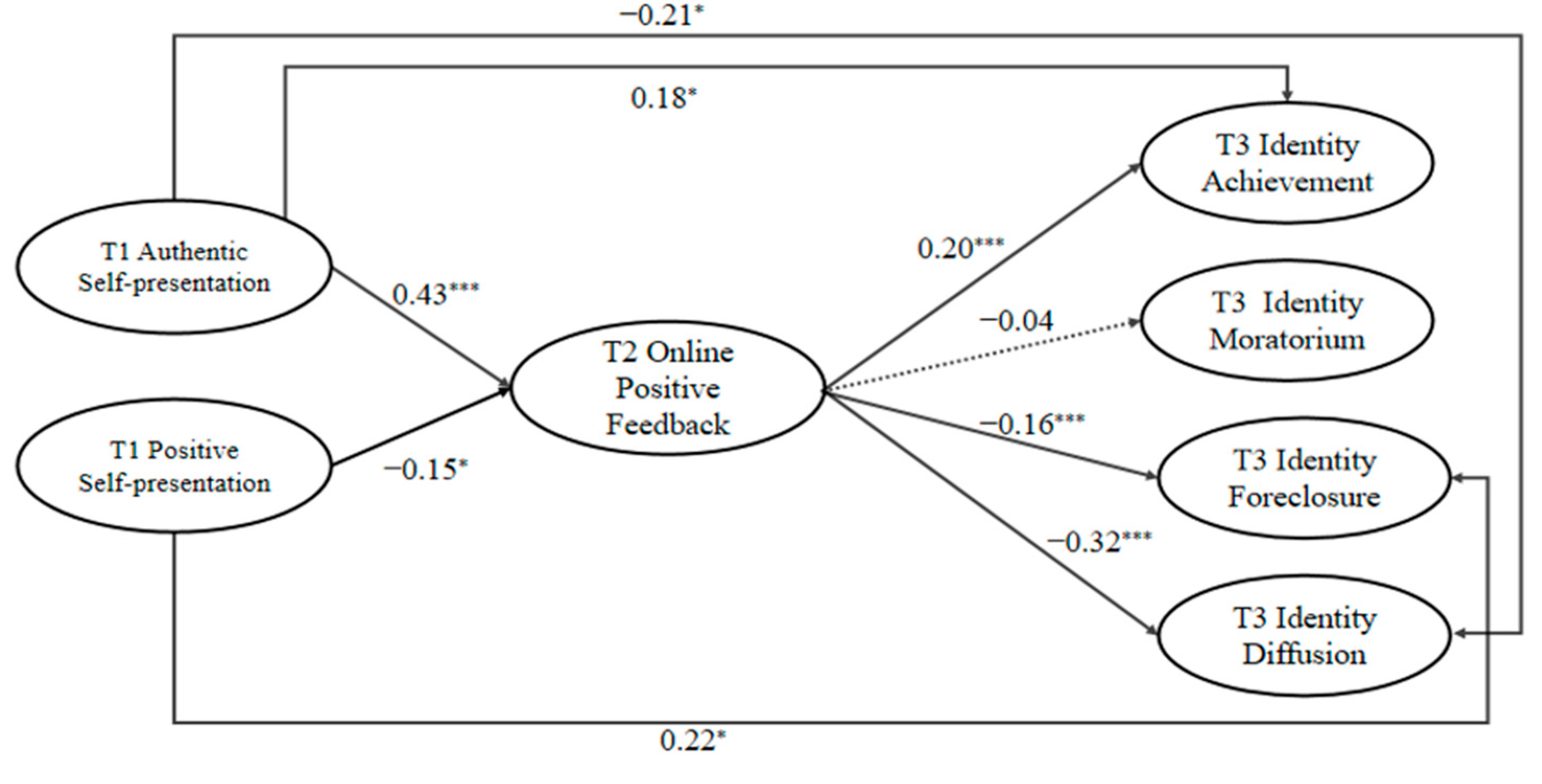
Figure 2: Path diagrams for direct associations among self-presentation, positive feedback, and ego identity. Note: *p < 0.05, ***p < 0.001. Solid lines represent significant path coefficients, dashed lines indicate non-significant path coefficients. Gender was coded as male = 0, female = 1. The control variables, i.e., gender and age, were not presented in the figure. Abbreviations: T1, the first time point; T2, the second time point; T3, the third time point.
Table 2: Longitudinal mediating effects of online positive feedback.
| Path | β | p | 95%CI |
|---|---|---|---|
| T1 WMAP → T2 OPF → T3 IA | 0.09 | <0.001 | [0.04, 0.13] |
| T1 WMAP → T2 OPF → T3 IM | −0.02 | 0.454 | [−0.07, 0.03] |
| T1 WMAP → T2 OPF → T3 IF | −0.07 | 0.001 | [−0.11, −0.03] |
| T1 WMAP → T2 OPF → T3 ID | −0.14 | <0.001 | [−0.20, −0.08] |
| T1 WMPP → T2 OPF → T3 IA | −0.03 | 0.047 | [−0.06, 0.00] |
| T1 WMPP → T2 OPF → T3 IM | 0.01 | 0.500 | [−0.01, 0.03] |
| T1 WMPP → T2 OPF → T3 IF | 0.02 | 0.044 | [0.00, 0.05] |
| T1 WMPP → T2 OPF → T3 ID | 0.05 | 0.031 | [0.00, 0.09] |
The results indicated a significant difference in model fit between the unconstrained and constrained models (Δχ2 = 26.62, p < 0.05). This finding suggested that the mediating effect of T2 online positive feedback on the relationship between T1 self-presentation on WeChat Moments and T3 ego identity differed significantly across gender groups.
Subsequently, gender differences in specific path coefficients were examined (see Table 3). For the direct paths, T1 authentic self-presentation was positively associated with T2 online positive feedback in both males and females (bmale = 0.19, p = 0.009; bfemale = 0.25, p < 0.001), with no significant gender difference (Δb = 0.06, p = 0.436). T1 Positive self-presentation and T2 online positive feedback were only significantly negatively correlated among females (b = −0.10, p = 0.013), whereas the correlation was non-significant among males (b = 0.04, p = 0.575), with no significant gender difference (Δb = −0.14, p = 0.095).
T2 online positive feedback was positively related to T3 identity achievement in both males and females (bmale = 0.27, p < 0.001; bfemale = 0.13, p = 0.002), with this association being significantly stronger among males than females (Δb = −0.14, p = 0.041). In addition, T2 online positive feedback showed a significant positive association with identity moratorium among males (b = 0.14, p = 0.012), whereas this relation was not significant among females (b = −0.02, p = 0.566); the gender difference was statistically significant (Δb = −0.16, p = 0.015). A negative association between T2 online positive feedback and identity foreclosure (b = −0.16, p < 0.001) emerged only in the female group. Moreover, T2 online positive feedback was negatively associated with identity diffusion in both females (bfemale = −0.23, p < 0.001) and males (bmale = −0.11, p = 0.049), although the gender differences were marginal and did not reach conventional levels of significance (ΔbIF = −0.17, p = 0.063; ΔbID = −0.12, p = 0.069).
With respect to the direct effects from T1 self-presentation to T3 identity statuses, T1 authentic self-presentation was significantly related to identity achievement only among females (bfemale = 0.11, p = 0.001; bmale = 0.00, p = 0.993), and T1 positive self-presentation was significantly associated with identity foreclosure only in the female group (bfemale = 0.16, p < 0.001; bmale = −0.02, p = 0.810). However, the corresponding gender differences were not statistically significant (ΔbIA = 0.11, p = 0.126; ΔbIF = 0.18, p = 0.061). No significant associations or gender differences were observed between T1 authentic self-presentation and identity moratorium (bmale = −0.04, p = 0.470; bfemale = 0.03, p = 0.392; Δb = 0.07, p = 0.294) or identity foreclosure (bmale = 0.11, p = 0.210; bfemale = −0.05, p = 0.146; Δb = −0.16, p = 0.093). Similarly, T1 positive self-presentation was not significantly related to identity achievement (bmale = −0.05, p = 0.535; bfemale = −0.03, p = 0.517; Δb = 0.02, p = 0.832), identity moratorium (bmale = 0.02, p = 0.725; bfemale = −0.01, p = 0.764; Δb = −0.04, p = 0.652), or identity diffusion (bmale = −0.01, p = 0.879; bfemale = 0.04, p = 0.305; Δb = 0.05, p = 0.518) in either group.
Regarding the indirect paths, for both males and females, T1 authentic self-presentation was positively associated with T3 identity achievement via T2 online positive feedback (bfemale = 0.03, p = 0.005; bmale = 0.05, p = 0.024). Four additional significant specific indirect paths were observed only among females: T1 authentic self-presentation was indirectly and negatively related to identity foreclosure (b = −0.04, p < 0.001) and identity diffusion (b = −0.06, p < 0.001) through T2 online positive feedback; likewise, T1 positive self-presentation showed positive indirect associations with identity foreclosure (b = 0.02, p = 0.029) and identity diffusion (b = 0.02, p = 0.019) via T2 online positive feedback. By contrast, the mediating effects of T2 online positive feedback in the associations between T1 positive self-presentation and identity achievement (bmale = 0.01, p = 0.593; bfemale = −0.01, p = 0.059; Δb = −0.02, p = 0.276) or identity moratorium (bmale = 0.01, p = 0.612; bfemale = 0.00, p = 0.593; Δb = 0.00, p = 0.758) were not significant in either gender. Furthermore, no significant gender difference was found in the indirect association between T1 authentic self-presentation and identity moratorium via T2 online positive feedback (bmale = 0.03, p = 0.081; bfemale = −0.01, p = 0.572; Δb = −0.03, p = 0.077).
Table 3: Unstandardized path coefficients and difference tests for the estimated model.
| Path | Male | Female | Δb | 95%CI | ||
|---|---|---|---|---|---|---|
| b | 95%CI | b | 95%CI | |||
| T1 WMAP → T2 OPF | 0.19** | [0.05, 0.33] | 0.25*** | [0.18, 0.32] | 0.06 | [−0.09, 0.21] |
| T1 WMPP → T2 OPF | 0.04 | [−0.12, 0.18] | −0.10* | [−0.18, −0.02] | −0.14 | [−0.30, 0.02] |
| T2 OPF → T3 IA | 0.27*** | [0.18, 0.38] | 0.13** | [0.05, 0.22] | −0.14* | [−0.27, 0.00] |
| T2 OPF → T3 IM | 0.14* | [0.03, 0.25] | −0.02 | [−0.10, 0.05] | −0.16* | [−0.30, −0.04] |
| T2 OPF → T3 IF | −0.02 | [−0.15, 0.10] | −0.16*** | [−0.24, −0.09] | −0.14 | [−0.29, 0.00] |
| T2 OPF → T3 ID | −0.11* | [−0.23, −0.01] | −0.23*** | [−0.31, −0.16] | −0.12 | [−0.26, 0.01] |
| T1 WMAP → T3 IA | 0.00 | [−0.12, 0.12] | 0.11** | [0.04, 0.18] | 0.11 | [−0.03, 0.25] |
| T1 WMAP → T3 IM | −0.04 | [−0.16, 0.07] | 0.03 | [−0.04, 0.10] | 0.07 | [−0.06, 0.22] |
| T1WMAP → T3 IF | 0.11 | [−0.06, 0.28] | −0.05 | [−0.11, 0.02] | −0.16 | [−0.34, 0.02] |
| T1 WMAP → T3 ID | −0.09 | [−0.22, 0.04] | −0.08* | [−0.15, −0.01] | 0.01 | [−0.14, 0.15] |
| T1 WMPP → T3 IA | −0.05 | [−0.18, 0.10] | −0.03 | [−0.12, 0.05] | 0.02 | [−0.14, 0.19] |
| T1 WMPP → T3 IM | 0.02 | [−0.11, 0.16] | −0.01 | [−0.09, 0.07] | −0.04 | [−0.20, 0.12] |
| T1 WMPP → T3 IF | −0.02 | [−0.18, 0.15] | 0.16*** | [0.08, 0.24] | 0.18 | [−0.02, 0.37] |
| T1 WMPP → T3 ID | −0.01 | [−0.15, 0.12] | 0.04 | [−0.04, 0.12] | 0.05 | [−0.11, 0.21] |
| T1 WMAP → T2 OPF → T3 IA | 0.05* | [0.01, 0.10] | 0.03** | [0.01, 0.06] | −0.02 | [−0.07, 0.03] |
| T1 WMAP → T2 OPF → T3 IM | 0.03 | [0.00, 0.07] | −0.01 | [−0.03, −0.01] | −0.03 | [−0.08, 0.00] |
| T1 WMAP → T2 OPF → T3 IF | −0.01 | [−0.04, 0.02] | −0.04*** | [−0.07, −0.02] | −0.04* | [−0.07, 0.00] |
| T1 WMAP → T2 OPF → T3 ID | −0.02 | [−0.06, 0.00] | −0.06*** | [−0.09, −0.04] | −0.04* | [−0.07, 0.00] |
| T1 WMPP → T2 OPF → T3 IA | 0.01 | [−0.03, 0.06] | −0.01 | [−0.03, 0.00] | −0.02 | [−0.07, 0.02] |
| T1 WMPP → T2 OPF → T3 IM | 0.01 | [−0.02, 0.03] | 0.00 | [0.00, 0.01] | 0.00 | [−0.03, 0.02] |
| T1 WMPP → T2 OPF → T3 IF | 0.00 | [−0.02, 0.01] | 0.02* | [0.00, 0.03] | 0.02 | [0.00, 0.04] |
| T1 WMPP → T2 OPF → T3 ID | −0.01 | [−0.03, 0.01] | 0.02* | [0.01, 0.05] | 0.03* | [0.00, 0.06] |
Recent theoretical work [8] emphasizes that social feedback in digital environments constitutes a key mechanism through which online behaviors influence identity development. Extending this perspective, the present three-wave, one-year longitudinal study examined the associations among self-presentation on WeChat Moments, online positive feedback, and ego identity statuses in emerging adults, and further explored whether these associations differed by gender. The findings indicated that authentic self-presentation was positively associated with online positive feedback, which was in turn associated with higher levels of identity achievement and lower levels of foreclosure and diffusion. In contrast, positive self-presentation was negatively associated with online positive feedback, and lower levels of online positive feedback were associated with lower identity achievement and higher levels of foreclosure and diffusion. Notably, gender differences emerged in these patterns of association. For both males and females, authentic self-presentation was positively associated with higher levels of identity achievement via online positive feedback. However, for other identity statuses, the indirect associations of authentic and positive self-presentation through online positive feedback were observed only among females. No such significant indirect effects were detected in the male group. Specifically, among females, authentic self-presentation was associated with lower levels of identity foreclosure and diffusion via online positive feedback, whereas positive self-presentation was associated with higher levels of identity foreclosure and diffusion through online positive feedback.
4.1 The Relationship between Self-Presentation on WeChat Moments and Ego Identity Statuses
The results of the longitudinal mediation model showed that, in addition to the mediating role of positive online feedback, both positive and authentic self-presentation on WeChat Moments were directly associated with identity statuses. Positive self-presentation was significantly and positively associated with identity foreclosure, whereas its effects on identity achievement, moratorium, and diffusion were nonsignificant. This result partially supports Hypothesis 1. Previous research has also identified a positive association between positive self-presentation on social networking sites and identity foreclosure [68]. Positive self-presentation on WeChat Moments may reflect a form of positive illusion [21], involving cognitive filtering of negative aspects of the self, real life, and the future. Such distorted self-representations may impede self-integration and identity exploration [40], thereby making emerging adults more prone to identity foreclosure. The nonsignificant predictive effects on the other three identity statuses may be explained by the fact that positive self-presentation provides clear, externally derived behavioral templates and expectations (“what I should present”). Although this externally referenced approach to identity construction may, to some extent, reduce the directionlessness associated with identity diffusion, it essentially avoids deeper exploration of core values and beliefs. As a result, individuals are unlikely to enter the exploratory state of identity moratorium or to reach identity achievement.
This study found that authentic self-presentation was positively associated with identity achievement and negatively associated with identity diffusion, which is consistent with previous research findings [12], thus partially supporting Hypothesis 2. Authentic self-presentation represents a form of self-reflection and self-integration that becomes externally manifested through the social affordances of WeChat, thereby facilitating self-discovery and self-construction. Through the continuous cycle of discovering and constructing the self, identity development progresses toward higher levels [29]. Thus, authentic self-presentation on WeChat Moments is directly related to identity achievement and inversely related to identity diffusion among college students.
4.2 The Mediating Role of Online Positive Feedback
The present study found that online positive feedback emerged as a central mechanism linking self-presentation to ego identity. This is consistent with research showing that online social gratifications enhance perceived social support, strengthen relational bonds, and encourage continued self-expression [47,48]. On WeChat Moments, an acquaintance-based platform, positive feedback reflects authentic social confirmation from individuals who matter developmentally, such as close friends or family members.
The present study found that authentic self-presentation was positively related to online positive feedback, which in turn was positively associated with identity achievement and negatively associated with identity moratorium, foreclosure, and diffusion. This result supports Hypothesis H3a. This is consistent with prior research showing that authentic self-disclosure fosters genuine interpersonal connections [69,70,71]. Because WeChat Moments primarily involve close social relationships, authentic self-presentation is more likely to elicit sincere and supportive responses from others [21,71]. Such positive feedback not only strengthens emotional bonding and enhances individuals’ sense of relatedness and self-efficacy [22], but also fulfills their need for autonomy through expressing the true self. According to self-determination theory [72], satisfaction of basic psychological needs fosters intrinsic motivation for healthy identity exploration, promotes self-reflection [32], and facilitates self-concept verification [73]. These processes ultimately support the development of identity achievement and reduce the likelihood of individuals remaining in moratorium, foreclosure, or diffusion statuses.
In contrast, positive self-presentation was associated with lower levels of online positive feedback, and this reduced feedback was in turn linked to lower identity achievement and a higher likelihood of moratorium, foreclosure, and diffusion. This result supports Hypothesis H3b. Although this finding contradicts some previous studies [49], it is consistent with the results reported by Xiong et al. [74]. Highly polished or strategically enhanced self-presentations may be perceived as boastful, eliciting envy or rejection from others [74] and consequently limiting substantive social support [66,75]. According to Cooley’s [76] concept of the “looking-glass self”, individuals form their self-concepts through others’ reactions during social interaction. Reduced positive feedback following positive self-presentation implies a lack of high-quality and accurate “social mirrors”, which may impede the development of a coherent self-understanding and, in turn, make individuals more likely either to prematurely adopt external standards (foreclosure) or to remain in a state of confusion and uncertainty (diffusion or moratorium).
This study also identified gender differences in the relationships among self-presentation on WeChat Moments, online positive feedback, and ego identity statuses, and Hypothesis 4 was partially supported.
First, the gender-based multi-group analyses revealed a largely gender-invariant pattern of associations. For both males and females, authentic self-presentation was positively associated with online positive feedback. In addition, online positive feedback was positively associated with identity achievement and negatively associated with identity diffusion. Notably, the indirect association between authentic self-presentation and identity achievement via online positive feedback was observed in both men and women, indicating a stable pattern across gender groups. These findings suggest that engaging in authentic self-expression on WeChat Moments, together with the receipt of positive feedback from others, may constitute a potentially shared psychological resource for identity development that is not strongly contingent on gender role differences.
This interpretation is consistent with prior research showing that authentic self-presentation on social networking sites tends to be associated with greater online positive feedback, which is further linked to indicators of identity formation [46,54,55]. From the perspective of self-determination theory [72], expressing one’s thoughts and feelings in an open and unembellished manner on WeChat Moments may be related to the satisfaction of autonomy needs, whereas the experience of receiving positive online feedback may be associated with the fulfillment of relatedness and/or competence needs. The satisfaction of these basic psychological needs has been theorized to support the integration of ego identity [68]. Taken together, these processes may reflect a common underlying pathway through which digital social environments are linked to identity development in the digital age.
Secondly, the present study found that online positive feedback was significantly associated with identity moratorium among males but not among females, whereas its negative association with identity foreclosure was significant only among females. According to social role theory [77], males are more likely to seek external validation for competence and status, interpreting feedback as an indicator of achievement or social status [12]. In this context, positive feedback may encourage continued identity exploration because it reinforces a sense of competence and openness to diverse possibilities (e.g., experimenting with vocational labels). Such feedback may not necessarily accelerate commitment for males, but rather sustain exploratory flexibility in areas tied to status and achievement. In contrast, females tend to interpret online positive feedback as a form of social support and relational affirmation, which can mitigate pressures toward premature identity foreclosure by providing reassurance and emotional resources for adaptive identity integration [22]. Some studies indicate that women generally exhibit greater interpersonal sensitivity and relational orientation in social media contexts, making supportive feedback more likely to facilitate integrated self-concept development and reduce tendencies toward foreclosure [78]. Consequently, for females, online positive feedback may facilitate healthy identity formation by buffering against premature foreclosure caused by external pressures, thereby explaining its negative association with identity foreclosure. Taken together, these findings indicate that online positive feedback serves as a protective factor for ego identity development in both genders, albeit through distinct mechanisms: males tend to leverage positive feedback to sustain exploratory flexibility, while females utilize it to refine integrative coherence.
More importantly, the present study identified a gender-specific pattern of indirect associations. Among women, authentic self-presentation was indirectly associated with lower levels of identity foreclosure and diffusion through online positive feedback, whereas positive self-presentation was indirectly associated with higher levels of identity foreclosure and diffusion via online positive feedback. Notably, these indirect associations were observed only in the female subsample. This gender-specific pattern suggests that males and females may differ in the psychological processes through which they interpret and utilize social feedback in online contexts.
With respect to the protective pathway of authentic self-presentation among women, this pattern may be interpreted through an integrative lens combining relational self-theory and self-verification theory. According to gender role theory, women are more strongly socialized to develop a relationally oriented self that emphasizes interpersonal connection and emotional attunement [63]. Within this framework, women’s engagement in authentic self-presentation may be more closely aligned with seeking understanding and acceptance from others. The online positive feedback received in this context may therefore be experienced primarily as relational affirmation and emotional support, which is consistent with the central premise of self-verification theory that individuals seek feedback that confirms their core self-views [79]. Such experiences of self-verification may be associated with reduced anxiety and uncertainty during identity exploration, thereby being linked to a lower likelihood of gravitating toward identity statuses characterized by premature commitment (foreclosure) or lack of direction (diffusion).
In contrast, the risk-related pathway of positive self-presentation observed among women may reflect processes involving heightened reliance on external validation and self-objectification. Positive self-presentation typically emphasizes the display of a carefully curated and socially desirable image. When women rely on this strategy to obtain positive feedback, their sense of self-worth may become more strongly contingent on external evaluations, such as likes and praise [22]. Although such feedback is ostensibly positive, it may remain relatively superficial and insufficiently connected to the individual’s authentic self. Over time, this pattern may reinforce an objectified self-perspective characterized by viewing the self through the lens of others’ approval [80]. As a result, individuals may either remain committed to a socially rewarded but potentially inauthentic identity (foreclosure) or experience heightened confusion when discrepancies between the idealized image and the lived self become salient (diffusion). In this sense, feedback linked to positive self-presentation may be less likely to provide genuine self-verification and may instead be associated with increased vulnerability stemming from dependence on external approval, thereby corresponding to less adaptive identity outcomes.
Finally, the absence of significant indirect associations among men further underscores the specificity of the gendered socialization processes described above. Male socialization tends to emphasize an instrumental and autonomous self-orientation, leading men to interpret online feedback more often as recognition of competence, achievement, or status rather than as confirmation of relational value [81]. Consequently, online positive feedback may be more closely linked to identity processes involving achievement-related affirmation or sustained exploration, and less strongly associated with identity foreclosure, which are more deeply rooted in relational insecurity and self-verification concerns. Additionally, the relatively smaller sample size of the male subgroup in the present study may have limited the statistical power to detect weaker indirect associations. Future research employing more balanced samples is needed to further examine the distinctive pathways through which online feedback may relate to identity development among men.
In sum, this longitudinal study clarified the mediating role of online positive feedback and the moderating role of gender in the associations between self-presentation on WeChat Moments and ego identity development in emerging adulthood. These findings offer valuable implications for designing targeted educational and developmental practices aimed at helping emerging adults adopt more adaptive strategies for social media use to support their identity formation process.
4.4 Strengths, Limitations, and Further Directions
This study adopted a longitudinal design to examine the temporal relationships among college students’ self-presentation on WeChat Moments, online positive feedback, and ego identity. The findings indicated that WeChat Moments, a Chinese social media platform grounded in real-life acquaintance networks, is more conducive to authentic self-presentation, whereas platforms characterized by weaker social ties tend to be associated with more curated and embellished forms of self-presentation. Moreover, authentic self-presentation on WeChat Moments was positively associated with identity achievement and negatively associated with identity foreclosure and diffusion through online positive feedback, whereas positive self-presentation exhibited the opposite pattern of associations. Furthermore, consistent with social role theory, this study found gender-differentiated pathways: among females, authentic self-presentation was indirectly associated with lower levels of identity foreclosure and diffusion through online positive feedback, whereas positive self-presentation was indirectly associated with higher levels of identity foreclosure and diffusion via online positive feedback. These significant indirect associations were not observed among males. These findings refine conventional perspectives on gender differences and offer new evidence for understanding ego identity development within digital contexts.
However, several limitations should be noted. First, this study relied on participants’ self-reports for data collection, which might introduce subjectivity. Future research could incorporate informant reports or behavioral data to enhance the robustness of the findings. Second, the internal consistency coefficients of two subscales in the ego identity measure were relatively low, which may have affected the reliability of the results. Subsequent studies should consider revising or refining this measure to improve its psychometric quality. Third, T1 online positive feedback and ego identity statuses were not controlled in the model analyses, potentially influencing the accuracy of the results and the inference of causal relationships. Future research is needed to further validate this issue. Fourth, although a longitudinal design allows for quasi-causal inferences, it does not permit definitive conclusions about causality. Experimental or intervention-based designs would be valuable for more rigorous causal testing. Additionally, differences in audience composition and interaction norms across platforms can shape users’ self-presentation strategies and the types of feedback they receive. This study focused on WeChat Moments, a widely used social platform embedded in the Chinese cultural context and characterized by acquaintance-based social interactions. As a result, the sample may be subject to homogeneity bias. Caution is therefore warranted when generalizing these findings to other cultural contexts or to open social platforms such as Weibo or Instagram.
This study examined the longitudinal associations among self-presentation on WeChat Moments, online positive feedback, and ego identity statuses in emerging adults, as well as potential gender differences in these pathways. Authentic self-presentation was positively associated with online positive feedback, which in turn was linked to greater identity achievement and lower levels of foreclosure and diffusion. In contrast, positive self-presentation was associated with reduced online positive feedback, which in turn was linked to lower identity achievement and higher levels of identity foreclosure and diffusion. Gender differences emerged in these patterns. For both males and females, authentic self-presentation was associated with higher identity achievement via online positive feedback. However, the indirect associations with other identity statuses were observed only among females: authentic self-presentation was linked to lower levels of identity foreclosure and diffusion, whereas positive self-presentation was associated with higher levels of foreclosure and diffusion through online positive feedback. No comparable indirect associations were detected among males. Overall, the findings indicate that online positive feedback is closely linked to self-presentation strategies and ego identity statuses, with these associations varying by gender. Specifically, authentic self-presentation accompanied by online positive feedback is linked to higher identity achievement in both men and women, whereas reliance on positive self-presentation may entail greater developmental vulnerability, particularly among women. These findings provide theoretical and practical implications for fostering healthy identity development in the digital era.
Acknowledgement:
Funding Statement: This research was supported by the National Social Science Fund of China (No. 23BSH123).
Author Contributions: Conceptualization, Shuqing Wang, Xiaorui Zhu and Xiumei Yan; methodology, Shuqing Wang, Xiaorui Zhu and Xiumei Yan; software, Shuqing Wang; validation, Shuqing Wang, Xiaorui Zhu and Xin Gao; formal analysis, Shuqing Wang, Xiaorui Zhu, Xin Gao and Jialing Deng; investigation, Shuqing Wang and Xiaorui Zhu; resources, Shuqing Wang; data curation, Shuqing Wang, Xiaorui Zhu, Xin Gao and Jialing Deng; writing—original draft preparation, Shuqing Wang and Xiaorui Zhu; writing—review and editing, Shuqing Wang, Xiaorui Zhu and Xiumei Yan; visualization, Shuqing Wang and Xiaorui Zhu; supervision, Shuqing Wang and Xiumei Yan; project administration, Shuqing Wang; funding acquisition, Shuqing Wang. All authors reviewed and approved the final version of the manuscript.
Availability of Data and Materials: The data that support the findings of this study are available from the Corresponding Author [Xiumei Yan] upon reasonable request.
Ethics Approval: This study was strictly conducted in accordance with the principles of the Helsinki Declaration throughout all procedures, and was approved by the Ethics Committee of the School of Education and Psychology, University of Jinan (No. 201709003).
Informed Consent: It was conducted ethically with written consent from all participants.
Conflicts of Interest: The authors declare no conflicts of interest.
References
1. Arnett JJ . Emerging adulthood: the winding road from the late teens through the twenties. New York, NY, USA: Oxford University Press; 2024. doi:10.1093/oso/9780197695937.001.0001. [Google Scholar] [CrossRef]
2. Erikson EH . Identity: youth and crisis. New York, NY, USA: Norton; 1968. [Google Scholar]
3. Luyckx K , Vanderhaegen J , Raemen L , Claes L . Identity formation in adolescence and emerging adulthood: a process-oriented and applied perspective. Eur J Dev Psychol. 2025; 22( 2): 168– 87. doi:10.1080/17405629.2023.2250128. [Google Scholar] [CrossRef]
4. Meeus W . The study of adolescent identity formation 2000–2010: a review of longitudinal research. J Res Adolesc. 2011; 21( 1): 75– 94. doi:10.1111/j.1532-7795.2010.00716.x. [Google Scholar] [CrossRef]
5. Soh S , Cruz B , Meca A , M Harari G . A digital identity intervention incorporating social media activities promotes identity exploration and commitment among emerging adults. Identity. 2025; 25( 2): 330– 46. doi:10.1080/15283488.2024.2404004. [Google Scholar] [CrossRef]
6. Xiao X , Tao H . Relationship maintenance in WeChat moments: navigating social anxiety and the desire for belongingness. Curr Psychol. 2024; 43( 35): 28172– 82. doi:10.1007/s12144-024-06366-x. [Google Scholar] [CrossRef]
7. Granic I , Morita H , Scholten H . Beyond screen time: identity development in the digital age. Psychol Inq. 2020; 31( 3): 195– 223. doi:10.1080/1047840X.2020.1820214. [Google Scholar] [CrossRef]
8. Soh S , Talaifar S , Harari GM . Identity development in the digital context. Soc Pers Psychol Compass. 2024; 18( 2): e12940. doi:10.1111/spc3.12940. [Google Scholar] [CrossRef]
9. Xiong Y , Zhou Y . The impact of online social interaction on college students’ socio-emotional competence mediated by bonding social capital. Sci Rep. 2025; 15( 1): 33287. doi:10.1038/s41598-025-18957-0. [Google Scholar] [CrossRef]
10. Schwartz SJ , Côté JE , Arnett JJ . Identity and agency in emerging adulthood: two developmental routes in the individualization process. Youth Soc. 2005; 37( 2): 201– 29. doi:10.1177/0044118X05275965. [Google Scholar] [CrossRef]
11. Iwasa Y , Hihara S , Ishizaki K , Yasui G , Hiro M , Sugimura K . Identity development and online and offline prosocial behaviors among early and middle adolescents. Front Psychol. 2023; 14: 1148347. doi:10.3389/fpsyg.2023.1148347. [Google Scholar] [CrossRef]
12. Manago AM , Graham MB , Greenfield PM , Salimkhan G . Self-presentation and gender on MySpace. J Appl Dev Psychol. 2008; 29( 6): 446– 58. doi:10.1016/j.appdev.2008.07.001. [Google Scholar] [CrossRef]
13. Wang YN , Nie R , Li Z , Zhou N . WeChat Moments use and self-esteem among Chinese adults: the mediating roles of personal power and social acceptance and the moderating roles of gender and age. Pers Individ Differ. 2018; 131: 31– 7. doi:10.1016/j.paid.2018.04.012. [Google Scholar] [CrossRef]
14. Marcia JE . Development and validation of ego-identity status. J Pers Soc Psychol. 1966; 3( 5): 551– 8. doi:10.1037/h0023281. [Google Scholar] [CrossRef]
15. Heshmati R , Rahiminejad A . Investigation of maladjustment based on identity status: foreclosure, identity diffusion, moratorium and identity achievement. J Res Health. 2020: 225– 32. doi:10.32598/JRH.10.4.1419.1. [Google Scholar] [CrossRef]
16. Sznitman GA , Zimmermann G , Van Petegem S . Further insight into adolescent personal identity statuses: differences based on self-esteem, family climate, and family communication. J Adolesc. 2019; 71: 99– 109. doi:10.1016/j.adolescence.2019.01.003. [Google Scholar] [CrossRef]
17. Berzonsky MD . A social-cognitive perspective on identity construction. In: Handbook of identity theory and research. New York, NY, USA: Springer; 2011. p. 55– 76. doi:10.1007/978-1-4419-7988-9_3. [Google Scholar] [CrossRef]
18. Beyers W , Luyckx K . Ruminative exploration and reconsideration of commitment as risk factors for suboptimal identity development in adolescence and emerging adulthood. J Adolesc. 2016; 47: 169– 78. doi:10.1016/j.adolescence.2015.10.018. [Google Scholar] [CrossRef]
19. Hatano K , Sugimura K . Is adolescence a period of identity formation for all youth? Insights from a four-wave longitudinal study of identity dynamics in Japan. Dev Psychol. 2017; 53( 11): 2113– 26. doi:10.1037/dev0000354. [Google Scholar] [CrossRef]
20. Sugimura K , Hihara S , Hatano K , Umemura T , Crocetti E . The interplay between personal identity and social identity among vocational high school students: a three-wave longitudinal study. J Youth Adolesc. 2025; 54( 2): 454– 67. doi:10.1007/s10964-024-02073-9. [Google Scholar] [CrossRef]
21. Kim J , Lee JR . The Facebook paths to happiness: effects of the number of Facebook friends and self-presentation on subjective well-being. Cyberpsychol Behav Soc Netw. 2011; 14( 6): 359– 64. doi:10.1089/cyber.2010.0374. [Google Scholar] [CrossRef]
22. Pérez-Torres V . Social media: a digital social mirror for identity development during adolescence. Curr Psychol. 2024; 43( 26): 22170– 80. doi:10.1007/s12144-024-05980-z. [Google Scholar] [CrossRef]
23. Strano MM . User descriptions and interpretations of self-presentation through Facebook profile images. J Psychosoc Res Cyberspace. 2008; 2( 2): 5– 14. [Google Scholar]
24. Bareket-Bojmel L , Moran S , Shahar G . Strategic self-presentation on Facebook: personal motives and audience response to online behavior. Comput Hum Behav. 2016; 55: 788– 95. doi:10.1016/j.chb.2015.10.033. [Google Scholar] [CrossRef]
25. Bai J , Song X , Song J . People’s attitudes toward others’ positive self-presentations and demotivation self-presentations on SNS. Acta Psychol. 2024; 243: 104160. doi:10.1016/j.actpsy.2024.104160. [Google Scholar] [CrossRef]
26. Dinh TCT , Lee Y . Understanding the psychological drivers of online self-presentation: a survey study on social media exposure, social comparison, social network type and FOMO. BMC Psychol. 2025; 13( 1): 781. doi:10.1186/s40359-025-03117-w. [Google Scholar] [CrossRef]
27. Peng W , Shi G , Hu X , Zhuang H . The association between self-presentation on social network sites and interpersonal relationship satisfaction among high school students: the chain mediating role of self-esteem and self-identity. Front Psychol. 2025; 16: 1647474. doi:10.3389/fpsyg.2025.1647474. [Google Scholar] [CrossRef]
28. Harter S , Marold DB , Whitesell NR , Cobbs G . A model of the effects of perceived parent and peer support on adolescent false self behavior. Child Dev. 1996; 67( 2): 360– 74. doi:10.2307/1131819. [Google Scholar] [CrossRef]
29. Noon EJ , Yang CC , Pesout O , Stefanczyk MM , Seiler G . Insta-identity: the longitudinal reciprocal relationship between authentic and positive self-presentation on Instagram and the sexual identity development of sexual minority youth. Comput Hum Behav. 2024; 158: 108278. doi:10.1016/j.chb.2024.108278. [Google Scholar] [CrossRef]
30. Luyckx K , Soenens B , Berzonsky MD , Smits I , Goossens L , Vansteenkiste M . Information-oriented identity processing, identity consolidation, and well-being: the moderating role of autonomy, self-reflection, and self-rumination. Pers Individ Differ. 2007; 43( 5): 1099– 111. doi:10.1016/j.paid.2007.03.003. [Google Scholar] [CrossRef]
31. Liu QQ , Sun XJ , Zhou ZK , Niu GF , Kong FC , Lian SL . The effect of honest self-presentation in online social network sites on life satisfaction: the chain mediating role of online positive feedback and general self-concept. J Psychol Sci. 2016; 39( 2): 406– 11. (In Chinese). doi:10.16719/j.cnki.1671-6981.20160223. [Google Scholar] [CrossRef]
32. Yang CC , Brown BB . Online self-presentation on Facebook and self development during the college transition. J Youth Adolesc. 2016; 45( 2): 402– 16. doi:10.1007/s10964-015-0385-y. [Google Scholar] [CrossRef]
33. Rogers CR . A theory of therapy, personality, and interpersonal relationships as developed in the client-centered framework. New York, NY, USA: McGraw-Hill; 1959. [Google Scholar]
34. Bunker CJ , Balcerowska JM , Precht LM , Margraf J , Brailovskaia J . Perceiving the self as authentic on social media precedes fewer mental health symptoms: a longitudinal approach. Comput Hum Behav. 2024; 152: 108056. doi:10.1016/j.chb.2023.108056. [Google Scholar] [CrossRef]
35. Hong EK , Zhang Y , Sedikides C . Future self-continuity promotes meaning in life through authenticity. J Res Pers. 2024; 109: 104463. doi:10.1016/j.jrp.2024.104463. [Google Scholar] [CrossRef]
36. Șurariu C , Carnelley KB , Hart CM . The social benefits of self-disclosure and self-presentation through social media: a systematic review. Behav Inf Technol. 2025: 1– 45. doi:10.1080/0144929X.2025.2590096. [Google Scholar] [CrossRef]
37. Crocetti E . Identity formation in adolescence: the dynamic of forming and consolidating identity commitments. Child Dev Perspect. 2017; 11( 2): 145– 50. doi:10.1111/cdep.12226. [Google Scholar] [CrossRef]
38. Avci H , Baams L , Kretschmer T . A systematic review of social media use and adolescent identity development. Adolesc Res Rev. 2025; 10( 2): 219– 36. doi:10.1007/s40894-024-00251-1. [Google Scholar] [CrossRef]
39. De Lise F , Luyckx K , Crocetti E . Identity matters for well-being: the longitudinal associations between identity processes and well-being in adolescents with different cultural backgrounds. J Youth Adolesc. 2024; 53( 4): 910– 26. doi:10.1007/s10964-023-01901-8. [Google Scholar] [CrossRef]
40. Wong TK , Hamza CA . Online self-presentation, self-concept clarity, and depressive symptoms: a within-person examination. J Youth Adolesc. 2025; 54( 4): 997– 1013. doi:10.1007/s10964-024-02109-0. [Google Scholar] [CrossRef]
41. Higgins ET . Self-discrepancy: a theory relating self and affect. Psychol Rev. 1987; 94( 3): 319– 40. doi:10.1037/0033-295X.94.3.319. [Google Scholar] [CrossRef]
42. Reinecke L , Trepte S . Authenticity and well-being on social network sites: a two-wave longitudinal study on the effects of online authenticity and the positivity bias in SNS communication. Comput Hum Behav. 2014; 30: 95– 102. doi:10.1016/j.chb.2013.07.030. [Google Scholar] [CrossRef]
43. Luyckx K , Klimstra TA , Duriez B , Schwartz SJ , Vanhalst J . Identity processes and coping strategies in college students: short-term longitudinal dynamics and the role of personality. J Youth Adolesc. 2012; 41( 9): 1226– 39. doi:10.1007/s10964-012-9753-z. [Google Scholar] [CrossRef]
44. Pilarska A . Effects of self-concept differentiation on sense of identity: the divided self revisited again. Pol Psychol Bull. 2017; 48( 2): 255– 63. doi:10.1515/ppb-2017-0029. [Google Scholar] [CrossRef]
45. Schwartz SJ , Beyers W , Luyckx K , Soenens B , Zamboanga BL , Forthun LF , et al. Examining the light and dark sides of emerging adults’ identity: a study of identity status differences in positive and negative psychosocial functioning. J Youth Adolesc. 2011; 40( 7): 839– 59. doi:10.1007/s10964-010-9606-6. [Google Scholar] [CrossRef]
46. Liu QQ , Sun XJ , Zhou ZK , Niu GF . Self-presentation on social network sites and ego identity: mediation of online positive feedback. Chin J Clin Psychol. 2015; 23( 6): 1094– 7. (In Chinese). doi:10.16128/j.cnki.1005-3611.2015.06.032. [Google Scholar] [CrossRef]
47. Pang H , Ruan Y . Disentangling composite influences of social connectivity and system interactivity on continuance intention in mobile short video applications: the pivotal moderation of user-perceived benefits. J Retail Consum Serv. 2024; 80: 103923. doi:10.1016/j.jretconser.2024.103923. [Google Scholar] [CrossRef]
48. Pang H , Qiao Y , Li Y , Wang L . Do network externalities and perceived gratifications boost WeChat continued use? Combining perspectives of network externalities and uses and gratifications. Acta Psychol. 2024; 251: 104610. doi:10.1016/j.actpsy.2024.104610. [Google Scholar] [CrossRef]
49. Liu D , Brown BB . Self-disclosure on social networking sites, positive feedback, and social capital among Chinese college students. Comput Hum Behav. 2014; 38: 213– 9. doi:10.1016/j.chb.2014.06.003. [Google Scholar] [CrossRef]
50. Chen YA , Mares ML . Social media self-presentation of LGBTQ+ youth in the United States: the role of identity exploration, context collapse, and supportive feedback. J Comput Mediat Commun. 2025; 30( 6): zmaf020. doi:10.1093/jcmc/zmaf020. [Google Scholar] [CrossRef]
51. Ding Q , Zhang MM , Zhang YX . Narcissism and social network sites addiction: the mediating role of conspicuous self-presentation. Chin J Clin Psychol. 2019; 27( 1): 99– 102. (In Chinese). doi:10.16128/j.cnki.1005-3611.2019.01.020. [Google Scholar] [CrossRef]
52. Chen X , Sun M , Wu D , Song XY . Information-sharing behavior on WeChat moments: the role of anonymity, familiarity, and intrinsic motivation. Front Psychol. 2019; 10: 2540. doi:10.3389/fpsyg.2019.02540. [Google Scholar] [CrossRef]
53. Eisenbarth C , Kirkhart C . Multidimensional social support and depressive symptoms in college students: direct associations and stress-buffering roles. Discov Psychol. 2025; 5( 1): 173. doi:10.1007/s44202-025-00516-3. [Google Scholar] [CrossRef]
54. Pempek TA , Yermolayeva YA , Calvert SL . College students’ social networking experiences on Facebook. J Appl Dev Psychol. 2009; 30( 3): 227– 38. doi:10.1016/j.appdev.2008.12.010. [Google Scholar] [CrossRef]
55. Walther JB , Liang YJ , DeAndrea DC , Tong ST , Carr CT , Spottswood EL , et al. The effect of feedback on identity shift in computer-mediated communication. Medium Psychol. 2011; 14( 1): 1– 26. doi:10.1080/15213269.2010.547832. [Google Scholar] [CrossRef]
56. Li WD , Zhao X , Zhou H . The ego identity status of Chinese college students: an integration of findings from six empirical studies on identity. China Youth Study. 2008; 12: 58– 62. (In Chinese). [Google Scholar]
57. Ahadzadeh AS , Ong FS , Sharif SP . Relationship between positive body image and selective visual self-presentation on social networking sites: moderating role of gender. Makara Hum Behav Stud Asia. 2023; 27( 2): 58– 73. doi:10.7454/hubs.asia.1101023. [Google Scholar] [CrossRef]
58. Joinson AN , Paine C , Buchanan T , Reips UD . Measuring self-disclosure online: blurring and non-response to sensitive items in web-based surveys. Comput Hum Behav. 2008; 24( 5): 2158– 71. doi:10.1016/j.chb.2007.10.005. [Google Scholar] [CrossRef]
59. Reed P , Saunders J . Sex differences in online assertive self-presentation strategies. Pers Individ Differ. 2020; 166: 110214. doi:10.1016/j.paid.2020.110214. [Google Scholar] [CrossRef]
60. Heiman T , Zafrir A . The role of self-presentation on social networks sites: examining the self-esteem of young people in different identity status and gender differences. Psychology. 2024; 15( 2): 155– 72. doi:10.4236/psych.2024.152011. [Google Scholar] [CrossRef]
61. Kolesnyk D , de Jong MG , Pieters R . Gender gaps in deceptive self-presentation on social-media platforms vary with gender equality: a multinational investigation. Psychol Sci. 2021; 32( 12): 1952– 64. doi:10.1177/09567976211016395. [Google Scholar] [CrossRef]
62. Markus HR , Kitayama S . Culture, self, and the reality of the social. Psychol Inq. 2003; 14( 3–4): 277– 83. doi:10.1080/1047840X.2003.9682893. [Google Scholar] [CrossRef]
63. Cross SE , Madson L . Models of the self: self-construals and gender. Psychol Bull. 1997; 122( 1): 5– 37. doi:10.1037/0033-2909.122.1.5. [Google Scholar] [CrossRef]
64. Zhang T , Xi S , Jin Y , Wu Y . Self-construal priming modulates self-evaluation under social threat. Front Psychol. 2017; 8: 1759. doi:10.3389/fpsyg.2017.01759. [Google Scholar] [CrossRef]
65. Bennion LD , Adams GR . A revision of the extended version of the objective measure of ego identity status: an identity instrument for use with late adolescents. J Adolesc Res. 1986; 1( 2): 183– 97. doi:10.1177/074355488612005. [Google Scholar] [CrossRef]
66. Wang SQ , Chen HC . Revision of Chinese simplified version of the extend objective measure of ego identity status-2 in college students. Chin J Clin Psychol. 2013; 21( 2): 196– 9. (In Chinese). doi:10.16128/j.cnki.1005-3611.2013.02.003. [Google Scholar] [CrossRef]
67. Hu LT , Bentler PM . Cutoff criteria for fit indexes in covariance structure analysis: conventional criteria versus new alternatives. Struct Equ Model A Multidiscip J. 1999; 6( 1): 1– 55. doi:10.1080/10705519909540118. [Google Scholar] [CrossRef]
68. Wang SQ , Wang XJ , Yan FX , Sun HY , Wei SH . The influence of self-presentation on social networking sites on college students’ ego identity: a longitudinal mediating role of online social support and basic psychological needs satisfaction. Chin J Clin Psychol. 2025; 33( 6): 1258– 64. (In Chinese). doi:10.16128/j.cnki.1005-3611.2025.06.023. [Google Scholar] [CrossRef]
69. Rossignac-Milon M , Pillemer J , Bailey ER , Blaine Horton C Jr , Iyengar SS . Just be real with me: perceived partner authenticity promotes relationship initiation via shared reality. Organ Behav Hum Decis Process. 2024; 180: 104306. doi:10.1016/j.obhdp.2023.104306. [Google Scholar] [CrossRef]
70. Sosik VS , Bazarova NN . Relational maintenance on social network sites: how Facebook communication predicts relational escalation. Comput Hum Behav. 2014; 35: 124– 31. doi:10.1016/j.chb.2014.02.044. [Google Scholar] [CrossRef]
71. Costello MA , Pettit C , Hellwig AF , Hunt GL , Bailey NA , Allen JP . Adolescent social learning within supportive friendships: self-disclosure and relationship quality from adolescence to adulthood. J Res Adolesc. 2024; 34( 3): 805– 17. doi:10.1111/jora.12947. [Google Scholar] [CrossRef]
72. Deci EL , Ryan RM . The “what” and “why” of goal pursuits: human needs and the self-determination of behavior. Psychol Inq. 2000; 11( 4): 227– 68. doi:10.1207/S15327965PLI1104_01. [Google Scholar] [CrossRef]
73. Russo C , Barni D , Zagrean I , Danioni F . Value consistency across relational roles and basic psychological needs satisfaction: the mediating role of self-concept clarity. Soc Sci. 2021; 10( 8): 291. doi:10.3390/socsci10080291. [Google Scholar] [CrossRef]
74. Xiong GZ , Chen M , Wang L . Self-presentation on social networking sites and self-esteem in college students: the mediating effect of online positive feedback. China J Health Psychol. 2021; 29( 5): 772– 76. (In Chinese). doi:10.13342/j.cnki.cjhp.2021.05.027. [Google Scholar] [CrossRef]
75. Li C , Ybarra O , Lee DS , Adams S , Bi C . Worse than a braggart: interpersonal costs of humblebragging in China. Asian J Soc Psychol. 2025; 28( 1): e12671. doi:10.1111/ajsp.12671. [Google Scholar] [CrossRef]
76. Cooley CH . Human nature and the social order. New York, NY, USA: Charles Scribner’s Sons; 1902. [Google Scholar]
77. Eagly AH . Reporting sex differences. Am Psychol. 1987; 42( 7): 756– 7. doi:10.1037/0003-066X.42.7.755. [Google Scholar] [CrossRef]
78. Tifferet S , Vilnai-Yavetz I . Gender differences in Facebook self-presentation: an international randomized study. Comput Hum Behav. 2014; 35: 388– 99. doi:10.1016/j.chb.2014.03.016. [Google Scholar] [CrossRef]
79. Swann WB Jr . Self-verification: bringing social reality into harmony with the self. In: Social psychological perspectives on the self. Hillsdale, NJ, USA: Lawrence Erlbaum; 1983. p. 33– 66. [Google Scholar]
80. Tifferet S . Gender differences in social support on social network sites: a meta-analysis. Cyberpsychol Behav Soc Netw. 2020; 23( 4): 199– 209. doi:10.1089/cyber.2019.0516. [Google Scholar] [CrossRef]
81. Bem SL . Gender schema theory: a cognitive account of sex typing. Psychol Rev. 1981; 88( 4): 354– 64. doi:10.1037/0033-295X.88.4.354. [Google Scholar] [CrossRef]
Cite This Article
 Copyright © 2026 The Author(s). Published by Tech Science Press.
This work is licensed under a Creative Commons Attribution 4.0 International License , which permits unrestricted use, distribution, and reproduction in any medium, provided the original work is properly cited.
 Downloads
 Citation Tools
