
 Login
Login Register
 Submit a Paper
 Propose a Special lssue
 Open Access
ARTICLE
Latent Profile of Time Perspective, Rumination, and Emotional Approach Coping among Trauma-Exposed Individuals: Exploring Impacts on Posttraumatic Growth and Predictors
Counseling and Clinical Psychology, Hallym University, Chuncheon, Republic of Korea
* Corresponding Author: Sun-Young Im. Email:
International Journal of Mental Health Promotion 2026, 28(9), 3 https://doi.org/10.32604/ijmhp.2026.082397
Received 15 March 2026; Accepted 11 May 2026; Issue published 22 September 2026
 View Full Text
 Download PDF
Abstract
Background: In the context of growing uncertainty and intersecting societal crises, trauma has become a common psychological experience that deeply affects individuals’ identities, beliefs, temporal orientation, and emotional regulation. Posttraumatic growth (PTG) emerges through processes of inner struggle and meaning reconstruction, and recovery should be understood as a complex system shaped by interacting cognitive and emotional factors. This study aimed to classify trauma-exposed individuals based on combinations of key psychological variables and examine predictors of latent profile membership, as well as differences in PTG across classes. Methods: A total of 388 Korean adults with trauma histories completed measures of time perspective, rumination, emotional approach coping, event centrality, and PTG. Latent profile analysis (LPA) was conducted, followed by R3STEP to evaluate the effects of event centrality, age, and religiosity on class membership, and DU3STEP to test between-class differences. Results: Five latent profiles were identified: maladaptive time perspective with passive processing, ambiguous time perspective with moderate processing, adaptive time perspective with growth-oriented processing, maladaptive time perspective with active processing, and disorganized time perspective with active processing. Event centrality emerged as the strongest predictor of profile membership, with age and religiosity also contributing to class differentiation. Significant differences in PTG were observed across profiles (Wald χ2 (4) = 527.78, p < 0.001), with the adaptive time perspective and growth-oriented processing profile showing the highest PTG levels (Mean = 4.19, SE = 0.05), which was significantly higher than the maladaptive-passive profile (Class 1; Mean = 1.61, SE = 0.24), demonstrating a substantial range in posttraumatic adaptation. Conclusion: Posttraumatic growth emerges not through psychological stability, but through the active cognitive-emotional integration of traumatic events, even amidst disorganized temporal orientations. The findings identify event centrality and adaptive time perspectives as the primary drivers of growth, shifting the focus of trauma recovery from mere symptom reduction to the structural reorganization of life narratives.Keywords
The growing uncertainty and compounding crises of contemporary society have increased individuals’ likelihood of encountering traumatic events. For instance, the COVID-19 pandemic posed not only direct health risks but also widespread disruptions—including unemployment, social isolation, and losses—that have left many people with trauma-like experiences [1] and have prompted calls to broaden the conceptualization of trauma. Indeed, large-scale epidemiological research indicates that approximately 70% of adults across 24 countries on six continents have experienced at least one traumatic event [2], suggesting that trauma is no longer confined to discrete incidents or particular population groups but rather constitutes a pervasive psychological phenomenon. At the same time, trauma can fundamentally rebuild an individual’s identity, core beliefs, interpersonal relationships, and temporal orientation of life. Consequently, posttraumatic adaptation involves not merely symptom reduction or a return to baseline functioning but a broader reconstruction of one’s life narrative and sense of self [3,4]. In this context, the present study conceptualizes posttraumatic recovery and adaptation not as fixed endpoints but as dynamic processes that emerge from the interplay among temporal perception, emotion, and cognition. Adopting this perspective may yield meaningful implications for the development of psychological interventions aimed at fostering adaptive functioning and psychological growth among trauma-exposed individuals.
1.1 Conceptualization and Process of Posttraumatic Growth
Paradoxically, individuals who experience trauma may also undergo posttraumatic growth (PTG), which refers to positive qualitative changes that extend beyond a mere return to pre-trauma levels of functioning. PTG encompasses transformative shifts in self-perception, interpersonal relationships, and core values [4]. The revised PTG model proposed by Tedeschi et al. conceptualizes posttraumatic reactions as an integrative and non-linear trajectory [5]. Rather than treating PTG as a static outcome, the model emphasizes the cognitive and emotional processing mechanisms that unfold throughout the adaptation process.
The model begins with individuals’ pre-existing core belief systems. Traumatic events disrupt these fundamental assumptions about the self, others, and the world, and the extent to which an event becomes central to one’s identity is associated with greater belief disruption and emotional distress [6]. Following this disruption, some individuals shift from intrusive rumination—unbidden and difficult-to-control thoughts triggered by the trauma—toward deliberate rumination, which involves intentional efforts to explore the event’s meaning and engage in cognitive reappraisal [7]. This transition constitutes a central mechanism of meaning reconstruction and cognitive restructuring. Emotional approach coping and social support further facilitate this reconstructive process, thereby enabling individuals to develop revised belief systems and a renewed sense of self, ultimately leading to the experience of PTG.
Importantly, the updated model by Tedeschi et al. underscores that PTG and posttraumatic stress disorder (PTSD) are not mutually exclusive [5]. Positive changes and distress-related symptoms may co-occur within the same individual [8], indicating that PTG should be understood not as a definitive end state but as a continuous transformation that often unfolds alongside ongoing psychological struggle [5].
1.2 The Roles of Time Perspective, Rumination, and Emotional Approach Coping
Prior research on PTG has primarily relied on variable-centered approaches that emphasize average associations among individual predictors, thereby assuming population homogeneity and overlooking the heterogeneity of trauma responses [9]. However, person-centered studies demonstrate that distinct patterns of adaptation emerge depending on how psychological factors combine within individuals following trauma [10,11]. Although time perspective, rumination, and emotional approach coping have each been identified as influential predictors of PTG, prior studies have largely examined these variables in isolation. Such a fragmented approach limits our understanding of how temporal orientation, cognitive processing, and emotional regulation jointly operate within individuals following trauma. Given that trauma responses vary widely across individuals, the present study focuses on these three psychological factors, as trauma adaptation is inherently multifarious in nature and requires an integrative perspective to capture diverse trajectories of posttraumatic adaptation.
Time perspective refers to individuals’ cognitive and emotional orientation toward the past, present, and future [12]. Zimbardo and Boyd identified five temporal orientations [12]. A past-negative time perspective involves viewing past experiences as regretful or aversive and is strongly associated with depression, anxiety, and posttraumatic stress [13]. A past-positive perspective reflects nostalgic and affectionate recollections of the past, contributing to psychological well-being and meaning-making and serving as an emotional resource that may facilitate PTG. A present-hedonistic perspective emphasizes pleasure, spontaneity, and moment-to-moment engagement; while it may enhance life satisfaction, excessive levels can lead to impulsivity and avoidance [13]. A present-fatalistic perspective, characterized by beliefs that life is governed by forces outside one’s control, is associated with helplessness and despair and is commonly observed in trauma responses [14]. Finally, a future-oriented time perspective—grounded in planning, goal setting, and self-regulation—supports rebuilding one’s life and constructing new meaning after trauma [12].
Trauma often disrupts the balance among these temporal orientations, amplifying fixation on a particular time perspective. Increases in past-negative and present-fatalistic perspectives, accompanied by decreases in future orientation, are closely related to posttraumatic stress symptoms (PTSS) and maladjustment [15,16]. Trauma-exposed individuals may become psychologically fixated on the past, with intrusive memories dominating the present [17], and such rigid temporal patterns share core features with PTSS [18]. Conversely, past-positive, future-oriented, and present-hedonistic perspectives have consistently been linked to higher levels of PTG [19,20].
Rumination constitutes another central process underlying PTG. It involves repetitive thinking about trauma-related experiences and comprises two distinct forms. Intrusive rumination refers to involuntary and distressing trauma-related thoughts and is closely linked to PTSD symptoms [21]. In contrast, deliberate rumination reflects intentional cognitive efforts to explore the meaning of the traumatic event and is a key facilitator of PTG [22]. Although most trauma-exposed individuals initially experience intrusive rumination, some gradually shift toward deliberate rumination over time, reconstructing the meaning of the event and reorganizing their sense of identity [21,23].
Emotional approach coping refers to active strategies aimed at acknowledging, understanding, and expressing one’s emotions in stressful situations [24]. It includes emotional processing (attending to emotions without avoidance and exploring their meaning) and emotional expression, which involves verbal or nonverbal communication of emotional experiences. Rather than serving as mere catharsis, emotional approach coping facilitates adaptive adjustment by promoting emotional awareness and meaning construction. Recent evidence indicates positive associations between emotional approach coping and PTG [25,26,27] and demonstrates that intrusive rumination influences PTG through the dual mediating effects of emotional approach coping and deliberate rumination [28,29,30].
While each of these factors is critical, analyzing them in isolation fails to capture the dynamic interplay that occurs within individuals recovering from trauma. Temporal orientation, cognitive processing, and emotional regulation are not independent processes; rather, they interact to shape patterns of posttraumatic adaptation. For example, rumination processes may be influenced by individuals’ interpretations of past experiences, while emotional coping strategies may further modulate these cognitive processes. To move beyond the limitations of variable-centered approaches, the present study employs latent profile analysis (LPA) to examine how these dimensions co-occur within individuals. By identifying distinct configurations of time perspective, rumination, and emotional approach coping, this approach allows for the identification of theoretically meaningful adaptation patterns, as these domains represent interrelated temporal, cognitive, and emotional processes that jointly shape posttraumatic adjustment.
1.3 Predictors: Event Centrality, Age, and Religious Affiliation
Event centrality refers to the extent to which a traumatic event becomes a core reference point in an individual’s life story and identity [6]. It exerts a dual influence on both PTSD and PTG. When a traumatic experience challenges fundamental assumptions, the process of PTG may be activated [5], and higher event centrality plays a pivotal role in facilitating the shift from intrusive to deliberate rumination—an essential cognitive pathway leading to growth [31]. Greater event centrality is also associated with stronger emotional responses to the trauma and more active emotional coping efforts aimed at regulating or expressing these emotions [6,32]. From the perspective of appraisal theories of emotion, this tendency may further stimulate emotional approach coping strategies [33]. Recent work in Korea has highlighted the need to investigate the influence of event centrality on PTG using latent profile analytic approaches [34].
Age is another key individual-difference factor that shapes posttraumatic adjustment and growth. Developmental variations lead to different patterns and priorities in PTG across the lifespan [35]. Adults in midlife and beyond tend to show increases in past-positive time perspectives [36], whereas younger adults more frequently adopt future-oriented perspectives that are positively associated with PTG [37]. In addition, the association between intrusive rumination and PTG appears to weaken with age (), and older adults generally engage in emotional approach coping more effectively [38,39].
Religious affiliation represents a meaningful psychosocial resource that supports recovery by providing systems of value and meaning [40]. Meta-analytic evidence indicates that religiosity and spirituality are robust predictors of PTG [41], as faith can facilitate meaning reconstruction, foster the shift toward deliberate rumination, and enhance emotional support and a sense of belonging [42,43]. These three variables are included as predictors because they provide the critical context for how individuals navigate their internal psychological states. While event centrality indicates the degree to which a traumatic event is integrated into one’s core identity, age and religious affiliation offer the developmental and socio-cultural frameworks that guide the meaning-making process. By examining these factors as predictors of latent profile membership, this study aims to identify the specific contextual conditions that influence how temporal, cognitive, and emotional dimensions coalesce into distinct adaptation patterns.
1.4 Differences in PTG by Time Perspective, Rumination, and Emotional Approach Coping
PTG is not a singular outcome, but a gradual process shaped by shifts in temporal perception, rumination, and emotional approach coping. Tedeschi et al. emphasize that distress and growth often co-occur [5], and recent research conceptualizes PTG as an internal process of recovery and transformation rather than merely an end state [44]. Trauma-exposed individuals draw on different psychosocial resources, leading to diverse trajectories such as rapid growth, incremental change, or more limited improvement [41].
Although time perspective, rumination, and emotional approach coping independently influence PTG, the ways in which these factors combine within individuals can give rise to markedly distinct patterns of adjustment. For example, two individuals who exhibit similarly high levels of deliberate rumination may nonetheless belong to different adaptation profiles depending on the temporal and emotional context surrounding their cognitive processing. One person may pair deliberate rumination with a future-oriented time perspective and emotional acceptance, aligning with a growth-oriented profile, whereas another may combine it with a past-negative orientation, resulting in a pattern of constrained growth.
This indicates that PTG is not determined by the isolated strength of any single variable, but rather by the unique configuration of psychological processing patterns that emerge within individuals. In this regard, differences in PTG among trauma-exposed individuals should be understood not simply as the presence or absence of growth, but as reflections of the diverse and dynamic ways in which individuals perceive, interpret, and emotionally integrate their traumatic experiences.
1.5 Research Rationale and Objectives
Understanding PTG requires attention to the substantial reconfiguration of core beliefs and life narratives, the subjective and meaning-making processes in which individuals engage, and the evolving, dynamic nature of growth that unfolds over time following highly stressful or traumatic events [5,44]. Given the multidimensional patterns that characterize trauma-exposed individuals’ psychological profiles, PTG processes are likely to vary substantially across individuals. Thus, a person-centered approach is needed to classify trauma-exposed individuals into latent subgroups and examine how these subgroups differ in their pathways toward growth. Time perspective may shape the direction of posttraumatic adaptation, and the transition from intrusive to deliberate rumination is likely intertwined with individuals’ time perspective. Tedeschi and Calhoun further emphasize that both cognitive and emotional processes are essential for PTG to unfold [4].
Recent person-centered studies have consistently reported that trauma responses are highly heterogeneous, with individuals exhibiting diverse patterns of adaptation and recovery [10,11]. Furthermore, cutting-edge research emphasizes that temporal orientation and cognitive-emotional processing play pivotal roles in post-traumatic adaptation [20,31]. However, these studies are generally limited to specific psychological domains and fall short of fully capturing the interactions between multiple dimensions. Therefore, the present study aims to examine how three distinct yet interacting psychological mechanisms—temporal (Time Perspective), cognitive (Rumination), and emotional (Emotional Approach Coping)—combine to form diverse patterns of post-traumatic adaptation. Accordingly, the present study employs latent profile analysis, a person-centered approach, to achieve a more integrated understanding of trauma adaptation. The first objective is to identify latent profiles of trauma-exposed individuals based on the unique configurations of time perspective, rumination, and emotional approach coping. Secondly, to examine the effects of event centrality, age, and religious affiliation on the classification of participants into latent profiles. Finally, to compare levels of PTG across the identified latent profiles.
By addressing these objectives, the present study aims to provide a more nuanced understanding of the complexity and individual variability inherent in PTG processes. These insights are expected to offer substantive empirical grounds for developing tailored psychological intervention strategies that correspond to the distinctive characteristics of each group.
Participants were 580 Korean adults aged 19 to 59 years. After providing informed consent online, they completed questionnaires assessing demographic characteristics and trauma-related experiences. Trauma exposure and perceived impact were measured using the Trauma Experience Questionnaire developed by Shin and Jeong [45]. This measure asks respondents to indicate whether they have experienced any of 16 major traumatic events and to report the timing of the event as well as the severity of distress experienced both at the time of the trauma and recently, each rated on a 7-point Likert scale. Participants were excluded based on three criteria: (1) traumatic events occurring over 10 years ago to minimize recall bias [46] and capture active meaning-making [47], following established protocols [48,49]; (2) impact ratings ≤4, as baseline distress is necessary to trigger growth; and (3) low reliability, defined as zero response variance. Multivariate outliers were also screened using Mahalanobis distance (p < 0.001). After applying these criteria, data from 388 participants were retained for the final analysis. The final sample consisted of 191 women and 197 men. 153 participants reported religious affiliation, whereas 235 reported no religious affiliation. The mean age was 34.91 years (SD = 8.91), with 104 participants in their 20s, 176 in their 30s, and 108 in their 40s to 50s. The most frequently reported trauma type was accidents or injuries (n = 75), followed by interpersonal relationship breakdown (n = 65), bereavement (n = 43), and serious illness of a loved one (n = 42). The study involving human participants was approved by the Hallym University Institutional Review Board (HIRB-2024-112). The study was conducted in accordance with local legislation and institutional requirements. Written informed consent was obtained from all participants prior to their involvement.
Time perspective was assessed using the Korean version of the Zimbardo Time Perspective Inventory (ZTPI), originally developed by Zimbardo and Boyd and later translated and validated for Korean college students by Yoon and Kim [12,50]. The scale consists of a total of 30 items and five subfactors: past-negative, past-positive, present-hedonistic, present-fatalistic, and future-oriented time perspectives. Items are rated on a 5-point Likert scale (1 = strongly disagree to 5 = strongly agree), and a sample item is “I cannot forget negative memories from my childhood.” Subscale scores were calculated as the sum (or mean) of the corresponding items and interpreted relative to their theoretical score ranges. Higher scores indicate a stronger tendency toward the respective time perspective, and the possible score range for each subscale varies depending on the number of items. In this study, internal consistency (α) coefficients for the five subfactors were 0.76, 0.85, 0.57, 0.78, and 0.74, respectively.
2.2.2 Event-Related Rumination
Intrusive and deliberate ruminative responses following major stressful life events were measured using the Korean version of the Event-Related Rumination Inventory (ERRI), originally developed by Cann et al. and later translated and validated by Ahn et al. [7,51]. The measure consists of a total of 20 items and includes two subscales: intrusive rumination and deliberate rumination. with items rated on a 4-point Likert scale (0 = not at all to 3 = often), and sample items include “I could not stop thoughts about the event when they came to mind” and “I thought about whether I had gained anything from the experience.” Subscale scores were calculated as the sum (or mean) of the corresponding items and interpreted relative to their theoretical score ranges. Higher scores indicate greater levels of intrusive or deliberate rumination. Internal consistency (α) coefficients for the two subfactors in the present study were 0.93 and 0.89, respectively.
2.2.3 Emotional Approach Coping
Emotional approach coping was measured using the Korean version of the Emotional Approach Coping Scale, developed by Stanton et al., and translated and validated by Kang and Yang [24,52]. The measure consists of a total of 16 items and includes two subfactors: emotional processing and emotional expression. with items rated on a 4-point Likert scale (1 = strongly disagree to 4 = strongly agree), and sample items include “I carefully examine my feelings to better understand them” and “I am willing to express my emotions”. Subscale scores were calculated as the sum (or mean) of the corresponding items and interpreted relative to their theoretical score ranges. Higher scores indicate greater use of Emotional approach coping. In the current study, internal consistency (α) coefficients for the two subfactors were 0.85 and 0.92, respectively.
PTG was assessed with the Korean version of the Posttraumatic Growth Inventory-Expanded (PTGI-X), originally developed by Tedeschi and Calhoun and expanded by Tedeschi et al. [5,53]. The Korean version used in this study was reviewed, translated, and validated by Im [54]. The original PTGI-X consists of five subfactors—new possibilities, improved relationships, personal strength, spiritual–existential change, and appreciation for life (25 items). The Korean version [55] comprises four subfactors—changes in self-perception, deeper relationships, spiritual–existential enhancement, and discovery of new possibilities (25 items). Items are rated on a 6-point Likert scale (0 = did not experience to 5 = experienced to a very great degree), and a sample item is “I came to see new possibilities that I had not previously considered.” Thus, total scores range from 0 to 125, with higher scores indicating greater levels of posttraumatic growth. Internal consistency (α) coefficients for the four subfactors in the present sample were 0.77, 0.82, 0.79, and 0.83, respectively.
Event centrality was measured using the Korean version of the Centrality of Event Scale, originally developed by Berntsen and Rubin and translated and validated by Cho and Lee [6,56]. The measure consists of a total of 20 items and includes three subfactors: reference point, turning point, and identity. and items are rated on a 5-point Likert scale (1 = not at all to 5 = very much), and a sample item is “This event has influenced the way I think and feel about other experiences.” Subscale scores were calculated as the sum (or mean) of the corresponding items and interpreted in relation to their theoretical score ranges. Higher scores indicate greater event centrality. Internal consistency (α) coefficients for the three subfactors in this study were 0.90, 0.88, and 0.88, respectively.
Data analyses were conducted using Mplus 8.3 (Muthén & Muthén, Los Angeles, CA, USA). Descriptive statistics were computed for all study variables, and skewness and kurtosis values were examined to assess the assumption of multivariate normality. Correlational analyses were then performed to identify associations among the key variables. Subsequently, latent profile analysis (LPA) was conducted. The optimal number of latent profiles was determined by considering multiple model fit indices in combination. Information criteria (IC), including the Akaike information criterion (AIC), Bayesian information criterion (BIC), and sample size-adjusted BIC (SABIC), were used, with lower values indicating better model fit. Classification quality was evaluated using entropy, which ranges from 0 to 1, with values closer to 1 indicating greater classification accuracy and reduced classification error. In addition, likelihood ratio tests, including the Lo–Mendell–Rubin likelihood ratio test (LMR-LRT) and the bootstrap likelihood ratio test (BLRT), were employed. A statistically significant p-value (p < 0.05) when comparing a model with k profiles to a model with k–1 profiles indicates that the model with more profiles provides a significantly better fit [57]. To ensure generalizability, each latent profile was required to comprise at least 5% of the total sample [57]. Furthermore, beyond statistical criteria, the interpretability and theoretical meaningfulness of the profiles were also considered in determining the optimal solution [58]. After identifying the latent profiles, differences among classes in the main study variables were examined using one-way analysis of variance (ANOVA). Predictors and outcome variables were incorporated using the manual three-step approach to maintain the integrity of the identified latent classes. In the first step, LPA was conducted to classify individuals into latent profiles. In the second step, the effects of predictor variables—specifically event centrality, age, and religious affiliation—on profile membership were examined using the R3STEP procedure [59]. This method accounts for classification uncertainty by utilizing posterior probability-based weights, ensuring that the relationships between predictors and classes are not biased by classification errors. In the third step, differences in posttraumatic growth (PTG) as a distal outcome across the identified profiles were analyzed using the DU3STEP method [59]. This procedure allows for the comparison of mean differences in PTG across the five latent classes without altering the original profile structure.
3.1 Descriptive Statistics and Correlations
Correlation coefficients among the major variables are provided in Table 1. Examination of the correlations among the LPA indicators revealed that all coefficients remained below the 0.80 threshold, confirming that there were no multicollinearity issues likely to cause statistical instability [60]. Subsequently, descriptive statistics for all study variables are presented in Table 2. The assumption of multivariate normality was satisfied for all variables, with skewness values less than 2 and kurtosis values less than 7, which are within the acceptable ranges [61].
3.2 Determination of the Number of Latent Profiles
Latent profile analysis was conducted using time perspective, rumination, and emotional approach coping as indicators. Models specifying between two and nine profiles were compared (Table 3). Based on both statistical and theoretical considerations, the five-profile solution was deemed optimal. Entropy increased sharply up to the four-profile model and then began to decline when moving from the seven- to the eight-profile model. The entropy for the five-profile model was 0.91, and the average latent class posterior probabilities for the most likely latent class membership ranged from 0.89 to 0.98 (Class 1: 0.96, Class 2: 0.94, Class 3: 0.98, Class 4: 0.94, Class 5: 0.89), indicating a high level of classification precision and model stability. The rate of decrease in the information criteria (AIC, BIC, SABIC) became notably smaller between the four- and five-profile solutions. The LMR-LRT supported the five-profile model, and the BLRT was significant across all models tested. In addition, the five-profile solution yielded clearly differentiated and theoretically interpretable classes, enhancing its clinical utility. Specifically, the five-profile model produced distinct subgroups that may correspond to clinically meaningful patterns requiring different intervention strategies. By contrast, the four-profile model—although conceptually simple and easy to interpret—combined features from theoretically distinct subgroups, thereby limiting its capacity to capture clinically relevant differentiation. The six-profile model was not supported by the LMR-LRT and included a class representing fewer than 5% of the total sample. Similarly, the seven-, eight-, and nine-profile solutions were excluded due to interpretational complexity and a lack of theoretical clarity. Accordingly, the five-profile model was selected as the final solution. Although the five-profile solution was retained based on statistical and conceptual considerations, the relatively small size of some classes suggests that this solution should be interpreted with caution, and more parsimonious alternatives may also be viable.
Table 1: Correlation analysis results among variables.
| Variable | 1 | 2 | 3 | 4 | 5 | 6 | 7 | 8 | 8-1 | 8-2 | 9 | 10 |
|---|---|---|---|---|---|---|---|---|---|---|---|---|
| 1. Past-negative time perspective | - | - | - | - | - | - | - | - | - | - | - | - |
| 2. Past-positive time perspective | −0.40*** | - | - | - | - | - | - | - | - | - | - | - |
| 3. Present-hedonistic time perspective | −0.03 | 0.51*** | - | - | - | - | - | - | - | - | - | - |
| 4. Present-fatalistic time perspective | 0.61*** | −0.40*** | −0.02 | - | - | - | - | - | - | - | - | - |
| 5. Future-oriented time perspective | −0.15** | 0.48*** | 0.33*** | −0.23*** | - | - | - | - | - | - | - | - |
| 6. Intrusive rumination | 0.48*** | −0.22*** | −0.04 | 0.34*** | 0.07 | - | - | - | - | - | - | - |
| 7. Deliberate rumination | −0.04 | 0.33*** | 0.22*** | −0.10* | 0.39*** | 0.22*** | - | - | - | - | - | - |
| 8. Emotional approach coping | −0.28*** | 0.42*** | 0.38*** | −0.25*** | 0.41*** | −0.03 | 0.60*** | - | - | - | - | - |
| 8-1. Emotional processing | −0.20*** | 0.37*** | 0.27*** | −0.22*** | 0.42*** | 0.06 | 0.64*** | 0.90*** | - | - | - | - |
| 8-2. Emotional expression | −0.30*** | 0.40*** | 0.42*** | −0.24*** | 0.34*** | −0.10* | 0.48*** | 0.93*** | 0.69*** | - | - | - |
| 9. Posttraumatic growth | −0.27*** | 0.48*** | 0.39*** | −0.35*** | 0.41*** | −0.12* | 0.51*** | 0.70*** | 0.59*** | 0.68*** | - | - |
| 10. Event centrality | −0.01 | 0.23*** | 0.26*** | −0.06 | 0.33*** | 0.18*** | 0.58*** | 0.53*** | 0.49*** | 0.49*** | 0.56*** | - |
Table 2: Descriptive statistics by variable.
| Variable | Mean | SD | Min | Max | Skewness | Kurtosis |
|---|---|---|---|---|---|---|
| Past-negative time perspective | 13.02 | 3.69 | 4 | 20 | −0.26 | −0.48 |
| Past-positive time perspective | 20.64 | 5.09 | 6 | 30 | −0.53 | −0.21 |
| Present-hedonistic time perspective | 19.31 | 4.51 | 6 | 30 | −0.08 | −0.11 |
| Present-fatalistic time perspective | 20.24 | 5.25 | 7 | 35 | 0.21 | −0.07 |
| Future-oriented time perspective | 21.45 | 4.38 | 8 | 30 | −0.40 | −0.03 |
| Intrusive rumination | 17.09 | 7.36 | 0 | 30 | −0.20 | −0.70 |
| Deliberate rumination | 19.10 | 6.15 | 0 | 30 | −0.53 | 0.24 |
| Emotional approach coping | 45.72 | 10.29 | 16 | 64 | −0.36 | −0.32 |
| Emotional processing | 23.74 | 5.09 | 8 | 32 | −0.67 | 0.40 |
| Emotional expression | 21.98 | 6.10 | 8 | 32 | −0.37 | −0.69 |
| Posttraumatic growth | 78.05 | 26.12 | 0 | 125 | −0.55 | −0.05 |
| Event centrality | 70.47 | 17.18 | 20 | 100 | −0.48 | −0.42 |
Table 3: Model fit comparison by number of latent profiles.
| Class | 2 | 3 | 4 | 5 | 6 | 7 | 8 | 9 |
|---|---|---|---|---|---|---|---|---|
| Fit Indexes | ||||||||
| Loglikelihood | −3634.99 | −3487.03 | −3394.34 | −3316.44 | −3263.54 | −3195.77 | −3145.20 | −3113.84 |
| AIC | 7325.97 | 7050.07 | 6884.68 | 6748.89 | 6663.08 | 6547.55 | 6466.40 | 6423.68 |
| BIC | 7436.88 | 7200.58 | 7074.81 | 6978.63 | 6932.43 | 6856.51 | 6814.97 | 6811.86 |
| SABIC | 7348.04 | 7080.01 | 6922.51 | 6794.60 | 6716.67 | 6609.02 | 6535.75 | 6500.92 |
| Entropy | 0.82 | 0.84 | 0.89 | 0.91 | 0.92 | 0.92 | 0.89 | 0.89 |
| LMR-LRT | 565.87** | 291.03 | 182.33* | 153.22* | 110.03 | 120.84 | 129.71 | 60.92 |
| BLRT | 575.36*** | 295.91*** | 185.39*** | 155.79*** | 111.87*** | 122.87*** | 131.89*** | 61.94*** |
| Class Size, n (%) | ||||||||
| Class 1 | 238 (61.34%) | 193 (49.74%) | 28 (7.22%) | 25 (6.44%) | 25 (6.44%) | 169 (43.56%) | 22 (5.67%) | 89 (22.94%) |
| Class 2 | 150 (38.66%) | 98 (25.26%) | 90 (23.20%) | 188 (48.45%) | 7 (1.80%) | 26 (6.70%) | 6 (1.55%) | 20 (5.16%) |
| Class 3 | - | 97 (25.00%) | 186 (47.94%) | 83 (21.39%) | 85 (21.91%) | 5 (1.29%) | 24 (6.19%) | 5 (1.29%) |
| Class 4 | - | - | 84 (21.65%) | 24 (6.19%) | 184 (47.42%) | 68 (17.53%) | 97 (25.00%) | 20 (5.16%) |
| Class 5 | - | - | - | 68 (17.53%) | 65 (16.75%) | 25 (6.44%) | 45 (11.60%) | 25 (6.44%) |
| Class 6 | - | - | - | - | 22 (5.67%) | 23 (5.93%) | 69 (17.78%) | 25 (6.44%) |
| Class 7 | - | - | - | - | - | 72 (18.56%) | 100 (25.77%) | 98 (25.26%) |
| Class 8 | - | - | - | - | - | - | 25 (6.44%) | 61 (15.72%) |
| Class 9 | - | - | - | - | - | - | - | 45 (11.60%) |
3.3 Characteristics of Latent Profiles and Class Labeling
The optimal latent profile solution based on time perspective, rumination, emotional processing, and emotional expression is presented in Fig. 1. The five latent profiles differed significantly across all indicators (Table 4). Class 1 comprised 25 individuals (6.44%). This class was characterized by high levels of past-negative and present-fatalistic time perspectives and intrusive rumination, together with low levels of past-positive time perspective, deliberate rumination, and both emotional processing and expression. Accordingly, this class was labeled the Maladaptive Time Perspective & Passive Processing profile (hereafter, Maladaptive–Passive). Class 2 included 188 individuals (48.45%). Members displayed ambiguous or undifferentiated patterns across all time perspectives and generally low activation of intrusive rumination, deliberate rumination, emotional processing, and emotional expression. This profile was therefore labeled the Ambiguous Time Perspective & Moderate Processing profile (Ambiguous–Moderate). Class 3 consisted of 83 individuals (21.39%). This class was characterized by low past-negative and present-fatalistic orientations and elevated levels of past-positive, present-hedonistic, and future-oriented time perspectives. Levels of intrusive rumination were low, whereas deliberate rumination and both emotional processing and expression were high. Based on this adaptive pattern, this class was labeled the Adaptive Time Perspective & Growth-Oriented Processing profile (Adaptive–Growth-Oriented). Class 4, comprising 24 individuals (6.19%), showed high past-negative and present-fatalistic orientations and low past-positive, present-hedonistic, and future-oriented perspectives. Although this class demonstrated the highest level of intrusive rumination, levels of deliberate rumination, emotional processing, and emotional expression were also elevated. This profile was therefore labeled the Maladaptive Time Perspective & Active Processing profile (Maladaptive–Active). Finally, Class 5 included 68 individuals (17.53%). Members of this class exhibited globally elevated levels across all time perspectives, intrusive and deliberate rumination, emotional processing, and emotional expression, but the overall pattern lacked a coherent directional structure. This class was labeled the Disorganized Time Perspective & Active Processing profile (Disorganized–Active).
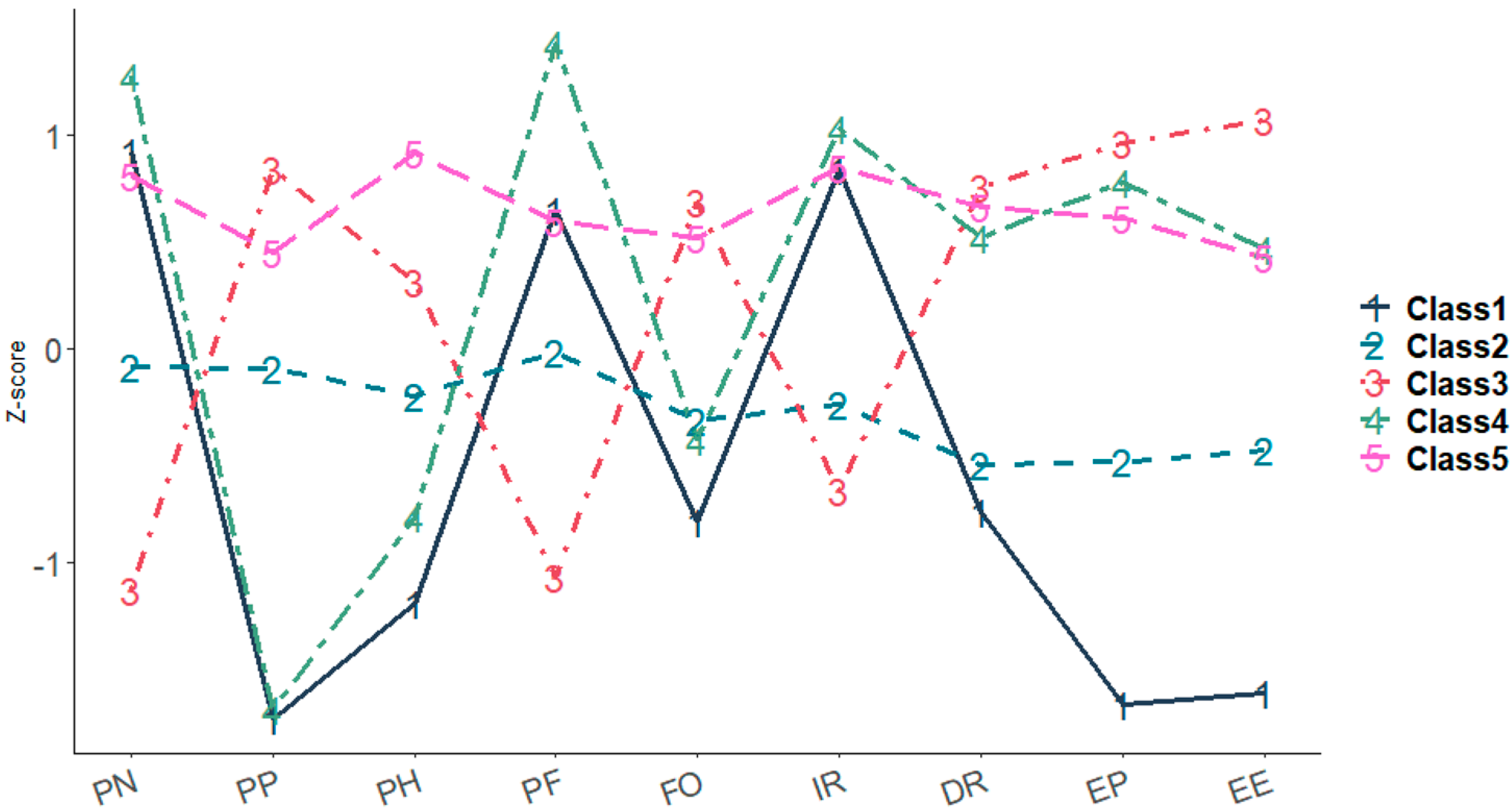
Figure 1: Latent profile diagram. Note: PN, Past-negative time perspective; PP, Past-positive time perspective; PH, Present-hedonistic time perspective; PF, Present-fatalistic time perspective; FO, Future-oriented time perspective; IR, Intrusive rumination; DR, Deliberate rumination; EP, Emotional processing; EE, Emotional expression.
Table 4: Comparison of observed variable values by latent profile (one-way results).
| Dependent Variable | F | df1 | df2 | Partial η2 | Post Hoc |
|---|---|---|---|---|---|
| Past-negative | 116.69*** | 4 | 383 | 0.55 | (4 = 1 = 5) > 2 > 3 |
| Past-positive | 122.79*** | 4 | 383 | 0.56 | 3 > 5 > 2 > (4 = 1) |
| Present-hedonistic | 45.51*** | 4 | 383 | 0.32 | 5 > 3 > 2 > (4 = 1) |
| Present-fatalistic | 81.95*** | 4 | 383 | 0.46 | 4 > (1 = 5) > 2 > 3 |
| Future-oriented | 33.15*** | 4 | 383 | 0.26 | (3 = 5) > (2 = 4 = 1) |
| Intrusive rumination | 54.53*** | 4 | 383 | 0.36 | (4 = 5 = 1) > 2 > 3 |
| Deliberate rumination | 62.47*** | 4 | 383 | 0.40 | (3 = 5 = 4) > 2 > 1 |
| Emotional processing | 151.60*** | 4 | 383 | 0.61 | (3 = 4 = 5) > 2 > 1 |
| Emotional expression | 124.90*** | 4 | 383 | 0.57 | 3 > (4 = 5) > 2 > 1 |
3.4 Effects of Predictors on Latent Profile Membership
To further interpret the latent profile solution, we examined the effects of event centrality, age, and religious affiliation on class membership. According to the results from the latent profile regression model, participants’ profiles differ depending on the level of centrality, age, and religious affiliation (Table 5). Using the Maladaptive Time Perspective & Passive Processing profile (Class 1) as the reference group, higher event centrality significantly increased the likelihood of belonging to the Adaptive Time Perspective & Growth-Oriented Processing profile (Class 3; B = 3.12, p < 0.001, OR = 22.56), the Maladaptive Time Perspective & Active Processing profile (Class 4; B = 2.23, p = 0.011, OR = 9.31), and the Disorganized Time Perspective & Active Processing profile (Class 5; B = 1.64, p = 0.009, OR = 5.13). For age, participants in their 20s served as the reference category. Individuals in their 30s did not significantly differ from the reference group in any of the class comparisons. Among participants in their 40s–50s, age did not significantly predict membership in Classes 2, 4, or 5 when Class 1 was the reference group, but it significantly decreased the likelihood of belonging to Class 3 (B = −2.38, p = 0.011, OR = 0.09). This pattern suggests that middle-aged adults may be less likely to belong to profiles characterized by flexible reconstruction and positive meaning-making following trauma. Religious affiliation also emerged as a significant predictor. When Class 1 was used as the reference group, having a religious affiliation did not significantly predict membership in Classes 2, 3, or 4; however, it significantly increased the likelihood of belonging to Class 5, the Disorganized Time Perspective & Active Processing profile (B = 1.47, p = 0.023, OR = 4.35). This pattern may indicate that religious involvement is associated with intensified cognitive and emotional engagement with traumatic experiences, which in some cases may take the form of complex and less clearly organized processing.
Table 5: Effects of predictor variables on latent profiles (logistic regression results).
| Reference Class | ||||||||
|---|---|---|---|---|---|---|---|---|
| Predictor Variable | Class 1 | Class 2 | Class 3 | Class 4 | ||||
| B | OR | B | OR | B | OR | B | OR | |
| Comparison Class: Class 2 | ||||||||
| EC | −0.71 | 0.49 | - | - | - | - | - | - |
| 30s | 0.40 | 1.49 | - | - | - | - | - | - |
| 40s–50s | 0.44 | 1.55 | - | - | - | - | - | - |
| Religion | 0.52 | 1.68 | - | - | - | - | - | - |
| Comparison Class: Class 3 | ||||||||
| EC | 3.12*** | 22.56 | 3.83*** | 45.98 | - | - | - | - |
| 30s | −0.18 | 0.84 | −0.57 | 0.56 | - | - | - | - |
| 40s–50s | −2.38* | 0.09 | −2.82*** | 0.06 | - | - | - | - |
| Religion | 0.37 | 1.44 | −0.15 | 0.86 | - | - | - | - |
| Comparison Class: Class 4 | ||||||||
| EC | 2.23* | 9.31 | 2.94*** | 18.97 | −0.89 | 0.41 | - | - |
| 30s | 0.02 | 1.02 | −0.37 | 0.69 | 0.20 | 1.22 | - | - |
| 40s–50s | −0.09 | 0.91 | −0.53 | 0.59 | 2.29** | 9.83 | - | - |
| Religion | 0.41 | 1.50 | −0.11 | 0.89 | 0.04 | 1.04 | - | - |
| Comparison Class: Class 5 | ||||||||
| EC | 1.64** | 5.13 | 2.35*** | 10.45 | −1.48* | 0.23 | −0.60 | 0.55 |
| 30s | 0.28 | 1.32 | −0.12 | 0.89 | 0.46 | 1.58 | 0.26 | 1.29 |
| 40s–50s | −0.30 | 0.74 | −0.73 | 0.48 | 2.08** | 8.01 | −0.21 | 0.82 |
| Religion | 1.47* | 4.35 | 0.95* | 2.59 | 1.11** | 3.02 | 1.07 | 2.90 |
3.5 Differences in Posttraumatic Growth across Latent Profiles
Differences in PTG across the five latent profiles were then examined (Table 6). The overall test indicated significant variation in PTG as a function of profile membership, Wald χ2 (4) = 527.78, p < 0.001. To control for Type I error in multiple comparisons, a Bonferroni correction was applied, setting the adjusted significance level at p < 0.005. All inter-group differences reported as significant remained statistically significant after this adjustment. The estimated mean PTG scores for each class were as follows: Adaptive Time Perspective & Growth-Oriented Processing (Class 3; 4.19), Disorganized Time Perspective & Active Processing (Class 5; 3.68), Maladaptive Time Perspective & Active Processing (Class 4; 3.07), Ambiguous Time Perspective & Moderate Processing (Class 2; 2.67), and Maladaptive Time Perspective & Passive Processing (Class 1; 1.61). Pairwise Wald tests revealed that Class 1 showed significantly lower PTG than all other classes: Class 2, χ2 = 18.41, p < 0.001; Class 3, χ2 = 113.52, p < 0.001; Class 4, χ2 = 13.53, p < 0.001; and Class 5, χ2 = 64.97, p < 0.001. Class 2 exhibited significantly lower PTG than Class 3 (χ2 = 435.68, p < 0.001) and Class 5 (χ2 = 76.40, p < 0.001) but did not significantly differ from Class 4 (χ2 = 1.58, p = 0.209). Class 3 showed the highest PTG of all profiles and was significantly higher than both Class 4 (χ2 = 13.23, p < 0.001) and Class 5 (χ2 = 21.67, p < 0.001). Finally, the difference between Class 4 and Class 5 did not reach statistical significance (χ2 = 3.56, p = 0.059).
Table 6: Analysis of differences in posttraumatic growth (PTG) levels among latent profiles.
| Class | Class 1 | Class 2 | Class 3 | Class 4 | Class 5 |
|---|---|---|---|---|---|
| Class 1 | |||||
| Class 2 | 18.41*** | ||||
| Class 3 | 113.52*** | 435.68*** | |||
| Class 4 | 13.53*** | 1.58 | 13.23*** | ||
| Class 5 | 64.97*** | 76.40*** | 21.67*** | 3.56 | |
| Estimated Means | 1.61 | 2.67 | 4.19 | 3.07 | 3.68 |
| Standard Error | 0.24 | 0.06 | 0.05 | 0.31 | 0.10 |
The present study identified latent profiles of trauma-exposed adults based on the integrated structural configurations of time perspective, rumination, and emotional approach coping. In addition, we examined the effects of event centrality, age, and religious affiliation on class membership, as well as differences in PTG across the identified profiles. Latent profile analysis yielded five distinct classes, each representing a unique configuration of posttraumatic adaptation characterized by different patterns of temporal orientation and cognitive–emotional processing. This person-centered approach provides a more granular understanding of trauma recovery compared to traditional variable-centered methods, offering a preliminary framework for intervention strategies tailored to the specific configurations of each subgroup.
These five profiles illustrate that posttraumatic adaptation is not a linear process but instead is characterized by multidimensional and dynamic patterns. Among them, the most noteworthy was the Disorganized Time Perspective & Active Processing profile (Class 5). Individuals in this profile showed high activation across all psychological variables; however, their temporal orientations appeared fragmented, and deliberate rumination and emotional approach coping co-occurred with elevated intrusive rumination. Strikingly, this profile demonstrated the second-highest level of PTG. This pattern suggests that PTG does not simply reflect a state of psychological stability but is associated with an effortful and sometimes distressing process of reflection and transformation. Individuals in this profile appear to be actively engaged in meaning-making despite—or even within—their psychological disorganization, aligning with recent perspectives conceptualizing PTG as a process rather than an outcome [5,62,63]. These results indicate that even when temporal interpretations remain inconsistent or unsettled, active emotional engagement and meaning exploration show a positive association with PTG. Thus, this profile highlights that growth can coexist with the complexity and turbulence of posttraumatic adjustment, representing a specific psychological state observed in our cross-sectional data rather than a demonstrated developmental pathway.
The second most prominent profile was the Adaptive Time Perspective & Growth-Oriented Processing Profile (Class 3). This profile was characterized by a balanced time perspective [12], high levels of deliberate rumination, and active emotional approach coping, and it exhibited the highest level of PTG among all profiles. A balanced time perspective reflects the capacity to flexibly engage with past, present, and future temporal frames, a pattern that has been repeatedly linked to positive posttraumatic adaptation [18]. Consistent with Tedeschi et al.’s model [5], which posits that intrusive rumination typically decreases, whereas deliberate rumination increases over time, individuals in Class 3 showed the lowest levels of intrusive rumination and the highest levels of deliberate rumination. This pattern suggests that members of this profile have effectively reconstructed the meaning of their traumatic experiences and integrated them into their broader life narratives. These findings align with prior studies reporting latent subgroups characterized by stabilized PTSD symptoms alongside high levels of PTG [34]. Thus, Class 3 appears to reflect an integrated stage of growth in which individuals accept the traumatic event as part of their life story and transform it into a psychological resource for self-understanding and goal reorientation [5,64].
The Maladaptive Time Perspective & Active Processing Profile (Class 4) was characterized by elevated past-negative and present-fatalistic orientations, low future orientation, heightened emotional approach coping and deliberate rumination, and the highest level of intrusive rumination among all classes. This profile demonstrated the third-highest level of PTG. Although these individuals remain strongly tied to the pain of the past, they also show pronounced efforts to acknowledge and express their emotional distress rather than avoid it. This pattern suggests that traumatic stress has not yet been resolved; however, active psychological engagement in meaning reconstruction and recovery is underway—a manifestation of “struggling growth” [20,65]. Thus, the coexistence of intrusive and deliberate rumination alongside emotional approach coping appears to reflect a transitional stage in which individuals are actively working through trauma while still experiencing substantial distress.
The Ambiguous Time Perspective & Moderate Processing profile (Class 2) exhibited mid-range levels across all observed variables, reflecting cognitive and emotional responses to trauma that were neither excessively heightened nor markedly suppressed. This profile demonstrated the second-lowest level of PTG. Although some degree of cognitive and emotional reconstruction appears to be occurring, these individuals do not yet seem to have reached a fully integrated stage of posttraumatic adaptation. This pattern aligns with prior findings suggesting that many trauma-exposed individuals do not fall neatly into distinctly adaptive or maladaptive patterns but instead occupy an intermediate zone in which the directionality of posttraumatic adjustment remains unclear [66].
The Maladaptive Time Perspective & Passive Processing profile (Class 1) was characterized by high levels of past-negative and present-fatalistic orientations, accompanied by markedly low levels of past-positive and future-oriented time perspectives. This profile also showed very low levels of emotional approach coping and deliberate rumination, reflecting an avoidant and passive psychological response pattern. Consequently, this profile demonstrated the lowest level of PTG. Although intrusive rumination occurred frequently, individuals in this class appeared to lack the cognitive resources or motivation necessary to transform these intrusive thoughts into more constructive meaning. According to Zimbardo and Boyd’s time perspective theory, trauma often disrupts the balance among temporal orientations and strengthens fixation on specific categories—particularly past-negative and present-fatalistic frames. Subsequent research has shown that such temporal rigidity is closely associated with PTSD symptoms [67,68]. In addition, the low levels of emotional expression and meaning-focused processing observed in this profile may reflect sociocultural tendencies in collectivistic contexts, such as Korea, where emotional internalization and suppression are often favored over overt emotional disclosure [69].
Additional comparisons revealed no significant differences in PTG between the Ambiguous Time Perspective & Moderate Processing profile (Class 2) and the Maladaptive Time Perspective & Active Processing profile (Class 4), nor between Class 4 and the Disorganized Time Perspective & Active Processing profile (Class 5). This pattern suggests that the relationship between profile structure and PTG does not follow a simple linear continuum from maladaptive to adaptive configurations. Individuals may arrive at similar levels of growth despite following different psychological configurations, highlighting the multidirectional nature of PTG and the possibility of equifinal outcomes. Class 2 appears to represent individuals who have not yet entered the more active processes necessary for PTG due to relatively low psychological activation, whereas Class 4 may reflect individuals who have begun to engage with trauma-related material but have not yet adopted strategies conducive to sustained growth.
Although both Class 4 and Class 5 exhibited high levels of emotional and cognitive activation, differences in their temporal orientations and rumination patterns seem to contribute to distinct psychological patterns and varying degrees of stability in growth. For individuals in Class 4, their predominantly negative and fatalistic temporal orientations suggest that therapeutic interventions should prioritize restructuring interpretations of past experiences and broadening future-oriented perspectives. In contrast, individuals in Class 5 demonstrate active attempts at emotional engagement and meaning exploration but struggle with inconsistent temporal perspectives and unstable rumination patterns. As such, therapeutic work with this profile may benefit from supporting cognitive organization and emotional integration to support a more coherent and stable adaptive configuration.
These latent profiles appear to reflect the interplay among time perspective, rumination, and emotional approach coping. The finding that multidimensional configurations of time perspective served as a central axis for class differentiation underscores that temporal orientation after trauma is not merely a dispositional tendency but a psychological foundation for recovery and growth. The qualitative shift in rumination has also been repeatedly identified as a core mechanism of PTG [7,17,70,71,72]. In this study, the profile characterized by high intrusive and low deliberate rumination (Class 1) aligned with a maladaptive pattern, whereas profiles characterized by higher deliberate rumination (Classes 3, 4, and 5) demonstrated active attempts to interpret and integrate the traumatic experience into individuals’ life narratives, reflecting configurations associated with growth and recovery. Similarly, profiles with low emotional approach coping (Classes 1 and 2) displayed more limited potential for growth, whereas those with higher levels (Classes 3, 4, and 5) may have benefited from recognizing, expressing, and accepting emotional distress—suggesting that emotional approach coping functions as a facilitator of recovery and growth [24,73,74]. This supports the view that emotional expression and processing are not merely cathartic but serve as psychological resources that enable meaning-making, self-integration, and interpersonal connection. Furthermore, Linley and Joseph suggested that groups characterized by simultaneously high intrusive rumination and emotional approach tendencies lie at the intersection of distress and growth [44]. Such “boundary” profiles differ from the predominantly adaptive or maladaptive categories emphasized in earlier trauma research, highlighting the presence of mixed or transitional patterns that warrant careful examination and tailored intervention [66]. Individuals situated at the boundary between distress and growth may possess the potential to shift toward more adaptive profiles over time, particularly when interventions strengthen internal resources and facilitate emotional expression [75].
Clinically, these findings suggest the importance of tailored interventions that reflect the specific characteristics of individuals’ posttraumatic responses. For profiles characterized by entrenched intrusive rumination and rigid negative time perspectives, interventions that focus on cognitive restructuring, temporal reorientation, and the integration of future-oriented goal setting may be particularly beneficial. In contrast, for profiles marked by heightened rumination and active emotional processing, approaches centered on narrative reconstruction and self-integration may offer greater therapeutic value [74,76].
To enhance the clinical utility of these findings, we suggest specific, profile-based recommendations for intervention. For Class 1 (Maladaptive Time Perspective & Passive Processing), interventions should focus on enhancing emotional processing and expression abilities, rather than just temporal reorientation. Since Classes 1 and 4 share similar maladaptive time perspectives yet show significant differences in PTG, the core differentiator is the activation of emotional approach coping. Therefore, for Class 1, therapeutic priority should be placed on fostering emotional awareness and disclosure as a prerequisite for any cognitive shift. For Class 2 (Ambiguous Time Perspective & Moderate Processing), the primary goal is to facilitate more focused cognitive and emotional engagement. Individuals in this profile maintain a neutral or intermediate state across all variables, rather than reflecting a deficit or negative condition. Interventions should focus on enhancing acute awareness of internal experiences and encouraging the adoption of active coping strategies. For Class 3 (Adaptive Time Perspective & Growth-Oriented Processing), interventions should support the maintenance and consolidation of adaptive functioning, particularly by reinforcing meaning-making processes and future-oriented goal setting. For Class 4 (Maladaptive Time Perspective & Active Processing), interventions should prioritize modifying maladaptive interpretations of past experiences while channeling high emotional activation into structured meaning-making processes. Evidence-based approaches such as Cognitive Processing Therapy may be particularly relevant for this profile. For Class 5 (Disorganized Time Perspective & Active Processing), interventions should prioritize psychological stabilization and the reduction of intrusive rumination. While individuals in this profile demonstrate high levels of emotional processing and reflection, they also grapple with complex and inconsistent temporal perspectives. The primary therapeutic goal should be to channel their high cognitive and emotional activation into a more stable adaptive configuration. Rather than focusing on “organization,” interventions should aim to mitigate the distress caused by frequent intrusive thoughts, allowing their existing capacity for deliberate rumination to lead to more coherent meaning-making. Event centrality, age, and religious affiliation were significantly associated with latent profile membership, with event centrality emerging as the strongest predictor. Higher event centrality increased the likelihood of belonging to the high-growth or cognitively and emotionally activated profiles (Classes 3, 4, and 5), whereas lower event centrality increased the likelihood of membership in the low-growth or avoidance-oriented profiles (Classes 1 and 2). This finding supports theoretical assertions that integrating a traumatic event into one’s core identity facilitates cognitive reappraisal and emotional integration [4,6]. Event centrality may enhance the potential for growth when the traumatic experience becomes not merely a past occurrence but a deeply incorporated component of one’s current self-concept and life direction [77,78].
Age and religious affiliation showed selective effects and should be interpreted with caution. Adults in their 40s–50s were less likely than those in their 20s to belong to the Adaptive Time Perspective & Growth-Oriented Processing profile (Class 3). This pattern might be related to age-related tendencies toward more rigid temporal orientations [79,80], less flexible psychological structures [81], and reduced emotional flexibility [82]. But this was not a consistent trend across all profiles. Similarly, although religious affiliation was associated with Class 5, the use of a simple binary measure and the lack of a uniform pattern across profile contrasts limit the interpretive weight of this variable. While religion may serve as a psychosocial resource for some [41,83], these findings remain exploratory. Future research should utilize more nuanced assessments to capture the qualitative dimensions of religious experience [83,84].
The present study has several limitations. First, the cross-sectional design restricts interpretations regarding temporal change and causal relationships. Future research should employ longitudinal designs and latent transition analyses to more precisely examine the developmental trajectories of PTG and transitions among latent profiles over time. Second, the exclusive use of self-report measures raises the possibility of response bias and sampling bias. Specifically, the relatively low internal consistency of the present-hedonistic subscale in this sample may introduce measurement error. While this indicator was retained for its essential theoretical and interpretative value, this lower reliability may potentially inflate classification indices like entropy; therefore, these classification results should not be viewed as absolute. In addition, the study did not fully capture the type, timing, and contextual characteristics of traumatic experiences. Future studies would therefore benefit from incorporating sampling strategies and more objective or multi-informant assessments that better reflect the complexity of trauma exposure. Third, religious affiliation was treated as a dichotomous variable, which limited our ability to account for qualitative dimensions of religiosity. Future research should include more nuanced indicators—such as continuous measures of religiousness or levels of intrinsic faith—to provide a more refined analysis. Moreover, examining religiosity in conjunction with other personality and psychological characteristics may enhance explanatory power and strengthen the validity of models that investigate mechanisms of posttraumatic adaptation and growth. Fourth, the results of this study are inherently sample-specific and situated within the South Korean cultural context, which necessitates caution in generalization. Cultural values such as social face and the emphasis on interpersonal harmony [85] may have influenced the participants’ emotional expression and the formation of passive coping profiles. Since these cultural nuances are likely specific to the Korean population, there are inherent limitations in overgeneralizing the configurations derived from this study to other populations, particularly individualistic Western cultures or different types of trauma. Fifth, this study did not perform measurement invariance testing or split-half cross-validation due to its exploratory nature, which was further complicated by the limited sample size of certain subgroups (e.g., religious participants in Class 2) that made multi-group analysis statistically challenging. Future research should prioritize larger, more balanced samples to verify the measurement invariance and reproducibility of these configurations. Notably, given that two of the identified subgroups (Class 1 and Class 4) were relatively small, the five-profile solution should be viewed as a preliminary framework rather than an unequivocal one. Future replication studies with larger and more diverse samples are necessary to confirm the stability and generalizability of these specific configurations. Furthermore, since this study did not conduct a stratified analysis based on the type of trauma, future research should incorporate analyses that account for specific trauma types to ensure a more nuanced understanding of posttraumatic adaptation, as the impact on psychological processes and growth may vary by the nature of the event.
Despite these limitations, the present study offers several important contributions. First, by applying a person-centered approach to PTG, the study highlights that individuals’ psychological characteristics combine in complex ways to reflect diverse patterns of posttraumatic adaptation. This finding underscores that posttraumatic responses are not linear and that, even when individuals experience the same traumatic event, differing constellations of time perspective, rumination, and emotional approach coping can lead to distinct profiles of recovery and growth. Second, by incorporating time perspective as a central variable in PTG research, the study provides empirical support for integrating Zimbardo and Boyd’s time perspective theory [12] with Tedeschi and Calhoun’s model of PTG [4]. Third, the findings demonstrate that event centrality, age, and religious affiliation play significant roles in latent profile membership. In particular, individuals with higher event centrality were more likely to belong to profiles characterized by active meaning-making and emotional engagement, supporting the notion that PTG is facilitated when traumatic experiences are interpreted as pivotal turning points in one’s life. These results carry meaningful implications for clinical practice. Specifically, they suggest that interventions aimed at fostering recovery and growth should prioritize early engagement in meaning-making processes—helping clients explore the question, “What did this event mean to me?” Moreover, the findings emphasize the importance of age-specific intervention strategies. For middle-aged adults, interventions that enhance emotional awareness [86,87], promote life reconstruction [88], and support meaning reconstruction [89] may be particularly effective in strengthening psychological flexibility and facilitating growth.
Moreover, the findings indicate that meaningful shifts in rumination and emotional integration need to occur in tandem for PTG to be effectively facilitated. This suggests that realigning one’s time perspective alone is insufficient; instead, interventions must integrate strategies that also target the directionality of rumination and the degree of emotional approach. In Korea, the application of time perspective therapy [18] remains in its early stages, underscoring the need for integrated, time perspective–based approaches in clinical and counseling contexts. Given that Korean trauma-exposed individuals often experience cultural barriers to emotional expression and struggle with ruminating on past experiences [90], time perspective interventions may play a meaningful role in promoting qualitative shifts in rumination and fostering emotional integration. Accordingly, future time perspective–based programs should incorporate components that enhance emotional approach and regulate rumination, thereby expanding into PTG-focused recovery models. Such developments may complement existing therapeutic protocols by providing practical tools to support deeper meaning reconstruction and long-term adaptive functioning.
The present study aimed to highlight PTG not as a fixed outcome but as a process unfolding along multiple psychological pathways following trauma. Importantly, the latent profiles identified in this study were not distinguished solely by their levels of PTG but rather by unique constellations of temporal integration, rumination patterns, and activation of emotional approach coping. The findings suggest that even individuals experiencing intense emotional distress and psychological disorganization may display growth-oriented configurations, characterized by high levels of deliberate rumination and emotional expression alongside their cognitive disorientation. These results underscore that PTG should not be conceptualized as an endpoint marked by recovery or the presence of positive affect, but as a gradual movement characterized by navigating uncertainty and psychological tension. Thus, PTG is better understood not in terms of whether growth has occurred, but in terms of how individuals interpret, integrate, and make meaning of their emotional turmoil and cognitive disorientation.
Acknowledgement:
Funding Statement: The authors received no specific funding for this study.
Author Contributions: Jubin Park: Conceptualization, Methodology, Formal analysis, Investigation, Data curation, Writing—original draft, Writing—review & editing, Visualization, Project administration, Validation. Jae-Chang Sim: Methodology, Formal analysis, Validation, Writing—review & editing, Visualization. Sun-Young Im: Methodology, Writing—review & editing, Supervision, Project administration. All authors reviewed and approved the final version of the manuscript.
Availability of Data and Materials: The data that support the findings of this study are available from the Corresponding Author, [Sun-Young Im], upon reasonable request.
Ethics Approval: The study involving human participants was approved by the Hallym University Institutional Review Board (HIRB-2024-112). The study was conducted in accordance with local legislation and institutional requirements. Written informed consent was obtained from all participants prior to their involvement.
Conflicts of Interest: The authors declare no conflicts of interest.
References
1. Fiorillo A , Gorwood P . The consequences of the COVID-19 pandemic on mental health and implications for clinical practice. Eur Psychiatry. 2020; 63( 1): e32. doi:10.1192/j.eurpsy.2020.35. [Google Scholar] [CrossRef]
2. Benjet C , Bromet E , Karam EG , Kessler RC , McLaughlin KA , Ruscio AM , et al. The epidemiology of traumatic event exposure worldwide: Results from the World Mental Health Survey Consortium. Psychol Med. 2016; 46( 2): 327– 43. doi:10.1017/s0033291715001981. [Google Scholar] [CrossRef]
3. Neimeyer RA . Meaning reconstruction & the experience of loss. Washington, DC, USA: American Psychological Association; 2001. doi:10.1037/10397-000. [Google Scholar] [CrossRef]
4. Tedeschi RG , Calhoun LG . Posttraumatic growth: Conceptual foundations and empirical evidence. Psychol Inq. 2004; 15( 1): 1– 18. doi:10.1207/s15327965pli1501_01. [Google Scholar] [CrossRef]
5. Tedeschi RG , Shakespeare-Finch J , Taku K , Calhoun LG . Posttraumatic growth: Theory, research, and applications. New York, NY, USA: Routledge; 2018. doi:10.4324/9781315527451. [Google Scholar] [CrossRef]
6. Berntsen D , Rubin DC . The centrality of event scale: A measure of integrating a trauma into one’s identity and its relation to post-traumatic stress disorder symptoms. Behav Res Ther. 2006; 44( 2): 219– 31. doi:10.1016/j.brat.2005.01.009. [Google Scholar] [CrossRef]
7. Cann A , Calhoun LG , Tedeschi RG , Triplett KN , Vishnevsky T , Lindstrom CM . Assessing posttraumatic cognitive processes: The Event Related Rumination Inventory. Anxiety Stress Coping. 2011; 24( 2): 137– 56. doi:10.1080/10615806.2010.529901. [Google Scholar] [CrossRef]
8. Zhang L , Wu X , Liu M , Liu A . Relationship between complex posttraumatic stress disorder symptoms and posttraumatic growth among adolescents and emerging adults with adverse childhood experiences. Psychol Trauma. 2026; 18( 2): 364– 73. doi:10.1037/tra0001932. [Google Scholar] [CrossRef]
9. Howard MC , Hoffman ME . Variable-centered, person-centered, and person-specific approaches: Where theory meets the method. Organ Res Methods. 2018; 21( 4): 846– 76. doi:10.1177/1094428117744021. [Google Scholar] [CrossRef]
10. Blackie LER , Hudson NW . Trauma exposure and short-term volitional personality trait change. J Pers. 2023; 91( 3): 583– 600. doi:10.1111/jopy.12759. [Google Scholar] [CrossRef]
11. Shin Y , Nam JK , Lee A , Kim Y . Latent profile analysis of post-traumatic stress and post-traumatic growth among firefighters. Eur J Psychotraumatol. 2023; 14( 1): 2159048. doi:10.1080/20008066.2022.2159048. [Google Scholar] [CrossRef]
12. Zimbardo PG , Boyd JN . Putting time in perspective: A valid, reliable individual-differences metric. J Pers Soc Psychol. 1999; 77( 6): 1271– 88. doi:10.1037/0022-3514.77.6.1271. [Google Scholar] [CrossRef]
13. Stolarski M , Bitner J , Zimbardo PG . Time perspective, emotional intelligence and discounting of delayed awards. Time Soc. 2011; 20( 3): 346– 63. doi:10.1177/0961463x11414296. [Google Scholar] [CrossRef]
14. Cretu RZ , Negovan-Zbăganu V . An exploratory approach of the structure of Zimbardo’s time perspective concept. Procedia Soc Behav Sci. 2013; 78: 753– 7. doi:10.1016/j.sbspro.2013.04.389. [Google Scholar] [CrossRef]
15. Potgieter JC , Heyns PM , Lens W . The time perspective of the Alzheimer caregiver. Dementia. 2012; 11( 4): 453– 71. doi:10.1177/1471301211421065. [Google Scholar] [CrossRef]
16. Zimbardo P , Boyd J . The time paradox: The new psychology of time that will change your life. New York, NY, USA: Free Press; 2008. [Google Scholar]
17. Ehlers A , Clark DM . A cognitive model of posttraumatic stress disorder. Behav Res Ther. 2000; 38( 4): 319– 45. doi:10.1016/S0005-7967(99)00123-0. [Google Scholar] [CrossRef]
18. Sword RM , Sword RKM , Brunskill SR , Zimbardo PG . Time perspective therapy: A new time-based metaphor therapy for PTSD. J Loss Trauma. 2014; 19( 3): 197– 201. doi:10.1080/15325024.2013.763632. [Google Scholar] [CrossRef]
19. Gökkaya F , Yurdalan F , Çıvgın U . Does time perspective affect the association between childhood traumas and post-traumatic growth? Curr Psychol. 2025; 44( 3): 1527– 40. doi:10.1007/s12144-025-07300-5. [Google Scholar] [CrossRef]
20. Saltzman LY , Terzis L . Psychological predictors of the time perspective: The role of posttraumatic stress disorder, posttraumatic growth, and temporal triggers in a sample of bereaved adults. PLoS One. 2024; 19( 3): e0298445. doi:10.1371/journal.pone.0298445. [Google Scholar] [CrossRef]
21. Lindstrom CM , Cann A , Calhoun LG , Tedeschi RG . The relationship of core belief challenge, rumination, disclosure, and sociocultural elements to posttraumatic growth. Psychol Trauma Theory Res Pract Policy. 2013; 5( 1): 50– 5. doi:10.1037/a0022030. [Google Scholar] [CrossRef]
22. Calhoun LG , Cann A , Tedeschi RG . The posttraumatic growth model: Sociocultural considerations. In: Weiss T , Berger R , editors. Posttraumatic growth and culturally competent practice: Lessons learned from around the globe. Hoboken, NJ, USA: John Wiley & Sons, Inc.; 2010. p. 1– 14. doi:10.1002/9781118270028.ch1. [Google Scholar] [CrossRef]
23. Im SY . Exploring the relationship between posttraumatic growth and meaning in life: Considering the multidimensional characteristics of life meaning. Cogn Behav Ther. 2017; 17( 3): 419– 43. (In Korean). [Google Scholar]
24. Stanton AL , Danoff-Burg S , Cameron CL , Bishop M , Collins CA , Kirk SB , et al. Emotionally expressive coping predicts psychological and physical adjustment to breast cancer. J Consult Clin Psychol. 2000; 68( 5): 875– 82. doi:10.1037/0022-006x.68.5.875. [Google Scholar] [CrossRef]
25. Darabos K , Renna ME , Wang AW , Zimmermann CF , Hoyt MA . Emotional approach coping among young adults with cancer: Relationships with psychological distress, posttraumatic growth, and resilience. Psychooncology. 2021; 30( 5): 728– 35. doi:10.1002/pon.5621. [Google Scholar] [CrossRef]
26. Eissenstat SJ , Kim S , Kim B . A meta-study of posttraumatic growth and coping strategies. Psychol Rep. 2024; 127( 4): 1588– 612. doi:10.1177/00332941221139724. [Google Scholar] [CrossRef]
27. Yeung NC , Chow TS . Coping with my own way: Mediating roles of emotional expression and social support seeking in the associations between individual differences and posttraumatic growth. Health Psychol Open. 2019; 6: 1– 8. doi:10.1177/2055102919846596. [Google Scholar] [CrossRef]
28. Park JH , Lim JM , Chang MS . Relationship between intrusive rumination and post-traumatic growth in interpersonal trauma and impersonal trauma: Mediating effect of deliberate rumination and emotional approach coping. Korean J Health Psychol. 2024; 29( 2): 257– 80. (In Korean). [Google Scholar]
29. Pan Y , Zhao H , Xu H , Huang Y , Dong C . Post accidental injury: Mediating roles of emotional expressivity, rumination, and posttraumatic growth. Nurs Health Sci. 2022; 24( 1): 236– 44. doi:10.1111/nhs.12919. [Google Scholar] [CrossRef]
30. Nik Jaafar NR , Abd Hamid N , Hamdan NA , Rajandram RK , Mahadevan R , Mohamad Yunus MR , et al. Posttraumatic growth and coping strategies among patients with head and neck cancer: Do approach coping and avoidant coping predict posttraumatic growth over time? Front Psychol. 2021; 12: 716674. doi:10.3389/fpsyg.2021.716674. [Google Scholar] [CrossRef]
31. Bakaitytė A , Puente-Martínez A , Ubilos-Landa S , Žukauskienė R . Path to posttraumatic growth: The role of centrality of event, deliberate and intrusive rumination, and self blame in women victims and survivors of intimate partner violence. Front Psychol. 2022; 13: 1018569. doi:10.3389/fpsyg.2022.1018569. [Google Scholar] [CrossRef]
32. Stevens SK , Timmer-Murillo SC , Tomas CW , Boals A , Larson CL , deRoon-Cassini T , et al. Event centrality and posttraumatic stress symptoms after traumatic injury: A longitudinal investigation. J Trauma Stress. 2022; 35( 6): 1734– 43. doi:10.1002/jts.22877. [Google Scholar] [CrossRef]
33. Yeo GC , Ong DC . Associations between cognitive appraisals and emotions: A meta-analytic review. Psychol Bull. 2024; 150( 12): 1440– 71. doi:10.1037/bul0000452. [Google Scholar] [CrossRef]
34. Sim JC , Im SY . A latent profile analysis of posttraumatic stress symptoms and posttraumatic growth among nurses during the COVID-19 pandemic. Korean J Clin Psychol. 2024; 10( 3): 427– 57. (In Korean). [Google Scholar]
35. Elam T , O’Brien C , Taku K . Posttraumatic growth and resilience. In: Berger R , editor. The routledge international handbook of posttraumatic growth. New York, NY, USA: Routledge; 2023. p. 57– 66. doi:10.4324/9781032208688-8. [Google Scholar] [CrossRef]
36. Laureiro-Martinez D , Trujillo CA , Unda J . Time perspective and age: A review of age associated differences. Front Psychol. 2017; 8: 101. doi:10.3389/fpsyg.2017.00101. [Google Scholar] [CrossRef]
37. Arpawong TE , Rohrbach LA , Milam JE , Unger JB , Land H , Sun P , et al. Stressful life events and predictors of post-traumatic growth among high-risk early emerging adults. J Posit Psychol. 2016; 11( 1): 1– 14. doi:10.1080/17439760.2014.994223. [Google Scholar] [CrossRef]
38. Allen N , Hevey D , Cogley C , O’Keeffe F . A meta-analysis of the association between event-related rumination and posttraumatic growth: The Event-Related Rumination Inventory and the Posttraumatic Growth Inventory. J Trauma Stress. 2022; 35( 6): 1575– 85. doi:10.1002/jts.22875. [Google Scholar] [CrossRef]
39. Carstensen LL , Turan B , Scheibe S , Ram N , Ersner-Hershfield H , Samanez-Larkin GR , et al. Emotional experience improves with age: Evidence based on over 10 years of experience sampling. Psychol Aging. 2011; 26( 1): 21– 33. doi:10.1037/a0021285. [Google Scholar] [CrossRef]
40. Hoyt MA , Wang AW , Boggero IA , Eisenlohr-Moul TA , Stanton AL , Segerstrom SC . Emotional approach coping in older adults as predictor of physical and mental health. Psychol Aging. 2020; 35( 4): 591– 603. doi:10.1037/pag0000463. [Google Scholar] [CrossRef]
41. Asgari Z , Aghajani A . Understanding and the role of religious spiritual interventions on healing of psychological traumas: A qualitative overview. J Qual Res Health Sci. 2025; 14: 1502. doi:10.34172/jqr.1502. [Google Scholar] [CrossRef]
42. Prati G , Pietrantoni L . Optimism, social support, and coping strategies as factors contributing to posttraumatic growth: A meta-analysis. J Loss Trauma. 2009; 14( 5): 364– 88. doi:10.1080/15325020902724271. [Google Scholar] [CrossRef]
43. Wilson JT , Boden JM . The effects of personality, social support and religiosity on posttraumatic growth. Australas J Disaster Trauma Stud. 2008; 1: 1– 19. [Google Scholar]
44. Joseph S , Linley PA . Positive adjustment to threatening events: An organismic valuing theory of growth through adversity. Rev Gen Psychol. 2005; 9( 3): 262– 80. doi:10.1037/1089-2680.9.3.262. [Google Scholar] [CrossRef]
45. Shin SY , Jung NW . The effects of meaning in life and social support on posttraumatic growth: The mediating role of deliberate rumination. Hum Underst. 2012; 33( 2): 217– 35. (In Korean). [Google Scholar]
46. Helgeson VS , Reynolds KA , Tomich PL . A meta-analytic review of benefit finding and growth. J Consult Clin Psychol. 2006; 74( 5): 797– 816. doi:10.1037/0022-006x.74.5.797. [Google Scholar] [CrossRef]
47. Linley PA , Joseph S . Positive change following trauma and adversity: A review. J Trauma Stress. 2004; 17( 1): 11– 21. doi:10.1023/B:JOTS.0000014671.27856.7e. [Google Scholar] [CrossRef]
48. Im SY , Kwon SM . The influence of cognitive strategies and belief systems on posttraumatic growth following relational loss. Korean J Clin Psychol. 2013; 32( 3): 567– 88. (In Korean). doi:10.15842/kjcp.2013.32.3.006. [Google Scholar] [CrossRef]
49. Sim JC , Jo HI , Park JB , Im SY . Development and validation of the Korean short form of the posttraumatic growth inventory-expanded (PTGI-X-SF). Korean J Clin Psychol. 2026; 12( 1): 19– 48. (In Korean). [Google Scholar]
50. Yoon SJ , Kim JS . Validation of the Korean version of the Zimbardo time perspective inventory. Korean J Educ Psychol. 2012; 26( 2): 587– 606. (In Korean). [Google Scholar]
51. Ahn HN , Joo HS , Min JW , Sim KS . Validation of the Korean version of the event-related rumination inventory (K-ERRI). Cogn Behav Ther. 2013; 13( 1): 149– 72. (In Korean). [Google Scholar]
52. Kang Y , Kim S , Park JW . Validation of the emotional approach coping scale: A preliminary study with cadet samples. Korean J Clin Psychol. 2015; 34( 2): 455– 75. (In Korean). [Google Scholar]
53. Tedeschi RG , Calhoun LG . The Posttraumatic Growth Inventory: Measuring the positive legacy of trauma. J Trauma Stress. 1996; 9( 3): 455– 71. doi:10.1002/jts.2490090305. [Google Scholar] [CrossRef]
54. Im SY . Psychometric properties of the posttraumatic growth inventory-expanded (PTGI-X). Korean J Clin Psychol. 2023; 9( 1): 161– 81. (In Korean). [Google Scholar]
55. Kim SH , Lim S , Shin J , Lee DH , Lee DH . Validation of the Korean version of the posttraumatic growth inventory-expanded. Korean Psychol J Cult Soc Issues. 2020; 26( 3): 195– 220. (In Korean). doi:10.20406/kjcs.2020.8.26.3.195. [Google Scholar] [CrossRef]
56. Jo MS , Lee YH . Validation of the centrality of event scale. Korean J Psychol Gen. 2011; 30( 3): 763– 74. (In Korean). [Google Scholar]
57. Spurk D , Hirschi A , Wang M , Valero D , Kauffeld S . Latent profile analysis: A review and “how to” guide of its application within vocational behavior research. J Vocat Behav. 2020; 120: 103445. doi:10.1016/j.jvb.2020.103445. [Google Scholar] [CrossRef]
58. Masyn KE . Latent profile analysis and finite mixture modeling. In: Little TD , editor. The Oxford handbook of quantitative methods in psychology: Vol. 2: Statistical analysis. Oxford, UK: Oxford University Press; 2013. p. 551– 611. doi:10.1093/oxfordhb/9780199934898.013.0025. [Google Scholar] [CrossRef]
59. Asparouhov T , Muthén B . Auxiliary variables in mixture modeling: Three-step approaches using mplus. Struct Equ Model A Multidiscip J. 2014; 21( 3): 329– 41. doi:10.1080/10705511.2014.915181. [Google Scholar] [CrossRef]
60. Tabachnick BG , Fidell LS . Using multivariate statistics. 6th ed. Boston, MA, USA: Pearson Education; 2013. [Google Scholar]
61. Curran PJ , West SG , Finch JF . The robustness of test statistics to nonnormality and specification error in confirmatory factor analysis. Psychol Methods. 1996; 1( 1): 16– 29. doi:10.1037/1082-989x.1.1.16. [Google Scholar] [CrossRef]
62. Dursun P , Söylemez I . Posttraumatic growth: A comprehensive evaluation of the recently revised model. Turk J Psychiatry. 2020; 31( 1): 59– 69. doi:10.5080/u23694. [Google Scholar] [CrossRef]
63. Zhou X , Zhen R . A three-phase process model of posttraumatic stress disorder and growth: Understanding the mechanisms underlying posttraumatic reactions. Psychol Trauma Theory Res Pract Policy. 2024; 16( 6): 1033– 43. doi:10.1037/tra0001666. [Google Scholar] [CrossRef]
64. Ahn JH , Yang SJ . Balanced time perspective, meaning reconstruction, and post-adversity growth in middle-aged adults. Soc Sci Res. 2022; 38( 2): 117– 44. (In Korean). [Google Scholar]
65. Pat-Horenczyk R , Saltzman LY , Hamama-Raz Y , Perry S , Ziv Y , Ginat-Frolich R , et al. Stability and transitions in posttraumatic growth trajectories among cancer patients: LCA and LTA analyses. Psychol Trauma Theory Res Pract Policy. 2016; 8( 5): 541– 9. doi:10.1037/tra0000094. [Google Scholar] [CrossRef]
66. Jeffrey H , Yamagishi H . Identifying post-traumatic stress symptom typologies in clinical and non-clinical healthcare staff: A latent profile analysis. Eur J Psychotraumatol. 2024; 15: 2351323. doi:10.1080/20008066.2024.2351323. [Google Scholar] [CrossRef]
67. Hosseini Ramaghani NA , Rezaei F , Sepahvandi MA , Gholamrezaei S , Mirderikvand F . The mediating role of the metacognition, time perspectives and experiential avoidance on the relationship between childhood trauma and post-traumatic stress disorder symptoms. Eur J Psychotraumatol. 2019; 10( 1): 1648173. doi:10.1080/20008198.2019.1648173. [Google Scholar] [CrossRef]
68. Stolarski M , Matthews G , Postek S , Zimbardo PG , Bitner J . How we feel is a matter of time: Relationships between time perspectives and mood. J Happiness Stud. 2014; 15( 4): 809– 27. doi:10.1007/s10902-013-9450-y. [Google Scholar] [CrossRef]
69. Lee Y , Lee M , Park S . The mental health of ethnic minority youths in South Korea and its related environmental factors: A literature review. J Korean Acad Child Adolesc Psychiatry. 2019; 30( 3): 88– 99. (In Korean). doi:10.5765/jkacap.190019. [Google Scholar] [CrossRef]
70. Park CL . Making sense of the meaning literature: An integrative review of meaning making and its effects on adjustment to stressful life events. Psychol Bull. 2010; 136( 2): 257– 301. doi:10.1037/a0018301. [Google Scholar] [CrossRef]
71. Taku K , Calhoun LG , Tedeschi RG , Gil-Rivas V , Kilmer RP , Cann A . Examining posttraumatic growth among Japanese university students. Anxiety Stress Coping. 2007; 20( 4): 353– 67. doi:10.1080/10615800701295007. [Google Scholar] [CrossRef]
72. Triplett KN , Tedeschi RG , Cann A , Calhoun LG , Reeve CL . Posttraumatic growth, meaning in life, and life satisfaction in response to trauma. Psychol Trauma Theory Res Pract Policy. 2012; 4( 4): 400– 10. doi:10.1037/a0024204. [Google Scholar] [CrossRef]
73. Zoellner T , Maercker A , Rabe S . The two-component model of posttraumatic growth. In: Calhoun LG , Tedeschi RG , editors. Handbook of posttraumatic growth. Mahwah, NJ, USA: Lawrence Erlbaum; 2006. p. 181– 95. [Google Scholar]
74. Sloan DM , Marx BP , Lee DJ , Resick PA . A brief exposure-based treatment vs. cognitive processing therapy for posttraumatic stress disorder: A randomized noninferiority clinical trial. JAMA Psychiatry. 2018; 75( 3): 233– 9. doi:10.1001/jamapsychiatry.2017.4249. [Google Scholar] [CrossRef]
75. Seong Y , Park S . Factors affecting changes in the mental health of North Korean refugee youths: A three-year follow-up study. Int J Environ Res Public Health. 2021; 18( 4): 1696. (In Korean). doi:10.3390/ijerph18041696. [Google Scholar] [CrossRef]
76. Resick PA , Monson CM , Chard KM . Cognitive processing therapy for PTSD: A comprehensive manual. New York, NY, USA: Guilford Publications; 2016. [Google Scholar]
77. Boals A , Steward JM , Schuettler D . Advancing our understanding of posttraumatic growth by considering event centrality. J Loss Trauma. 2010; 15( 6): 518– 33. doi:10.1080/15325024.2010.519271. [Google Scholar] [CrossRef]
78. Gehrt TB , Berntsen D , Hoyle RH , Rubin DC . Psychological and clinical correlates of the Centrality of Event Scale: A systematic review. Clin Psychol Rev. 2018; 65: 57– 80. doi:10.1016/j.cpr.2018.07.006. [Google Scholar] [CrossRef]
79. Erbey M , Roebbig J , Babayan A , Kumral D , Reinelt J , Reiter AMF , et al. Positivity in younger and in older age: Associations with future time perspective and socioemotional functioning. Front Psychol. 2020; 11: 567133. doi:10.3389/fpsyg.2020.567133. [Google Scholar] [CrossRef]
80. Rönnlund M , Del Missier F , Mäntylä T , Carelli MG . The fatalistic decision maker: Time perspective, working memory, and older adults’ decision-making competence. Front Psychol. 2019; 10: 2038. doi:10.3389/fpsyg.2019.02038. [Google Scholar] [CrossRef]
81. Jacobs L , Allen R , Ly T , Bell J , Carroll D , Halli-Tierney A . Psychological inflexibility and geriatric primary care: Transforming peri-urban and rural aging. Innov Aging. 2021; 5( Suppl 1): 831. doi:10.1093/geroni/igab046.3046. [Google Scholar] [CrossRef]
82. Toh WX , Yang H . Age differences in emotion regulation and executive function. Innov Aging. 2023; 7( Suppl 1): 986. doi:10.1093/geroni/igad104.3169. [Google Scholar] [CrossRef]
83. Park CL . Religion as a meaning-making framework in coping with life stress. J Soc Issues. 2005; 61( 4): 707– 29. doi:10.1111/j.1540-4560.2005.00428.x. [Google Scholar] [CrossRef]
84. Shankov F , Böttche M , Lotzin A . Validation of the daily spiritual experience scale short forms among Russian Orthodox Christian women. J Relig Health. 2026; 65( 2): 794– 811. doi:10.1007/s10943-025-02402-7. [Google Scholar] [CrossRef]
85. Kim U , Park Y . The concept of self in Korea. In: Kim U , Yang KS , Hwang KK , editors. Indigenous and cultural psychology. New York, NU, USA: Springer; 2006. p. 183– 202. [Google Scholar]
86. Delhom I , Satorres E , Meléndez JC . Emotional intelligence intervention in older adults to improve adaptation and reduce negative mood. Int Psychogeriatr. 2022; 34( 1): 79– 89. doi:10.1017/S1041610220003579. [Google Scholar] [CrossRef]
87. Lin CL , Chen R , Kustanti CY , Chu H , Lee CK , Banda KJ . The effectiveness of emotion-oriented approaches on psychological outcomes and cognitive function in older adults: A meta-analysis of randomised controlled trials. J Glob Health. 2024; 14: 04123. doi:10.7189/jogh.14.04123. [Google Scholar] [CrossRef]
88. Tedeschi RG . The post-traumatic growth approach to psychological trauma. World Psychiatry. 2023; 22( 2): 328– 9. doi:10.1002/wps.21093. [Google Scholar] [CrossRef]
89. Neimeyer RA . Meaning reconstruction in the wake of loss: Evolution of a research program. Behav Change. 2016; 33( 2): 65– 79. doi:10.1017/bec.2016.4. [Google Scholar] [CrossRef]
90. Kwon DY . The effects of time perspective therapy on cognition and emotion in trauma survivors [ master’s thesis]. Seoul, Republic of Korea: Chung-Ang University; 2019. (In Korean). [Google Scholar]
Cite This Article
 Copyright © 2026 The Author(s). Published by Tech Science Press.
This work is licensed under a Creative Commons Attribution 4.0 International License , which permits unrestricted use, distribution, and reproduction in any medium, provided the original work is properly cited.
 Downloads
 Citation Tools
