
 Login
Login Register
 Submit a Paper
 Propose a Special lssue
 Open Access
ARTICLE
Longitudinal Relationship between Emotional Disorder and Non-Suicidal Self-Injury in Chinese University Students: A Random Intercept Cross-Lagged Panel Model
1 School of Journalism and Communication, Shanghai University, Shanghai, China
2 Faculty of Education, University of Macau, Macau, China
3 School of Humanities, Dalian University of Technology, Dalian, China
* Corresponding Author: Shaobo Liang. Email:
International Journal of Mental Health Promotion 2026, 28(9), 10 https://doi.org/10.32604/ijmhp.2026.082789
Received 23 March 2026; Accepted 28 May 2026; Issue published 22 September 2026
 View Full Text
 Download PDF
Abstract
Objectives: Whether emotional disorder (ED) and non-suicidal self-injury (NSSI) influence each other over time remains underexplored, particularly at the within-person level. This study examined the reciprocal longitudinal associations between ED and NSSI among mainland Chinese university students. Methods: Three-wave panel data were collected at six-month intervals from 574 Chinese university students at Wave 1 (51.22% female; mean age = 22.58 years, SD = 2.89). ED was assessed using the Multidimensional Emotional Disorder Inventory (MEDI), and NSSI frequency was measured using a validated six-item scale. A Random Intercept Cross-Lagged Panel Model (RI-CLPM) was used to separate stable between-person differences from within-person longitudinal effects. Missing data were handled using full-information maximum likelihood. Longitudinal measurement invariance was tested before examining cross-lagged associations. Results: At the between-person level, students with persistently higher ED also reported higher overall NSSI frequency (β = 0.487, p < 0.001). At the within-person level, ED at Wave 2 significantly predicted increased NSSI at Wave 3 (β = 0.351, p < 0.05), whereas the Wave 1 to Wave 2 path was not significant. Conversely, NSSI at Wave 1 predicted higher ED at Wave 2 (β = 0.183, p < 0.05), but this effect was not replicated from Wave 2 to Wave 3. Longitudinal measurement invariance supported the comparability of constructs across waves. Conclusions: ED and NSSI showed evidence of reciprocal within-person associations, although the effects were interval-specific rather than consistently bidirectional across all waves. These findings suggest that university counselling services should address both transdiagnostic emotional distress and self-injury behaviors in order to target the interval-specific associations identified here. Culturally sensitive interventions may be particularly important in the Chinese university context.Keywords
Self-harm without suicidal intent—formally defined as the deliberate infliction of damage to one’s own body tissue, not sanctioned by one’s social group, and carried out in the absence of any wish to die—has attracted mounting concern across clinical and public health communities worldwide. In mainland China, one-year prevalence estimates among student populations hover near 29% [1], a figure that underscores the scale of the problem and its distinctly high burden relative to many other cultural contexts. Beyond its immediate physical consequences, this behavior confers elevated risk for subsequent suicidal ideation and attempts [2,3] and co-occurs at high rates with a cluster of affective conditions—most notably depressive syndromes, anxiety disorders, and borderline personality features [4,5]. Despite this heightened visibility, the dynamic interplay through which emotional disturbance and self-injury maintain and intensify one another across time has received comparatively little rigorous longitudinal scrutiny, particularly in Chinese higher-education settings. Corroborating these elevated prevalence estimates, a Chinese adolescent longitudinal study found that negative life events prospectively elevated NSSI risk while life satisfaction served as a protective buffer, suggesting that contextual stressors and positive psychological resources jointly shape self-harm trajectories.
The transition into and through university represents a period of compressed developmental change: regulatory circuitry continues its protracted maturation, identity is actively renegotiated, and institutional demands press hard against still-forming coping resources [6]. Under such conditions, the functional appeal of self-injury is readily intelligible. The two-factor motivational framework advanced by Nock and Prinstein [7] situates the behavior within a broader operant logic: injury episodes may be sustained by their capacity to attenuate aversive inner states (automatic negative reinforcement) or by the interpersonal signals they transmit to significant others (social reinforcement). In the Chinese cultural milieu, where inhibiting overt emotional expression is normatively reinforced [8], outlets for adaptive distress communication are structurally constrained—a configuration that plausibly channels dysphoric affect into covert channels such as self-injury.
Emotional disorder (ED) occupies a privileged position among the psychosocial antecedents of self-injury. A transdiagnostic perspective highlights that depression, anxiety, and related affective conditions share a common substrate of deficient emotion regulation [4,9], and it is precisely this regulatory shortfall that appears to create the conditions under which self-injury serves its intended function [5,10]. What makes the association theoretically provocative is its apparent reciprocity: the emotions most likely to instigate injury—shame, guilt, ruminative self-blame—may simultaneously be those that self-injury itself generates. If this is correct, the two phenomena may not merely co-occur but potentially sustain one another through a temporally ordered process—a possibility that demands longitudinal models capable of capturing directionality.
Empirical illustrations of this cyclical dynamic can be drawn from several recent investigations. Spitzen et al. [5] tracked borderline personality features alongside NSSI across 12 months, demonstrating that post-injury shame and self-directed anger predicted subsequent self-harm episodes and accounted for part of the longitudinal effect of personality pathology. Wang et al. [3] traced a route from ruminative thinking—a cognitive pattern tightly linked to depressive disorder—through social disconnection to self-injury, with individual resilience moderating the pathway. Collectively, such work points toward a network of interconnected emotional processes in which psychopathology and self-injury amplify one another over time, a conclusion that demands longitudinal models capable of capturing directionality.
Three methodological gaps limit current understanding. First, cross-sectional designs remain dominant in this literature, rendering inferences about temporal precedence speculative. Second, the possibility that NSSI may itself aggravate emotional symptoms—rather than solely following from them—has rarely been tested within frameworks that permit both directions to be evaluated simultaneously. Third, investigations anchored in Confucian collectivist societies are scarce, even though cultural context shapes every link in the chain from emotional suffering to help-seeking to coping choice [11]. Chinese university students, juggling academic competition, social reorganization, and the normative injunction to manage emotion quietly, occupy an especially instructive position for studying these dynamics.
The current investigation responds to these gaps by embedding a three-wave panel design within a Random Intercept Cross-Lagged Panel Model (RI-CLPM). Conventional cross-lagged panel models (CLPMs) conflate between-person and within-person variance, meaning that cross-lagged paths in CLPMs largely reflect trait-level confounding rather than genuine intraindividual temporal dynamics [12]. The RI-CLPM resolves this by explicitly partitioning variance into a time-invariant random intercept (capturing stable individual differences) and wave-specific residuals (capturing within-person fluctuations); cross-lagged paths estimated on the residuals are therefore purged of between-person confounding, yielding cleaner tests of temporal precedence [12]. This distinction is especially important for NSSI research because stable individual vulnerabilities (e.g., chronic emotional burden) and dynamic state fluctuations may both contribute to self-harm risk through qualitatively different mechanisms. By applying RI-CLPM to Chinese university students—a population whose help-seeking is constrained by collectivist norms—the present study advances both mechanistic understanding and context-sensitive prevention.
1.1 Emotional Disorders and Non-Suicidal Self-Injury
Affective disorders—spanning the depressive, anxious, and dysregulatory end of the psychopathological spectrum—sit at the center of empirically supported risk models for NSSI. Converging lines of evidence cast NSSI not merely as a surface expression of emotional pain but as an instrumentally motivated act: one that offers, at least transiently, relief from states that otherwise feel inescapable [4]. What is less well understood is whether this instrumental logic creates conditions under which ED and self-injury sustain each other over time [13]—a possibility with profound implications for clinical prognosis and treatment sequencing.
Within the affective disorders, depressive conditions have attracted the greatest research investment. Prospective community and clinical studies consistently report that elevated depressive load at one assessment point predicts incident or escalating NSSI at a subsequent point. Liu et al. [2] observed this progression across a two-year window in a large Chinese adolescent cohort, showing that baseline depression scores forecasted NSSI engagement even after accounting for baseline self-injury rates. Faura-Garcia et al. [13] reached a complementary conclusion via systematic review: over periods of up to a year, depression and NSSI appear to co-escalate rather than follow a purely unidirectional sequence. Advances in network methodology have further refined the picture—Jia et al. [14] applied cross-lagged panel network analysis to identify psychomotor slowing and worthlessness as particularly influential symptom nodes that bridge depression and self-harm.
Anxiety has historically been overshadowed by depression in this literature, yet accumulating evidence supports its independent relevance. Heightened physiological arousal, fear-driven behavioral avoidance, and intolerance of affective uncertainty may each create motivational conditions that make injury an attractive regulatory tool [15,16]. Bao et al. [16] traced a longer causal chain in which problematic smartphone use amplified both anxious and depressive symptoms, which in turn elevated self-injury risk—an observation that highlights the digital dimension of youth mental health as increasingly relevant to understanding self-harm. Complementing these findings, research comparing NSSI patterns across mood disorder subtypes showed that emotion dysregulation is particularly pronounced in bipolar II patients who engage in NSSI [17], highlighting disorder-specific pathways. A meta-analysis of 22 studies (N = 14,588) confirmed that lower distress tolerance is associated with higher NSSI frequency (r = −0.14) [18], reinforcing affective regulatory capacity as a modifiable risk factor.
Below the threshold of diagnosable disorder, subclinical affective vulnerabilities confer meaningful additional risk. Wang et al. [19] identified dispositional emotional insecurity as a pathway to NSSI operating through experiences of peer rejection in early adolescence. Rejection sensitivity—an individual-difference variable reflecting heightened vigilance to interpersonal cues of disapproval—has similarly been linked to elevated self-harm likelihood via social anxiety, though emotional self-efficacy may attenuate this effect under certain conditions [15]. The practical implication is that prevention efforts should not be limited to those meeting formal diagnostic criteria.
Emotion dysregulation represents the most widely theorized proximate mechanism connecting these affective vulnerabilities to self-injury. As conceptualized by Gratz and Roemer [20], dysregulation encompasses not only poor impulse control but also restricted awareness of emotional states, difficulties accepting and tolerating aversive emotions, and limited access to adaptive regulatory strategies. Ma et al. [21] recently documented this pattern in a Chinese adolescent sample, finding that emotion dysregulation mediated the effects of perceived stress on both depression severity and NSSI frequency.
A further complication is that NSSI may intensify the very emotional vulnerabilities it purports to resolve. Post-injury affective sequelae frequently include shame, guilt, and self-directed contempt—emotional states that both consolidate negative self-representations and can directly trigger the regulatory urgency that motivates further self-harm [5]. Crucially, these self-conscious emotions may amplify depressive and anxious symptoms over the medium term through rumination and self-blame cycles: shame arising after NSSI episodes can activate perseverative negative self-focused cognition, which, over weeks to months, sustains and intensifies dysphoric affect and heightens physiological stress reactivity [22]. This shame–rumination–dysregulation pathway provides a plausible mechanism by which NSSI-generated negative affect could accumulate into measurable symptom elevation at a subsequent six-month assessment. Supporting this hypothesis longitudinally, Faura-Garcia et al. [13] and Liu et al. [23] independently documented that a history of self-injury predicted deteriorating emotional functioning in subsequent waves, even after controlling for baseline symptom levels. This pattern aligns with the experiential avoidance account [7], which argues that NSSI is functionally maintained by its short-term relieving effects while its long-term psychological costs accumulate.
Cultural context adds a final layer of complexity. Chinese society’s collectivist value system prioritizes interpersonal harmony and affective restraint [24], creating a climate in which overt acknowledgment of psychological suffering carries social risk. This suppressive norm may redirect distress away from interpersonal disclosure and toward covert self-management, elevating the functional appeal of self-injury as a private regulatory act [11]. Compounding this, stigma surrounding mental health help-seeking remains substantial in Chinese institutional contexts, potentially delaying the professional support that might interrupt escalating emotional distress before it reaches the self-harm threshold.
Three analytical gaps stand out from this review. First, the cross-lagged panel model (CLPM) used in many existing longitudinal studies treats stable inter-individual differences and within-person change as interchangeable, potentially inflating or distorting estimated temporal effects. The RI-CLPM addresses this by explicitly partitioning these variance components. Second, the reverse question—whether NSSI temporally predicts subsequent ED—has been examined far less often than the forward direction, leaving the feedback hypothesis only partially tested. Third, no study has yet applied RI-CLPM to examine both directions of this association among Chinese university students using a measure designed specifically to capture the transdiagnostic structure of ED.
The present study is designed to close these gaps. By deploying RI-CLPM on three-wave data from a Chinese university sample, we isolate within-person fluctuations in ED and NSSI that unfold on a semester-length timescale, while simultaneously modelling the stable individual differences that conventional cross-lagged approaches confound with genuine change.
The theoretical framework and empirical review developed above converge on a testable prediction: that ED and NSSI are not merely correlated outcomes of shared vulnerability but participants in an ongoing intraindividual feedback process. Prior observational studies have established that affective dysregulation—particularly depressive and anxious symptomatology—associates with elevated NSSI engagement [20,25,26], yet the dominant methodological approaches are ill-equipped to distinguish person-level risk from time-varying process [18]. The RI-CLPM resolves this limitation by separating the variance in each variable into a component reflecting stable person-level tendencies (the random intercept) and a residual representing occasion-specific deviation from each person’s own average [12]. Cross-lagged paths are then estimated on these residuals, yielding estimates of within-person temporal effects that are uncontaminated by stable inter-individual differences.
Our application focuses on Chinese university students—a cohort navigating the overlapping demands of academic evaluation, peer restructuring, and normative inhibition of emotional disclosure [16,19]. While the past decade has seen considerable growth in NSSI prevalence research within this population [15], the mechanisms linking emotional disturbance to self-injury at the intraindividual level remain poorly characterized. The present study addresses this limitation through person-centered longitudinal analysis.
Three waves of data were collected across one academic year. ED was operationalized as a composite of multiple transdiagnostic affective dimensions assessed with the MEDI, and NSSI was measured via a frequency-based self-report scale at each wave. Age and biological sex were retained as time-invariant covariates. Three specific predictions were registered:
Hypothesis 1: At the within-person level, ED at a given time point will positively predict NSSI six months later, net of the individual’s NSSI baseline.
Hypothesis 2: Conversely, NSSI at a given wave will positively predict ED at the next wave, net of the individual’s ED baseline.
Hypothesis 3: Both directional effects will survive adjustment for stable between-person differences captured in the random intercepts.
This design yields three substantive contributions. It advances beyond static trait accounts to illuminate how psychological distress and self-harm co-vary at the level of the individual across time. It offers the tests of the bidirectional hypothesis in a non-Western higher-education context, broadening the generalizability of models developed primarily in Western samples. And it translates empirical findings into time-sensitive clinical targets by identifying intervals during which early intervention may be particularly well-timed to address the associations between emotional distress and self-injury documented here. Fig. 1 depicts the structural framework underlying the RI-CLPM as applied in this study.
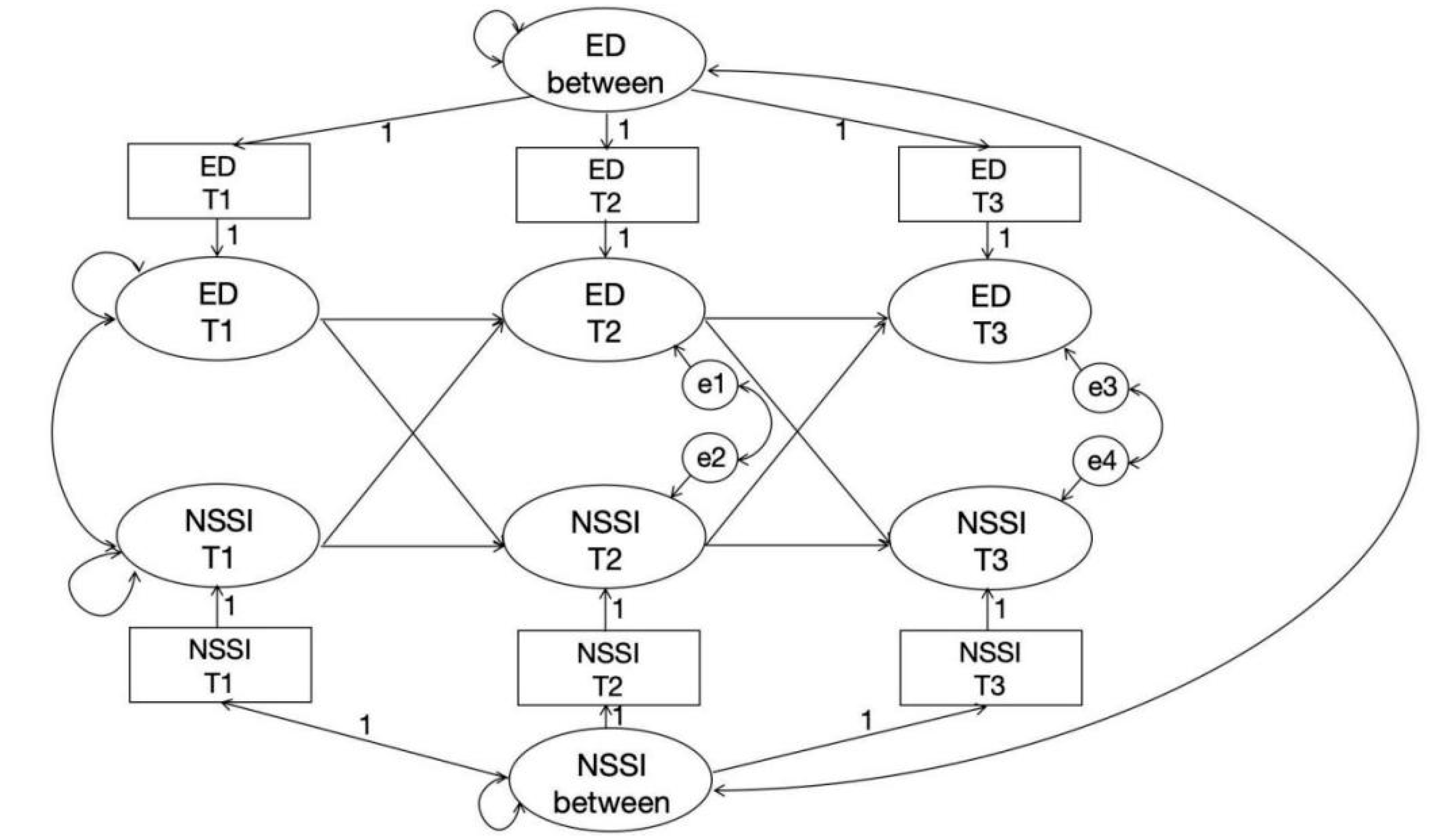
Figure 1: Structural diagram of the random intercept cross-lagged panel model linking emotional disorder (ED) and non-suicidal self-injury (NSSI) across three assessment waves.
2.1 Participants and Procedure
A cohort of 574 undergraduate and postgraduate students enrolled at universities in China provided data at three time points separated by six-month intervals (Wave 1: December 2024; Wave 2: June 2025; Wave 3: December 2025). The Wave 1 sample was 51.22% female (n = 294), with a mean age of 22.58 years (SD = 2.89; range: 18–27). Due to attrition, 404 students (49.50% female) returned data at Wave 2 and 324 (50.62% female) at Wave 3, yielding a cumulative attrition rate of 43.6%. To evaluate whether attrition introduced systematic bias, baseline characteristics (age, sex, Wave 1 emotional disorder scores, and Wave 1 NSSI scores) were compared between participants who completed all three waves and those who dropped out at Wave 2 or Wave 3 using independent-samples t-tests and chi-square tests. No statistically significant differences were observed on any baseline variable (all ps > 0.05), suggesting that attrition was approximately random with respect to the primary study variables. Full-information maximum likelihood (FIML) estimation was used in all structural equation models to handle missing data, which is appropriate under missing-at-random (MAR) assumptions and produces unbiased estimates when missingness is unrelated to unobserved variables [12]. All procedures were reviewed and sanctioned by the Biomedical Ethics Committee of Dalian University of Technology (approval reference: DUTSH250214, approved 14 February 2025). The Wave 1 data in December 2024 were collected as preliminary data under the broader institutional project; the formal use of these data for the present longitudinal analyses was reviewed and approved by the ethics committee as part of the overall project approval (DUTSH250214-01&02). The committee was informed of and sanctioned this arrangement. All procedures were conducted in keeping with the principles enshrined in the Declaration of Helsinki (1964) and its subsequent revisions. Written informed consent was secured from all adult participants prior to the first assessment, and for those below the age of majority, both parental consent and participant assent were obtained. Participants were recruited through convenience sampling via online survey platforms (Wenjuanxing) distributed through university social media channels; the sampling method was adopted to maximize accessibility and anonymity, which is particularly important when assessing stigmatized behaviors such as NSSI. Biological sex was recorded as a binary variable (male = 1, female = 2) for analytical purposes, reflecting the response options available in the original survey; response categories were male and female.
2.2.1 Emotional Disorder Symptoms
The Multidimensional Emotional Disorder Inventory (MEDI) [27] served as the primary measure of ED. This 32-item transdiagnostic instrument was constructed to capture eight interrelated symptom dimensions: neurotic temperament, positive temperament (reverse-keyed), autonomic arousal, somatic anxiety, social anxiety, depressed mood, motivational deficit, and intrusive cognitions. Respondents rated each item on a five-point frequency scale (1 = not at all, 5 = all the time), with higher composite scores reflecting greater aggregate ED burden. Cronbach’s alpha coefficients were 0.89, 0.91, and 0.88 at Waves 1, 2, and 3, respectively, indicating excellent measurement reliability across all occasions.
2.2.2 Non-Suicidal Self-Injury
Non-suicidal Self-injury. NSSI engagement was indexed at every wave using a six-item frequency checklist adapted from the functional assessment of self-mutilation developed by Prinstein et al. [28]; the adaptation involved retaining the six most commonly reported self-injurious behaviors (cutting, burning, hitting, scratching to draw blood, pinching, and bruising) and translating items into Chinese for this sample. Each item describes a discrete self-injurious act and asks respondents to indicate how often they engaged in that behavior over the preceding 6 months on a five-point scale (1 = never, 5 = ten or more times). Item responses were summed to yield a total score ranging from 6 to 30, with higher values reflecting more frequent self-harm. Internal consistency was 0.90, 0.88, and 0.89 at the three respective waves.
Analyses were carried out in R 4.4.2 using the lavaan (v0.6-17) and semTools packages. Distributional properties and bivariate associations among the focal variables and demographic covariates were first characterized via descriptive statistics (including skewness and kurtosis) and Pearson correlations. Missing data across all structural equation models were handled via full-information maximum likelihood (FIML) estimation, which uses all available data under the MAR assumption and produces less biased estimates than listwise deletion at comparable missingness rates.
Construct validity was evaluated through confirmatory factor analysis (CFA) implemented via the lavaan package, using the robust maximum likelihood estimator (MLR) to accommodate potential non-normality in item distributions. We then conducted a formal test of longitudinal measurement invariance, stepping through configural, metric, scalar, and strict models in sequence. Acceptability of each step was judged against the criteria of Cheung and Rensvold [29] as operationalized by Meade et al. [30]: a decrement in CFI or TLI of no more than 0.01 is considered tolerable evidence of invariance. This testing sequence confirms that latent variable means are comparable across waves—a prerequisite for interpreting cross-lagged effects as reflecting genuine change [31].
The core analytic framework was the RI-CLPM as formalized by Hamaker et al. [12]. This specification decomposes each observed score into a time-invariant random intercept (capturing the individual’s general standing on the construct across the study period) and a wave-specific residual (capturing the individual’s deviation from their own average at each occasion). Cross-lagged paths operate on the residual components, yielding within-person temporal effects purged of between-person confounding. The RI-CLPM additionally incorporates autoregressive paths for each construct’s residuals, concurrent residual correlations within each wave, and covariance between the two random intercepts. Age and biological sex were entered as time-invariant predictors of both random intercepts and all within-person residuals; these two demographic variables were selected a priori based on their established associations with NSSI and emotional disorder in the literature and to keep the model parsimonious. To demonstrate the incremental value of the RI-CLPM over conventional approaches, we additionally estimated a standard CLPM (without random intercepts) and a stability-only model (without cross-lagged paths) and compared model fit using AIC and BIC. All parameter estimates are reported with standardized β coefficients, standard errors (SE), 95% confidence intervals (CI), and p-values. Potential common method bias was assessed via Harman’s unrotated principal-components test before the main structural analyses were conducted. Procedural controls against common method variance included anonymous online administration, counterbalanced item ordering, and the six-month temporal separation between predictor and outcome waves.
Harman’s single-factor test was performed on the full item pool. The unrotated solution extracted multiple factors with eigenvalues exceeding 1.0, and the dominant factor accounted for 34.8% of total variance—a value comfortably below the 40% threshold conventionally used as evidence of problematic common method variance. This outcome suggests that shared method effects are unlikely to materially distort the estimated associations.
3.2 Descriptive Statistics and Correlations
Table 1 summarizes wave-specific descriptive statistics and the full matrix of Pearson correlations. All NSSI scores below refer to item-mean scores (dividing summed scores by 6) for consistency of scale comparison; the full summed score range was 6–30. NSSI item-mean scores were positively skewed at all waves (skewness range: 2.34–2.61; kurtosis range: 5.87–7.12), consistent with the heavily floor-bound distribution expected in a community sample; MLR estimation, which is robust to non-normality, was therefore used throughout. Aggregate emotional disorder (ED) item-mean scores held relatively steady across the study period (MeanW1 = 2.85, SD = 0.76; MeanW2 = 2.92, SD = 0.78; MeanW3 = 2.88, SD = 0.75), while NSSI scores declined incrementally (MeanW1 = 1.95, SD = 0.92; MeanW2 = 1.90, SD = 0.90; MeanW3 = 1.87, SD = 0.88). Temporal stability was moderate for both variables: inter-wave ED correlations ranged from r = 0.55 to 0.60; inter-wave NSSI correlations ranged from r = 0.43 to 0.49 (all ps < 0.001). The ED–NSSI associations were positive and consistent across the measurement grid. Wave 1 ED correlated r = 0.31 with concurrent NSSI and r = 0.34–0.35 with NSSI at subsequent waves; similar magnitudes held for later ED waves. Demographic variables contributed minimally: age and sex each correlated no higher than r = 0.10 with any primary variable, and only marginal negative associations emerged between sex and NSSI at Waves 2 and 3 (r ≈ −0.07).
Table 1: Wave-specific descriptive statistics and intercorrelations among all study variables.
| Variable | 1 | 2 | 3 | 4 | 5 | 6 | 7 | 8 |
|---|---|---|---|---|---|---|---|---|
| 1. Biological Sex | — | |||||||
| 2. Age | 0.050 | — | ||||||
| 3. Wave 1 ED | 0.020 | −0.040 | — | |||||
| 4. Wave 2 ED | −0.010 | 0.020 | 0.580*** | — | ||||
| 5. Wave 3 ED | 0.040 | −0.040 | 0.550*** | 0.600*** | — | |||
| 6. Wave 1 NSSI | 0.010 | 0.040 | 0.310*** | 0.420*** | 0.360*** | — | ||
| 7. Wave 2 NSSI | −0.080 | 0.030 | 0.340*** | 0.470*** | 0.430*** | 0.470*** | — | |
| 8. Wave 3 NSSI | −0.090 | 0.010 | 0.350*** | 0.440*** | 0.480*** | 0.430*** | 0.490*** | — |
| Mean (SD) | 1.51 (0.50) | 22.58 (2.89) | 2.85 (0.76) | 2.92 (0.78) | 2.88 (0.75) | 1.95 (0.92) | 1.90 (0.90) | 1.87 (0.88) |
3.3 Longitudinal Measurement Invariance
Configural, metric, scalar, and strict invariance models were fit sequentially for the ED and NSSI measures. Invariance was upheld at each step using the Cheung-Rensvold [29] benchmark implemented by Meade et al. [30]: all CFI and TLI decrements across adjacent models fell within the ≤0.01 tolerance band (detailed indices appear in Table 2). For the ED measure, the worst-case ΔCFI and ΔTLI were −0.005, respectively, with RMSEA and SRMR rising modestly at the strict level but remaining within acceptable limits. For the NSSI measure, the absolute values of fit decrements were even smaller, with ΔCFI ≤ 0.002 across all transitions and ΔTLI ranging from −0.002 to 0.006. Attainment of strict invariance justifies the cross-wave comparisons central to the RI-CLPM analysis.
Table 2: Sequential measurement invariance tests for emotional disorder (ED) and NSSI (non-suicidal self-injury) across three waves.
| Model | χ2(df) | CFI | ΔCFI | TLI | ΔTLI | RMSEA | SRMR |
|---|---|---|---|---|---|---|---|
| ED | |||||||
| Configural | 1310.45 (695) | 0.943 | — | 0.932 | — | 0.047 | 0.058 |
| Metric | 1355.21 (715) | 0.941 | −0.002 | 0.930 | −0.002 | 0.049 | 0.062 |
| Scalar | 1528.35 (735) | 0.936 | −0.005 | 0.925 | −0.005 | 0.051 | 0.071 |
| Strict | 1601.78 (755) | 0.932 | −0.004 | 0.921 | −0.004 | 0.053 | 0.074 |
| NSSI | |||||||
| Configural | 78.43 (24) | 0.970 | — | 0.955 | — | 0.079 | 0.035 |
| Metric | 91.67 (30) | 0.968 | −0.002 | 0.961 | 0.006 | 0.077 | 0.046 |
| Scalar | 96.88 (36) | 0.969 | 0.001 | 0.966 | 0.005 | 0.071 | 0.051 |
| Strict | 100.23 (42) | 0.968 | −0.001 | 0.964 | −0.002 | 0.069 | 0.053 |
The full RI-CLPM with age and sex as covariates fit the data well: χ2(9) = 8.574, CFI = 0.998, TLI = 0.996, RMSEA = 0.012 [90% CI: 0.000, 0.038], SRMR = 0.014. To demonstrate the incremental value of the RI-CLPM, we compared it against a conventional CLPM (without random intercepts) and a stability-only model. The RI-CLPM showed substantially better fit than the conventional CLPM (ΔAIC = −34.2; ΔBIC = −29.1), confirming that stable between-person variance was meaningfully contributing to observed associations in the conventional CLPM and that the RI-CLPM partitioning was warranted. The between-person random intercepts accounted for approximately 42% of the total variance in ED and 38% in NSSI, indicating that a substantial proportion of observed variability reflected stable individual differences rather than within-person fluctuation.
At the between-person level, the two random intercepts correlated substantially and positively (β = 0.487, SE = 0.071, 95% CI [0.348, 0.626], p < 0.001): students whose ED was chronically elevated relative to the sample as a whole also tended to report chronically more frequent NSSI, independent of any occasion-specific fluctuation (supporting Hypothesis 3). At the within-person level, concurrent residual correlations between ED and NSSI were significant at Waves 2 and 3 (β = 0.342, SE = 0.089, 95% CI [0.168, 0.516], p < 0.05 and β = 0.256, SE = 0.094, 95% CI [0.072, 0.440], p < 0.05, respectively) but not at Wave 1 (β = 0.181, SE = 0.116, 95% CI [−0.046, 0.408], p = 0.118), suggesting that situational co-elevation of both variables became more consistent as the study progressed.
Autoregressive continuity—that is, the degree to which a person’s Wave t residual predicted their Wave t + 1 residual on the same construct—was moderate for ED (Wave 2→Wave 3: β = 0.389, SE = 0.078, 95% CI [0.236, 0.542], p < 0.001) but negligible for the Wave 1→Wave 2 interval (β = 0.151, SE = 0.174, 95% CI [−0.190, 0.492], p = 0.386). This asymmetry may reflect the differential academic demands across semesters: the Wave 1→2 interval spanned the high-stress examination period (December–June), during which external stressors may have temporarily overridden dispositional emotional continuity. NSSI residuals showed no statistically reliable autoregressive continuity at either interval (Waves 1→2: β = −0.093, SE = 0.112, 95% CI [−0.313, 0.127], p = 0.402; Waves 2→3: β = −0.048, SE = 0.143, 95% CI [−0.328, 0.232], p = 0.739), suggesting that occasion-specific NSSI fluctuated substantially around each individual’s typical level and was highly sensitive to situational context.
Critically, two of the four cross-lagged paths reached statistical significance. Elevated ED residuals at Wave 2 predicted elevated NSSI residuals at Wave 3 (β = 0.351, SE = 0.163, 95% CI [0.031, 0.671], p < 0.05), supporting Hypothesis 1 for the Wave 2→Wave 3, whereas the corresponding Wave 1→Wave 2 ED-to-NSSI path did not (β = 0.034, SE = 0.176, 95% CI [−0.311, 0.379], p = 0.847). In the reverse direction, elevated NSSI residuals at Wave 1 predicted elevated ED residuals at Wave 2 (β = 0.183, SE = 0.091, 95% CI [0.005, 0.361], p < 0.05), supporting Hypothesis 2 for the Wave 1→Wave 2, but NSSI at Wave 2 did not predict ED at Wave 3 (β = 0.025, SE = 0.096, 95% CI [−0.163, 0.213], p = 0.796), not supporting Hypothesis 2 for this interval. Demographic covariates were uniformly non-significant in predicting any residual or random intercept parameter (all ps > 0.05). It should be noted that the NSSI measure used a 6-month retrospective recall window, which matches the six-month wave interval. Adjacent NSSI reporting windows, therefore, cover non-overlapping periods, supporting the temporal independence of cross-lagged comparisons.
Applying RI-CLPM to three-wave panel data from Chinese university students, this study generated fine-grained evidence on how ED and NSSI may be related both across individuals and within the same individual over time. The results complicate a simple unidirectional story and lend partial, qualified support to a reciprocal process account—while underscoring important boundaries on that interpretation.
4.1 Trait-Level Co-Elevation: A Foundation of Shared Vulnerability
The robust positive correlation between the two random intercepts (β = 0.487) establishes that chronically distressed students are, on average, also chronic self-injurers. This finding replicates at the person level what the broader literature has consistently documented in group-level analyses: ED is one of the most reliable dispositional predictors of self-harm engagement [12]. What the RI-CLPM adds is the reassurance that this person-level association is not merely an artefact of correlated occasion-specific fluctuations. Even after all time-varying sources of covariation are stripped out by the random intercept decomposition, students with higher baseline emotional burden carry substantially higher baseline self-injury risk. The clinical implication is straightforward: identifying individuals with persistently elevated affective distress is a meaningful strategy for targeting NSSI prevention resources, as prior meta-analytic and longitudinal synthesis confirms [32,33,34].
4.2 Intraindividual Dynamics: Who Spills over into Self-Harm, and When?
The within-person cross-lagged findings paint a more nuanced picture. ED residuals at Wave 2 significantly predicted NSSI residuals at Wave 3, suggesting that transient elevations in a person’s emotional distress may be associated with increased self-injury six months later. The affect regulation account [10] provides a plausible mechanism over a medium-term timescale: although regulatory relief from NSSI operates on an immediate (minutes-to-hours) timescale, a sustained elevation in distress across weeks to months may gradually exhaust adaptive coping resources, progressively increasing the functional pull of self-injury until it becomes more behaviorally entrenched. It is important to acknowledge, however, that the acute psychological processes central to affect regulation theories (e.g., immediate emotional relief) are not directly captured at a six-month measurement interval; the present findings speak to medium-term predictive associations rather than confirming real-time regulatory mechanisms. The absence of a significant Wave 1→Wave 2 cross-lagged effect may suggest that the ED-to-NSSI pathway required more time or accumulated distress exposure to manifest, or alternatively may reflect the higher stress variability of the Wave 1–2 interval. This interval-specific inconsistency should be treated cautiously and replicated before drawing firm conclusions about developmental consolidation.
The reverse path—NSSI residuals at Wave 1 predicting ED residuals at Wave 2 (β = 0.183)—provides partial and tentative support for the feedback hypothesis. Consistent with the post-injury affective literature [5], engaging in NSSI at levels above one’s typical rate may be associated with elevated shame, guilt, and self-directed anger in the months that follow, thereby raising ED above its own baseline. The shame–rumination pathway elaborated earlier offers a plausible medium-term mechanism that is compatible with a six-month detection window. However, the non-significance of the corresponding Wave 2→Wave 3 path prevents generalization and cautions against characterizing this as a reliably bidirectional cycle. The asymmetry across intervals may reflect adaptation: individuals who engaged in more NSSI at Wave 1 may have subsequently accessed informal support or modified their behavioral patterns, attenuating the prospective emotional consequence in the Wave 2–3 interval. Alternatively, the earlier path may reflect a spurious finding given the relatively modest sample size at later waves. The pattern is broadly coherent with recent evidence positioning ED more consistently as a precursor than as a sequela of NSSI in community samples [35,36], while still suggesting that the reverse influence may be detectable under specific conditions and at specific measurement intervals.
4.3 Situational Co-Activation and Convergence with Existing Research
Comparable depression-to-NSSI effects across six-month intervals have been documented by Xavier et al. [36] in an adolescent sample, and analogous patterns in first-year university students have been reported by Xu et al. [24]. Extending these findings, the within-wave ED–NSSI residual correlations at Waves 2 and 3 suggest that, beyond predictive temporal effects, the two variables also respond to shared situational triggers within the same assessment occasion—academic crises, interpersonal ruptures, or socially evaluative contexts that simultaneously heighten distress and lower the threshold for self-harm [37,38]. The current results extend those findings by suggesting that these temporal associations persist when stable individual differences are explicitly modelled, though the interval-dependent inconsistency in cross-lagged paths requires future replication before strong inferences about causal mechanisms are warranted. The asymmetric autoregressive paths—significant for ED only from Wave 2 to Wave 3, and non-significant for NSSI at both intervals—deserve attention in their own right. The lack of within-person NSSI continuity implies that NSSI episodes are highly sensitive to situational context and do not simply persist from one semester to the next; clinically, this suggests that NSSI may be more state-like than trait-like at the within-person level, consistent with ecological momentary evidence that self-harm urges fluctuate substantially on a daily basis. Comparing the present findings with recent literature, Soto-Sanz et al. [32] demonstrated in 2283 Spanish adolescents that stressful life events directly predicted NSSI, with socio-emotional strengths mediating these associations—converging with our between-person finding that chronically elevated emotional distress constitutes a stable risk for NSSI. This aligns with evidence that emotion dysregulation profiles differ across mood disorder subtypes in those who self-injure [17], and with meta-analytic evidence that lower distress tolerance predicts more frequent NSSI [18], jointly suggesting that state-level regulatory burden and trait-level regulatory capacity both contribute to self-harm risk.
4.4 Theoretical Yield: Dysregulation and Self-Conscious Emotional Mediators
The observed interval-specific bidirectionality is broadly consistent with theoretical frameworks that treat emotion regulation deficit as the shared substrate linking affective disorders to self-injury [20,39], though it should be emphasized that the present data do not directly test mediation and that the following represents theoretical integration rather than empirically confirmed mechanisms. Poor regulatory capacity may prime the system for self-harm by narrowing the repertoire of available coping responses and amplifying the aversive quality of emotional states. Concurrently, negative self-conscious emotions—shame, embarrassment, self-critical rumination—have been theorized to function as mediators that translate affective disorder features into proximal motivations for self-injurious behavior [22]; future mediation studies explicitly testing these pathways within a longitudinal RI-CLPM framework are needed to verify these mechanisms. Interventions that specifically target maladaptive self-evaluative processes while simultaneously building regulatory competence may therefore be well positioned in principle to disrupt the cycle at multiple points [36], though intervention research directly evaluating this in Chinese university populations is still needed.
4.5 Cultural Specificity and Prevention Implications
The present findings can be considered in light of the Chinese sociocultural context, though it should be noted explicitly that no cultural variables were directly measured in this study; the following, therefore, represents post-hoc theoretical speculation rather than empirically tested cultural explanation. In Confucian collectivist settings, open expression of personal suffering is readily construed as an imposition on relational harmony, motivating affective suppression that may channel distress inward rather than outward [39]. The stable between-person association documented here may partly reflect this culturally shaped dynamic, as individuals who chronically suppress emotional disclosure are precisely those whose internal distress load is most likely to manifest in covert behaviors such as self-injury [1]. Future studies should directly measure cultural variables such as emotional suppression, face concern, and help-seeking stigma to test these hypotheses empirically. From a practical standpoint, the within-person findings suggest two specific windows for intervention in Chinese university settings: (1) when a student’s emotional burden is observed to rise above their own typical level (e.g., through repeated screening), proactive outreach and early distress intervention may reduce downstream NSSI risk; (2) following disclosure or identification of NSSI episodes, early clinical attention to post-injury shame and guilt may attenuate the emotional burden that could otherwise perpetuate further self-harm. Intervention modalities including dialectical behavior therapy, acceptance-based approaches, and culturally adapted mindfulness programs merit evaluation in this population.
4.6 Limitations and Future Directions
Several boundaries constrain the confidence with which these findings can be interpreted. First, exclusive reliance on self-report instruments introduces susceptibility to social desirability and retrospective recall distortions, problems that are particularly acute when assessing stigmatized behaviors [38]. Future designs should incorporate behavioral observation, clinical interview, or experience-sampling methods to corroborate or qualify self-reported data.
Second, the NSSI measure employed a 6-month retrospective recall window matched to the six-month wave interval, which supports the temporal independence of adjacent NSSI assessments. Future research using even shorter recall windows (e.g., monthly ecological momentary assessment) could further sharpen temporal resolution and reduce retrospective recall bias.
Third, the cross-lagged results were inconsistent across the two measurement intervals—ED predicted NSSI only in the Wave 2→3 interval, and NSSI predicted ED only in the Wave 1→2 interval. With only three waves, interval-specific inconsistency is difficult to disentangle from genuine dynamic differences, statistical power limitations, or estimation fluctuations. Readers should interpret these patterns with appropriate caution; replication with four or more waves would substantially strengthen inference about the temporal structure of these associations.
Fourth, the model included only age and biological sex as covariates, which omits potentially important confounders such as prior mental health diagnoses, academic stress, problematic smartphone use, and interpersonal functioning. While this maintained model parsimony, residual confounding cannot be excluded. Future studies should incorporate theory-driven covariates to rule out alternative explanations for the observed cross-lagged effects.
Fifth, six-month inter-wave spacing privileges detection of medium-range effects while remaining insensitive to the moment-to-moment emotional cascades that may be most clinically relevant to self-injury episodes. The affect regulation and shame-cycle mechanisms invoked in the Discussion operate over hours to days; the present design cannot test these proximal dynamics. Dense temporal designs—such as daily diary protocols or ecological momentary assessment—would permit resolution of these micro-level dynamics [17].
Sixth, the decision to model ED as a single composite variable, while analytically consistent with the transdiagnostic perspective, may obscure the differential contributions of its constituent dimensions. The MEDI composite aggregates neurotic temperament, depressed mood, social anxiety, somatic anxiety, and other components, yet the discussion frequently invokes specific constructs (shame, rumination, anxiety) that are not separately modelled. Shame and guilt have been shown to occupy distinct pathways toward self-injury [28], as have purely anxious versus purely depressive presentations [10]. Disaggregating the MEDI into its subscales or employing network approaches would allow examination of which specific affective dimensions drive each directional effect and would better align theory with measurement.
Seventh, the RI-CLPM assumes linearity and symmetry in the temporal relationships it estimates. Self-regulatory systems in emerging adulthood are likely characterized by threshold effects, nonlinear escalation, and asymmetric recovery dynamics. Extensions of the RI-CLPM framework that permit nonlinearity or moderation by individual difference variables [40] would be valuable next steps.
Eighth, the sample was drawn exclusively from Chinese universities, enhancing cultural specificity but limiting generalizability to younger adolescents, clinical groups, or students in other cultural settings. Cross-cultural replication would test whether the observed interval-dependent patterns are universal or context-dependent.
Finally, no cultural variables (e.g., emotional suppression, face concern, help-seeking stigma) were directly measured, limiting the cultural interpretation in the Discussion to post-hoc speculation. Future research should incorporate validated measures of culturally specific constructs to empirically test whether these variables moderate the ED–NSSI dynamic process. The RI-CLPM also identifies that within-person effects exist but cannot reveal why they occur. Mediation analyses incorporating emotion dysregulation, self-critical thinking, and impulsivity [38] within longitudinal frameworks would advance the mechanistic understanding necessary to guide intervention design.
This investigation employed a three-wave random intercept cross-lagged analytical framework to examine how ED and non-suicidal self-injury may co-evolve within individual Chinese university students over a one-year period. Two principal conclusions can be drawn tentatively. At the trait level, students who carry a persistently elevated emotional burden were substantially more likely than their peers to engage in repeated self-harm—an association that survived explicit decomposition of between-person and within-person variance components. At the intraindividual level, within-person elevations in emotional distress above an individual’s own baseline at Wave 2 were associated with elevated self-injury at Wave 3, and early within-person elevations in NSSI at Wave 1 were associated with elevated emotional distress at Wave 2; however, these cross-lagged effects were each observed in only one of the two intervals tested, and the interval-specific asymmetry warrants caution against asserting a consistently bidirectional cycle. The data are most reliably interpreted as suggesting that ED tends to precede NSSI at the within-person level, with the reverse influence potentially present but less robust.
These findings suggest potential implications for how university mental health services prioritize their resources. Routine screening for transdiagnostic emotional burden—rather than disorder-specific diagnostic categories—may provide an efficient early-warning indicator for students at heightened self-injury risk. Conversely, clinical attention to NSSI should not presume that addressing the behavior in isolation will automatically resolve underlying emotional distress; the data suggest that NSSI may be associated with emotional states that perpetuate it, though the causal direction of this relationship requires further longitudinal investigation. Integrated treatment approaches that simultaneously target emotional regulatory capacity and self-harm behavior, delivered with sensitivity to the communicative constraints imposed by Chinese cultural norms, hold potential promise for interrupting the associations identified here, and warrant evaluation in future controlled studies.
Acknowledgement:
Funding Statement: The authors received no specific funding for this study.
Author Contributions: The authors confirm their contributions to the paper as follows: Conceptualization, Xin Xu and Shaobo Liang; Methodology, Xin Xu; Formal Analysis, Xin Xu; Writing—Original Draft Preparation, Xin Xu; Writing—Review and Editing, Shaobo Liang; Supervision, Shaobo Liang; Project Administration, Shaobo Liang. All authors reviewed and approved the final version of the manuscript.
Availability of Data and Materials: The data supporting the findings of this study are available from the corresponding author upon reasonable request.
Ethics Approval: This study was reviewed and approved by the Biomedical Ethics Committee of Dalian University of Technology (DUTSH250214-01, approved 14 February 2025) in accordance with the ethical standards of the 1964 Declaration of Helsinki and its later amendments. The Wave 1 data (December 2024) were collected as preliminary data within the broader institutional project; this preliminary data collection was conducted under a separate sub-approval (DUTSH250214-02) within the same overarching project application. Although the data collection preceded the formal approval date of DUTSH250214-01, the ethics committee was fully informed of and retrospectively sanctioned this timeline arrangement as part of the overall project approval. The formal use of these data for the present longitudinal analyses was reviewed and approved by the ethics committee as part of the overall project approval. The committee was informed of and sanctioned this arrangement. Informed consent was obtained from all individual participants included in the study.
Conflicts of Interest: The authors declare no conflicts of interest.
References
1. Tang J , Yu Y , Wu Y , Du Y , Ma Y , Zhu H , et al. Association between non-suicidal self-injuries and suicide attempts in Chinese adolescents and college students: A cross-section study. PLoS One. 2011; 6( 4): e17977. doi:10.1371/journal.pone.0017977. [Google Scholar] [CrossRef]
2. Liu S , You J , Ying J , Li X , Shi Q . Emotion reactivity, nonsuicidal self-injury, and regulatory emotional self-efficacy: A moderated mediation model of suicide ideation. J Affect Disord. 2020; 266: 82– 9. doi:10.1016/j.jad.2020.01.083. [Google Scholar] [CrossRef]
3. Wang H , Wen S , Wang Y , Zhou Y , Niu B . Rumination, loneliness, and non-suicidal self-injury among adolescents with major depressive disorder: The moderating role of resilience. Soc Sci Med. 2025; 364: 117512. doi:10.1016/j.socscimed.2024.117512. [Google Scholar] [CrossRef]
4. Gratz KL , Rosenthal MZ , Tull MT , Lejuez CW , Gunderson JG . An experimental investigation of emotion dysregulation in borderline personality disorder. J Abnormal Psychol. 2006; 115( 4): 850– 5. doi:10.1037/0021-843X.115.4.850. [Google Scholar] [CrossRef]
5. Spitzen TL , Tull MT , Baer MM , Dixon-Gordon KL , Chapman AL , Gratz KL . Predicting engagement in nonsuicidal self-injury (NSSI) over the course of 12 months: The roles of borderline personality disorder pathology and emotional consequences of NSSI. J Affect Disord. 2020; 277: 631– 9. doi:10.1016/j.jad.2020.08.049. [Google Scholar] [CrossRef]
6. Ahmed SP , Bittencourt-Hewitt A , Sebastian CL . Neurocognitive bases of emotion regulation development in adolescence. Dev Cogn Neurosci. 2015; 15: 11– 25. doi:10.1016/j.dcn.2015.07.006. [Google Scholar] [CrossRef]
7. Nock MK , Prinstein MJ . A functional approach to the assessment of self-mutilative behavior. J Consult Clin Psychol. 2004; 72( 5): 885– 90. doi:10.1037/0022-006X.72.5.885. [Google Scholar] [CrossRef]
8. Najmi S , Wegner DM , Nock MK . Thought suppression and self-injurious thoughts and behaviors. Behav Res Ther. 2007; 45( 8): 1957– 65. doi:10.1016/j.brat.2006.09.014. [Google Scholar] [CrossRef]
9. Turner BJ , Chapman AL , Layden BK . Intrapersonal and interpersonal functions of non suicidal self-injury: Associations with emotional and social functioning. Suicide Life Threat Behav. 2012; 42( 1): 36– 55. doi:10.1111/j.1943-278X.2011.00069.x. [Google Scholar] [CrossRef]
10. Chapman AL , Gratz KL , Brown MZ . Solving the puzzle of deliberate self-harm: The experiential avoidance model. Behav Res Ther. 2006; 44( 3): 371– 94. doi:10.1016/j.brat.2005.03.005. [Google Scholar] [CrossRef]
11. Hong F , Tarullo AR , Mercurio AE , Liu S , Cai Q , Malley-Morrison K . Childhood maltreatment and perceived stress in young adults: The role of emotion regulation strategies, self-efficacy, and resilience. Child Abuse Negl. 2018; 86: 136– 46. doi:10.1016/j.chiabu.2018.09.014. [Google Scholar] [CrossRef]
12. Hamaker EL , Kuiper RM , Grasman RPPP . A critique of the cross-lagged panel model. Psychol Meth. 2015; 20( 1): 102– 16. doi:10.1037/a0038889. [Google Scholar] [CrossRef]
13. Faura-Garcia J , Calvete E , Orue I . Longitudinal associations between nonsuicidal self-injury, depressive symptoms, hopelessness, and emotional dysregulation in adolescents. Arch Suicide Res. 2024; 28( 3): 800– 14. doi:10.1080/13811118.2023.2237075. [Google Scholar] [CrossRef]
14. Jia Q , Wu Z , Liu B , Feng Y , Liang W , Liu D , et al. Exploring the longitudinal relationships between non-suicidal self-injury and depressive symptoms in adolescents: A cross-lagged panel network analysis. BMC Psychiatry. 2025; 25( 1): 358. doi:10.1186/s12888-025-06806-3. [Google Scholar] [CrossRef]
15. Christoforou R , Boyes M , Hasking P . Emotion profiles of university students engaging in non-suicidal self-injury: Association with functions of self-injury and other mental health concerns. Psychiatry Res. 2021; 305: 114253. doi:10.1016/j.psychres.2021.114253. [Google Scholar] [CrossRef]
16. Bao L , Zhang W , Zhao J , Geng J . A longitudinal study on problematic smartphone use and Non-Suicidal Self-Injury: The mediating role of academic procrastination and anxiety. BMC Psychol. 2025; 13( 1): 1093. doi:10.1186/s40359-025-03360-1. [Google Scholar] [CrossRef]
17. Yang SY , Lee D , Jeong H , Cho Y , Ahn JE , Hong KS , et al. Comparison of patterns of non-suicidal self-injury and emotion dysregulation across mood disorder subtypes. Front Psychiatry. 2022; 13: 757933. doi:10.3389/fpsyt.2022.757933. [Google Scholar] [CrossRef]
18. Akbari M , Seydavi M , Firoozabadi MA , Babaeifard M . Distress tolerance and lifetime frequency of non-suicidal self-injury (NSSI): A systematic review and meta-analysis. Clin Psychol Psychother. 2024; 31( 1): e2957. doi:10.1002/cpp.2957. [Google Scholar] [CrossRef]
19. Wang H , Yu C , Liao X , Ni X , Liu X , Chen P . Emotional insecurity and non-suicidal self-injury among Chinese early adolescents: A longitudinal moderated mediation model involving internet gaming disorder and peer victimization. Child Psychiatry Hum Dev. 2025: 1– 11. doi:10.1007/s10578-025-01921-4. [Google Scholar] [CrossRef]
20. Gratz KL , Roemer L . Multidimensional assessment of emotion regulation and dysregulation: Development, factor structure, and initial validation of the difficulties in emotion regulation scale. J Psychopathol Behav Assess. 2004; 26( 1): 41– 54. doi:10.1023/B:JOBA.0000007455.08539.94. [Google Scholar] [CrossRef]
21. Ma H , Liu X , Du X , Chi D , Zhang Y , Yu H , et al. The emotion regulation motive of nonsuicidal self-injury mediates the relationship between motor impulsivity and NSSI frequency in adolescents. Front Psychiatry. 2025; 16: 1692721. doi:10.3389/fpsyt.2025.1692721. [Google Scholar] [CrossRef]
22. Sheehy K , Noureen A , Khaliq A , Dhingra K , Husain N , Pontin EE , et al. An examination of the relationship between shame, guilt and self-harm: A systematic review and meta-analysis. Clin Psychol Rev. 2019; 73: 101779. doi:10.1016/j.cpr.2019.101779. [Google Scholar] [CrossRef]
23. Liu J , Li JT , Zhou M , Liu HF , Fan YY , Mi S , et al. Non-suicidal self-injury in adolescents with mood disorders and the roles of self-compassion and emotional regulation. Front Psychiatry. 2023; 14: 1214192. doi:10.3389/fpsyt.2023.1214192. [Google Scholar] [CrossRef]
24. Xu Z , Kong Y , Yang Y , Tian M , Liu Y , Lin L . Non-suicidal self-injury in Chinese adolescents: Longitudinal associations with negative life events and life satisfaction. Front Psychiatry. 2024; 15: 1470371. doi:10.3389/fpsyt.2024.1470371. [Google Scholar] [CrossRef]
25. Gardner KJ , Paul E , Selby EA , Klonsky ED , Mars B . Intrapersonal and interpersonal functions as pathways to future self-harm repetition and suicide attempts. Front Psychol. 2021; 12: 688472. doi:10.3389/fpsyg.2021.688472. [Google Scholar] [CrossRef]
26. Wang L , Liu J , Yang Y , Zou H . Prevalence and risk factors for non-suicidal self-injury among patients with depression or bipolar disorder in China. BMC Psychiatry. 2021; 21( 1): 389. doi:10.1186/s12888-021-03392-y. [Google Scholar] [CrossRef]
27. Rosellini AJ , Brown TA . The Multidimensional Emotional Disorder Inventory (MEDI): Assessing transdiagnostic dimensions to validate a profile approach to emotional disorder classification. Psychol Assess. 2019; 31( 1): 59– 72. doi:10.1037/pas0000649. [Google Scholar] [CrossRef]
28. Prinstein MJ , Guerry JD , Browne CB , Rancourt D . Interpersonal models of nonsuicidal self-injury. In: Nock MK , editor. Understanding nonsuicidal self-injury. Washington, DC, USA: American Psychological Association; 2008. p. 79– 98. doi:10.1037/11875-005. [Google Scholar] [CrossRef]
29. Cheung GW , Rensvold RB . Evaluating goodness-of-fit indexes for testing measurement invariance. Struct Equ Model A Multidiscip J. 2002; 9( 2): 233– 55. doi:10.1207/S15328007SEM0902_5. [Google Scholar] [CrossRef]
30. Meade AW , Johnson EC , Braddy PW . Power and sensitivity of alternative fit indices in tests of measurement invariance. J Appl Psychol. 2008; 93( 3): 568– 92. doi:10.1037/0021-9010.93.3.568. [Google Scholar] [CrossRef]
31. Putnick DL , Bornstein MH . Measurement invariance conventions and reporting: The state of the art and future directions for psychological research. Dev Rev. 2016; 41: 71– 90. doi:10.1016/j.dr.2016.06.004. [Google Scholar] [CrossRef]
32. Soto-Sanz V , Marzo JC , Falcó R , Moreno-Amador B , Piqueras JA , López-Fernández FJ . Recent stressful life events and suicidal behaviors and NSSI in adolescents: Examining the role of socio-emotional strengths. Arch Suicide Res. 2026: 1– 16. doi:10.1080/13811118.2025.2590678. [Google Scholar] [CrossRef]
33. Wolff JC , Thompson E , Thomas SA , Nesi J , Bettis AH , Ransford B , et al. Emotion dysregulation and non-suicidal self-injury: A systematic review and meta-analysis. Eur Psychiatry. 2019; 59: 25– 36. doi:10.1016/j.eurpsy.2019.03.004. [Google Scholar] [CrossRef]
34. Yang Y , Ji T , Liu Y , Tian M , Yang Y , Zhang Y , et al. Non-suicidal self-injury and emotion regulation strategies among secondary school and university students: A network analysis perspective. Behav Sci. 2025; 15( 11): 1517. doi:10.3390/bs15111517. [Google Scholar] [CrossRef]
35. Neacsiu AD , Rizvi SL , Linehan MM . Dialectical behavior therapy skills use as a mediator and outcome of treatment for borderline personality disorder. Behav Res Ther. 2010; 48( 9): 832– 9. doi:10.1016/j.brat.2010.05.017. [Google Scholar] [CrossRef]
36. Xavier A , Pinto Gouveia J , Cunha M . Non-suicidal self-injury in adolescence: The role of shame, self-criticism and fear of self-compassion. Child Youth Care Forum. 2016; 45( 4): 571– 86. doi:10.1007/s10566-016-9346-1. [Google Scholar] [CrossRef]
37. Liu Y , Zhang N , Bao G , Huang Y , Ji B , Wu Y , et al. Predictors of depressive symptoms in college students: A systematic review and meta-analysis of cohort studies. J Affect Disord. 2019; 244: 196– 208. doi:10.1016/j.jad.2018.10.084. [Google Scholar] [CrossRef]
38. Niu S , Yin X , Pan B , Chen H , Dai C , Tong C , et al. Understanding comorbidity between non-suicidal self-injury and depressive symptoms in a clinical sample of adolescents: A network analysis. Neuropsychiatr Dis Treat. 2024; 20: 1– 17. doi:10.2147/NDT.S443454. [Google Scholar] [CrossRef]
39. Hamaker EL , Asparouhov T , Brose A , Schmiedek F , Muthén B . At the frontiers of modeling intensive longitudinal data: Dynamic structural equation models for the affective measurements from the COGITO study. Multivar Behav Res. 2018; 53( 6): 820– 41. doi:10.1080/00273171.2018.1446819. [Google Scholar] [CrossRef]
40. Chen X , French DC , Schneider BH . Peer relationships in cultural context. Cambridge, UK: Cambridge University Press; 2006. doi:10.1017/CBO9780511499739. [Google Scholar] [CrossRef]
Cite This Article
 Copyright © 2026 The Author(s). Published by Tech Science Press.
This work is licensed under a Creative Commons Attribution 4.0 International License , which permits unrestricted use, distribution, and reproduction in any medium, provided the original work is properly cited.
 Downloads
 Citation Tools
