
 Login
Login Register
 Submit a Paper
 Propose a Special lssue
 Open Access
ARTICLE
Dose-Response Associations between Physical Activity and Poor Mental Health among High-School Students: Sleep Duration as a Potential Mediator
1 School of Foreign Languages, Shandong University of Political Science and Law, Jinan, China
2 School of Physical Education and Sports Science, Soochow University, Suzhou, China
* Corresponding Authors: Qingru Zhang. Email: ; Jin Yan. Email:
International Journal of Mental Health Promotion 2026, 28(9), 4 https://doi.org/10.32604/ijmhp.2026.083872
Received 12 April 2026; Accepted 16 July 2026; Issue published 22 September 2026
 View Full Text
 Download PDF
Abstract
Backgrounds: This study examined whether sleep duration may potentially mediate the association between moderate-to-vigorous physical activity (MVPA) and mental health between in a nationally representative sample of U.S. high school students. Methods: Data from 15,671 U.S. high school students participating in the 2023 Youth Risk Behavior Survey (YRBS) were analyzed. MVPA was measured as weekly days achieving at least 60 min of activity, and frequent poor mental health was defined as reporting poor mental health most of the time or always during the past 30 days. Sleep duration was evaluated as a mediator. Survey-weighted regression and Karlson–Holm–Breen mediation analyses were performed, adjusting for relevant sociodemographic and health-related covariates. Results: Each additional day of MVPA was associated with a 7.5% lower odds of frequent self-reported poor mental health (OR = 0.925, 95% CI: 0.898–0.954), while each additional hour of sleep was associated with a 29.0% lower odds (OR = 0.710, 95% CI: 0.668–0.756). KHB mediation analysis indicated that sleep duration emerged as a potential mediator of this association. The total association between MVPA and frequent poor mental health was β = −0.048 (95% CI: −0.072 to −0.025), with an indirect effect through sleep duration of β = −0.025 (95% CI: −0.031 to −0.019), accounting for 52.0% of the observed association. The proportion of the association accounted for by sleep duration was higher in females (55.68%) than in males (44.22%). Conclusions: More frequent achievement of the 60-min PA guideline was associated with lower odds of frequent poor mental health among U.S. high school students. Sleep duration accounted for approximately one-half of this observed association, supporting its potential role in the relationship between physical activity and mental health. Strategies that promote both regular physical activity and adequate sleep may help improve adolescent mental health.Keywords
Supplementary Material
Supplementary Material FileAdolescence is widely recognised as a critical developmental period characterised by rapid physical, psychological, cognitive, and social changes, during which many mental health problems first emerge and may persist into adulthood [1,2]. Mental disorders developed during this stage can negatively affect educational attainment, interpersonal relationships, behavioural regulation, and long-term quality of life, while also increasing the risk of chronic disease and psychosocial difficulties later in life. The World Health Organization has estimated that approximately one in seven adolescents aged 10–19 years experiences a mental disorder, making mental health conditions a major contributor to the global burden of disease among young people. In particular, depression and anxiety are among the most prevalent and disabling psychiatric conditions in adolescence, often associated with emotional distress, impaired daily functioning, academic difficulties, and reduced social participation [3,4,5]. More concerningly, suicide remains one of the leading causes of death among adolescents and young adults worldwide, highlighting the urgent need for effective prevention and early intervention strategies. Given the substantial personal, social, and economic consequences associated with adolescent mental health disorders, increasing attention has been directed toward identifying modifiable lifestyle-related protective factors that can be promoted at the population level.
Regular physical activity (PA) has consistently been associated with better mental health outcomes among children and adolescents, with previous reviews demonstrating beneficial associations with depressive symptoms, anxiety, and general well-being [6,7,8,9]. However, physical inactivity remains widespread worldwide. International surveillance data suggest that most adolescents do not meet recommended activity levels [10,11,12]. In response, the World Health Organization 2020 guidelines emphasize that “every move counts,” highlighting the value of helping youth transition from complete inactivity to at least some moderate-to-vigorous physical activity (MVPA) [12,13,14,15,16]. This “least active first” perspective is supported by recent United States surveillance research that has treated “no MVPA” (0 days achieving at least 60 min of MVPA during the previous week) as a meaningful indicator. Across Youth Risk Behavior Surveillance (YRBS) cycles from 2005 to 2021 (N = 115,926), the prevalence of no MVPA declined from 24.3% in 2005 to 15.5% in 2021, yet this still suggests that roughly one in six adolescents report zero days meeting the 60-min threshold [17]. This subgroup is particularly relevant for prevention efforts because moving from none to some MVPA may yield substantial relative benefits.
Two evidence gaps limit public health translation. First, many studies contrast “active versus inactive” or “meeting versus not meeting guidelines,” which can obscure whether mental health benefits accrue progressively across the full spectrum of PA. Dose–response evidence is therefore valuable because it supports clearer and more actionable messaging, including whether increasing from 0 to 1–2 days per week is meaningfully associated with mental health, and whether additional days confer incremental benefit. Second, surveillance systems often operationalize adolescent MVPA using a simple, policy-relevant item: the number of days during the previous week in which at least 60 min of PA was achieved. However, fewer studies have leveraged this metric to test national-level dose–response patterns for mental health outcomes [18,19,20].
Sleep may represent a key pathway linking PA and mental health during adolescence, particularly in relation to anxiety and depressive symptoms [21,22,23]. Adolescents are generally advised to obtain 8–10 h of sleep each night; however, inadequate sleep remains prevalent and has been linked to impaired emotional regulation and an increased likelihood of mental health difficulties [24,25,26]. PA may support healthier sleep through multiple mechanisms, including circadian regulation, reduced stress reactivity, and improved cardiometabolic function, while adequate sleep may in turn buffer psychological distress [27,28]. Intervention research also suggests that sleep-related factors can partially mediate mental health improvements in school-based PA programs among adolescents [29]. Nevertheless, mediation hypotheses have rarely been examined using nationally representative surveillance data, and it remains unclear whether sleep duration helps explain any dose–response association between weekly “60-min activity days” and frequent poor mental health in the general high school population.
To address these gaps, the present study uses data from the 2023 United States Youth Risk Behavior Survey, a nationally representative survey of students in grades 9–12, to examine the dose–response association between the number of days achieving at least 60 min of PA (0–7 days) and frequent poor mental health. In addition, this study evaluates whether sleep duration may serve as a potential mediator of this association. We hypothesize that a higher frequency of PA is associated with a lower likelihood of frequent poor mental health, and that sleep duration partially explains this relationship. By quantifying these associations using a policy-relevant measure of PA, this study aims to provide evidence to inform practical and scalable strategies for improving adolescent mental health, particularly among those with very low or no engagement in MVPA.
This study used data from the 2023 YRBS, a nationally representative survey administered by the Centers for Disease Control (CDC) and Prevention among U.S. high school students [30]. The survey employed a three-stage cluster sampling design to obtain nationally representative estimates of students in Grades 9–12 attending both public and private schools [27]. Data collection was conducted during the spring semester of 2023 in participating schools across the United States. Students completed a self-administered, computer-based (tablet- or web-enabled) questionnaire during regular class time in classroom settings. The survey was administered under standardized procedures by trained survey staff in coordination with school personnel. Teachers and school staff were present in the classroom to maintain order; however, they did not view students’ responses, ensuring privacy and confidentiality. The electronic administration format reduced missing data and processing time compared with earlier paper-based surveys and enhanced data quality through automated checks [27]. The survey protocol was approved by the institutional review boards at CDC, the survey contractor. Parental permission was obtained following local requirements, and student participation was voluntary and anonymous. This study involved secondary analysis of de-identified, publicly available YRBS data. Ethical approval for the study was obtained at national or regional levels, with each participating jurisdiction receiving authorization from an institutional review board, ethics committee, or equivalent governmental agency responsible for human research oversight in accordance with local ethical and regulatory requirements. The present secondary analysis was approved by the Ethics Committee of Soochow University (SUDA20240626H06). The authors did not participate in the original data collection. For the 2023 YRBS, ethical approval, parental permission procedures, and student participation protocols were managed by the Centers for Disease Control and Prevention (CDC) and participating jurisdictions in accordance with local regulations. The publicly available dataset used in this study was fully de-identified prior to release. All analyses were conducted in accordance with the Declaration of Helsinki and relevant ethical standards. The data were collected and analyzed anonymously. Further information regarding the YRBSS is available in the study protocol [31].
The initial 2023 YRBS sample included 20,103 students. Consistent with recommended practices for regression analyses with missing data, participants with missing values on the outcome variable (frequent poor mental health; n = 4398) were excluded prior to the imputation process. This approach was adopted because imputing outcome variables may introduce bias and does not improve estimation efficiency in regression models [32]. We also removed students classified as “Ungraded or other grade” among the remaining sample (n = 34) to restrict the sample to high school adolescents. These exclusions yielded a final analytic sample of 15,671 students.
2.3.1 Exposure: Moderate-to-Vigorous Physical Activity
MVPA was measured by a single item: “During the past 7 days, on how many days were you physically active for a total of at least 60 min per day?” Responses ranged from 0 to 7 days. This metric aligns with public health guidelines and has been used in previous surveillance studies [12]. We treated MVPA days as a continuous variable (0–7 days) to examine dose–response associations. To assess the robustness of this modelling choice, supplementary analyses were conducted by modelling MVPA and sleep duration as categorical variables. Although this is a discrete, bounded variable, we modeled MVPA as a continuous predictor to facilitate interpretation of dose–response patterns and comparability with prior studies.
2.3.2 Outcome: Frequent Poor Mental Health
The outcome was derived from the question: “During the past 30 days, how often was your mental health not good? (Poor mental health includes stress, anxiety, and depression).” Responses of “most of the time” or “always” were coded as frequent poor mental health (Yes = 1). Responses of “never,” “rarely,” or “sometimes” were coded as the reference (No = 0). This single-item measure is a global self-rated indicator of poor mental health and does not constitute a clinical diagnosis. It captures adolescents’ perceived mental health status during the past 30 days, including stress, anxiety, and depression, and was used as a population-level surveillance indicator of frequent poor mental health, consistent with CDC YRBS reporting [7]. Therefore, it has been widely used as a surveillance proxy in adolescent epidemiological studies.
2.3.3 Mediator: Sleep Duration
Sleep duration was assessed by the question: “On an average school night, how many hours of sleep do you get?” Response options ranged from “4 or less hours” to “10 or more hours.” For analysis, we transformed responses into an approximate continuous variable (4–10 h) to preserve dose-response information, with the lowest category (“4 or less hours”) coded as 4 h and the highest category (“10 or more hours”) coded as 10 h. We modelled sleep duration as a continuous variable to provide a parsimonious summary of the dose–response association and to facilitate comparison with prior studies that treated sleep duration continuously. This approach assumes approximately equal spacing between adjacent response categories, and the coding of the two open-ended categories described above treats them as point value. To examine the robustness of this assumption, we additionally modelled sleep duration as a categorical variable (see Supplementary Table S1). Although self-reported sleep duration is subject to recall bias and estimation error, prior validation studies have demonstrated moderate agreement between adolescent self-reported sleep duration and objective measures such as actigraphy, supporting its utility for epidemiological surveillance of sleep behavior patterns [33,34]. Therefore, this item has been widely used in large-scale population-based studies of adolescent sleep health.
According to previous studies, several potential confounding variables were included in the analyses, including age (continuous), sex (male/female), grade level (9th–12th), and race/ethnicity [4]. Race/ethnicity was based on self-reported YRBS data and categorized as non-Hispanic White, non-Hispanic Black or African American, Hispanic/Latino, and all other races. The “all other races” category included American Indian or Alaska Native, Asian, Native Hawaiian or Other Pacific Islander, and multiple race non-Hispanic/Latino students. Race/ethnicity was included as a covariate to account for sociodemographic differences in physical activity, sleep, and mental health. Body weight status was categorized as underweight, normal weight, overweight, or obesity using age- and sex-specific CDC BMI-for-age percentiles (<5th percentile: underweight; 5th to <85th percentile: normal weight; 85th to <95th percentile: overweight; and ≥95th percentile: obesity) [35]. Smoking status was defined as any cigarette use in the past 30 days, and alcohol consumption was defined as any alcohol use in the past 30 days; both were coded as binary variables (yes/no) and adjusted for in the analyses. These variables were included because prior evidence suggests that they are associated with adolescents’ PA participation and mental health status, and therefore may confound the observed associations [17,36].
To reduce bias and preserve statistical power, we handled missing data on exposure variables and covariates using Multiple Imputation by Chained Equations (MICE). Importantly, consistent with methodological recommendations, the outcome variable was not imputed. Instead, only missing values in the exposure (MVPA) and covariates were imputed. More specifically, 20 imputed datasets were created using predictive mean matching for continuous and ordinal variables, while categorical variables were imputed through logistic regression methods, consistent with approaches adopted in earlier YRBS studies [37]. The original five-level ordinal measure of mental health frequency was retained as a predictor during imputation to maximize information retention. The binary outcome for frequent poor mental health was created by recording the observed five-level mental health frequency variable after the imputation process. Survey design variables (weights, strata, primary sampling units) were included in the imputation models to maintain the complex sampling structure. Estimates from the 20 imputed datasets were pooled using Rubin’s rules to obtain combined coefficients, standard errors, 95% confidence intervals, and p-values.
All statistical analyses were conducted in Stata (version 17.0; StataCorp LP, College Station, TX, USA). To ensure national representativeness, we incorporated the complex sampling design of the YRBS, including primary sampling units, strata, and sampling weights. Initially, weighted prevalence estimates with corresponding 95% confidence intervals (CIs) were computed for all variables of interest. Next, survey-weighted logistic regression models (both unadjusted and adjusted) were applied to assess the association between MVPA days (treated as a continuous variable) and frequent poor mental health. Results were presented as odds ratios (ORs) with 95% CIs. Sensitivity analyses were additionally performed using categorical specifications of MVPA and sleep duration to assess potential non-linearity in the exposure–response associations. Subsequently, mediation effects were examined using the Karlson–Holm–Breen (KHB) approach. This method is appropriate for binary outcomes in logistic regression as it corrects for rescaling bias that arises when comparing coefficients across nested nonlinear models [38]. It enables decomposition of the overall association between MVPA and frequent poor mental health into a direct pathway (MVPA → outcome) and an indirect pathway mediated by sleep (MVPA → sleep → outcome). The mediated proportion was calculated as the ratio of the indirect effect to the total effect, multiplied by 100%. All mediation analyses were adjusted for age, sex, grade, race/ethnicity, body weight, smoking status, and alcohol consumption. In addition, we conducted stratified analyses by sex to assess potential effect modification. Statistical significance was defined as a two-sided p-value < 0.05 across all analyses.
3.1 Descriptive Characteristics of the Study Population
The analytic sample comprised 15,671 high school students. As shown in Table 1, based on unweighted proportions, 50.04% of participants were male and 49.42% were female. Participants were mainly distributed across Grades 9 to 12, with 26.00% in 9th grade, 27.43% in 10th grade, 24.71% in 11th grade, and 20.92% in 12th grade. Regarding race/ethnicity, White students accounted for the largest proportion of the sample (48.66%), followed by students classified as all other races (21.01%), Hispanic/Latino students (18.91%), and Black or African American students (10.11%).
Table 1: Descriptive characteristics of the study population.
| Characteristic | Category | Unweighted (n) | Unweighted (%) | |
|---|---|---|---|---|
| Sex | Female | 7745 | 49.42 | |
| Male | 7842 | 50.04 | ||
| Missing | 84 | 0.54 | ||
| Grade | 9th grade | 4075 | 26.00 | |
| 10th grade | 4299 | 27.43 | ||
| 11th grade | 3872 | 24.71 | ||
| 12th grade | 3278 | 20.92 | ||
| Missing | 147 | 0.94 | ||
| Age | 12 years old or younger | 17 | 0.11 | |
| 13 years old | 23 | 0.15 | ||
| 14 years old | 1901 | 12.13 | ||
| 15 years old | 4090 | 26.10 | ||
| 16 years old | 4185 | 26.71 | ||
| 17 years old | 3622 | 23.11 | ||
| 18 years old or older | 1759 | 11.22 | ||
| Missing | 74 | 0.47 | ||
| Race | White | 7625 | 48.66 | |
| Black or African American | 1584 | 10.11 | ||
| Hispanic/Latino | 2963 | 18.91 | ||
| All Other Races | 3293 | 21.01 | ||
| Missing | 206 | 1.31 | ||
| Body Weight | Underweight | 499 | 3.18 | |
| Normal | 9189 | 58.64 | ||
| Overweight | 2138 | 13.64 | ||
| Obese | 2363 | 15.08 | ||
| Missing | 1482 | 9.46 | ||
| MVPA | 0 days | 2265 | 14.45 | |
| 1 day | 1076 | 6.87 | ||
| 2 days | 1367 | 8.72 | ||
| 3 days | 1632 | 10.41 | ||
| 4 days | 1473 | 9.40 | ||
| 5 days | 2125 | 13.56 | ||
| 6 days | 1224 | 7.81 | ||
| 7 days | 3915 | 24.98 | ||
| Missing | 594 | 3.79 | ||
| Sleep | ≤4 h | 1438 | 9.18 | |
| 5 h | 2197 | 14.02 | ||
| 6 h | 3721 | 23.74 | ||
| 7 h | 4074 | 26.00 | ||
| 8 h | 2504 | 15.98 | ||
| 9 h | 615 | 3.92 | ||
| ≥10 h | 207 | 1.32 | ||
| Missing | 915 | 5.84 | ||
| Poor Mental Health | No | 10,878 | 69.41 | |
| Yes | 4793 | 30.59 | ||
| Smoke | No | 14,776 | 94.29 | |
| Yes | 653 | 4.17 | ||
| Missing | 242 | 1.54 | ||
| Alcohol | No | 11,804 | 75.32 | |
| Yes | 3319 | 21.18 | ||
| Missing | 548 | 3.50 |
In terms of body weight status, most students were categorized as having normal weight (58.64%), followed by obesity (15.08%), overweight (13.64%), and underweight (3.18%). Regarding MVPA, 14.45% of participants reported no days with at least 60 min of MVPA during the past 7 days, whereas 24.98% reported achieving this level of activity on all 7 days. For sleep duration on school nights, 9.18% reported sleeping ≤4 h, 14.02% reported 5 h, 23.74% reported 6 h, and 26.00% reported 7 h, indicating that 72.94% of participants reported sleeping less than 8 h on school nights. By contrast, 15.98% reported 8 h, 3.92% reported 9 h, and 1.32% reported ≥10 h of sleep. The distributions of MVPA days and sleep duration are presented in Supplementary Fig. S1. Overall, 30.59% of participants reported frequent poor mental health. In addition, 4.17% reported smoking, defined as any cigarette use in the past 30 days, and 21.18% reported alcohol use, defined as any alcohol consumption in the past 30 days.
3.2 Unadjusted and Adjusted Associations between Baseline Characteristics and Frequent Poor Mental Health
In the survey-weighted univariable logistic regression models, both MVPA and sleep duration showed inverse associations with frequent poor mental health. For MVPA, each additional day was linked to a 7.5% reduction in the odds of frequent poor mental health (OR = 0.925, 95% CI: 0.898–0.954, p < 0.001). Similarly, each extra hour of sleep corresponded to a 29.0% decrease in the odds (OR = 0.710, 95% CI: 0.668–0.756, p < 0.001).
Regarding covariates, male students showed markedly lower odds of experiencing frequent poor mental health compared with female students (OR = 0.367, 95% CI: 0.323–0.416, p < 0.001). Using White students as the reference group, reduced odds were observed among Black or African American students (OR = 0.786, 95% CI: 0.634–0.975, p = 0.029), Hispanic/Latino students (OR = 0.759, 95% CI: 0.648–0.888, p = 0.001), and those from other racial/ethnic backgrounds (OR = 0.785, 95% CI: 0.630–0.978, p = 0.031). In terms of weight status, obesity was linked to increased odds of frequent poor mental health relative to normal weight (OR = 1.207, 95% CI: 1.012–1.440, p = 0.037), whereas no statistically significant associations were identified for underweight or overweight categories. Both smoking (OR = 2.739, 95% CI: 2.018–3.719, p < 0.001) and alcohol consumption (OR = 1.793, 95% CI: 1.530–2.100, p < 0.001) were positively associated with the outcome. No significant relationships were detected for age or grade level in the unadjusted analyses (p = 0.053, Table 2).
Table 2: Unadjusted and adjusted associations between baseline characteristics and frequent poor mental health among US adolescents.
| Variable | Category | Crude OR | 95% CI | p-Value | Adjusted OR | 95% CI | p-Value |
|---|---|---|---|---|---|---|---|
| MVPA (days/week) | - | 0.925 | 0.898 to 0.954 | <0.001 | 0.977 | 0.945 to 1.010 | 0.164 |
| Sleep (hours/night) | - | 0.710 | 0.668 to 0.756 | <0.001 | 0.710 | 0.664 to 0.759 | <0.001 |
| Age | 12 years old or younger | Ref. | - | - | Ref. | - | - |
| 13 years old | 0.093 | 0.008 to 1.033 | 0.053 | 0.116 | 0.015 to 0.883 | 0.038 | |
| 14 years old | 0.493 | 0.097 to 2.507 | 0.388 | 1.112 | 0.186 to 6.652 | 0.906 | |
| 15 years old | 0.497 | 0.097 to 2.556 | 0.397 | 0.953 | 0.156 to 5.814 | 0.958 | |
| 16 years old | 0.490 | 0.095 to 2.527 | 0.389 | 0.805 | 0.136 to 4.761 | 0.809 | |
| 17 years old | 0.549 | 0.107 to 2.813 | 0.466 | 0.862 | 0.148 to 5.026 | 0.867 | |
| 18 years old or older | 0.399 | 0.080 to 1.989 | 0.257 | 0.605 | 0.112 to 3.266 | 0.553 | |
| Sex | Female | Ref. | - | - | Ref. | - | - |
| Male | 0.367 | 0.323 to 0.416 | <0.001 | 0.366 | 0.321 to 0.418 | <0.001 | |
| Grade | 9th grade | Ref. | - | - | Ref. | - | - |
| 10th grade | 1.116 | 0.943 to 1.321 | 0.198 | 1.160 | 0.940 to 1.432 | 0.164 | |
| 11th grade | 1.130 | 0.914 to 1.397 | 0.253 | 1.191 | 0.901 to 1.574 | 0.216 | |
| 12th grade | 1.036 | 0.918 to 1.170 | 0.558 | 1.125 | 0.811 to 1.560 | 0.475 | |
| Race | White | Ref. | - | - | Ref. | - | - |
| Black or African American | 0.786 | 0.634 to 0.975 | 0.029 | 0.672 | 0.537 to 0.841 | 0.001 | |
| Hispanic/Latino | 0.759 | 0.648 to 0.888 | 0.001 | 0.698 | 0.581 to 0.838 | <0.001 | |
| All Other Races | 0.785 | 0.630 to 0.978 | 0.031 | 0.728 | 0.578 to 0.917 | 0.008 | |
| Body Weight | Normal weight | Ref. | - | - | Ref. | - | - |
| Underweight | 1.044 | 0.708 to 1.539 | 0.827 | 1.308 | 0.888 to 1.928 | 0.171 | |
| Overweight | 1.108 | 0.946 to 1.298 | 0.200 | 1.182 | 0.985 to 1.419 | 0.072 | |
| Obese | 1.207 | 1.012 to 1.440 | 0.037 | 1.339 | 1.122 to 1.599 | 0.002 | |
| Smoke | No | Ref. | - | - | Ref. | - | - |
| Yes | 2.739 | 2.018 to 3.719 | <0.001 | 2.030 | 1.474 to 2.796 | <0.001 | |
| Alcohol | No | Ref. | - | - | Ref. | - | - |
| Yes | 1.793 | 1.530 to 2.100 | <0.001 | 1.578 | 1.333 to 1.866 | <0.001 |
In the fully adjusted multivariable model, sleep duration remained inversely associated with frequent poor mental health, with each additional hour of sleep associated with lower odds (OR = 0.710, 95% CI: 0.664–0.759). The association for MVPA was attenuated and its confidence interval included the null (OR = 0.977, 95% CI: 0.945–1.010), indicating little independent association after accounting for sleep duration and covariates. Among covariates, male sex (OR = 0.366, 95% CI: 0.321–0.418), Black or African American (OR = 0.672, 95% CI: 0.537–0.841), Hispanic/Latino (OR = 0.698, 95% CI: 0.581–0.838), and other racial/ethnic backgrounds (OR = 0.728, 95% CI: 0.578–0.917) were associated with lower odds, whereas obesity (OR = 1.339, 95% CI: 1.122–1.599), smoking (OR = 2.030, 95% CI: 1.474–2.796), and alcohol use (OR = 1.578, 95% CI: 1.333–1.866) were associated with higher odds of frequent poor mental health (Table 2).
Sensitivity analyses modelling sleep duration as a categorical variable showed a graded inverse association with frequent poor mental health up to 9 h, with a slight attenuation in the highest (≥10 h) category, which contained few participants. Results for categorical MVPA and sleep duration are presented in Supplementary Table S1.
3.3 Mediation Analysis of Sleep Duration
Using the KHB mediation approach, we found that sleep duration emerged as a potential mediator in the observed association between MVPA and frequent poor mental health. In the fully adjusted model, the overall effect of MVPA on frequent poor mental health remained statistically significant (β = −0.048, 95% CI: −0.072 to −0.025, p < 0.001), suggesting that more days of MVPA were associated with reduced odds of experiencing frequent poor mental health.
When sleep duration was incorporated into the model, the estimated direct association between MVPA and frequent poor mental health was reduced from β = −0.048 to β = −0.023. The confidence interval for the direct effect ranged from −0.047 to 0.001, indicating substantial attenuation of the association after accounting for sleep duration. The estimated indirect effect through sleep duration was β = −0.025 (95% CI: −0.031 to −0.019), accounting for 51.96% of the total association. (Table 3).
Table 3: Mediation analysis of sleep duration on the association between moderate-to-vigorous physical activity and poor mental health.
| Effect | β (log-odds) | 95% CI | p-Value |
|---|---|---|---|
| Total Effect | −0.048 | −0.072 to −0.025 | <0.001 |
| Direct Effect | −0.023 | −0.047 to 0.001 | 0.057 |
| Indirect Effect | −0.025 | −0.031 to −0.019 | <0.001 |
| Proportion mediated | 51.96% | - | - |
Consistent with the mediation model, MVPA was positively associated with sleep duration (β = 0.082, p < 0.001), and sleep duration was inversely associated with frequent poor mental health (β = −0.343, p < 0.001). These pathway coefficients are presented in Fig. 1.
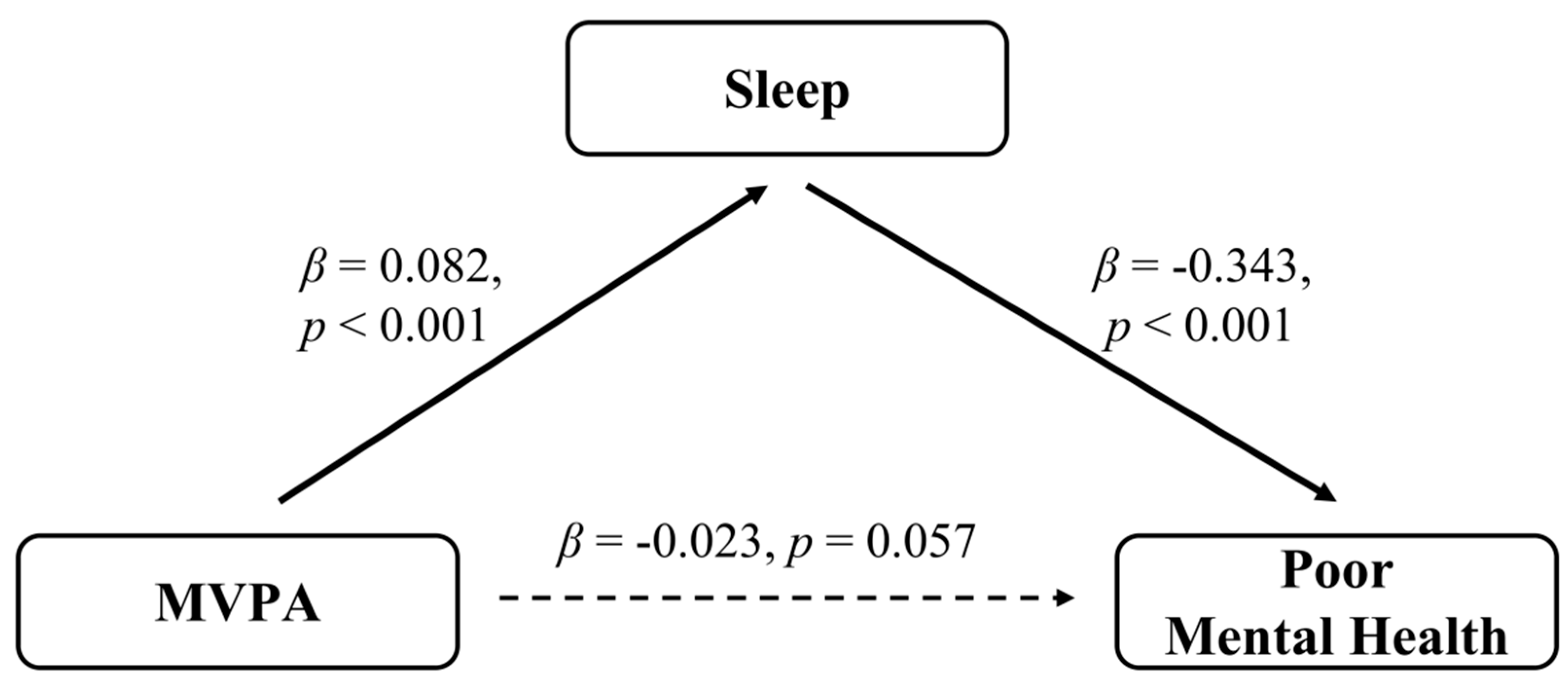
Figure 1: Mediation model for the association between days of 60-min physical activity and frequent poor mental health, with sleep duration as a potential mediator. All β values are unstandardized path coefficients. Coefficients for paths leading to frequent poor mental health are expressed as KHB logit coefficients on the log-odds scale. MVPA: Moderate-to-Vigorous Physical Activity.
3.4 Sex-Stratified Mediation Analyses
In sex-stratified KHB mediation analyses, the overall association between MVPA and frequent poor mental health remained significant in both male and female students. For males, the total effect was β = −0.059 (95% CI: −0.097 to −0.021, p = 0.002). After accounting for sleep duration, the magnitude of the direct association was reduced from β = −0.059 to β = −0.033 in males and from β = −0.042 to β = −0.019 in females. In contrast, the indirect pathway via sleep duration remained significant (β = −0.026, 95% CI: −0.035 to −0.017, p < 0.001), with 44.22% of the total effect explained by mediation. For females, a significant total effect was also observed (β = −0.042, 95% CI: −0.072 to −0.012, p = 0.006). The direct effect became non-significant after adjustment for sleep (β = −0.019, 95% CI: −0.050 to 0.012, p = 0.237), while the indirect effect through sleep duration remained statistically significant (β = −0.023, 95% CI: −0.032 to −0.015, p < 0.001). The mediated proportion was 55.68%. Overall, sleep duration exhibited a significant mediating role in both sexes, with a higher mediation proportion observed among females compared with males (Table 4).
Table 4: Sex-stratified mediation analysis of sleep duration on the association between moderate-to-vigorous physical activity and poor mental health.
| Effect | Male (n = 7842) | Female (n = 7745) | ||||
|---|---|---|---|---|---|---|
| β (log-odds) | 95% CI | p-Value | β (log-odds) | 95% CI | p-Value | |
| Total Effect | −0.059 | −0.097 to −0.021 | 0.002 | −0.042 | −0.072 to −0.012 | 0.006 |
| Direct Effect | −0.033 | −0.071 to 0.006 | 0.093 | −0.019 | −0.050 to 0.012 | 0.237 |
| Indirect Effect | −0.026 | −0.035 to −0.017 | <0.001 | −0.023 | −0.032 to −0.015 | <0.001 |
| Proportion mediated | 44.22% | - | - | 55.68% | - | - |
Using nationally representative data from U.S. high school students, the present study yielded four principal findings. First, greater weekly frequency of achieving at least 60 min of PA was linked to reduced odds of frequent poor mental health, indicating a dose–response inverse relationship between MVPA and mental health outcomes in adolescents. Second, sleep duration on school nights showed a positive association with MVPA while being negatively associated with frequent poor mental health. Third, sleep duration statistically accounted for approximately 52% of the observed association between MVPA and frequent poor mental health. After sleep duration was included in the model, the estimated direct association was reduced by roughly half, suggesting that sleep duration may explain a substantial proportion of the observed relationship. Fourth, this indirect effect was evident in both males and females, with a numerically larger mediated proportion among females than males, although the overall pattern was similar across sex.
From a socioecological perspective, it is important to interpret the observed associations within broader structural and contextual conditions that shape adolescents’ PA and sleep opportunities, rather than attributing them solely to individual behaviors. Ecological models of health behavior emphasize that behavior is embedded within multiple interacting levels of influence, including individual, interpersonal, organizational, community, and policy environments [39]. In the U.S. context, adolescents’ ability to engage in regular MVPA and obtain sufficient sleep is strongly influenced by upstream determinants such as school start times and academic workload, screen-based and digital engagement demands, family socioeconomic circumstances, neighborhood safety, availability of recreational spaces, housing stability, and environmental conditions such as noise and crowding [40,41,42]. These factors may simultaneously constrain movement opportunities and disrupt sleep patterns, thereby contributing to both behavioral clustering and mental health outcomes. For example, excessive evening exposure to electronic media has been associated with delayed sleep onset and reduced sleep duration in adolescents [41], while early school start times have been linked to insufficient sleep and circadian misalignment [40]. Therefore, the associations observed in this study should be understood as embedded within a multilevel system of constraints and resources, rather than as purely individual-level behavioral effects.
From a public health perspective, the descriptive findings also indicate a substantial clustering of behavioral and mental health risk in this population: 15.8% of students reported no days of 60-min MVPA, approximately 77% slept less than 8 h on school nights, and 28.5% reported frequent poor mental health. These prevalences underscore the relevance of low-threshold strategies that simultaneously promote movement and sufficient sleep in adolescents [12,26]. Overall, these results align with existing evidence from reviews, intervention trials, and longitudinal studies, which consistently suggest that greater engagement in PA is associated with better mental health outcomes among adolescents. They also support the view that sleep represents a key associated factor and may serve as a potential mechanism underlying this relationship [7,36,37,43,44].
4.1 Interpretation of the Dose–Response Association between MVPA Days and Frequent Poor Mental Health
The inverse graded pattern identified in this study indicates that improvements in mental health may increase progressively as adolescents engage in more days per week with at least 60 min of MVPA, rather than being restricted to those who meet the full 7-day guideline. This interpretation is in line with prior review evidence showing that higher PA levels are typically linked to reduced psychological distress in youth [7,17]. This interpretation is further corroborated by nationally representative evidence from the United States, where high school students engaging in PA on at least 5 days per week showed lower odds of depressive symptoms in 2019 [45], Similarly, the 2023 YRBS report indicated that adolescents who achieved ≥60 min of PA on at least 5 days per week had a lower prevalence of persistent feelings of sadness or hopelessness [46]. Prospective studies also support these patterns. A recent cohort study found that engaging in 4–7 h per week of MVPA was associated with fewer subsequent depressive symptoms and a reduced risk of incident depression, while additional activity beyond this range showed limited added benefit [47]. Similarly, a 2025 systematic review and meta-analysis synthesizing evidence from 11 prospective observational studies reported that greater PA participation was associated with a reduced risk of depression in adolescents [48]. Taken together, these findings suggest that moving adolescents from no activity to some activity may be particularly meaningful, while the exact shape of the exposure–response curve may vary according to whether PA is operationalized as days/week, total weekly duration, or adherence to a categorical guideline.
Several mechanisms may help explain why more frequent MVPA days are associated with a lower likelihood of frequent poor mental health. Conceptual and empirical work has suggested that PA may influence youth mental health through neurobiological, psychosocial, and behavioral pathways [18]. In practical terms, more frequent MVPA may provide repeated opportunities for affect regulation, stress reduction, perceived competence, and social interaction across the week, while also displacing sedentary time and supporting healthier daily routines. One possible interpretation is that the number of days with 60 min of MVPA captures not only total activity volume but also the regularity of engagement, which may itself be relevant for emotional well-being. This interpretation is compatible with longitudinal evidence showing that greater sedentary behavior and lower movement across adolescence are associated with higher later depressive symptoms [49]. At the same time, caution is warranted because the present study is cross-sectional; adolescents with frequent poor mental health may also be less likely to engage in regular PA because of low motivation, fatigue, or social withdrawal. Even so, the current findings, together with prospective and intervention evidence, support the public health relevance of encouraging more frequent MVPA participation among adolescents, especially among students reporting very low or zero activity [36,48].
4.2 Sleep Duration as a Mediating Pathway
In this study, sleep duration statistically accounted for 51.96% of the observed association between MVPA days and frequent poor mental health. After accounting for sleep duration, the estimated direct association between MVPA and frequent poor mental health was markedly attenuated, decreasing from β = −0.048 to β = −0.023. This pattern suggests that a substantial proportion of the observed association may operate through differences in sleep duration. These findings are consistent with the possibility that sleep duration may represent one potential behavioral pathway linking PA and mental health, although this interpretation cannot establish temporal or causal relationships. These results are consistent with the emerging literature on 24-h movement behaviors, which generally indicates that more favorable mental health profiles are observed when sufficient sleep is combined with higher PA and reduced sedentary time [44]. They also align with findings from intervention research, including the Burn 2 Learn cluster randomized trial, which investigated sleep-related factors as mediators of changes in mental health outcomes among older adolescents [29].
A sleep-mediated pathway is plausible from a developmental and behavioral perspective. Sleep is central to emotional regulation, stress recovery, and affective functioning during adolescence. A meta-analysis of cohort studies further indicates that sleep disturbance is prospectively associated with an increased risk of later depression in children and adolescents [37]. Against this background, it is reasonable to infer that adolescents who engage in MVPA on more days of the week may benefit not only from the psychosocial and neurobehavioral effects of activity itself, but also from improved sleep-related recovery, which in turn may reduce vulnerability to frequent poor mental health. In this sense, the present findings support a 24-h behavioral perspective, in which movement and sleep should be considered interdependent rather than isolated targets [43].
At the same time, the mediation literature is not entirely consistent, and this nuance should be acknowledged. A recent systematic review of mediation and moderation studies concluded that evidence for sleep as a mediator between PA and mental health remains conflicting overall [50]. Importantly, most studies included in this review operationalized PA using frequency or time-based indicators (e.g., weekly duration or meeting guidelines), and very few specifically examined MVPA measured in daily “days per week” format. Therefore, the role of day-based MVPA patterns in the PA–sleep–mental health pathway remains underexplored, particularly in large population-based adolescent samples. Our study contributes to this literature by focusing on MVPA expressed as days per week and examining its association with mental health outcomes in a nationally representative sample, while also considering sleep duration as a potential behavioral correlate. Likewise, evidence from a large cross-national study involving adolescents from 12 countries found that sleep duration did not mediate the relationship between PA and psychological symptoms, although difficulties in sleep onset did play a mediating role [51]. Additional research has similarly suggested that aspects of sleep quality, rather than duration alone, may partly account for the link between unhealthy movement patterns and poorer mental health outcomes [52]. In this context, the present findings contribute novel evidence by demonstrating that, within a nationally representative sample of U.S. high school students, school-night sleep duration alone explains a meaningful proportion of the association. However, given the cross-sectional nature of the data, the mediation results should be regarded as statistical associations rather than causal pathways. Future longitudinal and intervention studies are needed to clarify whether changes in MVPA influence sleep duration as well as broader aspects of sleep health, and how these, in turn, relate to mental health outcomes [50,51,52].
4.3 Sex Differences in the Mediation Pattern
In analyses stratified by sex, sleep duration demonstrated comparable indirect associations in both male and female adolescents, with estimated mediated proportions of 44.2% and 55.7%, respectively. This pattern suggests that sleep may represent a somewhat more salient pathway linking MVPA to mental health among female adolescents, although the overall mediation structure was similar across sex. One possible explanation is that female adolescents generally report a greater burden of internalizing symptoms and poorer mental health than males. In the 2023 YRBS, a higher prevalence of poor mental health was observed among female students compared with their male counterparts. Consistent with this, cross-national studies have also shown that adolescent girls generally report poorer average mental health than boys across a range of psychological domains [53].
Differences in sleep health may provide an additional explanation. Previous studies suggest that girls often report shorter weekday sleep, poorer sleep quality, and a stronger coupling between sleep-related difficulties and emotional symptoms than boys [54,55]. For instance, a large study of Swedish adolescents reported that girls were more likely than boys to experience short weekday sleep duration, and that both insufficient sleep and poorer sleep quality were linked to depressive symptoms [54]. In a similar vein, research among Saudi adolescents found that female participants exhibited lower sleep quality scores and worse mental health outcomes than males, with a significant association between high stress levels and poor sleep observed only in girls [55]. Collectively, these findings suggest that adolescent girls may be more sensitive to the adverse mental health effects of inadequate or low-quality sleep, which may partly account for the higher mediated proportion identified in the current study [54,55].
At the same time, sex differences in the PA–mental health association itself appear to be less consistent. Halliday et al. found that adolescent girls tended to report lower levels of PA and worse mental health compared with boys, with their results supporting a mediating rather than moderating role of PA in the relationship between gender and mental health [56]. In contrast, a recent meta-analysis of prospective studies did not identify any significant sex differences in the association between PA and risk of depression among adolescents [57]. Overall, these results imply that the larger mediation effect observed in females in the current study may be attributable to a higher underlying prevalence of sleep problems and internalizing symptoms, rather than to sex-specific differences in the intrinsic effect of MVPA on mental health. Because the indirect effect was significant in both sexes and the difference in mediated proportion was descriptive, this sex difference should be interpreted cautiously and confirmed in future studies using formal moderated-mediation designs and broader measures of sleep health.
This study presents several notable strengths. First, it analyzed a large sample of 15,671 adolescents using data from the 2023 national YRBS, which employs a multistage complex sampling framework to produce nationally representative estimates of students in grades 9–12 from both public and private schools in the United States [27]. Second, PA exposure was defined as the number of days with at least 60 min of MVPA, offering a straightforward and policy-relevant indicator that is easily interpretable for surveillance and health communication purposes. Third, the analytic approach incorporated survey weights, strata, and primary sampling units, and applied multiple imputation to minimize bias from missing exposure and covariate information. In addition, the Karlson–Holm–Breen (KHB) method was used to decompose total, direct, and indirect effects in nonlinear models while correcting for rescaling bias, making it appropriate for mediation analysis in this context [58]. Fourth, the YRBS instrument has shown generally good test–retest reliability, supporting its suitability for population-level surveillance based on adolescent self-reported data [59]. Collectively, these methodological and data-related strengths enhance both the robustness and public health relevance of the study findings.
Several limitations should be acknowledged when interpreting the findings of this study. First, because the YRBS employs a cross-sectional design, causal relationships cannot be established, and the identified associations and mediation pathways should be interpreted as correlational rather than causal. As a result, the temporal ordering of variables could not be determined, and bidirectional or reverse associations may also be possible [50,60]. Second, the YRBS sample is limited to school-attending adolescents, which restricts generalizability to the broader adolescent population. Youth who are not enrolled in school may differ meaningfully in both behavioral patterns and mental health status [60]. Third, all variables were self-reported, which introduces potential measurement bias, including recall error, random misclassification, and social desirability bias. These issues may be more pronounced for behavioral variables such as PA, sleep duration, and substance use, as adolescents may overestimate or underestimate their behaviors. Although the YRBS has demonstrated acceptable test–retest reliability for surveillance purposes [59,60], self-report measures generally show only moderate agreement with objective assessments (e.g., accelerometry for PA or actigraphy for sleep), which may attenuate observed associations. Fourth, sleep was assessed only as approximate school-night duration and did not capture multidimensional aspects of sleep health, such as sleep quality, timing, variability, or weekend recovery sleep. This limited measurement scope may result in nondifferential misclassification and reduce sensitivity to detect more complex associations between sleep and mental health [50,52]. In addition, because the lowest and highest sleep categories were open-ended and coded as 4 and 10 h, respectively, floor and ceiling effects may have reduced the precision of sleep duration estimates at the extremes. Finally, frequent poor mental health was assessed using a single self-reported surveillance item rather than a validated multi-item diagnostic instrument. Therefore, the outcome should be interpreted as a perceived poor mental health burden at the population level, not as a clinical diagnosis or a measure of a specific mental disorder. These may include contextual, familial, and psychosocial influences that were not incorporated into the present models.
Among this nationally representative cohort of U.S. high school students, a greater number of weekly days achieving at least 60 min of PA was associated with lower odds of frequent poor mental health, demonstrating a clear inverse dose–response association. In addition, school-night sleep duration emerged as a potential mediator of this association, explaining roughly one-half of the total effect in both male and female adolescents. These findings suggest that promoting more frequent PA, particularly among adolescents with very low or no MVPA, together with adequate sleep, may represent an important public health strategy for improving adolescent mental health. However, given the cross-sectional design, these results reflect statistical associations rather than causal effects. Future longitudinal and intervention research is therefore required to establish temporal ordering and to determine whether increasing PA frequency and enhancing sleep can effectively reduce poor mental health among adolescents.
Acknowledgement:
Funding Statement: This Research Was Supported by the Education Ministry Humanities and Social Sciences Youth Fund (25YJC890048), Jiangsu Province Education Science “14th Five-Year Plan” Project (C/2024/01/99) and Suzhou Sports Bureau Project (Grant No. TY2025-305).
Author Contributions: The authors confirm contribution to the paper as follows: study conception and design: Liu Yang, Qingru Zhang; data collection: Jin Yan; analysis and interpretation of results: Liu Yang, Qingru Zhang, Jin Yan; draft manuscript preparation: Liu Yang, Qingru Zhang, Jin Yan. All authors reviewed and approved the final version of the manuscript.
Availability of Data and Materials: The data that support the findings of this study are publicly available from the Centers for Disease Control and Prevention (CDC) Youth Risk Behavior Surveillance System (YRBSS). The 2023 Youth Risk Behavior Survey (YRBS) dataset is available at: https://www.cdc.gov/yrbs/data/index.html. No additional data were generated for this study.
Ethics Approval: This study was approved by the Ethics Committee of Soochow University (SUDA20240626H06). The study involved secondary analysis of publicly available, de-identified data from the 2023 YRBS. Ethical approval, parental permission, and participant assent procedures for the original YRBS data collection were administered by the Centers for Disease Control and Prevention (CDC) and participating jurisdictions in accordance with applicable regulations.
Conflicts of Interest: The authors declare no conflicts of interest.
Supplementary Materials: The supplementary material is available online at https://www.techscience.com/doi/10.32604/ijmhp.2026.083872/s1.
References
1. Liu T , Li D , Yang H , Chi X , Yan J . Associations of sport participation with subjective well-being: a study consisting of a sample of Chinese school-attending students. Front Public Health. 2023; 11: 1199782. doi:10.3389/fpubh.2023.1199782. [Google Scholar] [CrossRef]
2. Sawyer SM , Azzopardi PS , Wickremarathne D , Patton GC . The age of adolescence. Lancet Child Adolesc Health. 2018; 2( 3): 223– 8. doi:10.1016/S2352-4642(18)30022-1. [Google Scholar] [CrossRef]
3. Bull FC , Al-Ansari SS , Biddle S , Borodulin K , Buman MP , Cardon G , et al. World Health Organization 2020 guidelines on physical activity and sedentary behaviour. Br J Sports Med. 2020; 54( 24): 1451– 62. doi:10.1136/bjsports-2020-102955. [Google Scholar] [CrossRef]
4. Hao Y , Lyu D , Zhang S , Guo B , Yan J . Sports participation and depressive symptoms in youth: demographic differences. Int J Ment Health Promot. 2024; 26( 10): 865– 73. doi:10.32604/ijmhp.2024.055231. [Google Scholar] [CrossRef]
5. Shi J , Gao M , Xu X , Zhang X , Yan J . Associations of muscle-strengthening exercise with overweight, obesity, and depressive symptoms in adolescents: findings from 2019 Youth Risk Behavior Surveillance system. Front Psychol. 2022; 13: 980076. doi:10.3389/fpsyg.2022.980076. [Google Scholar] [CrossRef]
6. Li H , Zhang W , Yan J . Physical activity and sedentary behavior among school-going adolescents in low- and middle-income countries: insights from the global school-based health survey. PeerJ. 2024; 12: e17097. doi:10.7717/peerj.17097. [Google Scholar] [CrossRef]
7. Centers for Disease Control and Prevention . Youth risk behavior survey (YRBS) 2025 standard questionnaire item rationale. Atlanta, GA, USA: Centers for Disease Control and Prevention; 2024. [Google Scholar]
8. Yan J , Lyu D , Morgan PJ , Cicchella A , Li M , Eather N . Does perceived physical literacy relate to academic achievement in Chinese university students? Insights from a cross-sectional study. Phys Educ Sport Pedagogy. 2025: 1– 18. doi:10.1080/17408989.2025.2603985. [Google Scholar] [CrossRef]
9. Yan J , Yang L , Lyu D , Du S . How does physical activity shape adolescents’ coping skills? unveiling the chain mediation of friendship quality and psychological resilience. Int J Ment Health Promot. 2025; 27( 3): 333– 45. doi:10.32604/ijmhp.2025.062297. [Google Scholar] [CrossRef]
10. Guthold R , Stevens GA , Riley LM , Bull FC . Global trends in insufficient physical activity among adolescents: a pooled analysis of 298 population-based surveys with 1·6 million participants. Lancet Child Adolesc Health. 2020; 4( 1): 23– 35. doi:10.1016/S2352-4642(19)30323-2. [Google Scholar] [CrossRef]
11. Liu S , Yu Q , Mahbub Hossain M , Doig S , Bao R , Zhao Y , et al. Meeting 24-h movement guidelines is related to better academic achievement: findings from the YRBS 2019 cycle. Int J Ment Health Promot. 2022; 24( 1): 13– 24. doi:10.32604/ijmhp.2021.017660. [Google Scholar] [CrossRef]
12. Chen S , Brown D , Pfledderer CD , Huang WY , Tremblay MS . Temporal trends of no moderate to vigorous physical activity in adolescents: a 16-year trend analysis of 115, 926 participants. Int J Behav Nutr Phys Act. 2025; 23( 1): 3. doi:10.1186/s12966-025-01862-0. [Google Scholar] [CrossRef]
13. Sun Q , Xu Z , Lyu D , Xu X , Wang L , Yan T , et al. Physical activity and cognitively difficulties in adolescents: a cross-sectional study of 13, 677 participants. Complement Ther Clin Pract. 2025; 59: 101965. doi:10.1016/j.ctcp.2025.101965. [Google Scholar] [CrossRef]
14. Chen S , Brown D , Parker K , Lee EY . Trends in adherence to the 24-h movement guidelines among US adolescents from 2011 to 2019: evidence from repeated cross-sectional cycles of the youth risk behavior surveillance system. Scand J Med Sci Sports. 2024; 34( 4): e14609. doi:10.1111/sms.14609. [Google Scholar] [CrossRef]
15. Chen S , Liang K , López-Gil JF , Drenowatz C , Tremblay MS . Association between meeting 24-h movement guidelines and academic performance in a sample of 67, 281 Chinese children and adolescents. Eur J Sport Sci. 2024; 24( 4): 487– 98. doi:10.1002/ejsc.12034. [Google Scholar] [CrossRef]
16. Chen S , Yan J , Zhao Y . A trend analysis of adherence to the muscle strengthening exercise guidelines in US adolescents. Int J Public Health. 2022; 67: 1605022. doi:10.3389/ijph.2022.1605022. [Google Scholar] [CrossRef]
17. Biddle SJH , Ciaccioni S , Thomas G , Vergeer I . Physical activity and mental health in children and adolescents: an updated review of reviews and an analysis of causality. Psychol Sport Exerc. 2019; 42: 146– 55. doi:10.1016/j.psychsport.2018.08.011. [Google Scholar] [CrossRef]
18. Lubans D , Richards J , Hillman C , Faulkner G , Beauchamp M , Nilsson M , et al. Physical activity for cognitive and mental health in youth: a systematic review of mechanisms. Pediatrics. 2016; 138( 3): e20161642. doi:10.1542/peds.2016-1642. [Google Scholar] [CrossRef]
19. Reece AS , Hulse GK . Co-occurrence across time and space of drug- and cannabinoid- exposure and adverse mental health outcomes in the national survey of drug use and health: combined geotemporospatial and causal inference analysis. BMC Public Health. 2020; 20( 1): 1655. doi:10.1186/s12889-020-09748-5. [Google Scholar] [CrossRef]
20. Shawon MSR , Hossain FB , Thabrew A , Kabir SF , Mahmood S , Islam MS . Burdens of sedentary behaviour and symptoms of mental health disorders and their associations among 297, 354 school-going adolescents from 68 countries. Ment Health Phys Act. 2025; 28: 100665. doi:10.1016/j.mhpa.2024.100665. [Google Scholar] [CrossRef]
21. Chen X , Yang Y , Zhong C , Zeng X , Qiu X , Zhou X , et al. The effect of physical activity on anxiety through sleep quality among Chinese high school students: evidence from cross-sectional study and longitudinal study. BMC Psychiatry. 2025; 25( 1): 495. doi:10.1186/s12888-025-06909-x. [Google Scholar] [CrossRef]
22. Marquez J , Panayiotou M , Farzinnia R , Cheng Q , Humphrey N . Longitudinal relationships across sleep, physical activity, and mental wellbeing in early-to-mid-adolescence: a developmental cascades investigation. Qual Life Res. 2025; 34( 5): 1233– 50. doi:10.1007/s11136-025-03894-2. [Google Scholar] [CrossRef]
23. Wang B , Zhou H . Physical activity and adolescent depression: the moderating effects of self-esteem, sleep quality and social support in mental health interventions. Int J Ment Health Nurs. 2025; 34( 4): e70126. doi:10.1111/inm.70126. [Google Scholar] [CrossRef]
24. Campbell IG , Cruz-Basilio A , Figueroa JG , Bottom VB . Earlier bedtime and its effect on adolescent sleep duration. Pediatrics. 2023; 152( 1): e2022060607. doi:10.1542/peds.2022-060607. [Google Scholar] [CrossRef]
25. Park GR , Kim J . Short sleep duration and adolescent health: does weekend catch-up sleep work and for whom? Public Health. 2023; 214: 91– 5. doi:10.1016/j.puhe.2022.11.008. [Google Scholar] [CrossRef]
26. Paruthi S , Brooks LJ , D’Ambrosio C , Hall WA , Kotagal S , Lloyd RM , et al. Recommended amount of sleep for pediatric populations: a consensus statement of the American academy of sleep medicine. J Clin Sleep Med. 2016; 12( 6): 785– 6. doi:10.5664/jcsm.5866. [Google Scholar] [CrossRef]
27. Brener ND , Mpofu JJ , Krause KH , Everett Jones S , Thornton JE , Myles Z , et al. Overview and methods for the youth risk behavior surveillance system—United States, 2023. MMWR Suppl. 2024; 73( 4): 1– 12. doi:10.15585/mmwr.su7304a1. [Google Scholar] [CrossRef]
28. Xia R , Yang L , Liang C , Lyu D , Zang W , Sun G , et al. Research on aerobic fitness in children and adolescents: a bibliometric analysis based on the 100 most-cited articles. Front Med. 2024; 11: 1409532. doi:10.3389/fmed.2024.1409532. [Google Scholar] [CrossRef]
29. Leahy AA , Diallo TMO , Eather N , Duncan MJ , Smith JJ , Morgan PJ , et al. Mediating effects of sleep on mental health in older adolescents: findings from the Burn 2 Learn randomized controlled trial. Scandinavian Med Sci Sports. 2023; 33( 11): 2369– 80. doi:10.1111/sms.14463. [Google Scholar] [CrossRef]
30. Peng Y , Xu Z , Du S , Hou T , Yan J . SHAP-enhanced machine learning identifies modifiable obesity predictors across adolescent weight groups: a 2021 YRBSS analysis. PLoS One. 2025; 20( 10): e0334502. doi:10.1371/journal.pone.0334502. [Google Scholar] [CrossRef]
31. Brener ND , Kann L , Shanklin S , Kinchen S , Eaton DK , Hawkins J , et al. Methodology of the youth risk behavior surveillance system—2013. Morb Mortal Week Rep Recomm Rep. 2013; 62( RR01): 1– 23. [Google Scholar]
32. von Hippel PT . Regression with missing ys: an improved strategy for analyzing multiply imputed data. Sociol Methodol. 2007; 37( 1): 83– 117. doi:10.1111/j.1467-9531.2007.00180.x. [Google Scholar] [CrossRef]
33. Lauderdale DS , Knutson KL , Yan LL , Liu K , Rathouz PJ . Self-reported and measured sleep duration: how similar are they? Epidemiology. 2008; 19( 6): 838– 45. doi:10.1097/ede.0b013e318187a7b0. [Google Scholar] [CrossRef]
34. Short MA , Gradisar M , Gill J , Camfferman D . Identifying adolescent sleep problems. PLoS One. 2013; 8( 9): e75301. doi:10.1371/journal.pone.0075301. [Google Scholar] [CrossRef]
35. Kuczmarski RJ . 2000 CDC growth charts for the United States: methods and development (No. 246). Atlanta, GA, USA: Centers for Disease Control and Prevention; 2002. [Google Scholar]
36. Recchia F , Bernal JDK , Fong DY , Wong SHS , Chung PK , Chan DKC , et al. Physical activity interventions to alleviate depressive symptoms in children and adolescents: a systematic review and meta-analysis. JAMA Pediatr. 2023; 177( 2): 132– 40. doi:10.1001/jamapediatrics.2022.5090. [Google Scholar] [CrossRef]
37. Marino C , Andrade B , Campisi SC , Wong M , Zhao H , Jing X , et al. Association between disturbed sleep and depression in children and youths: a systematic review and meta-analysis of cohort studies. JAMA Netw Open. 2021; 4( 3): e212373. doi:10.1001/jamanetworkopen.2021.2373. [Google Scholar] [CrossRef]
38. Kohler U , Karlson KB , Holm A . Comparing coefficients of nested nonlinear probability models. Stata J Promot Commun Stat Stata. 2011; 11( 3): 420– 38. doi:10.1177/1536867x1101100306. [Google Scholar] [CrossRef]
39. Sallis JF , Owen N , Fisher E . Ecological models of health behavior. Health Behav Theory Res Pract. 2015; 5( 43–64): 465– 85. [Google Scholar]
40. Adolescent Sleep Working Group, Committee on Adolescence, Council on School Health. School start times for adolescents. Pediatrics. 2014; 134( 3): 642. doi:10.1542/peds.2014-1697. [Google Scholar] [CrossRef]
41. Cain N , Gradisar M . Electronic media use and sleep in school-aged children and adolescents: a review. Sleep Med. 2010; 11( 8): 735– 42. doi:10.1016/j.sleep.2010.02.006. [Google Scholar] [CrossRef]
42. Sallis JF , Cervero RB , Ascher W , Henderson KA , Kraft MK , Kerr J . An ecological approach to creating active living communities. Annu Rev Public Health. 2006; 27: 297– 322. doi:10.1146/annurev.publhealth.27.021405.102100. [Google Scholar] [CrossRef]
43. Patte KA , Faulkner G , Qian W , Duncan M , Leatherdale ST . Are one-year changes in adherence to the 24-hour movement guidelines associated with depressive symptoms among youth? BMC Public Health. 2020; 20( 1): 793. doi:10.1186/s12889-020-08887-z. [Google Scholar] [CrossRef]
44. Sampasa-Kanyinga H , Chaput JP , Goldfield GS , Janssen I , Wang J , Hamilton HA , et al. The Canadian 24-h movement guidelines and psychological distress among adolescents: les directives canadiennes en matière de mouvement sur 24 heures et la détresse psychologique chez les adolescents. Can J Psychiatry. 2021; 66( 7): 624– 33. doi:10.1177/0706743720970863. [Google Scholar] [CrossRef]
45. Wang CH , Peiper N . Association between physical activity and sedentary behavior with depressive symptoms among US high school students, 2019. Prev Chronic Dis. 2022; 19: E76. doi:10.5888/pcd19.220003. [Google Scholar] [CrossRef]
46. Verlenden JV , Fodeman A , Wilkins N , Jones SE , Moore S , Cornett K , et al. Mental health and suicide risk among high school students and protective factors—youth risk behavior survey, United States, 2023. MMWR Suppl. 2024; 73( 4): 79– 86. doi:10.15585/mmwr.su7304a9. [Google Scholar] [CrossRef]
47. Jiang W , Sun L , He Y , Liu W , Hua Y , Zheng X , et al. Association between physical activity and depressive symptoms in adolescents: a prospective cohort study. Psychiatry Res. 2023; 329: 115544. doi:10.1016/j.psychres.2023.115544. [Google Scholar] [CrossRef]
48. Hou J , Deng Q , Sha L , Zhu J , Xiang R , Zhao X , et al. Physical activity and risk of depression in adolescents: a systematic review and meta-analysis of prospective observational studies. J Affect Disord. 2025; 371: 279– 88. doi:10.1016/j.jad.2024.11.065. [Google Scholar] [CrossRef]
49. Kandola A , Lewis G , Osborn DPJ , Stubbs B , Hayes JF . Depressive symptoms and objectively measured physical activity and sedentary behaviour throughout adolescence: a prospective cohort study. Lancet Psychiatry. 2020; 7( 3): 262– 71. doi:10.1016/S2215-0366(20)30034-1. [Google Scholar] [CrossRef]
50. White RL , Vella S , Biddle S , Sutcliffe J , Guagliano JM , Uddin R , et al. Physical activity and mental health: a systematic review and best-evidence synthesis of mediation and moderation studies. Int J Behav Nutr Phys Act. 2024; 21( 1): 134. doi:10.1186/s12966-024-01676-6. [Google Scholar] [CrossRef]
51. Vandendriessche A , Ghekiere A , Van Cauwenberg J , de Clercq B , Dhondt K , DeSmet A , et al. Does sleep mediate the association between school pressure, physical activity, screen time, and psychological symptoms in early adolescents? A 12-country study. Int J Environ Res Public Health. 2019; 16( 6): 1072. doi:10.3390/ijerph16061072. [Google Scholar] [CrossRef]
52. Werneck AO , Silva DR , Malta DC , Lima MG , Souza-Júnior PRB , Azevedo LO , et al. The mediation role of sleep quality in the association between the incidence of unhealthy movement behaviors during the COVID-19 quarantine and mental health. Sleep Med. 2020; 76: 10– 5. doi:10.1016/j.sleep.2020.09.021. [Google Scholar] [CrossRef]
53. Campbell OLK , Bann D , Patalay P . The gender gap in adolescent mental health: a cross-national investigation of 566, 829 adolescents across 73 countries. SSM Popul Health. 2021; 13: 100742. doi:10.1016/j.ssmph.2021.100742. [Google Scholar] [CrossRef]
54. Lemke T , Hökby S , Wasserman D , Carli V , Hadlaczky G . Associations between sleep habits, quality, chronotype and depression in a large cross-sectional sample of Swedish adolescents. PLoS One. 2023; 18( 11): e0293580. doi:10.1371/journal.pone.0293580. [Google Scholar] [CrossRef]
55. Rajab AM , Rajab TM , Basha AC , Al-Khani AM , Ali MA , Enabi S , et al. Gender differences in sleep and mental health among Saudi adolescents. Sleep Disord. 2021; 2021: 5513817. doi:10.1155/2021/5513817. [Google Scholar] [CrossRef]
56. Halliday AJ , Kern ML , Turnbull DA . Can physical activity help explain the gender gap in adolescent mental health? A cross-sectional exploration. Ment Health Phys Act. 2019; 16: 8– 18. doi:10.1016/j.mhpa.2019.02.003. [Google Scholar] [CrossRef]
57. Viner RM , Gireesh A , Stiglic N , Hudson LD , Goddings AL , Ward JL , et al. Roles of cyberbullying, sleep, and physical activity in mediating the effects of social media use on mental health and wellbeing among young people in England: a secondary analysis of longitudinal data. Lancet Child Adolesc Health. 2019; 3( 10): 685– 96. doi:10.1016/S2352-4642(19)30186-5. [Google Scholar] [CrossRef]
58. Karlson KB , Holm A , Breen R . Comparing regression coefficients between same-sample nested models using logit and probit: a new method. Sociol Methodol. 2012; 42( 1): 286– 313. doi:10.1177/0081175012444861. [Google Scholar] [CrossRef]
59. Jones SE , Brener ND , Queen B , Hershey-Arista M , Harris WA , Mpofu JJ , et al. Reliability of the 2021 national youth risk behavior survey questionnaire. Am J Health Promot. 2024; 38( 6): 843– 51. doi:10.1177/08901171241239735. [Google Scholar] [CrossRef]
60. Underwood JM , Brener N , Thornton J , Harris WA , Bryan LN , Shanklin SL , et al. Overview and methods for the youth risk behavior surveillance system—United States, 2019. MMWR Suppl. 2020; 69( 1): 1– 10. doi:10.15585/mmwr.su6901a1. [Google Scholar] [CrossRef]
Cite This Article
 Copyright © 2026 The Author(s). Published by Tech Science Press.
This work is licensed under a Creative Commons Attribution 4.0 International License , which permits unrestricted use, distribution, and reproduction in any medium, provided the original work is properly cited.
 Downloads
 Citation Tools
