
 Login
Login Register
 Submit a Paper
 Propose a Special lssue
 Open Access
ARTICLE

Assessing the Impact of Urban Green Spaces on Land Surface Temperature in Shah Alam and Putrajaya
1 School of Geomatics and Natural Resources, College of Built Environment, Universiti Teknologi MARA, Shah Alam, 40450, Selangor, Malaysia
2 Rosmin Talib Planning Consultant (RTPC), 21-2, Jalan Lengkuas B 16/B, Rimba Jaya, Shah Alam, 41300, Selangor, Malaysia
* Corresponding Author: Nafisah Khalid. Email:
(This article belongs to the Special Issue: Advancements in Geospatial Methods and Technologies for Sustainable Built Environment and Engineering)
Revue Internationale de Géomatique 2025, 34, 603-617. https://doi.org/10.32604/rig.2025.065369
Received 11 March 2025; Accepted 14 July 2025; Issue published 06 August 2025
 View Full Text
 Download PDF
Abstract
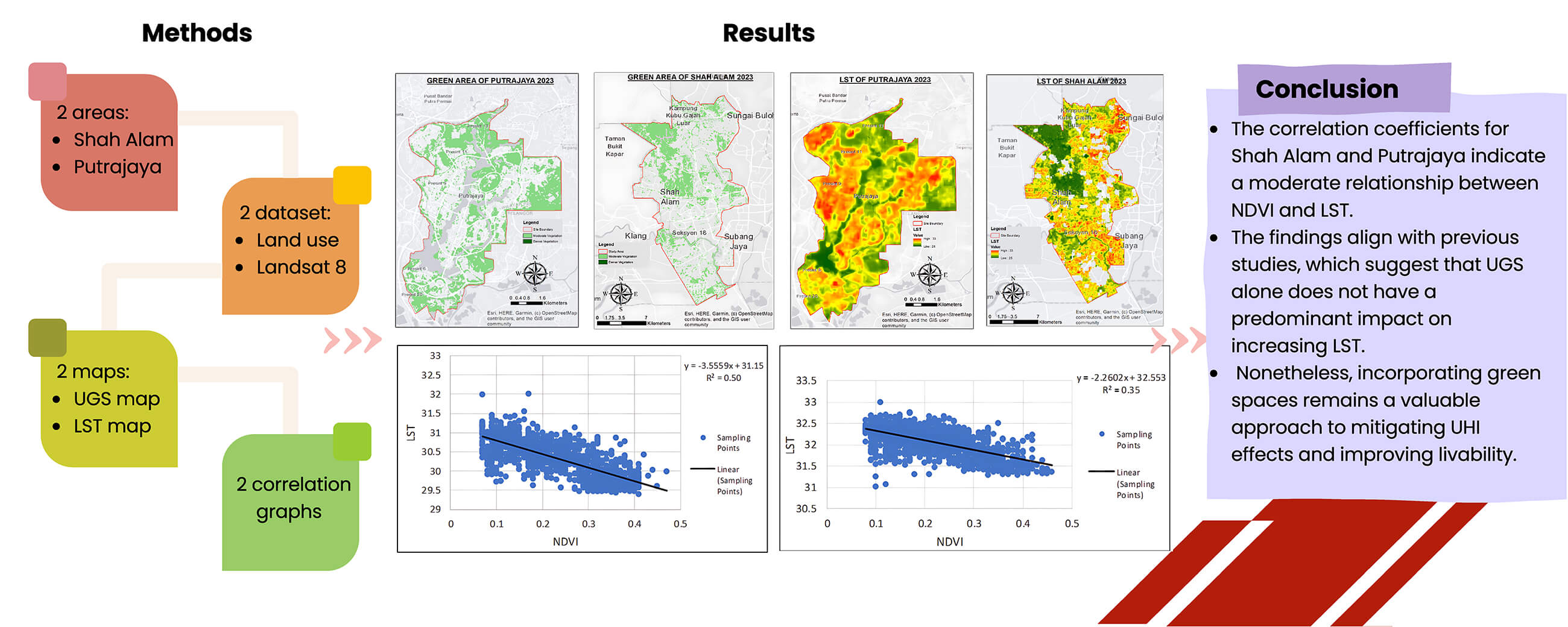
Urban green spaces (UGS) play a crucial role in promoting ecological, social, and environmental sustainability. UGS play a key role in reducing land surface temperature (LST) in rapidly urbanizing areas, thereby mitigating the urban heat island (UHI) effect. This paper conducts an extensive analysis of land use, Normalized Difference Vegetation Index (NDVI), and LST to examine the influence of the environmental landscapes of Shah Alam and Putrajaya from 2014 to 2023 on the variation of LST. In 2014, NDVI values in Shah Alam ranged from 0.35 to 0.50, fluctuating to 0.32 to 0.48 in 2023. Conversely, Putrajaya maintained a more stable NDVI range, from 0.40 to 0.52 in 2014 and 0.39 to 0.51 in 2023. Variations in LST reveal the thermal dynamics of both regions, with Shah Alam showing noticeable temperature increases. In 2014, Shah Alam’s LST ranged from 22°C to 32°C, rising to 25°C to 33°C in 2023. Highlighting the cooling effect of UGS, the study identified a moderate inverse correlation between NDVI and LST. Putrajaya’s planned urban greening initiatives outperformed Shah Alam’s scattered green spaces. The findings suggest that UGS does not solely drive increases in LST. However, integrating green spaces into urban development schemes remains a beneficial practice for improving city livability.Graphic Abstract
Keywords
Cite This Article
 Copyright © 2025 The Author(s). Published by Tech Science Press.
This work is licensed under a Creative Commons Attribution 4.0 International License , which permits unrestricted use, distribution, and reproduction in any medium, provided the original work is properly cited.
 Downloads
 Citation Tools
