
 Login
Login Register
 Submit a Paper
 Propose a Special lssue
 Open Access
REVIEW

Improving Cancer Therapy: The Strong Synergy of Ginsenosides and Chemotherapy
1 Cancer Biology Laboratory, Department of Biosciences and Bioengineering, Indian Institute of Technology Guwahati (IITG), Guwahati, Assam, India
2 Department of Science in Korean Medicine, Kyung Hee University, 24 Kyungheedae-ro, Dongdaemun-gu, Seoul, Republic of Korea
3 Radiological Sciences Department, College of Applied Medical Sciences, King Khalid University, Abha, Saudi Arabia
4 BioImaging Unit, Space Research Centre, Michael Atiyah Building, University of Leicester, Leicester, UK
5 Electrical Engineering Department, College of Engineering, King Khalid University, Abha, Saudi Arabia
6 Division of Radiology, Department of Medicine, College of Medicine and Surgery, King Khalid University, Abha, Saudi Arabia
7 Department of Pharmacology, College of Osteopathic Medicine, Lake Erie College of Osteopathic Medicine, Bradenton, FL, USA
* Corresponding Authors: Kwang Seok Ahn. Email: ; Ajaikumar B. Kunnumakkara. Email:
# These authors contributed equally to this work
(This article belongs to the Special Issue: Natural Product-Based Anticancer Drug Discovery)
BIOCELL 2026, 50(8), 4 https://doi.org/10.32604/biocell.2026.073397
Received 17 September 2025; Accepted 09 March 2026; Issue published 27 July 2026
 View Full Text
 Download PDF
Abstract
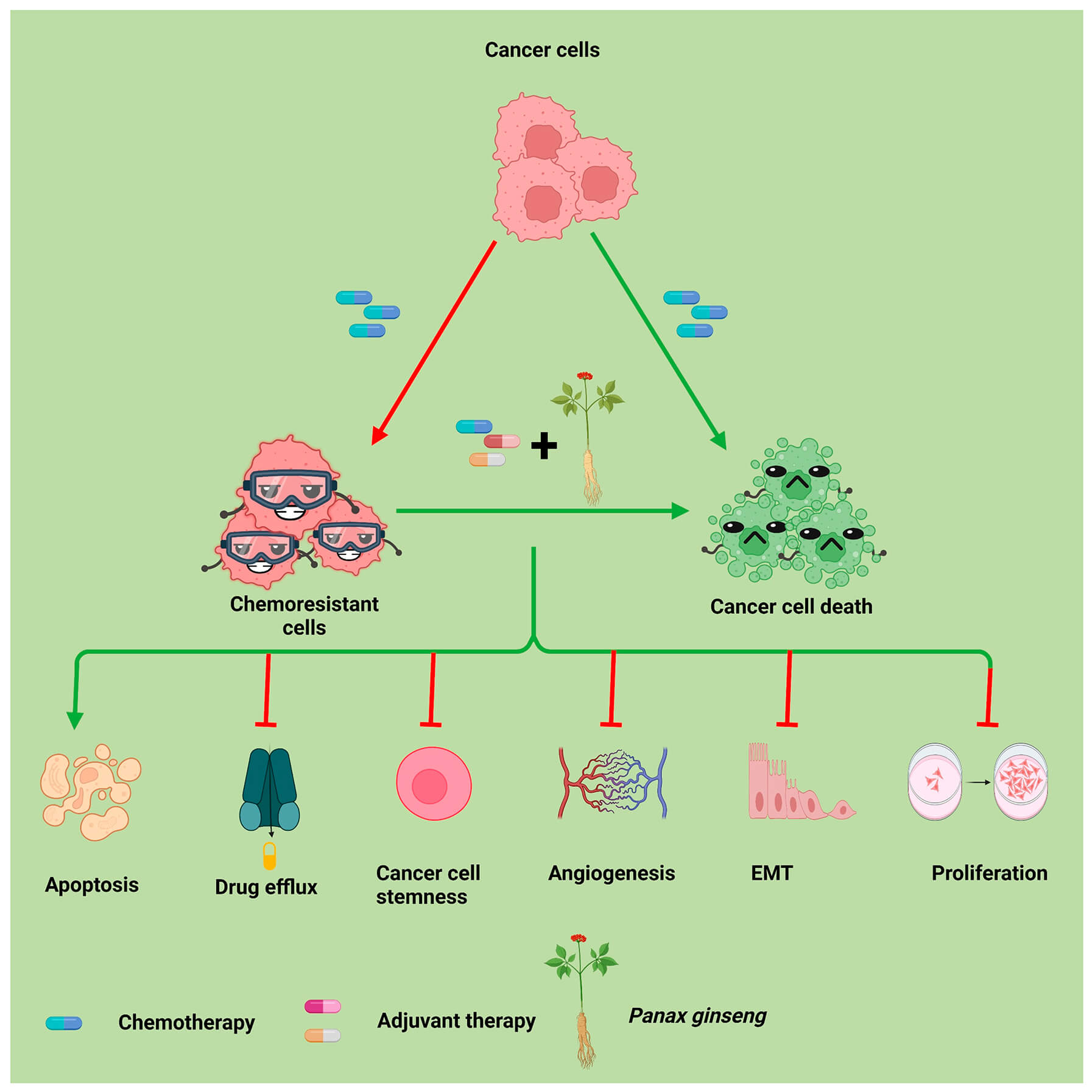
Despite the advancements achieved in chemotherapy, cancer continues to remain a formidable and lethal global threat, ranking as the second leading cause of death worldwide. The development of chemoresistance poses a significant hurdle in cancer treatment. Nonetheless, a therapeutic strategy known as chemosensitization has emerged to counteract cancer cell resistance, wherein the efficacy of one drug is augmented by another. Accumulating evidence suggests that natural products have attracted considerable attention in the cancer therapeutic realm due to their ability to combat multidrug resistance with minimal side effects. Ginsenosides, triterpene saponins extracted from Panax ginseng, have demonstrated significant anticancer activity while exhibiting relatively low toxicity and reduced adverse effects. Co-administration of ginsenosides with chemotherapeutic drugs has been shown to trigger apoptosis, as evidenced by an increased Bcl-2-associated X protein (Bax)/B-cell lymphoma 2 (Bcl-2) ratio, inhibit angiogenesis through suppression of vascular endothelial growth factor (VEGF); and hinder replicative immortality by downregulating stemness-associated markers such as octamer-binding transcription factor 4 (Oct4), Nanog, and sex determining region Y-box 2 (SOX2) in various cancers. Additionally, ginsenosides modulate key chemoresistance pathways, including nuclear factor-kappa B (NF-κB), signal transducers and activators of transcription (STAT), and phosphatidylinositol 3-kinase (PI3K)/protein kinase B (Akt), as well as their downstream targets, thereby rendering cancer cells more susceptible to chemotherapy. Notably, ginsenosides have been shown to modulate the tumor microenvironment and mitigate the side effects associated with chemotherapeutic drugs. This review aims to consolidate findings from preclinical and clinical studies to elucidate the role of ginsenosides as effective chemosensitizing agents.Graphic Abstract
Keywords
Cite This Article
 Copyright © 2026 The Author(s). Published by Tech Science Press.
This work is licensed under a Creative Commons Attribution 4.0 International License , which permits unrestricted use, distribution, and reproduction in any medium, provided the original work is properly cited.
 Downloads
 Citation Tools
