
 Login
Login Register
 Submit a Paper
 Propose a Special lssue
 Open Access
ARTICLE
Oridonin Ameliorates Nonalcoholic Steatohepatitis by Regulating Pyroptosis through the NF-κB/NLRP3 Axis
Department of Gastroenterology, The Third Affiliated Hospital of Southern Medical University, Guangzhou, China
* Corresponding Author: Yinghua Ou. Email:
BIOCELL 2026, 50(9), 12 https://doi.org/10.32604/biocell.2026.081188
Received 25 February 2026; Accepted 26 May 2026; Issue published 26 August 2026
 View Full Text
 Download PDF
Abstract
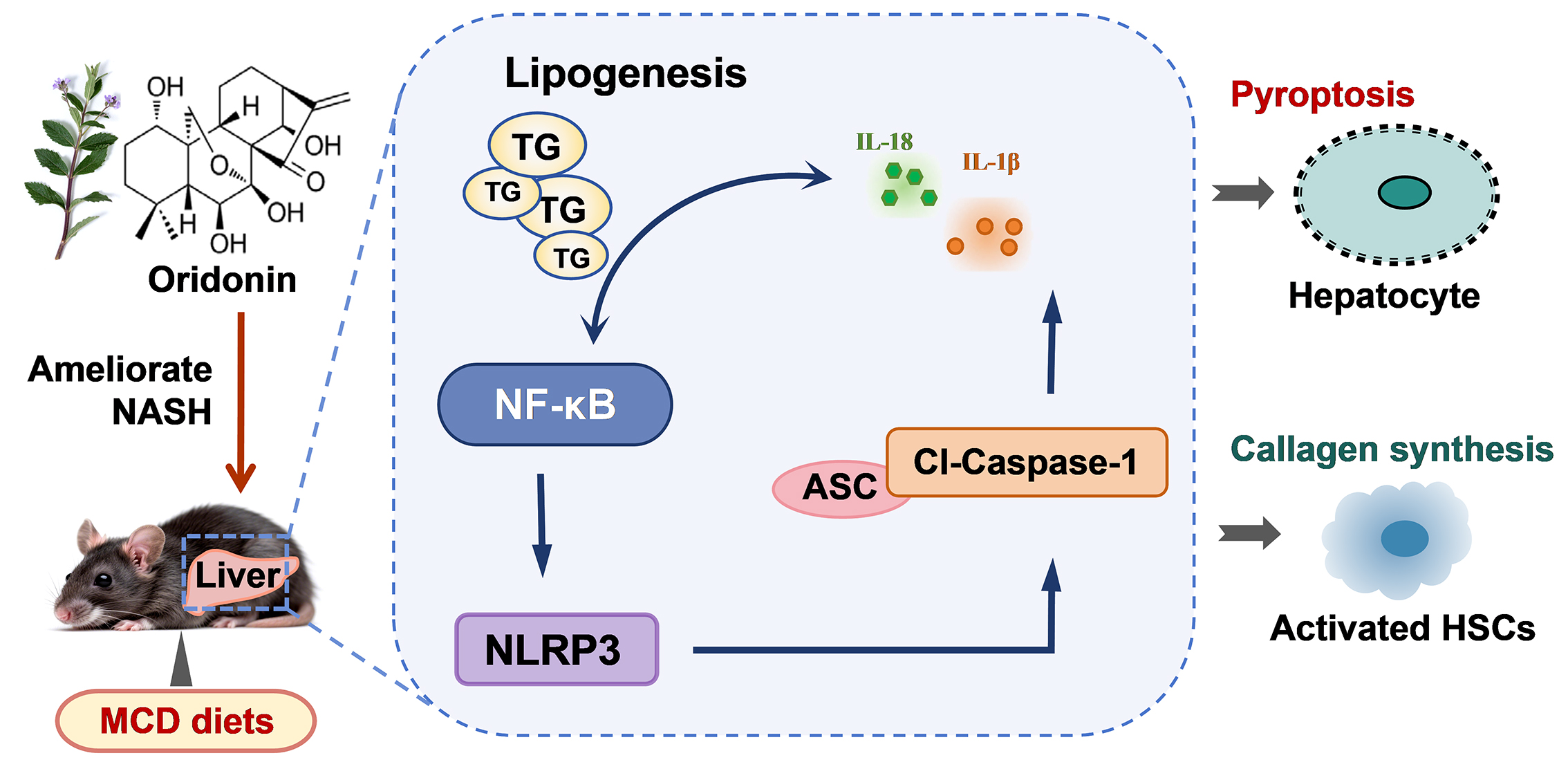
Background: Nonalcoholic steatohepatitis (NASH) is a liver disease characterized by inflammation and fibrosis. Oridonin (Ori) exhibits anti-inflammatory and anti-fibrotic properties, but its role in NASH remains unclear. The study aimed to investigate whether Ori alleviates NASH injury by regulating pyroptosis through the nuclear factor-κB (NF-κB)/nucleotide-binding oligomerization domain-like receptor protein 3 (NLRP3) axis. Methods: An in vitro NASH model was established in HepG2 cells using free fatty acids (FFA), and an in vivo model was induced in mice using a methionine-choline-deficient (MCD) diet. Biochemical assays, staining, flow cytometry, Western blot, and immunofluorescence assessed lipid accumulation, oxidative stress, inflammation, pyroptosis, and fibrosis. Results: Ori treatment (2.5–10 μM) dose-dependently reduced FFA-induced cell injury, lipid accumulation, reactive oxygen species (ROS) production, and release of interleukin (IL)-1β and IL-18, while decreasing PI and Caspase-1-positive cells and expression of N-GSDMD (p < 0.05). Ori also suppressed the expression of fibrosis markers alpha smooth muscle actin (α-SMA), Collagen III, and fibronectin (p < 0.05). In MCD-fed mice, Ori significantly attenuated hepatic steatosis, oxidative stress, inflammation, pyroptosis, and fibrosis, and alleviated liver enzyme levels and stiffness (p < 0.05). Mechanistically, Ori inhibited NF-κB activation (p-p65 and p-IκBα) and NLRP3 inflammasome assembly, as confirmed by lipopolysaccharide (LPS)/adenosine triphosphate (ATP) experiments. Conclusion: Ori can delay NASH progression via suppressing the NF-κB/NLRP3 pathway, reducing liver cell damage, lipid deposition, inflammation, pyroptosis, and fibrosis.Graphic Abstract
Keywords
Nonalcoholic steatohepatitis; oridonin; pyroptosis; lipid accumulation; nuclear factor-κB (NF-κB)/nucleotide-binding oligomerization domain-like receptor protein 3 (NLRP3) pathway
Cite This Article
APA Style
Peng, Q., He, F., Pan, S., Ou, Y. (2026). Oridonin Ameliorates Nonalcoholic Steatohepatitis by Regulating Pyroptosis through the NF-κB/NLRP3 Axis. BIOCELL, 50(9), 12. https://doi.org/10.32604/biocell.2026.081188
Vancouver Style
Peng Q, He F, Pan S, Ou Y. Oridonin Ameliorates Nonalcoholic Steatohepatitis by Regulating Pyroptosis through the NF-κB/NLRP3 Axis. BIOCELL. 2026;50(9):12. https://doi.org/10.32604/biocell.2026.081188
IEEE Style
Q. Peng, F. He, S. Pan, and Y. Ou, “Oridonin Ameliorates Nonalcoholic Steatohepatitis by Regulating Pyroptosis through the NF-κB/NLRP3 Axis,” BIOCELL, vol. 50, no. 9, pp. 12, 2026. https://doi.org/10.32604/biocell.2026.081188
 Copyright © 2026 The Author(s). Published by Tech Science Press.
This work is licensed under a Creative Commons Attribution 4.0 International License , which permits unrestricted use, distribution, and reproduction in any medium, provided the original work is properly cited.
 Downloads
 Citation Tools
