Home / Journals / BIOCELL / Vol.50, No.9, 2026
Special Issues
Table of Content
cover

On the Cover

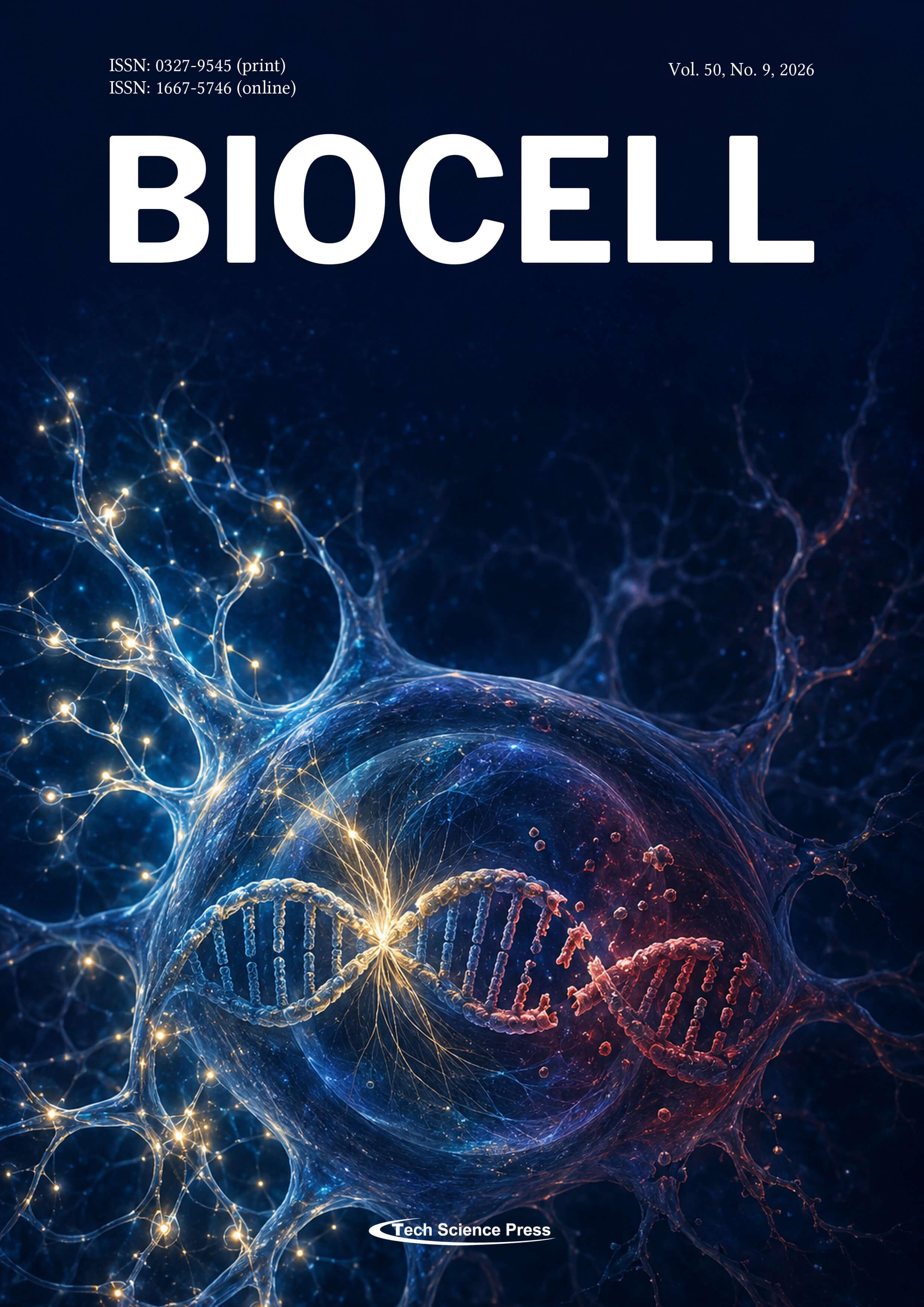
Within a neuronal nucleus, contrasting DNA states symbolize the dual role of double-strand breaks in the brain. Transient, regulated breaks support activity-dependent transcription and plasticity, whereas persistent or poorly repaired breaks are associated with neuronal dysfunction, aging, and disease. The cover image was created with AI-generated content via ChatGPT (Open AI), and it contains no copyrighted elements or misleading representations.

View this paper

  • Open AccessOpen Access

    REVIEW

    Physiological and Pathological DNA Double-Strand Breaks in the Central Nervous System

    Irina Shalaginova*, Boris Bakulevskiy
    BIOCELL, Vol.50, No.9, 2026, DOI:10.32604/biocell.2026.080400 - 26 August 2026
    Abstract This review discusses the dual role of DNA double-strand breaks (DSBs) in the brain, where they can act as both physiological regulators of gene expression and contributors to neuronal dysfunction under pathological conditions. In post-mitotic neurons, which rely mainly on non-homologous end joining, the balance between DSB formation and repair appears to be especially important. Recent studies show that transient activity-induced DSBs, particularly at regulatory regions of immediate early genes (IEGs), support chromatin remodeling and transcriptional activation. In contrast, persistent DSBs associated with chronic stress, hyperexcitability, ageing, or neurodegenerative disorders are linked to impaired repair, More >

  • Open AccessOpen Access

    REVIEW

    Multi-Omics-Driven Advances in Targeted and Immunologic Therapies for Triple-Negative Breast Cancer

    Kimiya Ganjooi, Sophia Strukel, Emma Eddy, Ryan Au, Vikrant Rai*
    BIOCELL, Vol.50, No.9, 2026, DOI:10.32604/biocell.2026.077955 - 26 August 2026
    (This article belongs to the Special Issue: Novel Targeted Therapy in Oncology)
    Abstract Triple-negative breast cancer (TNBC) is defined by the absence of estrogen, progesterone, and human epidermal growth factor receptor 2 expression and exhibits significant molecular heterogeneity and aggressive clinical behavior. The main treatment remains traditional chemotherapy, despite the modest duration of its effects, which has intensified the search for novel, non-chemotherapeutic drugs. Over the past few years, various molecularly targeted and immune-based treatments targeting TNBC’s diverse oncogenic drivers have been uncovered. In immunotherapy, checkpoint blockade and chimeric antigen receptor (CAR)-T cells show growing promise, enabling selective tumor targeting with reduced off-target toxicity. Multi-omics investigations integrating genomic,… More >

  • Open AccessOpen Access

    MINI REVIEW

    The Impact of COVID-19 on Breast Cancer and the Role of Neutrophil Extracellular Traps

    Amitabha Ray1,*, Thomas F. Moore2
    BIOCELL, Vol.50, No.9, 2026, DOI:10.32604/biocell.2026.076530 - 26 August 2026
    Abstract Severe acute respiratory syndrome coronavirus 2 (SARS-CoV-2)-related critical illness, i.e., severe form of coronavirus disease 2019 (COVID-19), is associated with a hyperinflammatory state. In COVID-19 disease, several components of the body, including the complement system, different cells such as endothelial cells, platelets, monocytes, and neutrophils, and various pro-inflammatory cytokines such as interleukin-6 and tumor necrosis factor α, can contribute to a state of coagulopathy, and ultimately, all these factors cause extensive tissue damage. This pathological process may contribute to increased aggressiveness in cancer cells or to the reawakening of dormant cancer cells. Studies have documented More >

    Graphic Abstract

    The Impact of COVID-19 on Breast Cancer and the Role of Neutrophil Extracellular Traps

  • Open AccessOpen Access

    MINI REVIEW

    PRX5 as a Redox Regulator of STAT3 Signaling in Cancer Stem Cells

    Eui-Hwan Choi*
    BIOCELL, Vol.50, No.9, 2026, DOI:10.32604/biocell.2026.079386 - 26 August 2026
    (This article belongs to the Special Issue: Autophagy and Oxidative Stress in Cancer: Molecular Crossroads and Cell Fate Decisions)
    Abstract Peroxiredoxin 5 (PRX5) is an atypical 2-Cys peroxiredoxin distributed across mitochondria, peroxisomes, cytosol, and nucleus. Unlike other PRX isoforms, PRX5 acts not only as a reactive oxygen species (ROS) scavenger but also as a redox-dependent regulator of oncogenic signaling. Cancer stem cells (CSCs) maintain low intracellular ROS to preserve self-renewal and drug resistance, and PRX5 has emerged as a key mediator of this redox control. This review examines the. PRX5-ROS-Signal Transducer and Activator of Transcription 3 (STAT3) axis in CSC biology. We present mechanistic evidence demonstrating that PRX5-mediated redox balance protects STAT3 from oxidative inactivation More >

  • Open AccessOpen Access

    REVIEW

    Research on Alveolar Type II Epithelial Cell Senescence in Idiopathic Pulmonary Fibrosis

    Lichun Zhong1,#, Dijia Wu2,#, Sirui Zhang2, Wenjing Liu2, Faping Wang3,*, Fengming Luo3,*
    BIOCELL, Vol.50, No.9, 2026, DOI:10.32604/biocell.2026.078898 - 26 August 2026
    (This article belongs to the Special Issue: Autophagy and Oxidative Stress in Cancer: Molecular Crossroads and Cell Fate Decisions)
    Abstract Idiopathic pulmonary fibrosis (IPF) is an age-associated, progressive fibrotic interstitial lung disease with limited disease-modifying therapies and poor long-term outcomes. Increasing evidence indicates that senescence of alveolar type II epithelial (AT2) cells is not merely a bystander phenomenon but a central driver of epithelial dysfunction, failed alveolar regeneration, and fibrotic remodeling. In this narrative review, we summarize recent mechanistic, single-cell, epigenetic, and translational studies that have reshaped the epithelial-centered model of IPF. We first outline normal AT2 biology and the regenerative AT2-to-AT1 trajectory, and then discuss how telomere dysfunction, endoplasmic reticulum stress, mitochondrial injury, DNA More >

  • Open AccessOpen Access

    REVIEW

    From Cardio-Kidney-Metabolic Syndrome to Periodontal Diseases: The Bio-Cellular Role of Propolis

    Jia-Feng Chang1,2, Ting-Yu Yeh3, I-Ta Lee4,*, Yue-Wen Chen5,6,*
    BIOCELL, Vol.50, No.9, 2026, DOI:10.32604/biocell.2026.080855 - 26 August 2026
    (This article belongs to the Special Issue: Unraveling Periodontal Disease: Molecular and Cellular Perspectives)
    Abstract Cardio-kidney-metabolic (CKM) syndrome and periodontal diseases are bi-directionally linked pathologies driven by systemic inflammation, oxidative stress, and metabolic dysregulation. Identifying pleiotropic therapeutic agents targeting this axis is a major clinical priority. This review evaluates the bio-cellular role of propolis, a natural resinous hive product, in mitigating CKM syndrome and periodontal disease. Propolis exerts robust protective effects by modulating key intracellular signaling pathways. Specifically, it upregulates nuclear factor erythroid 2-related factor 2 (Nrf2)-dependent antioxidant defenses, which subsequently interferes with redox-sensitive inflammatory triggers. Concurrently, it antagonizes pro-inflammatory signaling, including nuclear factor-kappa B (NF-κB), mitogen-activated protein kinase (MAPK), More >

  • Open AccessOpen Access

    REVIEW

    Costunolide as a Conceptual Framework for Host-Directed Antiviral Modulation: Mechanistic Insights and Future Perspectives

    Leonardo Acuña1, Mariam Ahumada Sabagh2, Víctor David Osorio Castillo1,2, Caverly Gooden3, María Luisa Veisaga4, Juan Liuzzi5,6, Manuel A. Barbieri2,3,5,6,7,*
    BIOCELL, Vol.50, No.9, 2026, DOI:10.32604/biocell.2026.079670 - 26 August 2026
    (This article belongs to the Special Issue: Bioactive Natural Components as Regulators of Cellular Pathways and Disease Progression)
    Abstract Costunolide, a sesquiterpene lactone from Saussurea lappa Clarke, exhibits broad pharmacological properties, including anti-inflammatory and anticancer effects. This review examines its emerging potential as a host-directed antiviral compound. Costunolide modulates conserved host signaling pathways frequently exploited during viral infection, including nuclear factor-kappa B (NF-κB), the NOD-like receptor family pyrin domain-containing 3 (NLRP3) inflammasome, and mitogen-activated protein kinase (MAPK) cascades. Inhibition of NF-κB may suppress viral transcription in human immunodeficiency virus (HIV-1) infection, while NLRP3 blockade may limit inflammasome-driven viral reactivation in Epstein–Barr virus (EBV) infection and attenuate hyperinflammation in severe acute respiratory syndrome coronavirus 2 (SARS-CoV-2) More >

  • Open AccessOpen Access

    ARTICLE

    Cytotoxicity Thresholds and Limited Modulation of LPS-Induced Microglial Activation by Croatian Olive Leaf Extracts: A Preliminary Study in a BV-2 Washout Model

    Kristina Pilipović1,*, Lucia Fabijančić2, Iva Kristić1, Lara Saftić Martinović3
    BIOCELL, Vol.50, No.9, 2026, DOI:10.32604/biocell.2026.079918 - 26 August 2026
    (This article belongs to the Special Issue: Cellular Mechanisms in Neurodegeneration, Injury, and Regeneration)
    Abstract Objectives: Neuroinflammation, largely mediated by microglial activation, plays a central role in the pathogenesis of neurodegenerative diseases. In this study, we aimed to evaluate olive leaf extracts (OLEs) from three Croatian cultivars (Buža, Oblica, and Leccino) in the context of lipopolysaccharide (LPS)-induced activation of BV-2 microglia. Methods: Extracts were prepared by aqueous maceration and ethanol extraction under conditions compatible with downstream cell-culture use. Total phenolic and flavonoid contents were determined for both extract types, alongside targeted liquid chromatography–mass spectrometry (LC–MS/MS) quantification of major phenolic compounds. Based on compositional analysis, ethanolic extracts were selected for further evaluation,… More >

  • Open AccessOpen Access

    ARTICLE

    Opioids Promote Autophagy and Attenuate LPS-Induced Cellular Senescence-Associated Changes in Microglia

    Akash S. Mali1, Debanjan Das2, Denise Greco1, Petr Telensky1, Jiri Novotny1,*
    BIOCELL, Vol.50, No.9, 2026, DOI:10.32604/biocell.2026.080886 - 26 August 2026
    Abstract Background: Opioids can modulate mitochondrial redox homeostasis and autophagy and are implicated in the regulation of key physiological and pathological processes, including aging, cellular metabolism, and tumorigenesis. The study aimed to investigate how opioid receptor agonists influence lipopolysaccharide-induced senescence in microglia. Methods: C8-B4 microglial cells were either left untreated or pretreated with different opioid agonists and subsequently exposed to lipopolysaccharide (LPS). Colorimetric assays, fluorescence microscopy, flow cytometry, and Western blotting were used to assess cellular senescence, autophagy-associated changes, reactive oxygen species, and calcium levels, as well as the expression of selected marker proteins and signaling molecules. Results:More >

    Graphic Abstract

    Opioids Promote Autophagy and Attenuate LPS-Induced Cellular Senescence-Associated Changes in Microglia

  • Open AccessOpen Access

    ARTICLE

    YOD1 Stabilizes RIPK1 via Deubiquitination to Activate NF-κB and Promote Cardiomyocyte H/R Injury

    Liangliang Liu, Linjun Wang, Xin Song, Zhen Liu*
    BIOCELL, Vol.50, No.9, 2026, DOI:10.32604/biocell.2026.080414 - 26 August 2026
    Abstract Background: Myocardial ischemia-reperfusion (I/R) injury represents a severe pathological process in cardiovascular diseases. This study aims to elucidate the mechanism of the yeast ovarian tumor (OTU) domain-containing protein 1 (YOD1) in cardiomyocyte injury. Methods: A hypoxia/reoxygenation (H/R) model was established using human AC16 cells to simulate I/R injury in vitro. Reverse transcription quantitative PCR (RT-qPCR) and western blotting were used to detect gene and protein expression. Cellular functions were evaluated using Cell Counting Kit-8 (CCK-8), lactate dehydrogenase (LDH), enzyme-linked immunosorbent assay (ELISA), flow cytometry, and biochemical kits. Protein interaction was validated through co-immunoprecipitation (Co-IP), ubiquitination assays, and… More >

  • Open AccessOpen Access

    ARTICLE

    Salviadione Attenuates Acute Lung Injury by Targeting VDAC1-Mediated Mitochondrial Ferroptosis

    Wentao Su1,#, Aishan Gulijiakela1,#, Jihao Xiong1, San Zhang1, Ke Ma2,*
    BIOCELL, Vol.50, No.9, 2026, DOI:10.32604/biocell.2026.081235 - 26 August 2026
    (This article belongs to the Special Issue: Bioactive Natural Components as Regulators of Cellular Pathways and Disease Progression)
    Abstract Objective: Mitochondrial dysfunction and ferroptosis contribute critically to acute lung injury (ALI), yet therapies targeting this pathway remain limited. This study investigates whether Salviadione, a rare alkaloid, protects against lipopolysaccharide (LPS)-induced epithelial damage by modulating the mitochondrial ferroptosis pathway. Methods: Network pharmacology, molecular docking, and molecular dynamics simulations identified potential targets. An in vitro model of lung epithelial injury was established using BEAS-2B cells exposed to LPS. Cell viability, lactate dehydrogenase (LDH) release, lipid peroxidation, Fe2+ accumulation, glutathione peroxidase 4 (GPX4) and acyl-CoA synthetase long-chain family member 4 (ACSL4) expression, mitochondrial membrane potential (ΔΨm), mitochondrial reactive oxygen species… More >

  • Open AccessOpen Access

    ARTICLE

    Oridonin Ameliorates Nonalcoholic Steatohepatitis by Regulating Pyroptosis through the NF-κB/NLRP3 Axis

    Qianqian Peng, Fengjian He, Shumin Pan, Yinghua Ou*
    BIOCELL, Vol.50, No.9, 2026, DOI:10.32604/biocell.2026.081188 - 26 August 2026
    Abstract Background: Nonalcoholic steatohepatitis (NASH) is a liver disease characterized by inflammation and fibrosis. Oridonin (Ori) exhibits anti-inflammatory and anti-fibrotic properties, but its role in NASH remains unclear. The study aimed to investigate whether Ori alleviates NASH injury by regulating pyroptosis through the nuclear factor-κB (NF-κB)/nucleotide-binding oligomerization domain-like receptor protein 3 (NLRP3) axis. Methods: An in vitro NASH model was established in HepG2 cells using free fatty acids (FFA), and an in vivo model was induced in mice using a methionine-choline-deficient (MCD) diet. Biochemical assays, staining, flow cytometry, Western blot, and immunofluorescence assessed lipid accumulation, oxidative stress, inflammation, pyroptosis,… More >

    Graphic Abstract

    Oridonin Ameliorates Nonalcoholic Steatohepatitis by Regulating Pyroptosis through the NF-κB/NLRP3 Axis

Per Page:

Share Link