Home / Journals / BIOCELL / Vol.49, No.9, 2025
Special Issues
Table of Content
cover

On the Cover

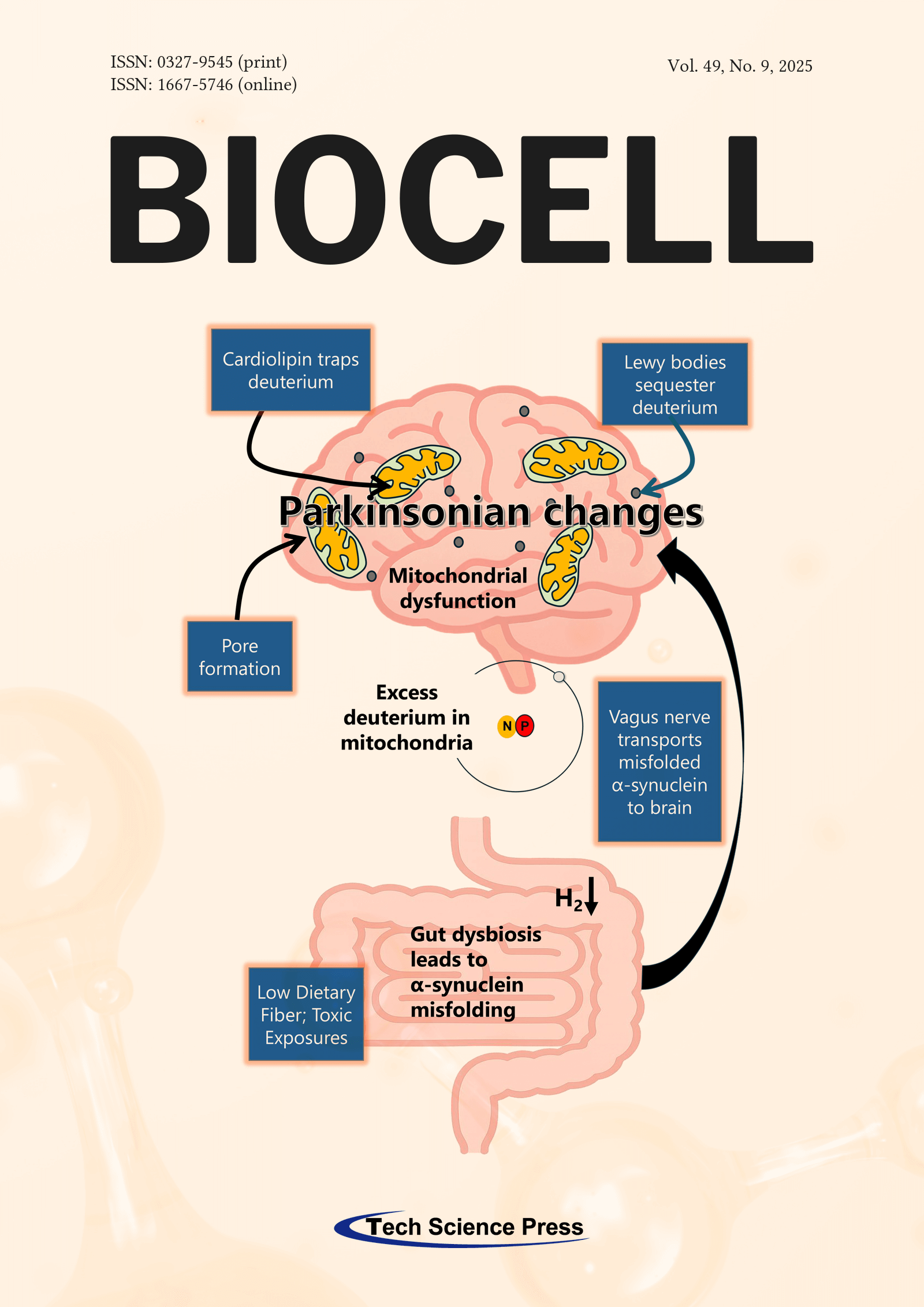
Parkinson's disease begins with gut dysbiosis, reducing the supply of the deuterium-depleted butyrate systemically. Excess deuterium damages mitochondrial ATPase pumps. Cardiolipin, a mitochondrial lipid, may trap and sequester deuterium. Cardiolipin induces pore formation in the outer mitochondrial membrane. Misfolded α-synuclein migrates from the gut to the brain via the vagus nerve. Lewy bodies sequester both α-synuclein and deuterium-loaded mitochondrial debris.

View this paper

  • Open AccessOpen Access

    REVIEW

    Mitochondrial Dysfunction in Parkinson’s Disease: Is Impaired Deuterium Depleted Nutrient Supply by Gut Microbes a Primary Factor?

    Stephanie Seneff1,*, Greg Nigh2, Anthony M. Kyriakopoulos3,4
    BIOCELL, Vol.49, No.9, pp. 1545-1572, 2025, DOI:10.32604/biocell.2025.066687 - 25 September 2025
    (This article belongs to the Special Issue: Cellular Mechanisms and Therapeutic Approaches in Protein Misfolding Diseases)
    Abstract Deuterium is a heavy isotope of hydrogen, with an extra neutron, endowing it with unique biophysical and biochemical properties compared to hydrogen. The ATPase pumps in the mitochondria depend upon proton motive force to catalyze the reaction that produces ATP. Deuterons disrupt the pumps, inducing excessive reactive oxygen species and decreased ATP synthesis. The aim of this review is to develop a theory that mitochondrial dysfunction due to deuterium overload, systemically, is a primary cause of Parkinson’s disease (PD). The gut microbes supply deuterium-depleted short chain fatty acids (SCFAs) to the colonocytes, particularly butyrate, and… More >

  • Open AccessOpen Access

    REVIEW

    Cross-Talk between Next-Generation Probiotics and the Immune System

    Mikhail Syromyatnikov1,2,*, Mariya Gladkikh1, Ekaterina Nesterova1, Shima Kazemzadeh1, Polina Morozova1, Olga Korneeva1
    BIOCELL, Vol.49, No.9, pp. 1573-1603, 2025, DOI:10.32604/biocell.2025.065311 - 25 September 2025
    (This article belongs to the Special Issue: Cellular and Molecular Mechanisms Underlying Inflammation and Immune Regulation: From Genotoxicity to Apoptosis)
    Abstract The gut microbiome is a complex community of microorganisms that plays a direct role in the health of both the gastrointestinal tract and the entire body. Numerous factors influence the abundance and diversity of gut microbiota. Microbial imbalance can contribute to disease development. Probiotics are biologically active supplements with promising properties that have high therapeutic potential. Currently, there is a tendency to switch from classic probiotic microorganisms represented by lactic acid bacteria to next-generation probiotics due to their unique ability to influence the human immune system. New-generation probiotics include bacteria such as Akkermansia muciniphila, Faecalibacterium prausnitzii, Bacteroides sp., More >

  • Open AccessOpen Access

    REVIEW

    Extracellular Vesicles as Therapeutic Tools against Infectious Diseases

    CHIOMA C. EZEUKO#, SANDANI V. T. WIJERATHNE#, QIANA L. MATTHEWS*
    BIOCELL, Vol.49, No.9, pp. 1605-1629, 2025, DOI:10.32604/biocell.2025.065474 - 25 September 2025
    (This article belongs to the Special Issue: Exploring the Mechanism and Theranostic Potential of Extracellular RNAs in Current Medicine)
    Abstract Extracellular vesicles (EVs) have arisen as potential therapeutic tools in managing infectious diseases because EVs can regulate cell-to-cell signaling, function as drug transport mechanisms, and influence immune reactions. They are obtained from a myriad of sources, such as plants, humans, and animal cells. EVs like exosomes and ectosomes can be utilized in their native form as therapeutics or engineered to encompass antimicrobials, vaccines, and oligonucleotides of interest with a targeted delivery strategy. An in-depth understanding of host-pathogen dynamics provides a solid foundation for exploiting its full potential in therapeutics against infectious diseases. This review mainly More >

  • Open AccessOpen Access

    REVIEW

    Immune Mechanisms of the Comorbid Course of Chronic Obstructive Pulmonary Disease and Tuberculosis

    Stanislav Kotlyarov1,*, Dmitry Oskin2
    BIOCELL, Vol.49, No.9, pp. 1631-1661, 2025, DOI:10.32604/biocell.2025.066675 - 25 September 2025
    (This article belongs to the Special Issue: Mechanisms Driving COPD, Atherosclerosis, and Cardiovascular Disease: From Pathogenesis to Therapeutic Innovations)
    Abstract Chronic obstructive pulmonary disease (COPD) and respiratory tuberculosis are important respiratory problems. Meeting together, these diseases can mutually worsen the severity of clinical manifestations and negatively affect prognosis. COPD and tuberculosis share a number of common risk factors and pathogenetic mechanisms involving various immune and non-immune cells. Inflammation, hypoxia, oxidative stress, and lung tissue remodeling play an important role in the comorbid course of COPD and respiratory tuberculosis. These mechanisms are of diagnostic interest and are promising therapeutic targets. Thus, the aim of the current review is to discuss the mechanisms of the comorbid course More >

  • Open AccessOpen Access

    REVIEW

    The Role of miRNAs in Mechanotransduction Regulation and Cancer Development

    Ana M. Vela-AlcáNtara1, Diego J. HernáNdez-SáNchez1,2, Elisa Tamariz1,*
    BIOCELL, Vol.49, No.9, pp. 1663-1695, 2025, DOI:10.32604/biocell.2025.066201 - 25 September 2025
    (This article belongs to the Special Issue: Non-coding RNAs (ncRNAs) in Human Diseases)
    Abstract Cells are exposed to various mechanical forces, including extracellular and intracellular forces such as stiffness, tension, compression, viscosity, and shear stress, which regulate cell biology. The process of transducing mechanical stimuli into biochemical signals is termed mechanotransduction. These mechanical forces can regulate protein and gene expression, thereby impacting cell morphology, adhesion, proliferation, apoptosis, and migration. During cancer development, significant changes in extracellular and intracellular mechanical properties occur, resulting in altered mechanical inputs to which cells are exposed. MicroRNAs (miRNAs), key post-transcriptional regulators of gene and protein expression, are increasingly recognized as mechanosensitive molecules involved in More >

  • Open AccessOpen Access

    ARTICLE

    Genome-Wide Gene Expression Profiling in Human Adipose-Derived Mesenchymal Stem Cells

    Sae Hee Cheon1, Sung-Whan Kim2,3,*
    BIOCELL, Vol.49, No.9, pp. 1697-1710, 2025, DOI:10.32604/biocell.2025.068743 - 25 September 2025
    (This article belongs to the Special Issue: Tissue Regeneration and Vascularization: From Stem Cells to Functional Tissues)
    Abstract Objectives: Despite the considerable regenerative capacity exhibited by adipose-derived mesenchymal stem cells (ASCs), their genetic and molecular mechanisms remain incompletely understood. Methods: In this study, we analyzed the global gene expression profile of adipose-derived mesenchymal stem cells (ASCs) using microarray analysis and compared it with stromal vascular fraction (SVF) cells. Results: Microarray analysis revealed that ASCs express elevated levels of genes related to the extracellular matrix (ECM; extracellular matrix) and collagen, which are critical components of tissue remodeling and wound healing. Additionally, genes associated with cell growth, differentiation, motility, and plasticity were highly expressed. When compared… More >

  • Open AccessOpen Access

    ARTICLE

    Rhein Inhibits Podocyte Ferroptosis and Epithelial-Mesenchymal Transition in Diabetic Nephropathy by Activating the SIRT1/p53/SLC7A11 Pathway

    Wei Hu1, Dan Xiong2,*
    BIOCELL, Vol.49, No.9, pp. 1711-1731, 2025, DOI:10.32604/biocell.2025.067670 - 25 September 2025
    Abstract Objectives: Podocytes undergo epithelial-mesenchymal transition (EMT) and ferroptosis in response to hyperglycemic stimulation. This is considered an important early event in the development and progression of diabetic nephropathy (DN). Rhein is the main active anthraquinone derivative in several common traditional herbal medicines. This study aimed to investigate the protective effects of Rhein on podocyte ferroptosis and EMT. Methods: The mouse glomerular podocyte cell line MPC5 was stimulated with high glucose (HG), Rhein, and the ferroptosis inhibitor ferrostatin-1 (Fer-1). Mechanistic investigations employed plasmids to overexpress and knockdown Sirtuin-1 (SIRT1), solute carrier family 7 member 11 (SLC7A11),… More >

  • Open AccessOpen Access

    ARTICLE

    Hibifolin Modulates the Activation of Mouse Bone Marrow-Derived Dendritic Cells and Attenuates Contact Dermatitis Induced by 2,4-Dinitro-1-Fluorobenzene

    Ya-Yi Chen1,2, Tzu-Ting Chen3, Ya-Hsuan Chao4, Wen-Ho Chuo5, Chieh-Shan Wu6,7, Ruo-Han Tseng8,*, Chieh-Chen Huang9,*
    BIOCELL, Vol.49, No.9, pp. 1733-1748, 2025, DOI:10.32604/biocell.2025.067011 - 25 September 2025
    (This article belongs to the Special Issue: Natural and Synthetic Small Molecules in the Regulation of Immune Cell Functions)
    Abstract Objectives: Professional antigen-presenting cells known as dendritic cells (DCs) assist as a connection between the innate and adaptive components of the immune response. DCs are attractive targets for immunomodulatory drugs because of their crucial function in triggering immunity. This study set out to examine, for the first time, how hibifolin affected mouse bone-marrow derived (BMDCs) dendritic cells, triggered by lipopolysaccharide (LPS) in vitro. Additionally, a mouse model of contact hypersensitivity (CHS) was used to assess its possible therapeutic effects in vivo. Methods: LPS was administered to BMDCs with or without hibifolin. Major Histocompatibility Complex (MHC) class II,… More >

  • Open AccessOpen Access

    ARTICLE

    ScRNA-seq and Experimental Analyses Unveil Lrg1 Regulating the Oxidative Phosphorylation Pathway to Affect Neutrophil Accumulation after Cerebral Ischemia-Reperfusion

    Luyao Jiang1,#, Longsheng Fu2,#, Shaofeng Xiong2,3, Guosheng Cao4, Yanqin Mei2,3, Yaoqi Wu2, Jin Chen1,*, Yanni LV2,5,6,*
    BIOCELL, Vol.49, No.9, pp. 1749-1769, 2025, DOI:10.32604/biocell.2025.068507 - 25 September 2025
    Abstract Background: After ischemic stroke, neutrophils hyperactivate, increasing in number and worsening inflammation, causing neural damage. Prior scRNA-seq showed Lrg1 modulates cells subsentence to cerebral ischemia-reperfusion injury, but its mechanism in regulating neutrophil accumulation/differentiation post-injury is unclear. Methods: Lrg1 knockout impact on neutrophil accumulation was assessed via immunofluorescence and western blot. Three-dimensional reconstruction of immunofluorescent staining analyzed cell-cell interactions among neutrophils and microglia. scRNA-seq of WT and Lrg1-/- mice from GSE245386 and GSE279462 was conducted. Each group conducted oxidative phosphorylation scoring via Gene Set Enrichment Analysis (GSEA), while Metascape was employed to perform GO and KEGG enrichment… More >

    Graphic Abstract

    ScRNA-seq and Experimental Analyses Unveil Lrg1 Regulating the Oxidative Phosphorylation Pathway to Affect Neutrophil Accumulation after Cerebral Ischemia-Reperfusion

  • Open AccessOpen Access

    ARTICLE

    Synergistic Anti-Lung Cancer and Immunomodulatory Effects of Combined Extracts from Acanthopanax sessiliflorus, Phragmites communis, and Pinus densiflora

    Anjali Kariyarath Valappil1,#, Reshmi Akter2,#, Muhammad Awais2, Dong Uk Yang3, Daehyo Jung2, Li Ling4, Eun Kim5, Kyu Hyeong Yoon5, Yoon Ok Lee5, Deok Chun Yang1,2,4,*
    BIOCELL, Vol.49, No.9, pp. 1771-1795, 2025, DOI:10.32604/biocell.2025.069145 - 25 September 2025
    (This article belongs to the Special Issue: Natural Product-Based Anticancer Drug Discovery)
    Abstract Objectives: The phytochemical investigation of traditional herbal medicines holds significant promise for modern drug discovery, particularly in cancer therapy. This study aimed to evaluate the cytotoxicity, apoptosis induction, and immune-modulatory activities of extracts from three herbal medicines with historical use in traditional medicine—Acanthopanax sessiliflorus, Phragmites communis, and Pinus densiflora, as well as their combined extract (GMAS 01/COM), on human lung cancer cells (A549) and normal cell lines, including murine macrophages (RAW 264.7) and human keratinocytes (HaCaT). Methods: Plant extracts were prepared using aqueous extraction, sonication, and rotary evaporation. The total phenolic and flavonoid contents were quantified using the… More >

  • Open AccessOpen Access

    CORRECTION

    Correction: MiR-16-5p Plays an Inhibitory Role in Human Non-Small Cell Lung Cancer through Fermitin Family Member 2

    Junqi Guo1,2, Yun Yang1,2, Wei Zhao1,2, Zhonghai Yan3, Xia Yang4, Yunfei Yan1,2, Ruimin Hao1,2, Jinxia Hu1,2,*, Fei Jiao1,2,*
    BIOCELL, Vol.49, No.9, pp. 1797-1797, 2025, DOI:10.32604/biocell.2025.071013 - 25 September 2025
    Abstract This article has no abstract. More >

Per Page:

Share Link
