Guest Editor(s)
Assoc. Prof. Elżbieta Płuciennik
Email: elzbieta.pluciennik@umed.lodz.pl
Affiliation: Department of Functional Genomics, Medical University of Lodz, Żeligowskiego 7/9, 90-752, Lodz, Poland.
Homepage: https://www.researchgate.net/profile/Elzbieta-Pluciennik?ev=hdr_xprf
Research Interests: molecular biology of cancer, cell therapy, signaling pathways essential in cancer therapy

Summary
Oncology has been transformed by targeted therapy, which provides therapies that target cancer cells precisely at the cellular level while causing the least amount of damage to healthy tissue. The particular molecular abnormalities—such as hyperactive proteins, altered genes, or signaling pathways—are the focus of targeted medicines, as opposed to standard chemotherapy, which generally targets quickly proliferating cells. Because of this accuracy, therapy may be greatly customized, leading to better results and less collateral effects.
Targeted treatments have been made possible by developments in molecular biology and genetic engineering, including precision CRISPR tools, nanoparticle delivery methods, CAR-T/NK cells, and p53 gene repair. This method, which is customized to the unique features of every tumor, delivers increased efficacy and less toxicity. Importantly, these therapies are grounded in cellular mechanisms that reveal functional insights at the cell level. Future developments include oncolytic viruses, base editors, new antibody–drug conjugates (ADCs), tumor-agnostic therapy (which target mutations independently of the kind of cancer), and dynamic resistance monitoring. The future of customized oncology is being shaped by these developments.
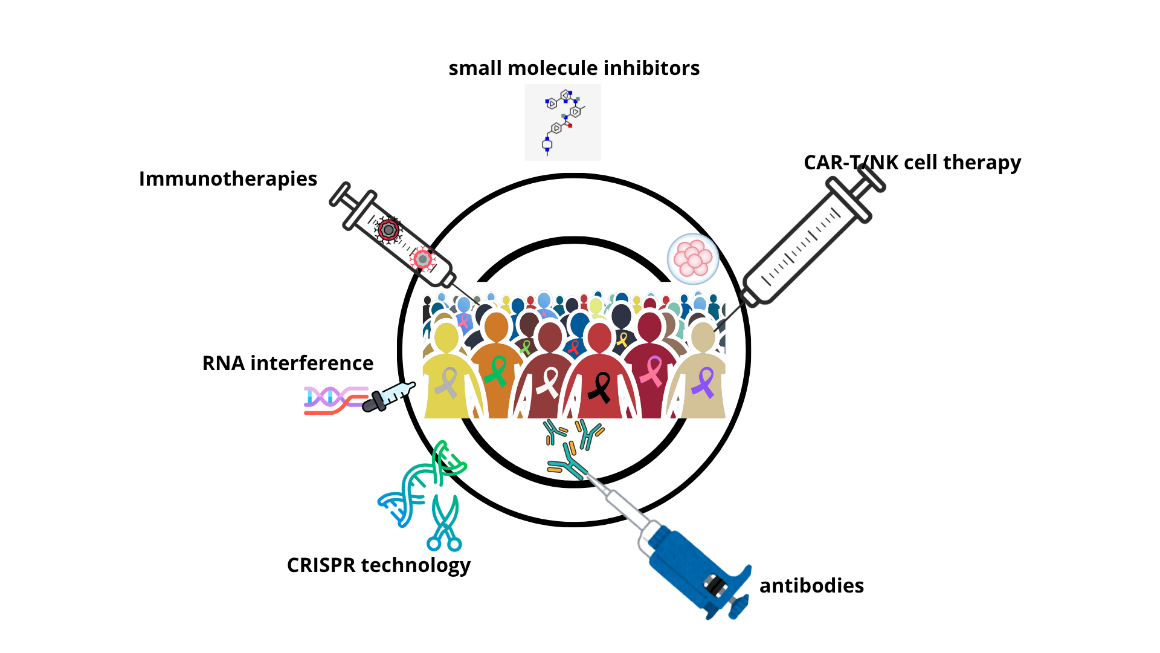
This Special Issue covers innovative targeted treatments for cancer, such as cell-based therapies, RNA interference (RNAi), antibody-based, and small molecule inhibitor-based approaches. Fundamentals, difficulties, preclinical and clinical research, and prospects for the future are all covered. The main areas of interest are targeted cancer treatment, antibody-based treatments, non-coding RNA treatments, and especially cell-based treatments including dendritic cell therapy, CAR-T/NK cell therapy, natural killer (NK) cell therapy, and chimeric antigen receptor (CAR)-T cell therapy, all with a focus on revealing cellular-level mechanisms and functions.
Research articles, review articles as well as short communications are invited.
Graphic Abstract
Keywords
targeted therapy, cancer, cell-based therapy, molecular mechanisms, CAR-T cells, nanoparticle delivery, RNA interference, antibody–drug conjugates, CRISPR technology
Published Papers

 Login
Login Register
 Submit a Paper
 Propose a Special lssue