
 Login
Login Register
 Submit a Paper
 Propose a Special lssue
 Open Access
ARTICLE
FedCCM: Communication-Efficient Federated Learning via Clustered Client Momentum in Non-IID Settings
1 Faculty of Information Engineering and Automation, Kunming University of Science and Technology, Kunming, 650500, China
2 Yunnan Key Laboratory of Computer Technologies Application, Kunming, 650500, China
* Corresponding Author: Kai Zeng. Email:
Computers, Materials & Continua 2026, 86(3), 72 https://doi.org/10.32604/cmc.2025.072909
Received 06 September 2025; Accepted 06 November 2025; Issue published 12 January 2026
 View Full Text
 Download PDF
Abstract
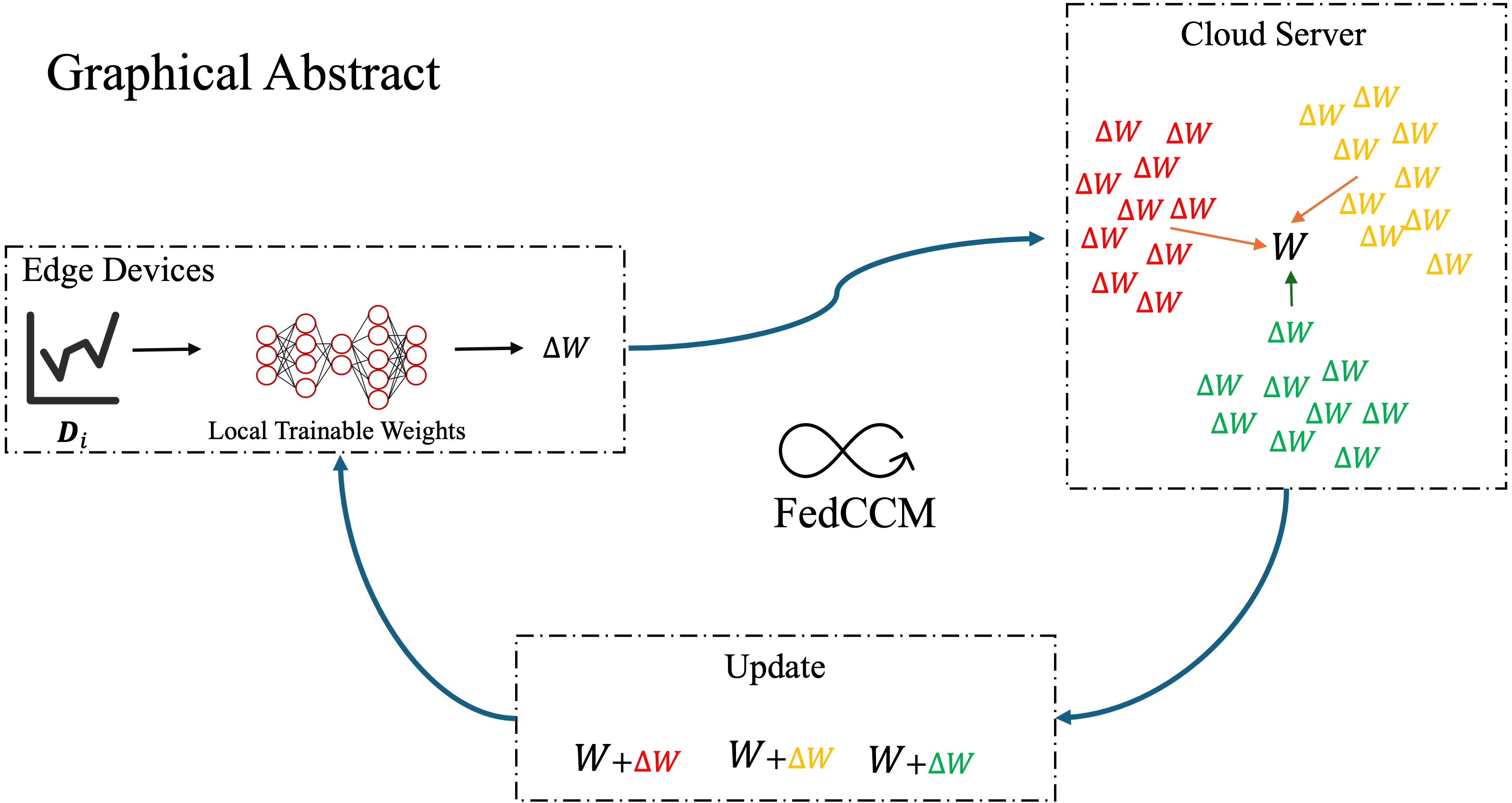
Federated learning often experiences slow and unstable convergence due to edge-side data heterogeneity. This problem becomes more severe when edge participation rate is low, as the information collected from different edge devices varies significantly. As a result, communication overhead increases, which further slows down the convergence process. To address this challenge, we propose a simple yet effective federated learning framework that improves consistency among edge devices. The core idea is clusters the lookahead gradients collected from edge devices on the cloud server to obtain personalized momentum for steering local updates. In parallel, a global momentum is applied during model aggregation, enabling faster convergence while preserving personalization. This strategy enables efficient propagation of the estimated global update direction to all participating edge devices and maintains alignment in local training, without introducing extra memory or communication overhead. We conduct extensive experiments on benchmark datasets such as Cifar100 and Tiny-ImageNet. The results confirm the effectiveness of our framework. On CIFAR-100, our method reaches 55% accuracy with 37 fewer rounds and achieves a competitive final accuracy of 65.46%. Even under extreme non-IID scenarios, it delivers significant improvements in both accuracy and communication efficiency. The implementation is publicly available at https://github.com/sjmp525/CollaborativeComputing/tree/FedCCM (accessed on 20 October 2025).Graphic Abstract
Keywords
Federated learning; distributed computation; communication efficient; momentum clustering; non-independent and identically distributed (non-IID)
Cite This Article
APA Style
Wen, H., Zeng, K. (2026). FedCCM: Communication-Efficient Federated Learning via Clustered Client Momentum in Non-IID Settings. Computers, Materials & Continua, 86(3), 72. https://doi.org/10.32604/cmc.2025.072909
Vancouver Style
Wen H, Zeng K. FedCCM: Communication-Efficient Federated Learning via Clustered Client Momentum in Non-IID Settings. Comput Mater Contin. 2026;86(3):72. https://doi.org/10.32604/cmc.2025.072909
IEEE Style
H. Wen and K. Zeng, “FedCCM: Communication-Efficient Federated Learning via Clustered Client Momentum in Non-IID Settings,” Comput. Mater. Contin., vol. 86, no. 3, pp. 72, 2026. https://doi.org/10.32604/cmc.2025.072909
 Copyright © 2026 The Author(s). Published by Tech Science Press.
This work is licensed under a Creative Commons Attribution 4.0 International License , which permits unrestricted use, distribution, and reproduction in any medium, provided the original work is properly cited.
 Downloads
 Citation Tools
