
 Login
Login Register
 Submit a Paper
 Propose a Special lssue
 Open Access
ARTICLE
Enhanced Thermal Performance of a Shell and Coil Tube Heat Exchanger Using Fins and Slots
1 Building and Construction Department, Shaqlawa Technical College, Erbil Polytechnic University, Erbil, 44001, Iraq
2 Department of Mechanical and Energy Engineering, Erbil Technical Engineering College, Erbil Polytechnic University, Erbil, 44001, Iraq
* Corresponding Author: Najiba Hasan Hamad. Email:
(This article belongs to the Special Issue: Advancements in Energy Resources and Their Processes, Systems, Materials and Policies for Affordable Energy Sustainability)
Energy Engineering 2026, 123(1), 14 https://doi.org/10.32604/ee.2025.073377
Received 17 September 2025; Accepted 13 November 2025; Issue published 27 December 2025
 View Full Text
 Download PDF
Abstract
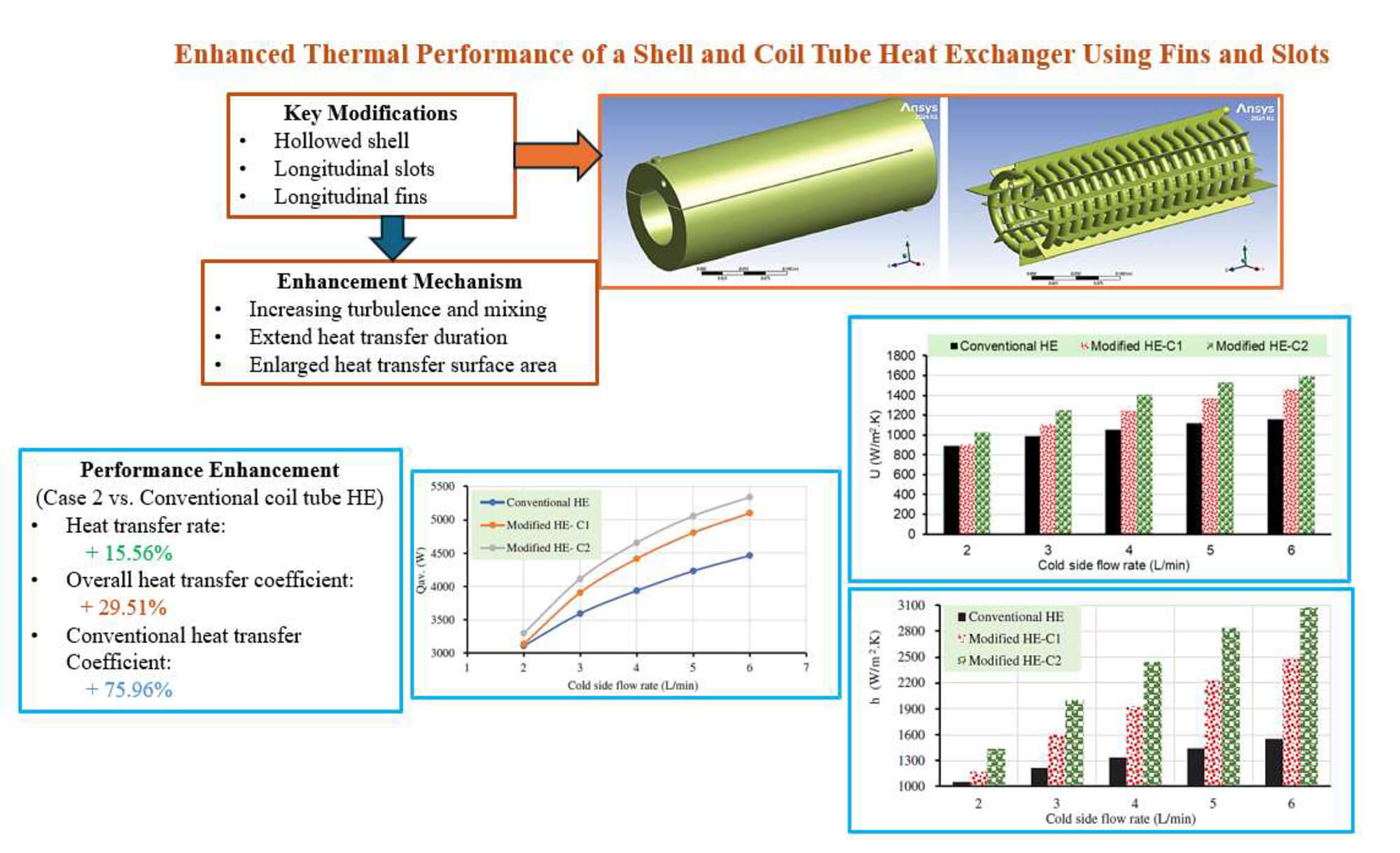
Coiled tube heat exchangers are widely preferred in shell structures due to their superior heat transfer performance, driven by favorable flow characteristics. This study investigates the effect of modifying coil and shell configurations on heat transfer efficiency. Two key enhancements were examined: adding fins to the outer coil surface and integrating longitudinal slots within a hollowed shell. These modifications promote turbulence and extend heat transfer duration, thereby improving performance. However, they also introduce challenges, including increased pressure loss and manufacturing complexity. Numerical simulations were conducted using ANSYS Fluent 2024R1 under identical boundary conditions. With a fixed cold-side flow rate of 3 L/min, the input temperatures for the hot and cold fluids were 333.15 and 291.65 K, respectively. The hot-side flow rate varied between 2 and 6 L/min. Simulation outcomes were reported for the objectives of the study that included the improvement in heat exchangers’ heat transfer enhancement. As it was indicated in the study outcomes, the average heat transfer rate increased by 15.56%, the overall heat transfer coefficient enhanced by about 29.51%, and the convective heat transfer coefficient improved by about 75.96% compared to the conventional shell-and-coil tube heat exchanger model. However, the modified technique resulted in a significant pressure drop.Graphic Abstract
Keywords
Cite This Article
 Copyright © 2026 The Author(s). Published by Tech Science Press.
This work is licensed under a Creative Commons Attribution 4.0 International License , which permits unrestricted use, distribution, and reproduction in any medium, provided the original work is properly cited.
 Downloads
 Citation Tools
