
 Login
Login Register
 Submit a Paper
 Propose a Special lssue
 Open Access
REVIEW
Supercapacitors in Modern Energy Systems: A Critical Review of Materials, Architectures, Digital Twins, AI Integration, and Applications
1 Energy Group, Cyient Ltd., Pune, 411057, India
2 Department of Electronics and Communication Engineering, Vasireddy Venkatadri Institute of Technology, Guntur, 522508, India
3 Department of Electronics and Communication Engineering, Koneru Lakshmaiah Education Foundation, Vaddeswaram, Guntur, 522302, India
4 Department of Electrical and Electronics Engineering, Vignan’s LARA Institute of Technology & Science, Guntur, 522213, India
5 Department of Electrical and Electronics Engineering, Vignan’s Foundation for Science Technology and Research, Guntur, 522213, India
6 Mobility Group, Eaton India Innovation Center LLP, Pune, 411028, India
* Corresponding Author: Rajanand Patnaik Narasipuram. Email:
(This article belongs to the Special Issue: Advances in Renewable Energy and Storage: Harnessing Hydrocarbon Prediction and Polymetric Materials for Enhanced Efficiency and Sustainability)
Energy Engineering 2026, 123(5), 3 https://doi.org/10.32604/ee.2026.076542
Received 22 November 2025; Accepted 31 December 2025; Issue published 27 April 2026
 View Full Text
 Download PDF
Abstract
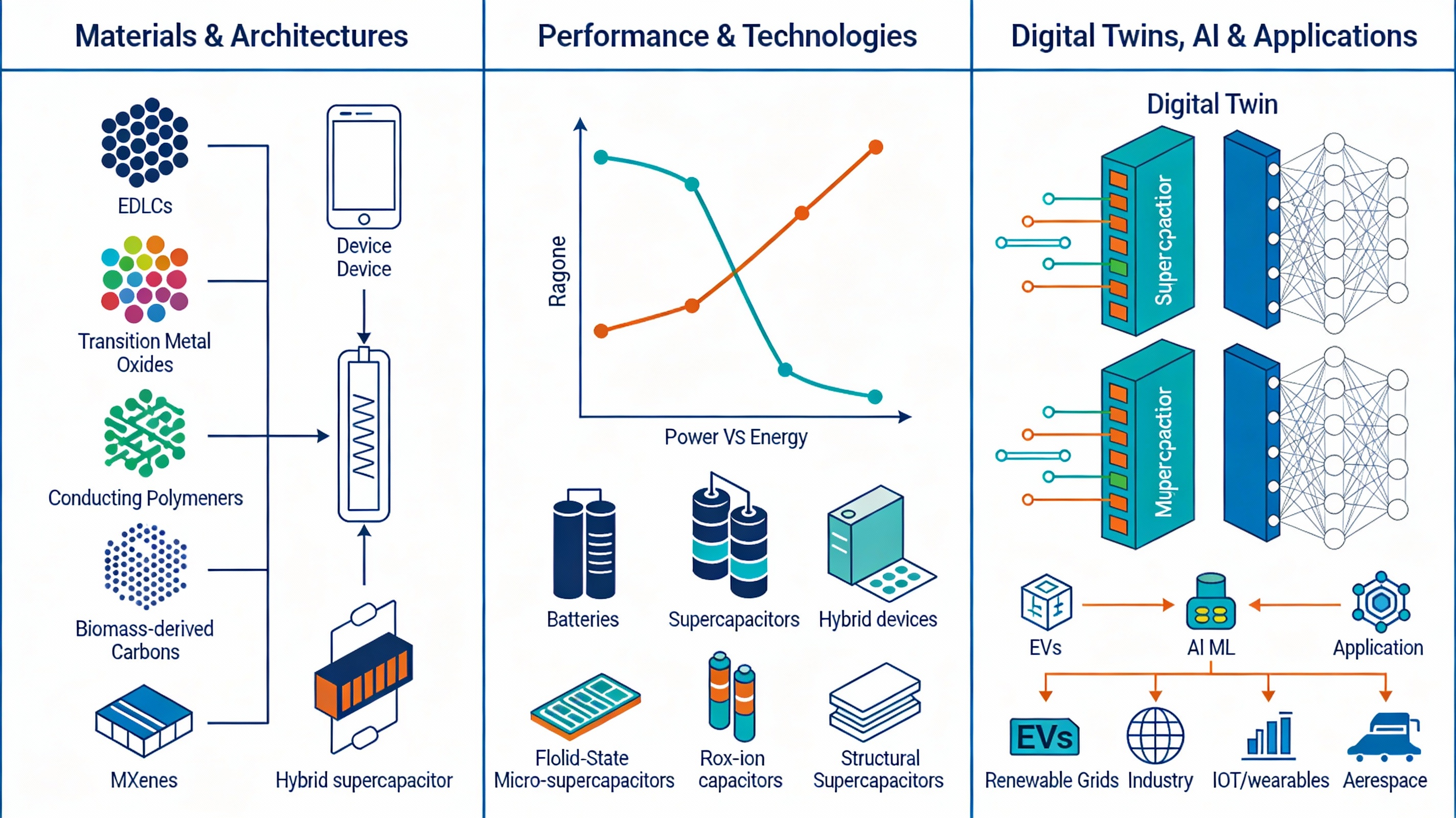
Supercapacitors are increasingly deployed as high power buffers in modern energy systems, yet their broader impact is constrained by limited energy density, fragmented testing practices, and incomplete understanding of lifecycle implications. This article presents a critical, method driven review based on a structured literature survey and explicit inclusion criteria, aggregating quantitative performance data for major electrode families (carbon materials, transition metal oxides, conducting polymers, biomass derived carbons, MXenes, and hybrid composites), electrolytes (aqueous, organic, ionic liquid, and gel/solid state), and device architectures (flexible, micro, solid state, lithium ion capacitors, and structural supercapacitors) under harmonized metrics such as capacitance, energy/power density, equivalent series resistance(ESR), cycle life, and operating voltage. The review benchmarks competing materials and commercial products, analyzes hybrid battery-supercapacitor configurations, and links quantified performance to application requirements in electric vehicles, renewable grids, industrial power conditioning, IoT/wearables, and aerospace, while emphasizing standardized testing protocols and lifecycle assessment as prerequisites for fair comparison and technology road mapping. Furthermore, the article examines concrete case studies of digital twin and AI enhanced modeling and control for supercapacitor based systems, detailing data needs, model structures, documented benefits, and open challenges, and concludes by outlining coordinated research and policy priorities in sustainable materials, device and system design, standardization, and circular economy strategies to enable reliable, evidence based deployment of supercapacitors in future low carbon energy infrastructures.Graphic Abstract
Keywords
Cite This Article
 Copyright © 2026 The Author(s). Published by Tech Science Press.
This work is licensed under a Creative Commons Attribution 4.0 International License , which permits unrestricted use, distribution, and reproduction in any medium, provided the original work is properly cited.
 Downloads
 Citation Tools
