
 Login
Login Register
 Submit a Paper
 Propose a Special lssue
 Open Access
REVIEW

Supercapacitors in Modern Energy Systems: A Critical Review of Materials, Architectures, Digital Twins, AI Integration, and Applications
1 Energy Group, Cyient Ltd., Pune, 411057, India
2 Department of Electronics and Communication Engineering, Vasireddy Venkatadri Institute of Technology, Guntur, 522508, India
3 Department of Electronics and Communication Engineering, Koneru Lakshmaiah Education Foundation, Vaddeswaram, Guntur, 522302, India
4 Department of Electrical and Electronics Engineering, Vignan’s LARA Institute of Technology & Science, Guntur, 522213, India
5 Department of Electrical and Electronics Engineering, Vignan’s Foundation for Science Technology and Research, Guntur, 522213, India
6 Mobility Group, Eaton India Innovation Center LLP, Pune, 411028, India
* Corresponding Author: Rajanand Patnaik Narasipuram. Email:
(This article belongs to the Special Issue: Advances in Renewable Energy and Storage: Harnessing Hydrocarbon Prediction and Polymetric Materials for Enhanced Efficiency and Sustainability)
Energy Engineering 2026, 123(5), 3 https://doi.org/10.32604/ee.2026.076542
Received 22 November 2025; Accepted 31 December 2025; Issue published 27 April 2026
 View Full Text
 Download PDF
Abstract
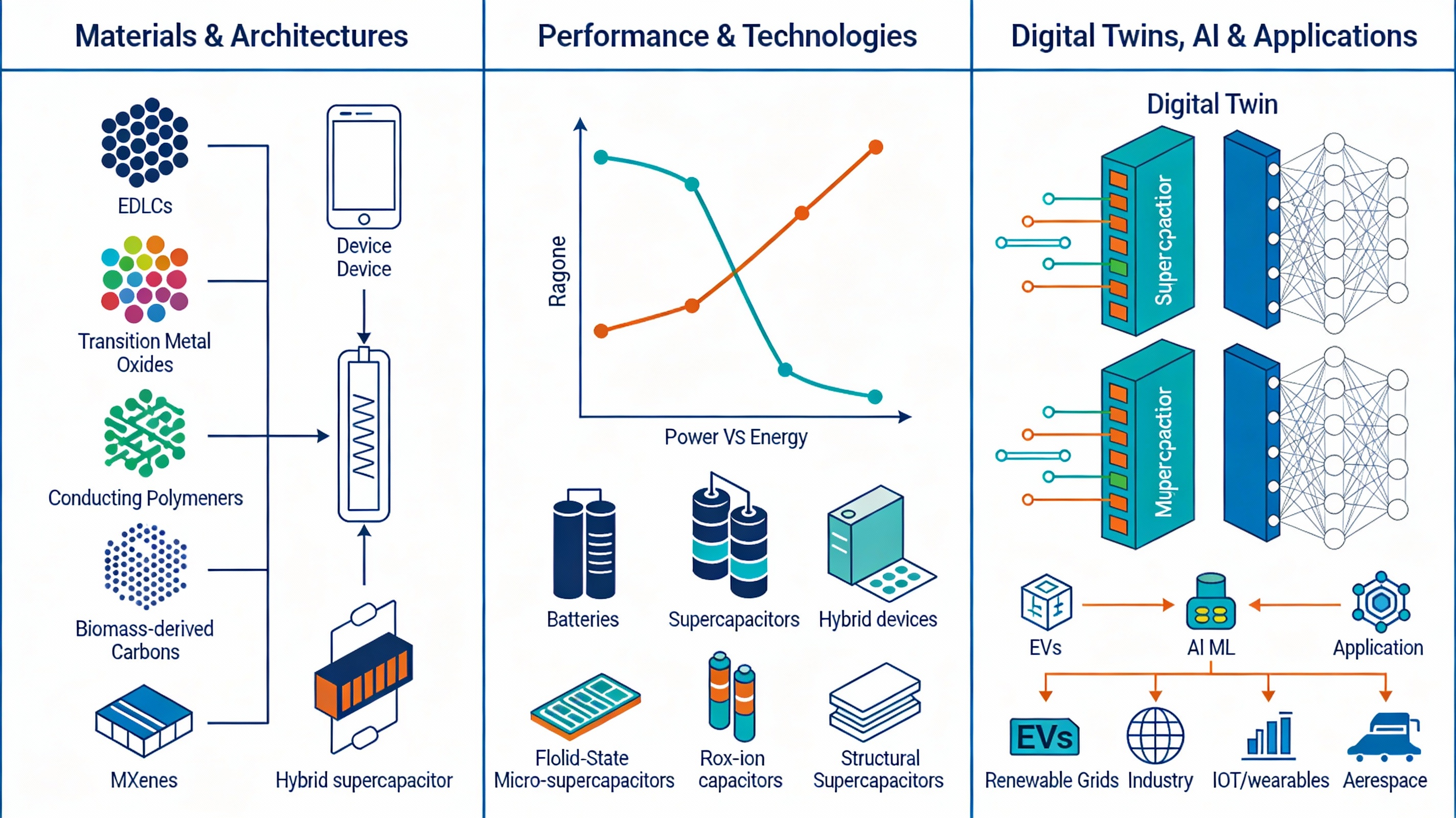
Supercapacitors are increasingly deployed as high power buffers in modern energy systems, yet their broader impact is constrained by limited energy density, fragmented testing practices, and incomplete understanding of lifecycle implications. This article presents a critical, method driven review based on a structured literature survey and explicit inclusion criteria, aggregating quantitative performance data for major electrode families (carbon materials, transition metal oxides, conducting polymers, biomass derived carbons, MXenes, and hybrid composites), electrolytes (aqueous, organic, ionic liquid, and gel/solid state), and device architectures (flexible, micro, solid state, lithium ion capacitors, and structural supercapacitors) under harmonized metrics such as capacitance, energy/power density, equivalent series resistance(ESR), cycle life, and operating voltage. The review benchmarks competing materials and commercial products, analyzes hybrid battery-supercapacitor configurations, and links quantified performance to application requirements in electric vehicles, renewable grids, industrial power conditioning, IoT/wearables, and aerospace, while emphasizing standardized testing protocols and lifecycle assessment as prerequisites for fair comparison and technology road mapping. Furthermore, the article examines concrete case studies of digital twin and AI enhanced modeling and control for supercapacitor based systems, detailing data needs, model structures, documented benefits, and open challenges, and concludes by outlining coordinated research and policy priorities in sustainable materials, device and system design, standardization, and circular economy strategies to enable reliable, evidence based deployment of supercapacitors in future low carbon energy infrastructures.Graphic Abstract
Keywords
The growing global emphasis on sustainable development and decarbonization has shifted the energy sector toward renewable energy sources such as solar, wind, and tidal power. While these alternatives to fossil fuels offer environmental benefits, they also introduce challenges due to their intermittent and variable nature. As a result, there is an increasing need for reliable energy storage solutions that can balance supply and demand, ensure grid stability, and enhance the overall efficiency of energy systems. Energy Storage Systems (ESSs) have emerged as key enablers of this transition, offering a wide range of applications from grid support to electric mobility. Among the various storage technologies, supercapacitors are gaining attention for their unique combination of high-power density, fast response, and long cycle life. This review comprehensively examines supercapacitors within the broader context of ESS technologies, focusing on their materials, technological advancements, integration strategies, and commercial perspectives [1,2].
The global energy landscape is shifting toward low-carbon, sustainable paradigms, with renewable sources like solar, wind, and tidal energy replacing fossil-based systems. However, these renewables are inherently intermittent, posing major challenges for grid stability and energy reliability. A recent study in Energy Conversion and Management: X provides a comprehensive overview of emerging energy storage technologies under different decarbonization scenarios and emphasizes the need to tailor storage technologies to power–energy–duration requirements in future grids [3]. Building on this perspective, the present review concentrates on supercapacitors, examining how their materials, architectures, and control strategies can address the high-power, fast-cycling segment of this broader storage landscape. ESSs are vital for decoupling generation from consumption and enabling load leveling and peak shaving, frequency and voltage regulation, uninterrupted power supply, and enhanced renewable energy integration [4]. The appropriate ESS technology depends on factors such as power and energy requirements, operational life, and system dynamics.
Various ESS technologies cater to distinct performance needs. Lithium-ion Batteries (LIBs) offer high energy density (100–265 Wh/kg) and good efficiency, although they are limited by power output and safety risks. Lead-acid batteries are cost-effective but bulky, with low energy density (

Figure 1: Ragone plot comparing power vs. energy density across various ESS technologies [10]
Further, Fig. 2 categorizes ESSs based on their operational principles (electromechanical, electromagnetic, electrochemical, chemical, and electrostatic) while integrating recent technological advancements such as flexible supercapacitors, solid-state batteries, and hydrogen-based fuel cells [12,13].

Figure 2: Categorizing energy storage systems based on operational principles
Among these, Supercapacitors have garnered increasing attention due to their superior power density, ultrafast charging capability, long cycle life, and wide operational temperature ranges [14]. Unlike traditional batteries, Supercapacitors are categorized into Electric Double-Layer Capacitors (EDLCs), Pseudo capacitors, and Hybrid Supercapacitors based on their charge storage mechanisms. Due to their inherently lower energy density, Supercapacitors are often integrated with batteries or fuel cells to form Hybrid Energy Storage Systems (HESS), aimed at optimizing both power and energy performance [15]. Applications range from renewable grid stabilization to electric vehicles, flexible electronics, and biomedical devices. Recent commercialization trends indicate substantial growth in supercapacitor-based solutions, driven by innovations from companies like Maxwell Technologies, Skeleton Technologies, and Panasonic [16]. Simultaneously, academic research has pivoted toward sustainable material development (e.g., MXenes, MOFs, biomass-derived carbons) and AI-assisted material discovery, enhancing device efficiency and sustainability. While a large volume of studies has addressed specific aspects of supercapacitor development, there is a critical need for a comprehensive, interdisciplinary review. Such a study should not only contextualize supercapacitors within the broader ESS landscape but also integrate insights from materials science, electrochemistry, system modeling, and application domains [17].
In addition to electrochemical systems like batteries and supercapacitors, hydrogen-based energy storage is gaining attention for its high energy density and suitability for long-duration storage. Technologies such as metal hydrides, magnesium alloys, and rare-earth-based hydrogen storage materials have shown promise in grid-scale and mobile applications, particularly when combined with fuel cells [18,19]. Rather than competing directly with supercapacitors, these hydrogen systems are increasingly considered as complementary elements in hybrid energy storage architectures, where supercapacitors handle rapid power transients and hydrogen-based systems provide long-term energy buffering in renewable-rich microgrids and mobility platforms.
This review aims to fill that gap by presenting a holistic perspective on supercapacitor technologies, covering historical development, current trends, practical challenges, and future opportunities. This review is organized as follows. Section 2 discusses the classification and working mechanisms of supercapacitors. Section 3 explores recent developments in materials and electrode designs. Section 4 focuses on technological advancements enhancing device performance. Section 5 addresses the integration of supercapacitors into hybrid energy systems. Section 6 reviews commercial products and benchmarking standards. Section 7 highlights modeling techniques and control strategies. Section 8 examines the existing challenges and envisions future research directions. Finally, Section 9 concludes with key insights and potential avenues for further development.
2 Classification of Supercapacitors
The advancement of supercapacitor technologies has been driven by the need for energy storage systems that can provide both high power density and enhanced durability. Unlike conventional storage devices, supercapacitors leverage distinct electrochemical phenomena to achieve rapid energy uptake and release. Their classification is primarily based on the mechanisms of charge storage at the electrode–electrolyte interface, which directly influences their electrochemical performance. A detailed understanding of these categories is crucial for optimizing supercapacitor design and selecting appropriate materials for specific energy storage applications [20].
2.1 Supercapacitors: Unique Characteristics and Emerging Potential
Supercapacitors, also termed electrochemical capacitors, combine high power output with exceptional longevity. Based on charge storage mechanisms, they are classified as Electric Double-Layer Capacitors (EDLCs), Pseudo capacitors, and Hybrid Supercapacitors. Compared to conventional batteries, Supercapacitors offer fast response times, long cycle life, wide operating temperature ranges, and superior safety with minimal maintenance needs. Significant advancements in electrode materials, electrolytes, and design architectures have notably improved the energy density and adaptability of supercapacitors for diverse applications [21]. Supercapacitors are ideal for applications requiring short bursts of high power. However, due to their inherently low energy density, they are often integrated with batteries or fuel cells in hybrid energy storage systems. Common applications include power smoothing in electric vehicles (EVs) and hybrid electric vehicles (HEVs), renewable grid stabilization, backup power for consumer electronics, and support for flexible electronics and biomedical sensors. Supercapacitor technologies have successfully transitioned from laboratory research to commercial deployment. Key players such as Maxwell Technologies, Skeleton Technologies, and Panasonic have launched various products into the market. Emerging innovations such as flexible supercapacitors, micro-supercapacitors, and solid-state configurations are poised to support new industries including IoT, robotics, and aerospace systems. Additionally, the focus on using sustainable materials like biomass-derived carbons, MXenes, and Metal–Organic Frameworks (MOFs), along with AI-assisted material discovery, is paving the way toward greener and more efficient supercapacitor technologies [22].
2.2 Fundamentals of Energy Storage in Supercapacitors
Supercapacitors, also known as electrochemical capacitors, are categorized based on their underlying charge storage mechanisms. Unlike traditional dielectric capacitors that utilize electrostatic charge separation, or batteries that rely on faradaic redox reactions in bulk materials, operate through either non-faradaic or rapid faradaic processes. These mechanisms enable Supercapacitors to deliver high power density, exceptional cycle life, and rapid charge/discharge capabilities [23]. Broadly, supercapacitors are classified into three main types electric double-layer capacitors (EDLCs), pseudocapacitors, and hybrid supercapacitors based on their underlying charge-storage mechanisms, and their position relative to traditional capacitors and batteries is summarized schematically in Fig. 3.

Figure 3: Basic mechanisms of charge storage in capacitors, batteries, and supercapacitors
2.2.1 Electric Double-Layer Capacitors (EDLCs)
EDLCs store energy by electrostatically accumulating ions at the interface between a high-surface-area porous electrode and an electrolyte, without any charge transfer across the interface. This non-faradaic process results in outstanding cycle stability and rapid power delivery. Carbon-based materials such as activated carbon, carbon nanotubes (CNTs), graphene, and carbon aerogels are commonly employed to maximize surface area and enhance capacitance [24]. EDLCs typically deliver high power densities (up to 10 kW/kg), excellent reversibility, and sustain over one million cycles with minimal degradation. However, their energy densities remain modest (1–10 Wh/kg), which limits their suitability for long-duration energy storage applications. EDLCs are predominantly utilized in applications such as power backup systems, regenerative braking modules, and consumer electronics, where high power and rapid cycling are prioritized over energy storage capacity. As illustrated in Fig. 4 EDLCs store energy by electrostatically accumulating ions at the interface between a high-surface-area porous carbon electrode and the electrolyte, without charge transfer across the interface. This non-faradaic process enables extremely high cycle life (>1 million cycles), but limits energy density due to the absence of redox reactions. Upon applying a voltage, positive and negative ions from the electrolyte align at the oppositely charged electrodes, forming a double layer without any faradaic (redox) reaction [25].

Figure 4: Schematic representation of charge storage in EDLC
This mechanism allows for rapid charge/discharge cycles and high power density. EDLCs store energy by electrostatic accumulation of charges at the electrode-electrolyte interface, rather than through chemical reactions. The porous carbon electrodes provide a large surface area for charge separation, enabling high capacitance. The absence of chemical changes ensures excellent cyclability, making EDLCs ideal for applications requiring quick energy bursts. EDLCs store energy by electrostatic accumulation of charges at the electrode-electrolyte interface, rather than through chemical reactions. The porous carbon electrodes provide a large surface area for charge separation, enabling high capacitance. The absence of chemical changes ensures excellent cyclability, making EDLCs ideal for applications requiring quick energy bursts [26].
Pseudo capacitors store charge through fast and reversible faradaic redox reactions occurring at or near the electrode surface. In contrast to EDLCs, pseudocapacitive mechanisms involve electron transfer, resulting in higher capacitance and energy densities [27]. Transition metal oxides (e.g.,

Figure 5: Pseudo capacitor redox mechanism and features
pseudo capacitors offer higher capacitance and energy density (often greater than 1000 F/g and >30 Wh/kg) due to redox-active materials. However, they generally exhibit lower power density and slower response times compared to EDLCs. These devices are suitable for applications requiring moderate energy and power levels, such as backup power systems and hybrid energy storage.
Hybrid supercapacitors are engineered to integrate the complementary strengths of EDLCs and pseudo capacitors or battery-type electrodes integrate both faradaic and non-faradaic processes within a single device to enhance energy storage capabilities. Typical hybrid configurations include asymmetric supercapacitors, which pair a battery-type electrode such as transition metal oxides or lithium-based materials with a capacitive carbon electrode, thereby combining the advantages of both systems. Another prominent design is the lithium-ion capacitor (LIC), which integrates a lithium-ion intercalating anode with a capacitor-type cathode.
Additionally, some hybrid systems employ redox-active electrolytes, where the electrolyte itself contributes to charge storage through reversible redox reactions. These hybrid systems achieve a balanced trade-off between energy and power performance, offering wider voltage windows and energy densities reaching up to 50 Wh/kg, while maintaining reasonable power delivery and moderate cycle life [30,31]. As a result, hybrid supercapacitors are increasingly finding applications in areas such as electric mobility, renewable energy grid stabilization, and industrial power smoothing. Fig. 6 summarizes representative hybrid supercapacitor architectures, including asymmetric devices, lithium-ion capacitors, and systems employing redox-active electrolytes, together with their key components and combined faradaic/non-faradaic storage mechanisms.

Figure 6: Types of hybrid supercapacitors with key components and storage mechanisms
Each class of supercapacitor exhibits distinct performance characteristics and associated trade-offs. EDLCs provide superior power density and cycle life but limited energy storage capability. Pseudo capacitors offer significantly improved energy densities at the expense of cycle life and power density. Hybrid supercapacitors attempt to bridge these differences, offering a balance between energy and power performance, making them versatile across a range of applications. A structured comparative analysis presented in Table 1 highlights key differences in capacitance, energy density, power output, response time, and cycle life across the different types. An in-depth understanding of these attributes is essential for selecting or designing supercapacitors tailored to specific application requirements. The classification of supercapacitors into EDLCs, pseudo capacitors, and hybrids forms a fundamental basis for comprehending their design strategies, performance characteristics, and technological applications. As demands for energy storage continue to evolve across sectors such as transportation, wearable devices, consumer electronics, and grid systems, this classification serves as a vital guide for material development and system-level optimization. Moreover, ongoing innovations are increasingly blurring the boundaries between these categories, particularly in the development of hybrid and multifunctional flexible systems [32,33].

3 Advances in Materials for Supercapacitors
The performance of supercapacitors is intrinsically linked to the properties of their constituent materials, including electrodes, electrolytes, and separators. Recent advancements in materials science, nanotechnology, and surface chemistry have yielded significant improvements in energy density, power density, cycling stability, and mechanical flexibility. This section critically reviews these developments and their implications for SC performance.
Electrode materials govern key performance metrics such as surface area, conductivity, and electrochemical stability. SC electrodes are broadly categorized into carbon-based materials, TMO, and conducting polymers. Fig. 7 illustrates classification of supercapacitor electrode materials.

Figure 7: Classification of supercapacitor electrode materials
Carbonaceous materials dominate EDLC applications due to their high surface area, conductivity, and cost-effectiveness. Activated carbon (AC), with a specific surface area of 500–3000
3.1.2 Conducting Polymers (CPs)
Conductive polymers (CPs) such as polyaniline (PANI), polypyrene (PPy), and poly(3,4-ethylenedioxythiophene) (PEDOT) offer high pseudo capacitance values ranging from 200 to 600 F/g, along with rapid charge transfer capabilities. However, their practical application is often limited by mechanical degradation and capacitance fading, primarily due to volumetric changes during charge–discharge cycling [37]. To address these challenges, several strategies have been developed, including nano structuring into forms like nanorods and nanotubes, forming composites with carbon materials or transition metal oxides (e.g., PANI/graphene hybrids), and incorporating crosslinking techniques or using stretchable substrates. These approaches significantly enhance the durability and flexibility of CP-based supercapacitors, making them particularly attractive for wearable and flexible energy storage applications [38].
3.1.3 Transition Metal Oxides (TMOs)
TMOs leverage pseudo capacitance through surface redox reactions, offering higher specific capacitance (200–1000 F/g) than carbon materials. Notable examples include

3.1.4 Emerging Sustainable Electrode Materials
In addition to conventional carbons, TMOs, and conducting polymers, there is growing interest in sustainable electrode materials that reduce environmental impact while maintaining high electrochemical performance. Biomass-derived carbons obtained from agricultural residues, food waste, and other renewable precursors offer tunable pore structures, high surface areas, and low cost, making them attractive for large-scale, eco-friendly supercapacitor production. Two-dimensional MXenes have also emerged as promising electrode candidates due to their high electronic conductivity, accessible redox-active sites, and versatile surface chemistry, which together enable high capacitance, improved rate capability, and good cycling stability. Recent studies highlight that composites combining biomass-derived carbons with MXenes or other nanomaterials can simultaneously leverage sustainability, mechanical robustness, and enhanced charge-storage characteristics, positioning these hybrid architectures as key directions for next-generation green supercapacitors.
Electrolytes play a critical role in determining the operational voltage, ionic conductivity, and overall safety of supercapacitors. They are generally classified into three main types. Aqueous electrolytes(electrochemical), such as

Figure 8: Electrolyte performance trade-offs
Recent research has demonstrated that asymmetric electrolyte systems, such as bi-phase solid/liquid configurations, can simultaneously support high-potential cathodes and low-potential anodes, thereby extending the voltage window and improving cyclic stability. These systems also mitigate decomposition and sedimentation issues at the electrode interfaces. In parallel, multi-electron redox materials, especially organic compounds with tailored molecular structures, have shown promise in multivalent metal batteries. These materials enable multiple redox reactions per molecule, significantly boosting energy density while maintaining flexibility and sustainability. Ionic liquid electrolytes continue to attract attention due to their non-volatility, wide electrochemical windows (up to 5 V), and compatibility with high-temperature operations. Despite their high cost and viscosity, they are increasingly used in solid-state and hybrid supercapacitor designs for aerospace and defense applications [41] and propoerties of super capacitors are shown in Table 3.

Separators are essential components in supercapacitors, preventing short-circuiting between electrodes while allowing efficient ion transport. Traditional separator materials include polyethylene (PE) and polypropylene (PP). Recent innovations have focused on enhancing separator performance through the development of nanofiber mats for increased porosity, ceramic-coated membranes to improve thermal stability, and electro spun composites that offer multifunctional properties [42]. These material advancements have significantly propelled supercapacitor technology forward. While carbon-based EDLCs have achieved commercial maturity, the incorporation of TMOs and CPs continues to push the boundaries of energy density. Moreover, the integration of hybrid materials alongside advanced electrolytes and separators is critical for next-generation applications, aiming to bridge the performance gap between supercapacitors and traditional batteries.
4 Recent Technological Advancements in Supercapacitors
Supercapacitor research has evolved beyond traditional material enhancements to encompass a wide range of structural innovations, multifunctional device architectures, and application-specific integrations. Recent technological developments aim not only to increase energy and power densities but also to address issues related to mechanical flexibility, operational safety, and system-level compatibility [43]. This section highlights emerging categories such as flexible and wearable supercapacitors, solid-state configurations, micro-supercapacitors, lithium-ion capacitors (LICs), and structural supercapacitors, along with their enabling technologies and practical implications as shown in Fig. 9.

Figure 9: Recent technical advancements in supercapacitors
4.1 Flexible and Wearable Supercapacitors
The increasing demand for lightweight, flexible energy storage devices that can integrate with non-planar substrates is driven by the rise of flexible electronics, wearable healthcare systems, smart textiles, and soft robotics. Flexible supercapacitors address these needs by incorporating deformable electrodes, stretchable current collectors, and gel or solid-state electrolytes. Carbon-based nanomaterials, such as graphene, carbon cloth, and MXenes, have become widely adopted due to their excellent conductivity, mechanical flexibility, and the ability to be processed into thin-film or fiber structures [44]. To further enhance energy density while maintaining flexibility, conducting polymers and metal oxides are often embedded in flexible matrices, such as PANI-coated textiles or
4.2 Solid-State and Gel Polymer Supercapacitors
Traditional liquid electrolytes in Supercapacitors pose safety risks such as leakage, flammability, and poor compatibility with flexible form factors. To overcome these limitations, recent advancements have focused on solid-state and gel polymer electrolytes (GPEs), which improve safety and enable monolithic device integration. GPEs typically consist of polymer matrices such as poly(vinyl alcohol) (PVA), polyethylene oxide (PEO), or PVDF-HFP, combined with ionic salts or ionic liquids to provide ionic conductivity [46]. These systems offer enhanced mechanical stability, low volatility, and simplified packaging. Notably, all-solid-state supercapacitors using MXene films, PANI hydrogels, or layered oxide structures with solid electrolytes have demonstrated promising performance metrics, including operating voltages above 2 V, high specific capacitance, and excellent thermal endurance. These devices are promising for flexible displays, implantable electronics, and micro-energy storage units.
Miniaturized energy storage devices, particularly micro-supercapacitors, have attracted significant interest for applications such as IoT sensors, implantable medical devices, and lab-on-a-chip systems. These are generally fabricated using planar electrode configurations, which eliminate the need for separators and reduce ion diffusion distances. Recent fabrication techniques include photolithography, laser scribing, screen printing, and inkjet deposition to form interdigitated microelectrode patterns on both flexible and rigid substrates [47]. Carbon-based materials like graphene and MXenes, along with pseudocapacitive inks containing compounds such as
4.4 Lithium-Ion Capacitors (LICs)
Lithium-ion capacitors (LICs) are a type of hybrid supercapacitor that combines the high energy density of lithium-ion batteries with the rapid charging capability of supercapacitors. These devices typically feature a battery-type anode, such as graphite or
4.5 Structural Supercapacitors
A transformative innovation in energy storage is the development of structural supercapacitors, which serve dual roles as mechanical load-bearing components and energy storage devices. These are particularly useful in weight-sensitive applications such as aerospace, automotive frames, drones, and unmanned aerial vehicles (UAVs).The core idea is to embed supercapacitor electrodes within composite structures using carbon fiber fabrics, multifunctional resins, and solid-state electrolytes [51]. Table 4 illustrates the Performance Comparison of Recent Supercapacitor Technologies/These designs offer significant weight savings by eliminating the need for separate energy storage and structural elements. Despite challenges in balancing mechanical strength with electrochemical performance, recent prototypes have achieved specific energy densities of 6–15 Wh/kg while retaining 50%–70% of their mechanical stiffness compared to traditional structural elements [52].

Recent advancements in supercapacitor technology have expanded their utility far beyond basic EDLC configurations. The development of flexible, wearable, and micro-scale Supercapacitors, alongside high-voltage solid-state and lithium-ion hybrids, has enabled their integration into a broad spectrum of modern technologies from soft electronics to electric mobility systems. Furthermore, structural Supercapacitors represent a paradigm shift toward multifunctional energy storage, promising entirely new form factors and engineering possibilities. These innovations not only improve performance but also drive the miniaturization, safety, and system-level adaptability required for next-generation energy ecosystems.
4.6 Printed and 3D-Printed Supercapacitors
Printed and 3D-printed supercapacitors are emerging as attractive options for low-cost, scalable, and design-flexible energy storage, particularly for flexible electronics and IoT devices. Techniques such as screen and inkjet printing enable the direct patterning of carbon, MXene, or conducting-polymer inks onto paper, polymer films, and textiles, while extrusion-based and stereolithography-type 3D printing allow fabrication of architected porous current collectors and structural electrodes. These additive manufacturing approaches support rapid prototyping, integration with printed circuits, and the realization of complex 3D architectures, though challenges remain in achieving high mass loading, interlayer adhesion, and uniform electrochemical performance at scale.
5 Applications of Supercapacitors
Supercapacitors have emerged as critical components in energy storage solutions across a broad spectrum of industries due to their unique attributes high power density, fast charging–discharging rates, exceptional cycle life, and environmental safety. While traditionally limited by their low energy density, recent material and device-level advancements have significantly expanded their range of practical applications as shown in Fig. 10. Today, Supercapacitors are being deployed in various forms: as standalone power buffers, integrated energy modules in hybrid systems, and embedded units within structural elements. This section discusses their applications across automotive and transportation, renewable energy integration, consumer electronics, industrial systems, and emerging wearable and biomedical platforms [53,54].

Figure 10: Applications of supercapacitors
5.1 Automotive and Transportation Systems
The transportation sector has been one of the earliest and most significant adopters of supercapacitor technology, with Supercapacitors extensively used in EVs, hybrid electric vehicles (HEVs), buses, trains, and trams for various high-power functionalities. One of the most prominent applications is in regenerative braking systems, where Supercapacitors quickly absorb and store kinetic energy during braking and release it during acceleration. In comparison to batteries, Supercapacitors can tolerate a higher number of charge–discharge cycles and enable faster energy capture without thermal degradation. Supercapacitors also play a crucial role in start–stop systems, particularly in hybrid buses and commercial vehicles, where they provide instant ignition power, thereby reducing fuel consumption and
5.2 Renewable Energy Systems and Grid Support
In the renewable energy sector, supercapacitors play a vital role in power smoothing, load leveling, and bridging power functions to manage the intermittency of sources such as solar photovoltaics (PV) and wind turbines. Supercapacitors are particularly effective in mitigating voltage and frequency fluctuations during rapid irradiance changes in solar arrays, providing buffer storage for wind farms during peak output or grid mismatch, and supporting inverters and microgrid controllers in distributed energy systems. Additionally, Supercapacitors are widely deployed in uninterruptible power supplies (UPS) and power factor correction systems, ensuring immediate response in critical loads such as hospitals, data centers, and telecom towers. HESS that combine lithium-ion batteries and supercapacitors are increasingly being used in microgrids, where Supercapacitors handle transient peak loads while batteries manage long-term energy supply [57].
Hybrid Supercapacitor–Hydrogen Systems
Hybrid energy storage systems that couple supercapacitors with hydrogen technologies (electrolyzers, storage tanks, and fuel cells) offer a promising route to simultaneously meet short-term power and long-duration energy requirements in renewable-dominated systems. In such architectures, supercapacitors are used for fast ramping, fault ride-through, and power smoothing, while hydrogen subsystems provide bulk energy storage over hours to days, enabling higher renewable penetration and improved system resilience in microgrids and advanced mobility concepts.
5.3 Consumer Electronics and IoT Devices
Supercapacitors are gaining momentum in portable and miniaturized electronic applications that require rapid charge/discharge, pulse power, and long cycle life. These applications include camera flashes and LED drivers, memory backup for SRAM/RTC systems, smart sensors and wireless modules, and hearing aids, RFID, and energy-harvesting circuits. Their long shelf life, fast response, and safe operation make them ideal for IoT environments, where power availability is intermittent or driven by energy harvesting, such as in piezoelectric or solar-powered wearables [58]. Furthermore, flexible and fiber-based Supercapacitors have been integrated into textiles, enabling wearable energy storage in the form of e-textiles, smart gloves, and biosignal trackers.
5.4 Industrial and Power Electronics
In industrial environments, supercapacitors are used for backup power in automation systems, pulse load support in power drives, and voltage stabilization in motor controllers. They are also applied in diesel generators and crane lifting equipment, where rapid bursts of energy are required repeatedly, and batteries would degrade quickly [59]. Table 5 shows Supercapacitors Usage Across Application Domains.Power electronics systems, such as DC-DC converters and energy recovery units, benefit from Supercapacitors due to their ability to handle high ripple currents and quick switching without overheating. Their minimal internal resistance ensures high efficiency and reduced maintenance costs over time.

Supercapacitors are increasingly finding applications in emerging fields such as smart buildings, where they are integrated into walls and windows for distributed energy buffering, as well as in railway energy harvesting systems, drone payload optimization, and military power electronics. With the ongoing development of multifunctional supercapacitors incorporating energy storage, sensing, and structural capabilities their role is expected to expand into space-constrained, highly dynamic, and ultra-fast charging environments. The exceptional characteristics of supercapacitors, particularly their high power density, fast response time, and extended cycle life, have made them suitable for a diverse range of applications. These include energy capture in regenerative braking systems and pulse support in biomedical implants. As a result, Supercapacitors are transitioning from niche components to mainstream elements of energy architectures. The continued evolution towards hybrid configurations and multifunctional integration positions supercapacitors as essential tools for addressing the global energy transition.
5.5 Space and Aerospace Applications
In space and aerospace systems, supercapacitors are increasingly used to deliver short, high-power pulses for actuation, deployment mechanisms, radar and communication payloads, and emergency backup functions in satellites, launch vehicles, and UAVs. Their wide operating temperature range, high cycle life, and tolerance to high charge/discharge rates make them well suited to handle peak loads and attitude-control events that would accelerate battery degradation. Supercapacitor modules can be integrated with batteries or fuel cells in spacecraft power buses to provide bus stabilization and fault ride-through, while in UAVs they support power-dense maneuvers such as take-off, rapid attitude changes, and payload operation. Ongoing research on structural and solid-state supercapacitors further enhances their potential for mass- and volume-constrained aerospace platforms by combining energy storage with load-bearing and improved safety.
6 Commercial Supercapacitor Technologies and Benchmarks
With growing interest in high-power, long-life, and environmentally safer energy storage solutions, supercapacitor technologies have progressed from lab-scale innovations to commercially viable products. Global demand for SC modules is steadily rising across automotive, industrial, consumer electronics, and renewable sectors, driven by performance reliability, fast charge/discharge characteristics, and extended lifetimes. Several manufacturers now offer modular, scalable, and application-specific supercapacitor systems ranging from millifarad chip capacitors to megajoule-scale storage banks.
6.1 Leading Manufacturers and Product Lines
Numerous companies worldwide have entered the supercapacitor market, offering diverse solutions tailored to various applications. Maxwell Technologies (acquired by Tesla) is known for its high-power supercapacitor modules used in electric buses, grid energy buffering, and industrial systems. Their BCAP series and XP modules deliver up to 3000 F capacitance and voltage ratings up to 160 V. Skeleton Technologies, based in Estonia, offers curved graphene-based ultracapacitors with low equivalent series resistance (ESR) and high power density. Their SkelCap and SkelStart modules are designed for automotive, rail, and defense applications [60–62]. CAP-XX, headquartered in Australia, specializes in thin-form-factor supercapacitors intended for wearables, IoT devices, and mobile electronics, with ultra-thin dual-cell configurations that are ideal for rapid pulse-power delivery. LS Mtron from South Korea supplies automotive-grade supercapacitor modules primarily used in regenerative braking, power backup, and start–stop systems, and they also offer SC-battery hybrid modules [63,64]. Table 6 shows Specifications from representative products across major categories.Other notable players include Nesscap (now part of Maxwell), Panasonic, AVX, and Eaton, who provide cylindrical and prismatic electric double-layer capacitors (EDLCs) and hybrid modules for general-purpose industrial and backup energy storage applications. The technical specifications of commercial supercapacitors vary based on design priorities such as energy density, power handling, temperature range, and form factor.

6.2 Standards and Certifications Industrial Integration and Use Cases
Commercial supercapacitor systems must conform to international quality, safety, and reliability standards. Key certifications include IEC 62391, which defines performance, safety, and lifetime testing for Supercapacitors; ISO 16750-2, which pertains to electrical and environmental stress testing in automotive applications; UL 810A, covering the electrical safety of electrochemical capacitors; and RoHS and REACH compliance, which ensures environmentally safe material use. These certifications are particularly critical in transportation and aerospace sectors, where reliability, flame retardance, and thermal endurance are tightly regulated. Supercapacitors are already commercially deployed in various integrated systems. In public transportation, Skeleton’s supercapacitors are utilized in Skoda trams and Hyundai hybrid buses. In wind energy applications, Supercapacitors are embedded in wind turbine pitch control systems to reduce mechanical wear and maintain safe blade orientation during voltage sags. For industrial UPS systems, companies like Eaton and Maxwell provide modules used in data centers, hospitals, and telecommunications infrastructure. In the marine and defense sectors, high-power SC banks are employed in naval radar systems, missile launchers, and electric propulsion systems [65]. Additionally, customized supercapacitor-battery hybrid systems are gaining traction in material handling, automated warehouses, and logistics, where the combination of fast charge-discharge and energy density is essential.
6.3 Market Trends and Commercial Challenges
According to recent market reports, the global supercapacitor market is projected to exceed USD 7 billion by 2030, driven by the electrification of transport and the growing trend of industrial automation. Despite this optimistic outlook, commercialization still faces several critical challenges. These include the inherently lower energy density of supercapacitors compared to batteries, which limits their standalone use in long-duration applications; cost competitiveness, particularly when incorporating advanced materials like MXenes or curved graphene; and the temperature sensitivity of certain organic electrolytes, which can affect performance in harsh environmental conditions. To overcome these limitations, manufacturers are increasingly focusing on hybrid systems that combine supercapacitors with batteries, the development of advanced nanomaterials to enhance performance, and automated manufacturing processes to bring down production costs.
The supercapacitor technology has now matured into a commercially viable solution with widespread adoption in the automotive, industrial, defense, and IoT sectors. Industry leaders such as Maxwell and Skeleton Technologies continue to deliver high-performance modules, showcasing the practical viability of supercapacitors in both standalone and hybrid configurations. As global emphasis on electrification, safety, and energy efficiency intensifies, supercapacitors are poised to play an increasingly significant role in the evolving energy landscape. Nevertheless, continued innovation is essential to address their current limitations in energy density and cost-effectiveness.
While commercial supercapacitor products demonstrate impressive performance metrics, several challenges persist. High-performance modules using advanced materials like curved graphene or MXenes face scalability issues due to complex synthesis and cost-intensive processing. Trade-offs between energy density and power density are evident, with thin-film devices offering rapid response but limited capacity, and bulk modules providing higher energy at the expense of form factor flexibility. Lifecycle assessments remain underdeveloped, with limited data on recyclability and environmental impact. Moreover, integration into existing systems requires compatibility with voltage ranges, thermal profiles, and control protocols, which vary across industries. Addressing these challenges is essential for broader adoption and sustainable deployment.
6.3.1 Second-Life Applications and Recycling
In parallel with primary deployment, there is growing interest in second-life applications and recycling pathways for supercapacitor modules, in line with circular-economy principles. End-of-life commercial devices have been demonstrated as viable electrode sources for electrochemical desalination and other low-rate applications after appropriate refurbishment, indicating that repurposing can extend functional lifetime and reduce waste. However, large-scale implementation requires robust methods for state-of-health assessment, safe disassembly, separation of carbon, current collectors, and electrolytes, and cost-effective regeneration of electrode performance. Life-cycle assessment studies further highlight that recycling and recovery of active materials can significantly mitigate the environmental footprint associated with supercapacitor production and disposal.
6.3.2 Geopolitical Influences and Supply Chain Criticality
The commercialization of supercapacitors is also shaped by geopolitical and supply-chain constraints associated with critical materials, particularly graphite, certain transition metals, and fluorinated polymers. Natural and synthetic graphite processing, which underpins many carbon-based electrodes, is highly concentrated in a few countries, creating exposure to export controls, trade disputes, and price volatility. Similar concerns apply to select metal oxides and ionic liquid components, emphasizing the need for diversified sourcing, domestic refining capacity, and the development of alternative or recycled feedstocks to enhance supply security and reduce geopolitical risk in future supercapacitor value chains.
7 Modeling, Control, and Energy Management of Supercapacitor-Based Systems
The practical deployment of supercapacitor energy storage systems in electric vehicles, renewable grids, and hybrid energy platforms demands a robust understanding of their dynamic behavior, electrical characteristics, and operational constraints. This is achieved through mathematical modeling and the development of intelligent control algorithms that facilitate real-time energy management. Due to their unique charge-discharge characteristics, nonlinear voltage response, and dependency on internal resistance and temperature, supercapacitors require specialized models distinct from conventional batteries or capacitors.
7.1 Electrical Equivalent Circuit Modeling
The most common approach to modeling supercapacitors is based on equivalent circuit models (ECMs). These models replicate the SC’s dynamic behavior using combinations of ideal electrical components such as resistors, capacitors, and voltage sources.
The simplest model represents the SC as a pure capacitor CC, assuming constant capacitance and no resistive losses. It obeys the relationship given by Eq. (1).
However, this model is inadequate for real-world simulations where ESR and leakage effects are non-negligible.
More realistic representations of supercapacitor behavior involve first-order or multi-order RC ladder networks, which provide a more accurate simulation of their electrical characteristics. These models incorporate elements such as series resistance (ESR), which accounts for ohmic losses; parallel RC branches, which represent diffusion processes and voltage relaxation effects; and leakage resistance (
7.2 Electrochemical and Physics-Based Models
Beyond circuit analogs, physics-based models provide a deeper understanding of supercapacitor behavior by incorporating electrochemical principles. These models include porous electrode theory, ion transport modeling, and the application of Nernst–Planck and Poisson equations. Such approaches offer high accuracy in capturing internal processes like charge distribution and ion dynamics within the electrode and electrolyte. Table 7 depicts Supercapacitor Modeling Approaches: Features and Suitability. However, due to their computational complexity, these models are more appropriate for material design, internal performance evaluation, and research purposes rather than real-time control or system-level simulations. Thermal effects play a crucial role in influencing the performance, efficiency, and aging of supercapacitors. Heat is primarily generated through Joule heating (

7.3 Control Strategies in Supercapacitors-Based Systems
Effective control algorithms are necessary to ensure safe operation, maximum utilization, and performance optimization of systems under varying loads and charging conditions.
7.3.1 Voltage and Current Management
Conventional controllers used in supercapacitor systems include PI/PID controllers, which are employed to maintain stable output voltage levels; hysteresis control, which is utilized for fast switching in DC–DC converters to ensure efficient power conversion; and state-of-charge (SoC) estimation algorithms, such as Coulomb counting and Kalman filtering, which help track the energy storage level of the supercapacitor. These controllers are essential for optimizing the performance and reliability of supercapacitor-based systems, ensuring they operate within their designed parameters.
7.3.2 Model Predictive Control (MPC)
Model Predictive Control (MPC) algorithms are increasingly being used in hybrid supercapacitor–battery systems to optimize energy flow dynamically. These controllers take into account factors such as load forecasting, temperature limits, and supercapacitor degradation profiles to make real-time decisions that maximize efficiency and prolong system lifespan. MPC is particularly effective in applications such as microgrid energy dispatch, regenerative braking, and fast-charging systems, where precise control over energy storage and distribution is essential for performance and reliability.
7.4 Energy Management in Hybrid Systems
In HESS that combine supercapacitors with batteries or fuel cells, effective energy management strategies are essential for optimizing system longevity, efficiency, and responsiveness. Common strategies include rule-based control, where simple thresholds are set to determine when Supercapacitors or batteries should contribute power; fuzzy logic control, which addresses uncertainty and nonlinearity in load profiles; and neural network-based controllers, which are adaptive systems trained on operational data to optimize real-time energy flow. These methods are widely implemented in hybrid electric vehicles, off-grid renewable systems, and emergency backup units, where supercapacitors handle high-power transients and batteries are responsible for managing overall energy capacity.
7.5 Digital Twin and AI-Enhanced Modeling
The integration of digital twin and AI-enhanced control technologies into supercapacitor systems represents a transformative approach to energy management, diagnostics, and system optimization. A digital twin is a dynamic, real-time virtual replica of a physical system that mirrors its behavior using sensor data, simulation models, and predictive analytics. In supercapacitor-based EV drivetrains and railway systems, digital twins have been used to continuously estimate internal resistance, temperature, and state-of-health, enabling adaptive derating and early fault detection for module banks under highly dynamic load profiles [66,67]. In microgrids and renewable plants, virtual replicas of SC banks interfaced with AI-based dispatch algorithms support optimal sharing of transient power between batteries, supercapacitors, and generators, improving frequency regulation and reducing cycling stress on batteries. Similar architectures are being explored for edge-IoT nodes, where lightweight twins of micro-supercapacitors guide local energy scheduling under intermittent harvesting.
Real-time sensor integration forms the backbone of digital twin frameworks. Sensors embedded within supercapacitor modules capture critical parameters such as voltage, current, temperature, and state-of-charge (SoC). This data is transmitted to a simulation engine that models the electrical and thermal behavior of the system under varying load conditions. The digital twin uses this information to forecast performance trends, detect anomalies, and recommend corrective actions. Practically, the digital twin is implemented as a layered architecture comprising: (i) a data layer receiving real-time measurements (voltage, current, temperature, SoC/SoH estimators), (ii) a model layer hosting reduced-order electrical/thermal models calibrated from lab tests, and (iii) an analytics/control layer running AI or MPC algorithms that update parameters and compute optimal charge–discharge profiles. The resulting control actions—such as current limits, power split commands in HESS, or cooling set-points—are then fed back to the physical system, closing the loop for continuous optimization.
AI-enhanced control leverages machine learning algorithms to interpret sensor data and optimize system behavior. Techniques such as neural networks, support vector machines, and decision trees are employed to predict degradation patterns, estimate remaining useful life, and adjust charge–discharge cycles dynamically. For example, convolutional neural networks (CNNs) can analyze thermal profiles to prevent overheating, while recurrent neural networks (RNNs) can model temporal dependencies in energy usage for predictive maintenance.
Feedback control frameworks are essential for implementing adaptive energy management strategies. Model Predictive Control (MPC) algorithms use digital twin simulations to anticipate future states and adjust control inputs accordingly. This enables real-time optimization of power flow, voltage regulation, and thermal stability. In microgrid applications, digital twins coordinate multiple energy sources, including supercapacitors, to balance supply and demand efficiently. In electric vehicles (EVs), AI-enhanced control systems manage regenerative braking and acceleration profiles to extend battery life and improve energy recovery.
Case studies demonstrate the practical benefits of these technologies. In EVs, digital twins have been used to simulate battery-supercapacitor hybrid systems, enabling real-time energy distribution and fault detection. In microgrids, AI algorithms optimize the dispatch of supercapacitor banks based on load forecasts and renewable generation patterns. These implementations have shown improvements in system reliability, energy efficiency, and operational safety.
Emerging trends in supercapacitor-based systems involve the integration of digital twin technology and AI-assisted modeling, where real-time sensor data and predictive analytics are leveraged to monitor supercapacitor health and performance, optimize charge–discharge cycles, and predict potential failure or degradation. Machine learning algorithms, trained on historical operational data, can forecast SoC, predict thermal behavior, and recommend optimal usage schedules, significantly improving the system’s overall efficiency and longevity. Modeling and control of supercapacitor-based energy storage systems are essential for their effective integration into modern power systems. Fig. 11 depicts digital twin and ai-enhanced modeling for supercapacitor applications.

Figure 11: Digital twin and AI-enhanced modeling for supercapacitor applications
While circuit-based models enable real-time control, electrochemical and thermal models are crucial for design optimization and performance evaluation. Advanced energy management techniques, such as MPC, fuzzy logic, and AI, are enhancing the reliability and efficiency of supercapacitor systems in complex, dynamic environments like electric vehicles, microgrids, and smart electronics, as supercapacitor adoption continues to grow, real-time digital modeling and predictive control will be foundational to intelligent energy management, ensuring these systems operate at their full potential.
Despite these advances, several challenges still limit widespread industrial deployment of DT and AI-based supervision for supercapacitor systems, including the need for high-quality labeled degradation data, model drift under new operating regimes, cybersecurity of connected assets, and the computational burden of high-fidelity twins in embedded controllers. Current research therefore focuses on hybrid physics-informed machine-learning models, transfer-learning strategies to reduce calibration effort, and edge-optimized implementations that can bring digital-twin capabilities into cost and resource constrained applications
8 Research Advancements and Challenges
Despite significant advancements in materials, architectures, and integration techniques, supercapacitors still face several technological, economic, and system-level challenges that limit their widespread replacement of conventional batteries in many applications. Addressing these barriers will be key to achieving next-generation energy storage systems that are efficient, scalable, and environmentally sustainable. This section presents the unresolved challenges and outlines strategic directions for future research.
8.1 Enhancing Energy Density without Compromising Power
One of the most critical limitations of supercapacitors is their relatively low energy density, which is typically an order of magnitude lower than that of lithium-ion batteries. Achieving energy densities above 50 Wh/kg, while still maintaining high power density and long cycle life, remains a fundamental challenge. Current research is focusing on several strategies to address this limitation, including the development of hybrid electrode materials that combine EDLC and pseudocapacitive behavior, the design of 3D-structured electrodes with hierarchical porosity to enhance surface area and charge storage, and the use of redox-active electrolytes that contribute additional charge storage capabilities. However, many of these solutions come with trade-offs, such as reduced rate capability, cycle instability, or increased fabrication complexity. Balancing these trade-offs is a critical direction for ongoing research.
8.2 Cycle Stability and Degradation Mechanisms
While electrical EDLCs typically offer more than 1 million charge/discharge cycles, pseudocapacitors and hybrid supercapacitors suffer from capacitance fading over time due to several degradation mechanisms. These include electrode swelling and contraction, structural fatigue, and electrolyte decomposition. To ensure the long-term durability of these devices, especially in mission-critical applications, it is crucial to understand and mitigate these degradation processes. Strategies such as in-situ diagnostics, advanced modeling, and material passivation techniques are being explored to address these challenges and enhance the longevity and performance of pseudocapacitors and hybrid Supercapacitors.
8.3 Electrolyte Innovations and Environmental Compatibility
Electrolytes play a critical role in influencing the performance, safety, and environmental impact of supercapacitors. Key challenges associated with electrolytes include the narrow voltage windows of aqueous electrolytes, the flammability and toxicity of organic solvents, and the high cost and viscosity of ionic liquids. To address these challenges, future research is focusing on the development of more sustainable and efficient electrolyte solutions. This includes green, non-toxic electrolytes based on bio-ionic liquids or deep eutectic solvents, aqueous electrolytes with enhanced voltage stability through pH and salt optimization, and solid-state or gel polymer systems that enable the creation of flexible, wearable, and implantable supercapacitors.
8.4 Scale-Up and Manufacturing Challenges
Despite the promising lab-scale performance of advanced materials like MXenes and graphene derivatives, these materials face significant scalability and processability challenges. Key issues include the reproducibility of nanostructures, batch-to-batch variability, and the cost-intensive nature of synthesis and post-processing. To overcome these challenges, there is a growing need for scalable and sustainable synthesis routes, such as green methods that minimize environmental impact. Additionally, roll-to-roll printing techniques and integration with printed and flexible electronics manufacturing lines are seen as promising solutions for large-scale production and cost-effective implementation of these advanced materials in supercapacitors and other energy storage devices.
8.5 Environmental and Safety Considerations
Supercapacitor technologies, while offering high power density and long cycle life, must also be evaluated through the lens of environmental sustainability and safety. The production of advanced materials such as MXenes and carbon nanostructures often involves energy-intensive or chemically hazardous processes. End-of-life management remains underdeveloped, with limited recycling infrastructure for supercapacitor components, particularly for hybrid systems that combine multiple material classes. Safety is another critical concern. Organic electrolytes, though enabling higher voltage windows, are often flammable and thermally unstable, posing risks in high-temperature environments. Solid-state and aqueous electrolytes offer safer alternatives but may compromise energy density.
From a cost perspective, supercapacitors generally have higher upfront costs per Wh compared to lithium-ion batteries but offer lower total cost of ownership in high-cycle applications due to their longevity and minimal maintenance. For instance, while LIBs may cost 150–200/kWh, commercial supercapacitors range from 500–1000/kWh, though this gap narrows significantly in applications requiring >100,000 cycles. Addressing these issues through green synthesis methods, biodegradable materials, and standardized lifecycle assessments will be essential for sustainable adoption.
8.6 Multi-Functionality and System Integration
Next-generation energy storage systems are increasingly focusing on multifunctional supercapacitors that not only store energy but also integrate additional capabilities such as structural support, thermal management, sensing, or communication. Examples of such multifunctional Supercapacitors include structural Supercapacitors used in aerospace and automotive applications, epidermal and textile-integrated Supercapacitors for health monitoring, and self-healing and biodegradable Supercapacitors designed for transient electronics. Research is progressing toward device-level co-design, where supercapacitors are embedded into larger systems with customized mechanical and electrical properties to enhance overall performance and functionality. To fully realize the potential of supercapacitors applications such as smart grids, EVs, and IoT, real-time modeling and diagnostics are essential. Table 8 shows key research gaps and promising approaches in supercapacitor technology. The main challenges include developing digital twins with accurate lifetime predictions, creating lightweight AI models that can be deployed on edge devices, and integrating physics-based models with data-driven analytics for real-time optimization. Future systems are expected to rely on self-aware energy storage devices that can dynamically optimize their usage based on operational context and environmental inputs, leading to more efficient and reliable performance across various applications.

For broader market penetration, supercapacitor technologies must overcome several key challenges, including high upfront costs particularly for devices using advanced materials along with the absence of standardized lifecycle assessments and limited frameworks for end-of-life recyclability and circular economy integration. Facilitating sustainable adoption will require public funding support, implementation of green procurement policies, and the establishment of standardized metrics for evaluating supercapacitor performance, safety, and environmental impact.
Looking ahead, the future of supercapacitor-based energy storage hinges on cross-disciplinary innovation that integrates nanomaterials, smart manufacturing techniques, intelligent control systems, and sustainable engineering practices. As global power systems shift toward more decentralized, mobile, and responsive architectures, Supercapacitors are expected to play an increasingly vital role in hybrid systems, smart wearables, and embedded energy storage applications. Overcoming current limitations through collaborative research and development will be critical to unlocking their full potential and driving the evolution of next-generation energy technologies.
Finally, policy and funding frameworks will strongly influence how rapidly supercapacitor technologies mature from promising prototypes to widely deployed assets. Targeted public R&D programs, coordinated standardization initiatives (IEC/ISO/IEEE), and green-procurement guidelines that reward low-carbon and recyclable components can steer research toward sustainable materials, robust testing protocols, and circular-economy designs. Economic incentives for recycling infrastructure, critical-materials recovery, and domestic manufacturing—aligned with broader critical-minerals and clean-energy strategies—can reduce supply-chain risks and accelerate industrial adoption, while also providing clearer signals to academia and industry on priority research directions.
Supercapacitors have emerged as pivotal components in modern energy storage systems, transitioning from simple power-buffering elements to advanced technologies supporting a wide range of high-performance applications. Their unique advantages—such as high power density, rapid charge-discharge rates, and exceptional cycle life—make them indispensable in electric vehicles (EVs), hybrid energy storage systems (HESSs), renewable energy integration, IoT devices, and wireless power transfer applications.
This review has comprehensively covered the evolution of supercapacitor technologies, highlighting advancements in electrode materials (carbon nanostructures, transition metal oxides, conducting polymers), electrolytes, and device architectures. It also emphasized the emergence of flexible and micro-supercapacitors, solid-state configurations, and AI-enhanced control systems including digital twins for predictive diagnostics and intelligent energy management.
To advance supercapacitor technologies, researchers should focus on developing scalable synthesis methods for advanced materials such as MXenes and biomass-derived carbons, exploring multifunctional device architectures suitable for flexible and structural energy storage, and integrating real-time modeling and AI for performance optimization and predictive maintenance. Simultaneously, industry stakeholders must prioritize lifecycle assessments and recycling strategies, cost-effective manufacturing and supply chain integration, and the standardization of performance metrics and safety protocols to accelerate commercialization. A collaborative approach between academia and industry will be essential to overcome current limitations and enable the widespread adoption of high-performance, sustainable supercapacitor systems.
Looking ahead, future research should focus on developing high-energy-density hybrid supercapacitors that maintain long cycle life and safety, while also exploring biodegradable and structural configurations for sustainable energy solutions. Optimizing electrode–electrolyte compatibility, controlling material morphology and porosity, and leveraging organic–inorganic hybrid strategies will be essential for enhancing electrochemical performance. The integration of AI and digital twin technologies will enable adaptive control, predictive diagnostics, and intelligent energy distribution, especially in applications such as electric vehicles, microgrids, and smart infrastructure.
Emerging technologies like Zinc-ion capacitors (ZICs) offer promising alternatives by combining battery-like energy density with supercapacitor-level power delivery and safety. A collaborative approach between researchers and industry stakeholders is needed to address scalability, cost-effectiveness, and standardization challenges, ultimately driving the widespread adoption of multifunctional, high-performance supercapacitor systems.
Acknowledgement: Authors used Perplexity AI for English language polishing.
Funding Statement: The authors received no specific funding for this study.
Author Contributions: Conceptualization, Rajanand Patnaik Narasipuram; methodology, Amit Singh Tandon; formal analysis, Rajanand Patnaik Narasipuram; investigation, Md M. Pasha; resources, Suresh Badugu; data curation, Saleha Tabassum; writing—original draft preparation, Attuluri R. Vijay Babu; writing—review and editing, Bharath Kumar N; visualization, Amit Singh Tandon; supervision, Rajanand Patnaik Narasipuram. All authors reviewed the results and approved the final version of the manuscript.
Availability of Data and Materials: Not applicable.
Ethics Approval: Not applicable.
Conflicts of Interest: The authors declare no conflicts of interest to report regarding the present study.
Abbreviations
| The following abbreviations are used in this manuscript | |
| ED | Energy Density |
| PD | Power Density |
| FC | Fuel Cell |
| SC-ESS | Supercapacitor-Based Energy Storage System |
| EDLC | Electric Double-Layer Capacitor |
| HESS | Hybrid Energy Storage System |
| LIB | Lithium-Ion Battery |
| RFB | Redox Flow Battery |
| CAES | Compressed Air Energy Storage |
| CNT | Carbon Nanotube |
| PANI | Polyaniline |
| PPy | Polypyrrole |
| TMO | Transition Metal Oxide |
| AC | Activated Carbon |
| IL | Ionic Liquid |
| GPE | Gel Polymer Electrolyte |
| PE | Polyethylene |
| PP | Polypropylene |
| PEDOT | Poly(3,4-Ethylenedioxythiophene) |
| PVA | Poly(Vinyl Alcohol) |
| PEO | Polyethylene Oxide |
| PVDF-HFP | Poly(Vinylidene Fluoride-Co-Hexafluoropropylene) |
| MSC | Micro-Supercapacitor |
| LIC | Lithium-Ion Capacitor |
| EV | Electric Vehicle |
| HEV | Hybrid Electric Vehicle |
| UPS | Uninterruptible Power Supply |
| KERS | Kinetic Energy Recovery System |
| ESR | Equivalent Series Resistance |
| ECM | Equivalent Circuit Model |
| SoC | State of Charge |
| MPC | Model Predictive Control |
| FEM | Finite-Element Model |
| MOF | Metal-Organic Framework |
References
1. Conway BE. Electrochemical supercapacitors: scientific fundamentals and technological applications. Cham, Switzerland: Springer Science & Business Media; 1999. [Google Scholar]
2. Miller JR, Simon P. Electrochemical capacitors for energy management. Science. 2008;321(5889):651–2. doi:10.1126/science.1158736. [Google Scholar] [CrossRef]
3. Mahmood M, Chowdhury P, Yeassin R, Hasan M, Ahmad T, Chowdhury NUR. Impacts of digitalization on smart grids, renewable energy, and demand response: an updated review of current applications. Energy Convers Manag X. 2024;24:100790. doi:10.1016/j.ecmx.2024.100790. [Google Scholar] [CrossRef]
4. Yadlapalli RT, Gopi CVVM, Sambath K, Kim HJ. Super capacitors for energy storage: progress, applications and challenges. J Energy Storage. 2022;49(3):104194. doi:10.1016/j.est.2022.104194. [Google Scholar] [CrossRef]
5. Armand M, Tarascon JM. Building better batteries. Nature. 2008;451(7179):652–7. doi:10.1038/451652a. [Google Scholar] [PubMed] [CrossRef]
6. Shah SS, Das M, Ogawa T. One stone, three birds: innovations and challenges of layered double hydroxides in batteries, supercapacitors, and hydrogen production. Batteries. 2025;11(5):193. doi:10.3390/batteries11050193. [Google Scholar] [CrossRef]
7. Yang Z, Zhang J, Kintner-Meyer MC, Lu X, Choi D, Lemmon JP, et al. Electrochemical energy storage for green grid. Chem Rev. 2011;111(5):3577–613. doi:10.1021/cr100290v. [Google Scholar] [PubMed] [CrossRef]
8. Hwang JY, Myung ST, Sun YK. Sodium-ion batteries: present and future. Chem Soc Rev. 2017;46(12):3529–614. doi:10.1039/C6CS00776G. [Google Scholar] [PubMed] [CrossRef]
9. Skyllas-Kazacos M, Chakrabarti MH, Hajimolana SA, Mjalli FS, Saleem M. Progress in flow battery research and development. Electrochim Acta. 2011;60(8):360–76. doi:10.1149/1.3599565. [Google Scholar] [CrossRef]
10. O’Hayre R, Cha SW, Colella W, Prinz FB. Fuel cell fundamentals. Hoboken, NJ, USA: John Wiley & Sons, Inc.; 2016. [Google Scholar]
11. Czagany M, Hompoth S, Keshri AK, Pandit N, Galambos I, Gacsi Z, et al. Supercapacitors: an efficient way for energy storage application. Materials. 2024;17(3):702. doi:10.3390/ma17030702. [Google Scholar] [PubMed] [CrossRef]
12. Chen H, Cong TN, Yang W, Tan C, Li Y, Ding Y. Progress in electrical energy storage system: a critical review. Prog Nat Sci. 2009;19(3):291–312. doi:10.1016/j.pnsc.2008.07.014. [Google Scholar] [CrossRef]
13. Simon P, Gogotsi Y. Materials for electrochemical capacitors. Nat Mater. 2008;7(11):845–54. doi:10.1038/nmat2297. [Google Scholar] [PubMed] [CrossRef]
14. Zhang LL, Zhao XS. Carbon-based materials as supercapacitor electrodes. Chem Soc Rev. 2009;38(9):2520–31. doi:10.1039/B813846J. [Google Scholar] [PubMed] [CrossRef]
15. Wang H, Casalongue HS, Liang Y, Dai H. Ni(OH)2 nanoplates grown on graphene as advanced electrochemical pseudocapacitor materials. Nano Lett. 2010;10(1):197–203. doi:10.1021/ja102267j. [Google Scholar] [PubMed] [CrossRef]
16. Sarfraz N, Kanwal N, Ali M, Ali K, Hasnain A, Ashraf M, et al. Materials advancements in solid-state inorganic electrolytes for highly anticipated all solid li-ion batteries. Energy Storage Mater. 2024;71(1):103619. doi:10.1016/j.ensm.2024.103619. [Google Scholar] [CrossRef]
17. Dai ZY, Wu P, Xiao LR, Kimura H, Hou CX, Sun XQ, et al. Non-stoichiometric Ni3ZnC0.7 carbide loading on melamine sponge-derived carbon for hydrogen storage performance improvement of MgH2. Rare Met. 2025;44(1):515–30. doi:10.1007/s12598-024-02943-y. [Google Scholar] [CrossRef]
18. Wang G, Zhang L, Zhang J. A review of electrode materials for electrochemical supercapacitors. Chem Soc Rev. 2012;41(2):797–828. doi:10.1039/C1CS15060J. [Google Scholar] [PubMed] [CrossRef]
19. Conway BE. Transition from ‘supercapacitor’ to ‘battery’ behavior in electrochemical energy storage. J Electrochem Soc. 1991;138(6):1539–48. doi:10.1149/1.2085829. [Google Scholar] [CrossRef]
20. Vladimir P, Iurii P. Supercapacitor energy storages in hybrid power supplies for frequency-controlled electric drives: review of topologies and automatic control systems. Energies. 2023;16(7):3287. doi:10.3390/en16073287. [Google Scholar] [CrossRef]
21. Zschiebsch W, Sturm Y, Kucher M, Hedayati DP, Behnisch T, Modler N, et al. Multifunctionality analysis of structural supercapacitors—a review. Materials. 2024;17(3):739. doi:10.3390/ma17030739. [Google Scholar] [PubMed] [CrossRef]
22. Jagadale A, Zhou X, Xiong R, Dubal D, Xu J, Yang S. Lithium ion capacitors (LICsdevelopment of the materials. Energy Storage Mater. 2019;19:314–29. doi:10.1016/j.ensm.2019.02.031. [Google Scholar] [CrossRef]
23. Zhu Y, Murali S, Stoller MD, Ganesh KJ, Cai W, Ferreira PJ, et al. Carbon-based supercapacitors produced by activation of graphene. Science. 2011;332(6037):1537–41. doi:10.1126/science.1200770. [Google Scholar] [PubMed] [CrossRef]
24. Shah SS, Niaz F, Ehsan MA, Das HT, Younas M, Khan AS, et al. Advanced strategies in electrode engineering and nanomaterial modifications for supercapacitor performance enhancement: a comprehensive review. J Energy Storage. 2024;79:110152. doi:10.1016/j.est.2023.110152. [Google Scholar] [CrossRef]
25. Liu C, Yu Z, Neff D, Zhamu A, Jang BZ. Graphene-based supercapacitor with an ultrahigh energy density. Nano Lett. 2010;10(12):4863–8. doi:10.1021/nl102661q. [Google Scholar] [PubMed] [CrossRef]
26. Burke A. Ultracapacitors: why, how, and where is the technology. J Power Sources. 2000;91(1):37–50. doi:10.1016/S0378-7753(00)00485-7. [Google Scholar] [CrossRef]
27. Basha SI, Shah SS, Ahmad S, Maslehuddin M, Al-Zahrani MM, Aziz MA. Construction building materials as a potential for structural supercapacitor applications. Chem Rec. 2022;2022(11):e202200134. doi:10.1002/tcr.202200134. [Google Scholar] [PubMed] [CrossRef]
28. Ma T, Yang H, Lu L. Development of a hybrid battery-ultracapacitor energy storage system for remote area renewable energy applications. Appl Energy. 2015;153:760–8. doi:10.1016/j.apenergy.2014.12.008. [Google Scholar] [CrossRef]
29. Salaheldeen M, Eskander TNA, Fathalla M, Zhukova V, Blanco JM, Gonzalez J, et al. Empowering the future: cutting-edge developments in supercapacitor technology for enhanced energy storage. Batteries. 2025;11(6):232. doi:10.3390/batteries11060232. [Google Scholar] [CrossRef]
30. Kavishka D, Dulsha KA. A review of supercapacitors: materials, technology, challenges, and renewable energy applications. J Energy Storage. 2024;96:112563. doi:10.1016/j.est.2024.112563. [Google Scholar] [CrossRef]
31. Khan HR, Ahmad AL. Supercapacitors: overcoming current limitations and charting the course for next-generation energy storage. J Ind Eng Chem. 2025;141:46–66. doi:10.1016/j.jiec.2024.07.014. [Google Scholar] [CrossRef]
32. Dubal DP, Ayyad O, Ruiz V, Gómez-Romero P. Hybrid energy storage: the merging of battery and supercapacitor chemistries. Chem Soc Rev. 2015;44(7):1777–90. doi:10.1039/c4cs00266k. [Google Scholar] [PubMed] [CrossRef]
33. Pereira T, Guo Z, Nieh S, Arias J, Hahn HT. Energy storage structural composites: a review. J Compos Mater. 2009;43(5):549–60. doi:10.1177/0021998308097682. [Google Scholar] [CrossRef]
34. Shi W, Xiong S, Li W, Zhang B. Research on 48 V super capacitor micro hybrid system with 12 V power supply multiplexing function. Energ Eng. 2021;118(3):643–54. doi:10.32604/EE.2021.014643. [Google Scholar] [CrossRef]
35. Frackowiak E, Béguin F. Carbon materials for the electrochemical storage of energy in capacitors. Carbon. 2001;39(6):937–50. doi:10.1016/S0008-6223(00)00183-4. [Google Scholar] [CrossRef]
36. Niu C, Sichel EK, Hoch R, Moy D, Tennent H. High power electrochemical capacitors based on carbon nanotube electrodes. Appl Phys Lett. 1997;70(11):1480–2. doi:10.1063/1.118568. [Google Scholar] [CrossRef]
37. Stoller MD, Ruoff RS. Best practice methods for determining an electrode material’s performance for ultracapacitors. Energy Environ Sci. 2010;3(9):1294–1301. doi:10.1039/c0ee00074d. [Google Scholar] [CrossRef]
38. Zhang K, Zhang LL, Zhao XS, Wu J. Graphene/polyaniline nanofiber composites as supercapacitor electrodes. Chem Eur J. 2012;18(43):14108–14119. doi:10.1021/cm902876u. [Google Scholar] [CrossRef]
39. Lee SW, Kim BS, Chen S, Shao-Horn Y, Hammond PT. Layer-by-layer assembly of all carbon nanotube ultrathin films for electrochemical applications. J Am Chem Soc. 2009;131(2):671–9. doi:10.1021/ja8055425. [Google Scholar] [CrossRef]
40. Zheng JP, Cygan PJ, Jow TR. Hydrous ruthenium oxide as an electrode material for electrochemical capacitors. J Electrochem Soc. 1995;142(8):2699–2703. doi:10.1149/1.2050077. [Google Scholar] [CrossRef]
41. Chowdhury P, Mahi NA, Yeassin R, Chowdhury NU, Farrok O. Biomass to biofuel: impacts and mitigation of environmental, health, and socioeconomic challenges. Energy Convers Manag X. 2025;25(3):100889. doi:10.1016/j.ecmx.2025.100889. [Google Scholar] [CrossRef]
42. Shah SS, Aziz MA, Al Marzooqi M, Khan AZ, Yamani ZH. Enhanced light-responsive supercapacitor utilizing BiVO4 and date leaves-derived carbon: a leap towards sustainable energy harvesting and storage. J Power Sources. 2024;602:234334. doi:10.1016/j.jpowsour.2024.234334. [Google Scholar] [CrossRef]
43. Zhi M, Xiang C, Li J, Li M, Wu N. Nanostructured carbon-metal oxide composite electrodes for supercapacitors: a review. Nanoscale. 2013;5(1):72–88. doi:10.1039/C2NR32040A. [Google Scholar] [PubMed] [CrossRef]
44. Snook GA, Kao P, Best AS. Conducting-polymer-based supercapacitor devices and electrodes. J Power Sources. 2011;196(1):1–12. doi:10.1016/j.jpowsour.2010.06.084. [Google Scholar] [CrossRef]
45. Krpan M, Kuzle I, Radovanović A, Milanović JV. Modelling of supercapacitor banks for power system dynamics studies. IEEE Trans Power Syst. 2021;36(5):3987–96. doi:10.1109/TPWRS.2021.3059954. [Google Scholar] [CrossRef]
46. Lemian D, Bode F. Battery-supercapacitor energy storage systems for electrical vehicles: a review. Energies. 2022;15(15):5683. doi:10.3390/en15155683. [Google Scholar] [CrossRef]
47. Cheng H, Li Q, Zhu L, Chen S. Graphene fiber-based wearable supercapacitors: recent advances in design, construction, and application. Small Methods. 2021;5(9):2100502. doi:10.1002/smtd.202100502. [Google Scholar] [PubMed] [CrossRef]
48. Tepale-Cortés A, Moreno-Saavedra H, Pacheco MJ, Pacheco JO, Hernández-Tenorio C, Valdivia R. Supercapacitor using polypyrrole and carbon nanotube composite as electrodes. J Carbon Res. 2025;11(4):80. doi:10.3390/c11040080. [Google Scholar] [CrossRef]
49. Bao W, Feng C, Wang C, Liu D, Fan X, Liang P. Polyoxometalates in electrochemical energy storage: recent advances and perspectives. Int J Mol Sci. 2025;26(21):10267. doi:10.3390/ijms262110267. [Google Scholar] [PubMed] [CrossRef]
50. Adeoye HA, Elghzal M, Lekakou C. Design and simulations of RT Na-S battery/supercapacitor energy storage systems integrated in grid/microgrid with renewables. Batteries. 2025;11(11):409. doi:10.3390/batteries11110409. [Google Scholar] [CrossRef]
51. Tie SF, Tan CW. A review of energy sources and energy management system in electric vehicles. Renew Sustain Energy Rev. 2013;20(4):82–102. doi:10.1016/j.rser.2012.11.077. [Google Scholar] [CrossRef]
52. Koohi-Kamali S, Tyagi VV, Rahim NA, Panwar NL, Mokhlis H. Emergence of energy storage technologies as the solution for reliable operation of smart power systems: a review. Renew Sustain Energy Rev. 2013;25(11):135–65. doi:10.1016/j.rser.2013.03.056. [Google Scholar] [CrossRef]
53. Ecker M, Gerschler JB, Vogel J, Käbitz S, Hust F, Dechent P, et al. Development of a lifetime prediction model for lithium-ion batteries based on extended accelerated aging test data. J Power Sources. 2012;215(3):248–57. doi:10.1016/j.jpowsour.2012.05.012. [Google Scholar] [CrossRef]
54. Dong Y, Sun L, Dong J, Zou W, Rong W, Liu J, et al. 3D-printed carbon-based electrochemical energy storage devices: material design, structural engineering, and application frontiers. Materials. 2025;18(22):5070. doi:10.3390/ma18225070. [Google Scholar] [PubMed] [CrossRef]
55. Li Q, Zhu YQ, Eichhorn SJ. Structural supercapacitors using a solid resin electrolyte with carbonized electrospun cellulose/carbon nanotube electrodes. J Mater Sci. 2018;53(20):14598–607. doi:10.1007/s10853-018-2665-x. [Google Scholar] [CrossRef]
56. IEC 62391-1:2017. Fixed electric double-layer capacitors for use in electric and electronic equipment. Washington, DC, USA: American National Standards Institute (ANSI); 2017. [Google Scholar]
57. MarketsandMarkets. Supercapacitor market—global forecast to 2030 [Internet]. 2023 [cited 2025 Dec 23]. Available from: https://www.marketsandmarkets.com/. [Google Scholar]
58. Muralee Gopi CVV, Ramesh R. Review of battery-supercapacitor hybrid energy storage systems for electric vehicles. Results Eng. 2024;24(1):582–103598. doi:10.1016/j.rineng.2024.103598. [Google Scholar] [CrossRef]
59. Beidaghi M, Gogotsi Y. Capacitive energy storage in micro-scale devices: recent advances in design and fabrication of microsupercapacitors. Energy Environ Sci. 2014;7(3):867–84. doi:10.1039/C3EE43526A. [Google Scholar] [CrossRef]
60. Kumar JSVS, Mustafa M, Begum SMU, Suresh B, Narasipuram RP. A digital twin driven iot architecture for enhanced xEV performance monitoring. Energy Eng. 2025;122(10):3891–904. doi:10.32604/ee.2025.070052. [Google Scholar] [CrossRef]
61. Maxwell technologies [Internet]. [cited 2025 Dec 23]. Available from: https://www.maxwell.com/. [Google Scholar]
62. Skeleton technologies [Internet]. [cited 2025 Dec 23]. Available from: https://www.skeletontech.com/. [Google Scholar]
63. CAP-XX product datasheets [Internet]. [cited 2025 Dec 23]. Available from: https://www.cap-xx.com/. [Google Scholar]
64. LS mtron supercapacitors [Internet]. [cited 2025 Dec 23]. Available from: https://www.lsmtron.com/. [Google Scholar]
65. Panasonic supercapacitor products [Internet]. [cited 2025 Dec 23]. Available from: https://industrial.panasonic.com/. [Google Scholar]
66. Yalavarthy URS, Kumar NB, Babu ARV, Narasipuram RP, Padmanaban S. Digital twin technology in electric and self-navigating vehicles: readiness, convergence, and future directions. Energy Convers Manag X. 2025;26(3):100949. doi:10.1016/j.ecmx.2025.100949. [Google Scholar] [CrossRef]
67. Vijay Babu AR, Bharath Kumar N, Patnaik Narasipuram R, Periyannan S, Hosseinpour A, Flah A. Solar energy forecasting using machine learning techniques for enhanced grid stability. IEEE Access. 2025;13(9):93735–54. doi:10.1109/ACCESS.2025.3574093. [Google Scholar] [CrossRef]
68. Aribou Z, Mzioud K, Ouakki M, Ferraa N, Bakkali S, Touhami ME. Recent advances in supercapacitor materials: a review on performance enhancement, flexibility, and scalability for next-generation energy storage. In: Advancements and innovations in electrochemical conversion and energy storage. Hershey, PA, USA: IGI Global Scientific Publishing; 2026. p. 163–236. [Google Scholar]
69. Huang S, Zhu X, Sarkar S, Zhao Y. Challenges and opportunities for supercapacitors. APL Mater. 2019;7(10):100901. [Google Scholar]
70. Lu J, Zhang J, Wang X, Zhang J, Tian Z, Zhu F, et al. A review of advanced electrolytes for supercapacitors. J Energy Storage. 2024;103:114338. doi:10.1016/j.est.2024.114338. [Google Scholar] [CrossRef]
71. Bertana V, Scordo G, Camilli E, Ge L, Zaccagnini P, Lamberti A, et al. 3D printed supercapacitor exploiting PEDOT-based resin and polymer gel electrolyte. Polymers. 2023;15(12):2657. doi:10.3390/polym15122657. [Google Scholar] [PubMed] [CrossRef]
Cite This Article
 Copyright © 2026 The Author(s). Published by Tech Science Press.
This work is licensed under a Creative Commons Attribution 4.0 International License , which permits unrestricted use, distribution, and reproduction in any medium, provided the original work is properly cited.
 Downloads
 Citation Tools
