
 Login
Login Register
 Submit a Paper
 Propose a Special lssue
 Open Access
ARTICLE
The Kalman Filter Design for MJS in Power System Based on Derandomization Technique
1 State Grid Zhejiang Electric Power Corporation Ltd., Taizhou Power Supply Company, Taizhou, 317101, China
2 College of Intelligent Science and Control Engineering, Jinling Institute of Technology, Nanjing, 211199, China
* Corresponding Author: Quan Li. Email:
Energy Engineering 2025, 122(12), 5001-5020. https://doi.org/10.32604/ee.2025.068866
Received 09 June 2025; Accepted 13 August 2025; Issue published 27 November 2025
 View Full Text
 Download PDF
Abstract
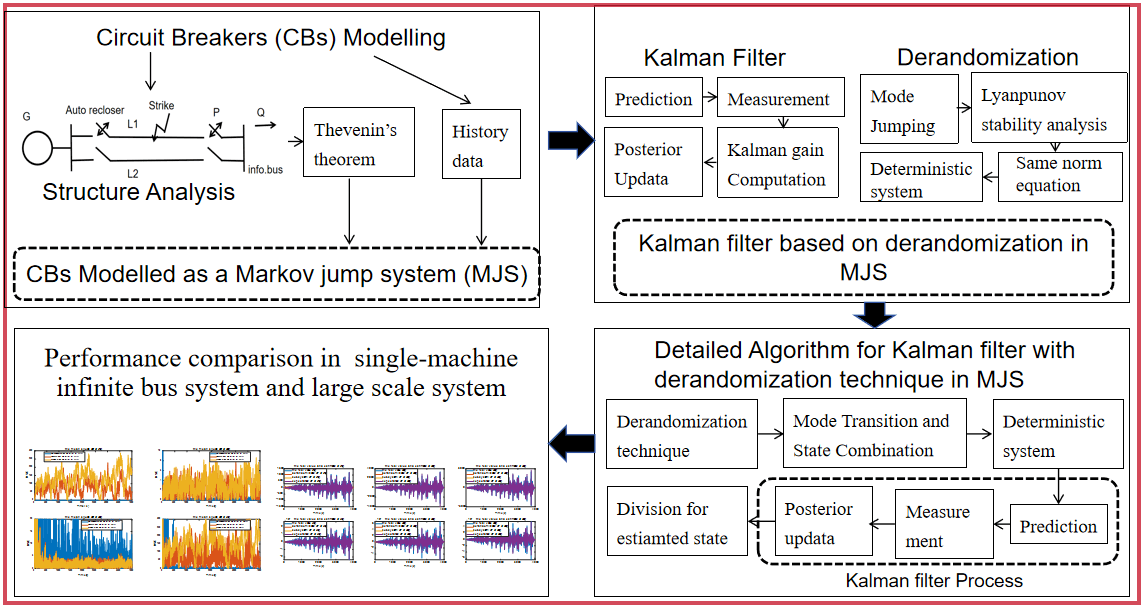
This study considers the state estimation problem of the circuit breakers (CBs), solving for random abrupt changes that occurred in power systems. With the abrupt changes randomly occurring, it is represented in a Markov chain, and then the CBs can be considered as a Markov jump system (MJS). In these MJSs, the transition probabilities are obtained from historical statistical data of the random abrupt changes when the faults occurred. Considering that the traditional Kalman filter (KF) frameworks based on MJS only depend on the subsystem of MJS, but neglect the stochastic jump between different subsystems. This study utilized the derandomization technique which transforms the stochastic MJS to a deterministic system to introduce the stochastic mode jumping in MJS, in which the state is still in the same norm, and the Lyapunov function is derived to show the stability condition of the systems, which proved that the transformed deterministic system is more conservative than the original MJS mathematically. After that, the Kalman filter algorithm is designed for estimating the state of the CBs depending on the transformed deterministic system. With the help of the Kalman filter, the estimation performance is derived by the recursive state estimation algorithm for the CBs. Furthermore, a single machine infinite-bus (SMIB) power system and a three-bus large scale system are proposed as practical examples to validate the effectiveness of the proposed algorithm.Graphic Abstract
Keywords
Markov jump system (MJS); circuit breaker (CB); Kalman filter; derandomization technique; power system; mode transition
Cite This Article
APA Style
Li, Q., Zhou, Z. (2025). The Kalman Filter Design for MJS in Power System Based on Derandomization Technique. Energy Engineering, 122(12), 5001–5020. https://doi.org/10.32604/ee.2025.068866
Vancouver Style
Li Q, Zhou Z. The Kalman Filter Design for MJS in Power System Based on Derandomization Technique. Energ Eng. 2025;122(12):5001–5020. https://doi.org/10.32604/ee.2025.068866
IEEE Style
Q. Li and Z. Zhou, “The Kalman Filter Design for MJS in Power System Based on Derandomization Technique,” Energ. Eng., vol. 122, no. 12, pp. 5001–5020, 2025. https://doi.org/10.32604/ee.2025.068866
 Copyright © 2025 The Author(s). Published by Tech Science Press.
This work is licensed under a Creative Commons Attribution 4.0 International License , which permits unrestricted use, distribution, and reproduction in any medium, provided the original work is properly cited.
 Downloads
 Citation Tools
