
 Login
Login Register
 Submit a Paper
 Propose a Special lssue
 Open Access
ARTICLE
Distribution Patterns of Deep Shale Reservoirs and Longitudinal Utilization Degree of Horizontal Wells
1 Shunan Division, PetroChina Southwest Oil & Gasfield Company, Luzhou, 646000, China
2 Shale Gas Research Institute of PetroChina Southwest Oil & Gas Field Company, Chengdu, 610051, China
3 Shale Gas Evaluation and Exploitation Key Laboratory of Sichuan Province, Chengdu, 610091, China
4 Development Department, Southwest Oil and Gas Field, PetroChina, Chengdu, 610059, China
* Corresponding Author: Ziqiang Xia. Email:
Energy Engineering 2025, 122(12), 5039-5054. https://doi.org/10.32604/ee.2025.069036
Received 12 June 2025; Accepted 18 August 2025; Issue published 27 November 2025
 View Full Text
 Download PDF
Abstract
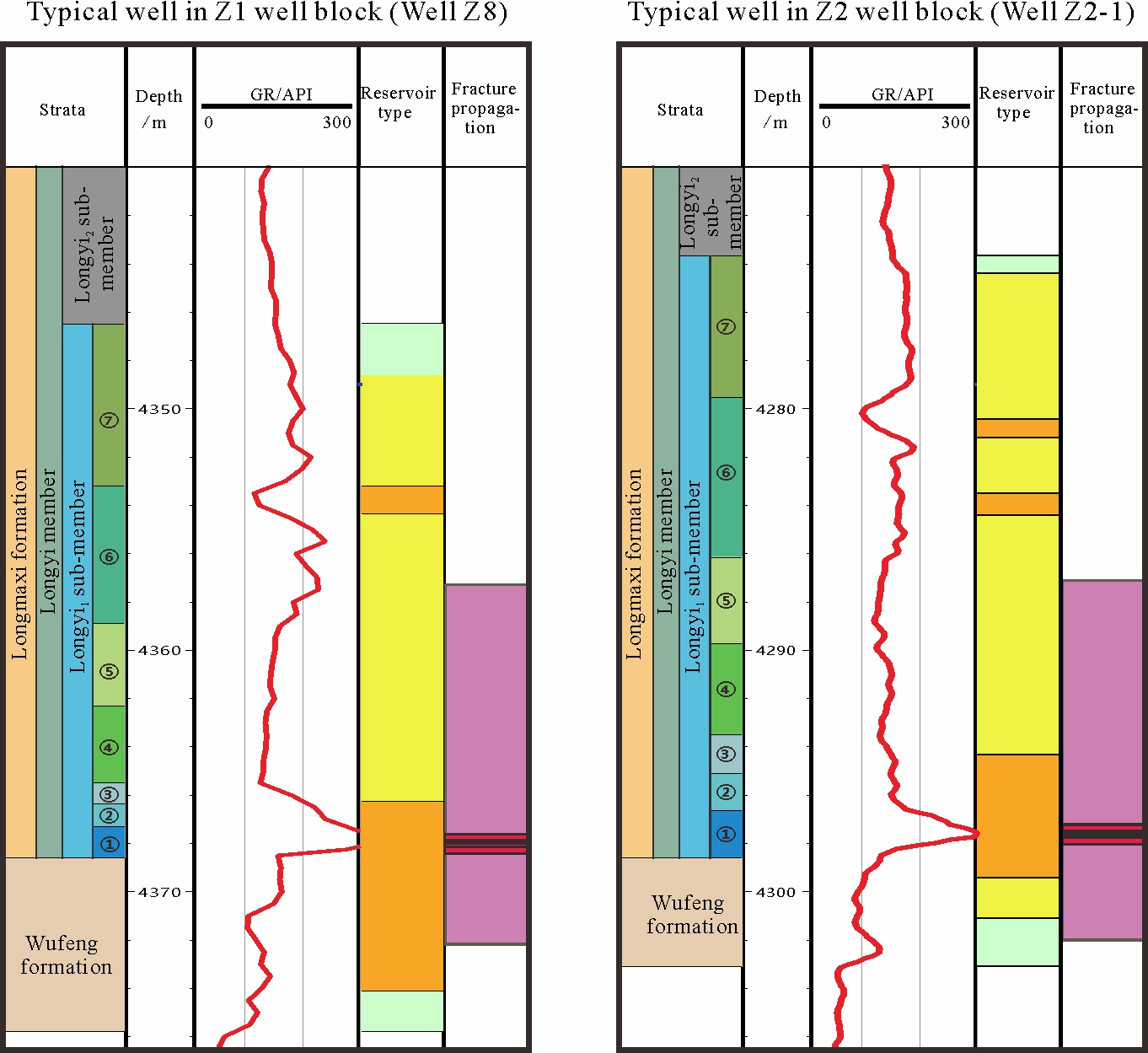
To explore and evaluate the longitudinal utilization degree of marine shale gas horizontal wells in southern Sichuan Basin (hereinafter referred to as “southern Sichuan”), focusing on the shale of Wufeng formation-Longyi1 sub-member in the deep Z block. By using the data from core experiments, well logging, and fracture height detection, a systematic analysis from the perspectives of reservoir distribution, longitudinal utilization height of hydraulic fractures, and longitudinal utilization degree of horizontal wells was conducted. The research results show that: (1) The overall reservoir conditions of the Wufeng formation-Longyi1 sub-member in the study area are relatively favorable, although the quality of Type I reservoir varies significantly among different well blocks; (2) The proppant tracer fracture height detection results show that fractures tend to extend upwards, the average total fracture height of fracture extend is 12.7 m, with the average upward extension height is 2.5 times the downward extension height; (3) The combination of fracture height and gas well productivity analysis suggests that targeting sub-layer ① as the horizontal well target can achieve full production of the continuous thickness of Type I reservoir in Z2 well block, whereas in Z1 well block, due to the significant proportion of the Wufeng formation in the continuous thickness of Type I reservoir, in the areas where the continuous thickness of Type I reservoir in Wufeng formation to middle sub-layer ① is greater than 4 m, horizontal wells cannot achieve full longitudinal utilization of the continuous thickness in top-quality Type I reservoir. The conclusion is that due to the limitations of longitudinal utilization height by artificial fracture networks and the variability in the distribution of continuous thickness of Type I reservoir, Z1 well block can continue to conduct horizontal well target tests and differentiated fracturing designs to further enhance the longitudinal utilization degree of the top-quality Type I reservoir.Graphic Abstract
Keywords
Cite This Article
 Copyright © 2025 The Author(s). Published by Tech Science Press.
This work is licensed under a Creative Commons Attribution 4.0 International License , which permits unrestricted use, distribution, and reproduction in any medium, provided the original work is properly cited.
 Downloads
 Citation Tools
