
 Login
Login Register
 Submit a Paper
 Propose a Special lssue
 Open Access
ARTICLE
Feasibility of Micro-Hydro Power for Rural Electrification in Bangladesh: A Case Study from the Chittagong Hill Tracts
1 School of Engineering, RMIT University, Melbourne, VIC 3000, Australia
2 Department of Mechanical Engineering, Chittagong University of Engineering & Technology, Chittagong, 4349, Bangladesh
* Corresponding Author: Ratan Kumar Das. Email:
(This article belongs to the Special Issue: Advanced Analytics on Energy Systems)
Energy Engineering 2025, 122(12), 4815-4835. https://doi.org/10.32604/ee.2025.071727
Received 11 August 2025; Accepted 26 September 2025; Issue published 27 November 2025
 View Full Text
 Download PDF
Abstract
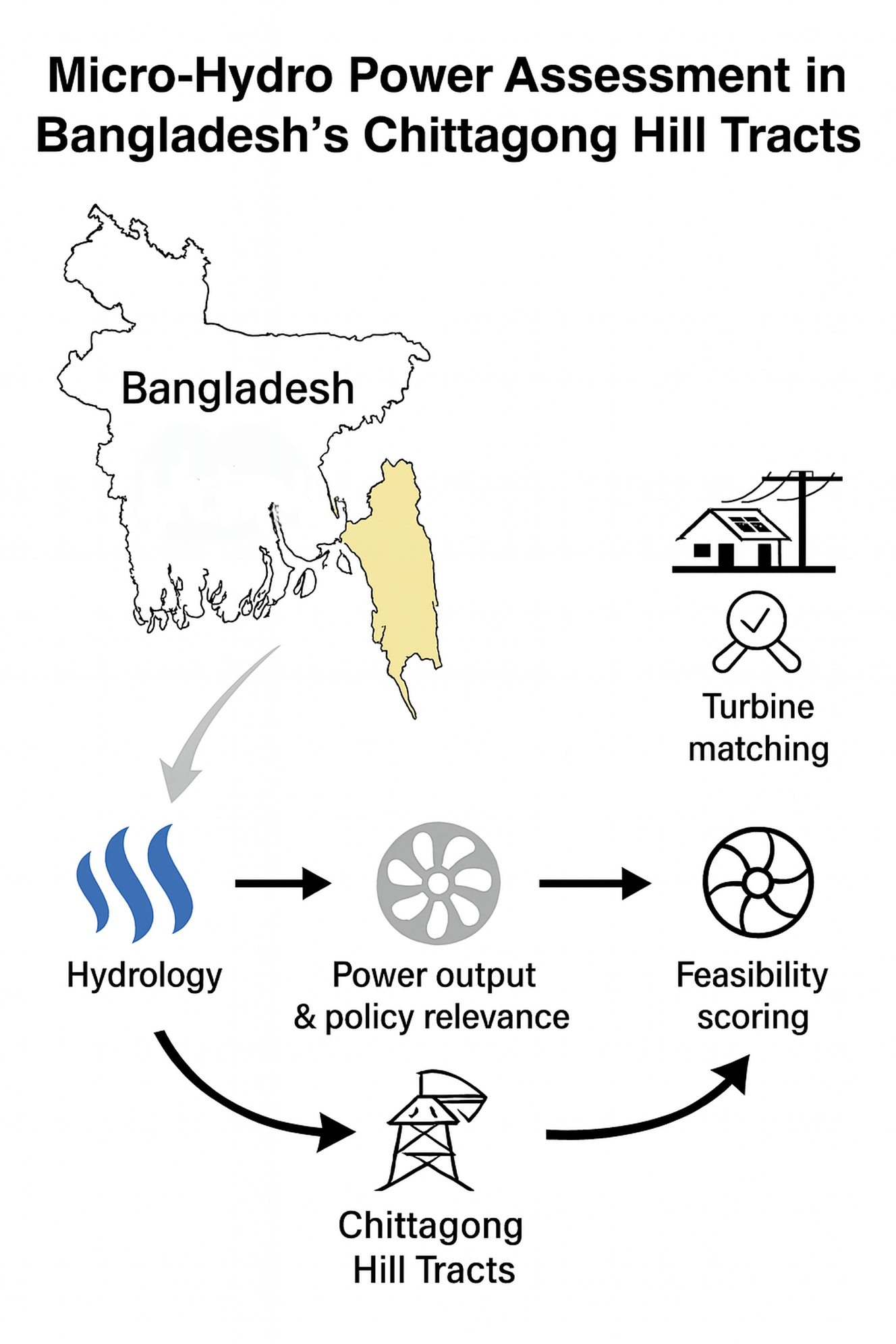
Bangladesh has achieved notable progress in expanding electricity access nationwide. Nonetheless, remote and topographically challenging regions such as the Chittagong Hill Tracts (CHT) continue to face coverage gaps due to grid extension difficulties. This research investigates the technical feasibility of micro-hydro power (MHP) systems as viable off-grid solutions for rural electrification in CHT. Field surveys conducted across various sites assessed available head and flow rates using GPS-based elevation measurements and portable flow meters. Seasonal fluctuations were factored into the analysis to ensure year-round operational viability. The study involved estimating power output, selecting appropriate turbine types based on head-flow data, and proposing preliminary plant configurations. Results identify multiple locations with adequate head (2.5 to 10.4 m) and flow rates (0.10 to 0.35 m3/s), capable of generating between 1.5 and 16.5 kW, sufficient for essential rural applications. Based on site-specific head and discharge characteristics, Kaplan and Francis turbines were identified as the most suitable configurations, offering high efficiency for the medium-flow, low-to-medium head environments typical of the studied regions. Despite inherent technical potential, challenges such as seasonal variability, infrastructure complexities, and policy deficiencies remain. This investigation addresses a critical knowledge gap in local renewable energy planning. It offers a data-driven foundation for pilot projects and community-scale electrification initiatives in Bangladesh’s remote mountainous areas.Graphic Abstract
Keywords
Cite This Article
 Copyright © 2025 The Author(s). Published by Tech Science Press.
This work is licensed under a Creative Commons Attribution 4.0 International License , which permits unrestricted use, distribution, and reproduction in any medium, provided the original work is properly cited.
 Downloads
 Citation Tools
