
 Login
Login Register
 Submit a Paper
 Propose a Special lssue
 Open Access
ARTICLE
Enhanced Efficiency of Solar-Assist Heat Pump Using Tracking PV/T Panel: A TRNSYS Simulation Study
Department of Mechanical and Energy Engineering, Erbil Technical Engineering College, Erbil Polytechnic University, Erbil, 44001, Iraq
* Corresponding Authors: Ashna Abduljabbar Haji. Email: ; Ranj S. Abdullah. Email:
(This article belongs to the Special Issue: Advancements in Energy Resources and Their Processes, Systems, Materials and Policies for Affordable Energy Sustainability)
Energy Engineering 2025, 122(12), 5111-5127. https://doi.org/10.32604/ee.2025.073367
Received 16 September 2025; Accepted 24 October 2025; Issue published 27 November 2025
 View Full Text
 Download PDF
Abstract
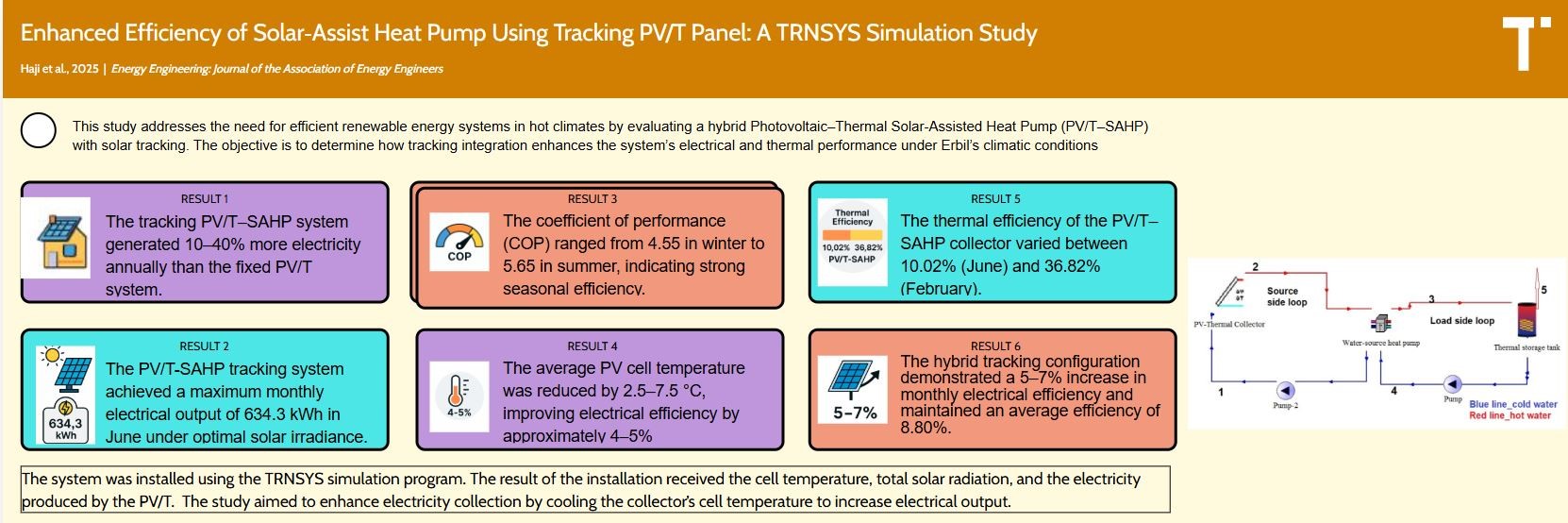
The hybrid photovoltaic solar-assisted heat pump are primarily used to generate electricity and provide thermal energy for heating applications. This study investigates the performance enhancement of a hybrid Photovoltaic Thermal Solar-Assisted Heat Pump (PV/T-SAHP) system integrated with a solar tracking mechanism. The system was simulated using TRNSYS to evaluate its monthly electrical output and coefficient of performance (COP) of the heat pump system over a year. The results showed a significant improvement in energy generation and efficiency compared to a conventional PV/T system without SAHP system. Overall, the solar tracking configuration of the PV/T-SAHP generated 10%–40% more electricity than the fixed system. The system for the tracking mode achieved a maximum monthly average electrical energy output of 634.349 kWh in June. Throughout the year, the tracking mode consistently outperformed the fixed mode. During the winter months of January and December, the tracking system produced 328.7 and 323.6 kWh, respectively, compared to 297.8 and 299.7 kWh for the fixed mode. The highest COP of 5.65 occurred in July, indicating a strong seasonal correlation with solar irradiance. In contrast, the minimum COP of 4.55 was observed in the months, February and March, reflecting reduced solar availability. The solar tracking feature consistently maintained an optimal panel angle, increasing energy gains and improving system efficiency. Overall, the integration of a heat pump and tracking control significantly improved system performance, making the hybrid PV/T-SAHP configuration a promising solution for year-round renewable energy generation.Graphic Abstract
Keywords
Cite This Article
 Copyright © 2025 The Author(s). Published by Tech Science Press.
This work is licensed under a Creative Commons Attribution 4.0 International License , which permits unrestricted use, distribution, and reproduction in any medium, provided the original work is properly cited.
 Downloads
 Citation Tools
