
 Login
Login Register
 Submit a Paper
 Propose a Special lssue
 Open Access
ARTICLE

Greenhouse Gas Payback of a Solar Photovoltaic System in Northeast Brazil: Effects of the Application of a Solar Coating
1 Department of Renewable Energy Engineering, Federal University of Paraíba, João Pessoa, 58051-900, Brazil
2 Graduate Program in Mechanical Engineering, Federal University of Paraíba, João Pessoa, 58051-900, Brazil
3 Department of Chemical Engineering, Faculty of Science and Engineering, Université Laval, Québec, QC G1V 0A6, Canada
4 Aragón Institute for Engineering Research (I3A), University of Zaragoza, Zaragoza, 50009, Spain
* Corresponding Author: Monica Carvalho. Email:
(This article belongs to the Special Issue: Recent Advances in Sustainable Solar Thermal and PV Systems)
Energy Engineering 2025, 122(8), 3265-3283. https://doi.org/10.32604/ee.2025.066218
Received 01 April 2025; Accepted 17 June 2025; Issue published 24 July 2025
 View Full Text
 Download PDF
Abstract
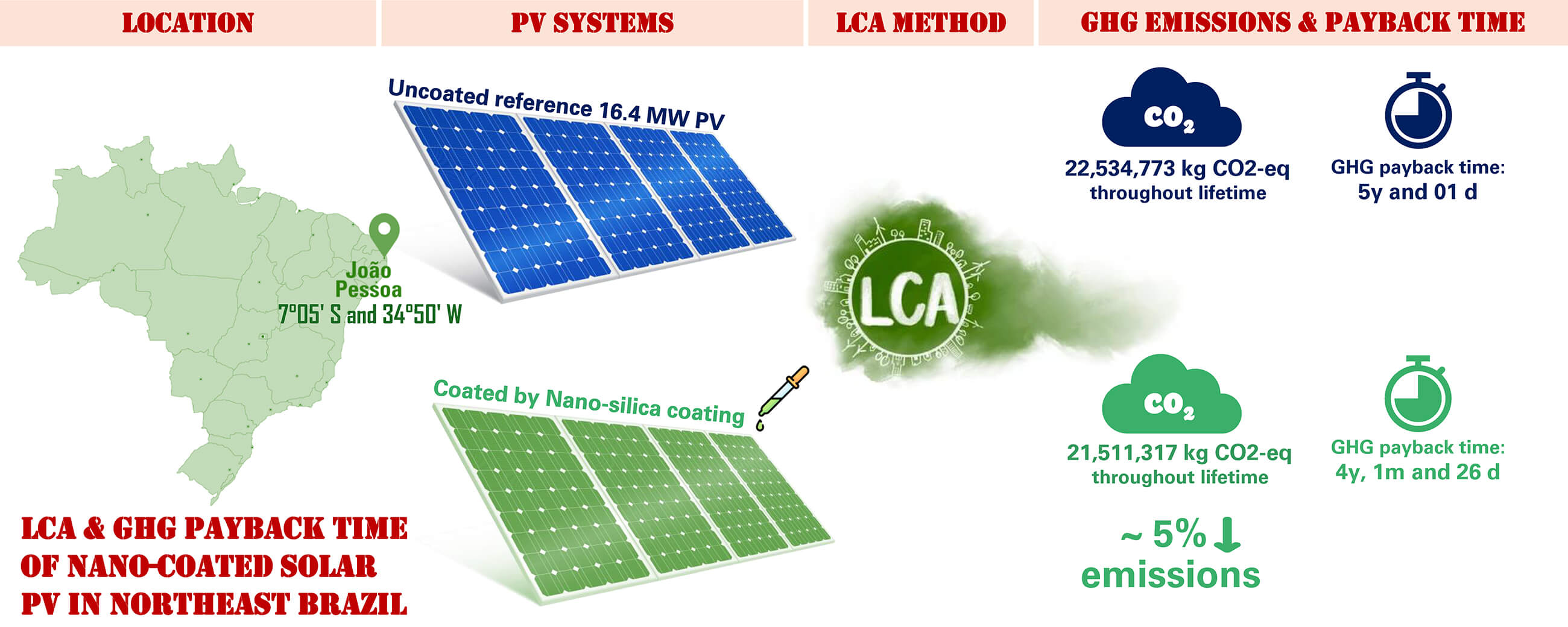
The application of different coatings on solar photovoltaic (PV) panels can be an efficient solution to increase performance and further mitigate the emission of greenhouse gases. This study uses the Life Cycle Assessment (LCA) methodology and the environmental payback concept to analyze the effects of the application of a nano-silica coating on a solar PV system installed in the Brazilian Northeast. Firstly, an uncoated reference 16.4 MW PV system is designed, and the detailed inventory is presented (PV panels, supporting structure, inverters, junction boxes, cables, transportation, maintenance and operation—including the replacement of equipment). The results of the LCA quantify the greenhouse gas emissions associated with the PV system. Electricity production is estimated by technical and local climate data. Subsequently, the environmental payback time of the system is calculated, which is the time required for the PV system to offset the emissions associated with system manufacturing, operation, and disposal. This is the first Brazilian study to verify the effects of a self-cleaning coating on a solar PV system throughout its lifetime, compared to the uncoated (reference system). The original photovoltaic system emitted 22,534,773 kg CO2-eq, with an environmental payback of 5 years and 1 day. When the self-cleaning coating is applied, the emissions are 21,511,317 kg CO2-eq (almost 5% lower) with a payback of 4 years, 1 month and 26 days. The application of self-cleaning coatings reduces the required area for installation (due to increased efficiency), and not only reduces emissions but is also aligned with global sustainability targets and contributes to the concept of sustainable and intelligent cities.Graphic Abstract
Keywords
Cite This Article
 Copyright © 2025 The Author(s). Published by Tech Science Press.
This work is licensed under a Creative Commons Attribution 4.0 International License , which permits unrestricted use, distribution, and reproduction in any medium, provided the original work is properly cited.
 Downloads
 Citation Tools
