
 Login
Login Register
 Submit a Paper
 Propose a Special lssue
 Open Access
ARTICLE

A Two-Layer Energy Management Strategy for Fuel Cell Ships Considering the Performance Consistency of Fuel Cells
1 Key Laboratory of Transport Industry of Marine Technology and Control Engineering, Shanghai Maritime University, Shanghai, 201306, China
2 Institut d’Électronique et des Technologies du numéRique, UMR CNRS 6164, Nantes Université, Nantes, 44000, France
3 China Classification Society Wuhan Rules & Research Institute, Wuhan, 430010, China
* Corresponding Author: Diju Gao. Email:
Energy Engineering 2025, 122(9), 3681-3702. https://doi.org/10.32604/ee.2025.068656
Received 03 June 2025; Accepted 23 July 2025; Issue published 26 August 2025
 View Full Text
 Download PDF
Abstract
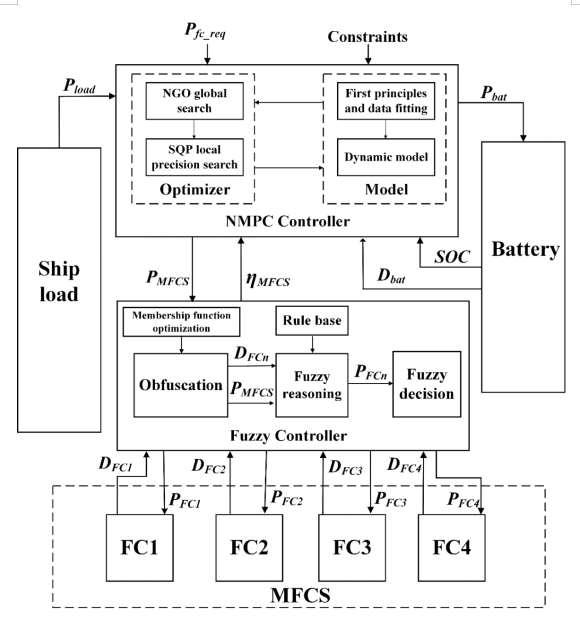
Hydrogen fuel cell ships are one of the key solutions to achieving zero carbon emissions in shipping. Multi-fuel cell stacks (MFCS) systems are frequently employed to fulfill the power requirements of high-load power equipment on ships. Compared to single-stack system, MFCS may be difficult to apply traditional energy management strategies (EMS) due to their complex structure. In this paper, a two-layer power allocation strategy for MFCS of a hydrogen fuel cell ship is proposed to reduce the complexity of the allocation task by splitting it into each layer of the EMS. The first layer of the EMS is centered on the Nonlinear Model Predictive Control (NMPC). The Northern Goshawk Optimization (NGO) algorithm is used to solve the nonlinear optimization problem in NMPC, and the local fine search is performed using sequential quadratic programming (SQP). Based on the power allocation results of the first layer, the second layer is centered on a fuzzy rule-based adaptive power allocation strategy (AP-Fuzzy). The membership function bounds of the fuzzy controller are related to the aging level of the MFCS. The Particle Swarm Optimization (PSO) algorithm is used to optimize the parameters of the residual membership function to improve the performance of the proposed strategy. The effectiveness of the proposed EMS is verified by comparing it with the traditional EMS. The experimental results show that the EMS proposed in this paper can ensure reasonable hydrogen consumption, slow down the FC aging and equalize its performance, effectively extend the system life, and ensure that the ship has good endurance after completing the mission.Graphic Abstract
Keywords
Cite This Article
 Copyright © 2025 The Author(s). Published by Tech Science Press.
This work is licensed under a Creative Commons Attribution 4.0 International License , which permits unrestricted use, distribution, and reproduction in any medium, provided the original work is properly cited.
 Downloads
 Citation Tools
