
 Login
Login Register
 Submit a Paper
 Propose a Special lssue
 Open Access
REVIEW
Curtain Wall Systems as Climate-Adaptive Energy Infrastructures: A Critical Review of Their Role in Sustainable Building Performance
1 Department of Architecture, ST.C., Islamic Azad University, Tehran, Iran
2 Energy and Environment Research Center, ShK.C., Islamic Azad University, Shahrekord, Iran
* Corresponding Author: Mehdi Jahangiri. Email:
Energy Engineering 2026, 123(1), 2 https://doi.org/10.32604/ee.2025.070089
Received 08 July 2025; Accepted 01 December 2025; Issue published 27 December 2025
 View Full Text
 Download PDF
Abstract
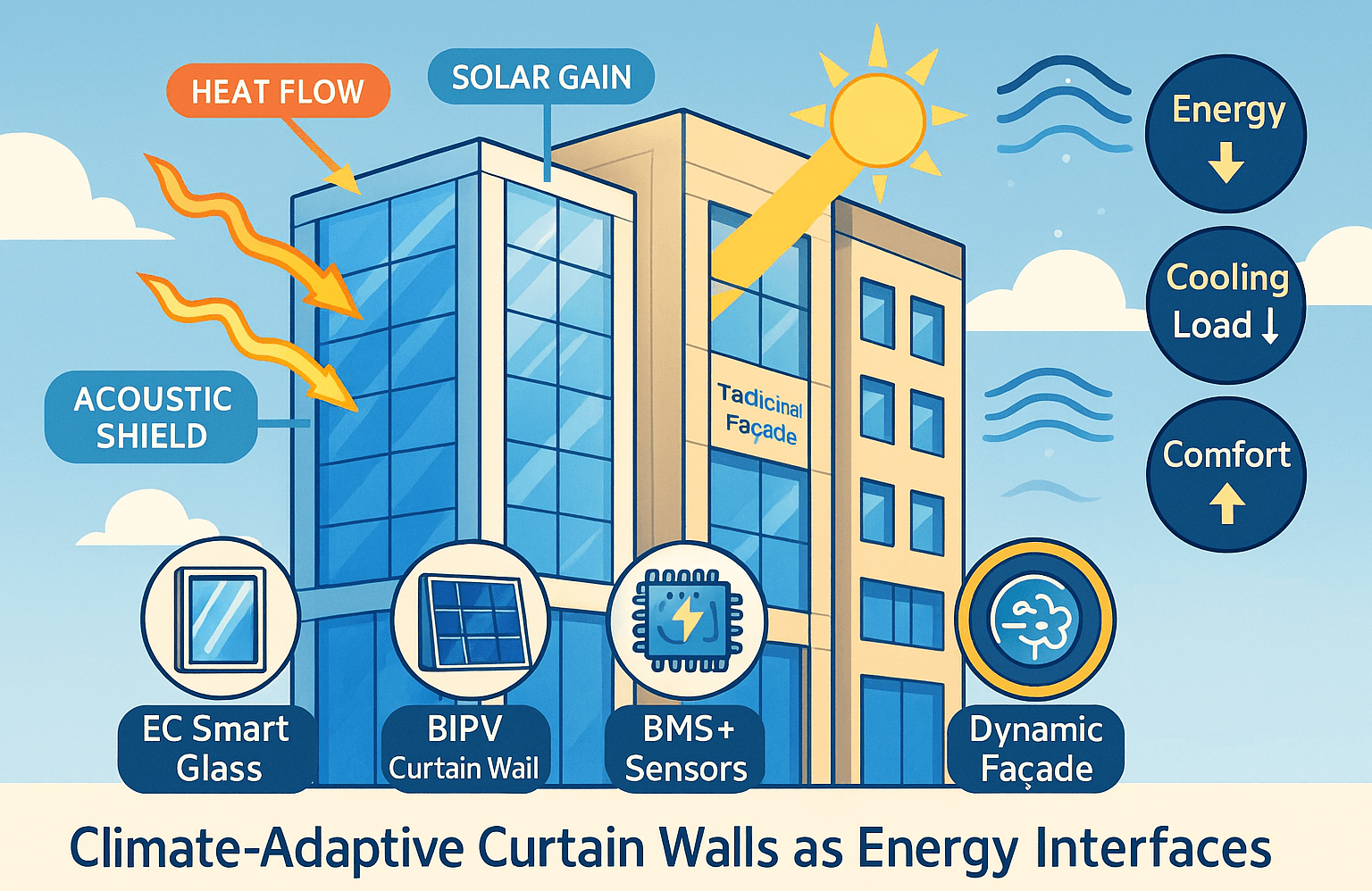
Curtain wall systems have evolved from aesthetic façade elements into multifunctional building envelopes that actively contribute to energy efficiency and climate responsiveness. This review presents a comprehensive examination of curtain walls from an energy-engineering perspective, highlighting their structural typologies (Stick and Unitized), material configurations, and integration with smart technologies such as electrochromic glazing, parametric design algorithms, and Building Management Systems (BMS). The study explores the thermal, acoustic, and solar performance of curtain walls across various climatic zones, supported by comparative analyses and iconic case studies including Apple Park, Burj Khalifa, and Milad Tower. Key challenges—including installation complexity, high maintenance costs, and climate sensitivity—are critically assessed alongside proposed solutions. A central innovation of this work lies in framing curtain walls not only as passive architectural elements but as dynamic interfaces that modulate energy flows, reduce HVAC loads, and enhance occupant comfort. The reviewed data indicate that optimized curtain wall configurations—especially those integrating electrochromic glazing and BIPV modules—can achieve annual energy consumption reductions ranging from approximately 5% to 27%, depending on climate, control strategy, and façade typology. The findings offer a valuable reference for architects, energy engineers, and decision-makers seeking to integrate high-performance façades into future-ready building designs.Graphic Abstract
Keywords
Curtain wall systems; energy efficiency; climate-responsive design; smart façades; electrochromic glass; parametric architecture; building envelope technologies
Cite This Article
APA Style
Rastbod, S., Jahangiri, M., Moradi, B., Nazari, H. (2026). Curtain Wall Systems as Climate-Adaptive Energy Infrastructures: A Critical Review of Their Role in Sustainable Building Performance. Energy Engineering, 123(1), 2. https://doi.org/10.32604/ee.2025.070089
Vancouver Style
Rastbod S, Jahangiri M, Moradi B, Nazari H. Curtain Wall Systems as Climate-Adaptive Energy Infrastructures: A Critical Review of Their Role in Sustainable Building Performance. Energ Eng. 2026;123(1):2. https://doi.org/10.32604/ee.2025.070089
IEEE Style
S. Rastbod, M. Jahangiri, B. Moradi, and H. Nazari, “Curtain Wall Systems as Climate-Adaptive Energy Infrastructures: A Critical Review of Their Role in Sustainable Building Performance,” Energ. Eng., vol. 123, no. 1, pp. 2, 2026. https://doi.org/10.32604/ee.2025.070089
 Copyright © 2026 The Author(s). Published by Tech Science Press.
This work is licensed under a Creative Commons Attribution 4.0 International License , which permits unrestricted use, distribution, and reproduction in any medium, provided the original work is properly cited.
 Downloads
 Citation Tools
