
 Login
Login Register
 Submit a Paper
 Propose a Special lssue
 Open Access
ARTICLE

Blockchain-Powered Dynamic Coordination of EV Charging in Integrated Transport-Power Systems
Electric Power Research Institute, State Grid Jiangsu Electric Power Co., Ltd., Nanjing, 211103, China
* Corresponding Author: Xiaodong Yuan. Email:
(This article belongs to the Special Issue: Sustainable Transport Technologies and Strategies: Impacts on Energy and Environment)
Energy Engineering 2026, 123(10), 10 https://doi.org/10.32604/ee.2025.074882
Received 20 October 2025; Accepted 18 December 2025; Issue published 30 August 2026
 View Full Text
 Download PDF
Abstract
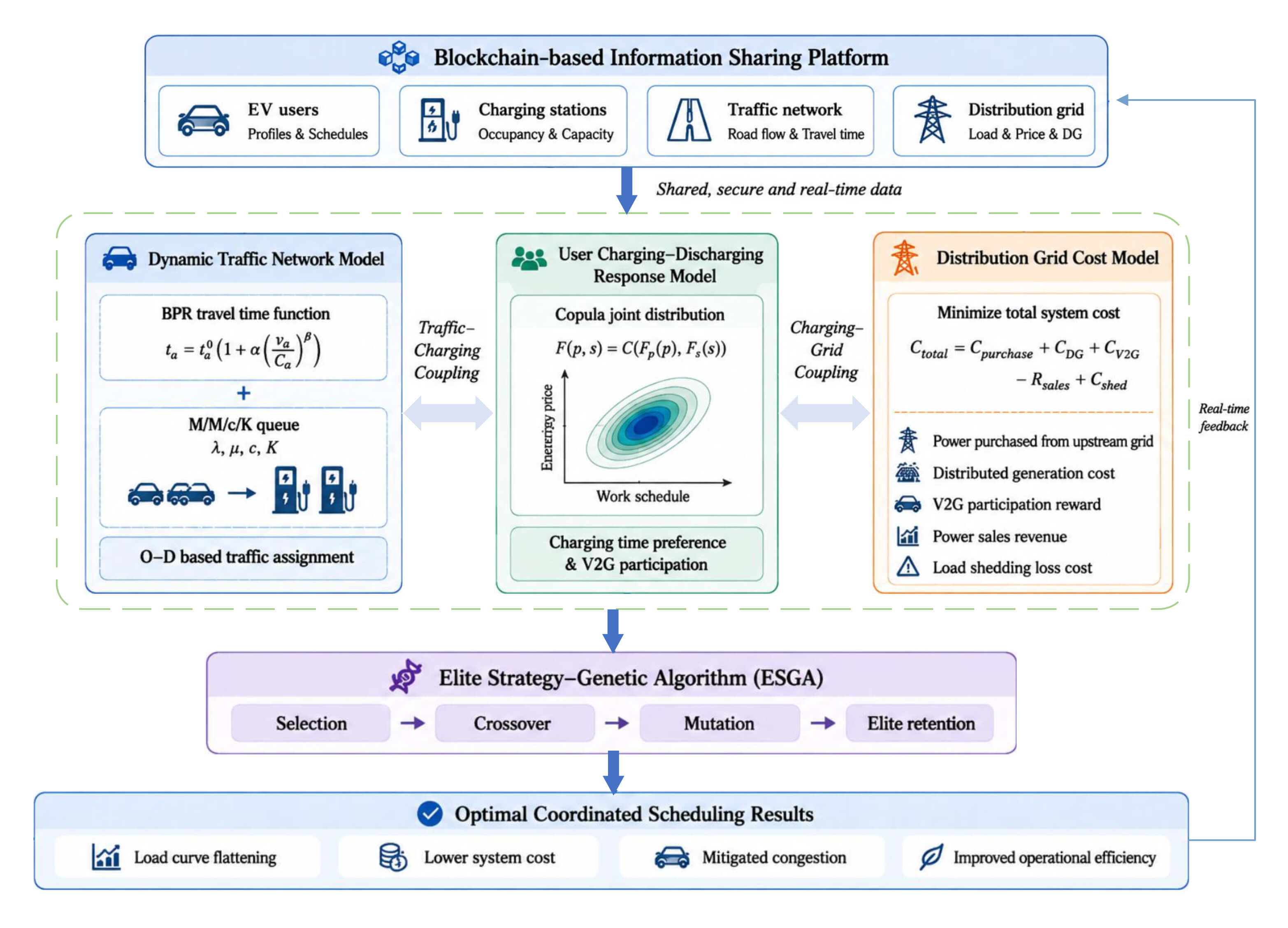
Electric vehicles (EVs), characterized by their large-scale deployment and flexible charging–discharging scheduling, represent a growing form of transportation. However, their widespread adoption poses considerable challenges to the security and stability of the power grid during peak charging periods, highlighting the need for effective management of the coupled traffic–grid system. To address this issue, this paper proposes a blockchain-driven optimization model for charging scheduling in dynamic traffic networks. Blockchain technology is introduced to ensure data transparency and security in decentralized decision-making. First, a queuing model integrating the Bureau of Public Roads (BPR) function with the M/M/c/K queue is established, and a dynamic traffic network model is constructed using origin–destination (O-D) combinations. This integrated model effectively captures travel time and queuing delays, thereby addressing constraints from user travel planning. Second, incorporating economic incentives for charging and discharging, a transfer model based on the Copula joint distribution is developed to quantify the influence of electricity prices and user work schedules on charging time preferences. Finally, a comprehensive objective function is formulated to minimize the total cost of the distribution network, incorporating key cost components such as power purchased from the upper-level grid, electricity generation from distributed sources, vehicle-to-grid (V2G) participation rewards, power sales revenue, and costs associated with load shedding losses. The model is solved using an elite strategy genetic algorithm (ESGA), demonstrating effectiveness in achieving collaborative optimization between grid and traffic flows. Case study results verify that the proposed strategy not only flattens the load curve but also reduces the overall system cost, thereby improving the operational efficiency of the coupled system.Graphic Abstract
Keywords
Cite This Article
 Copyright © 2026 The Author(s). Published by Tech Science Press.
This work is licensed under a Creative Commons Attribution 4.0 International License , which permits unrestricted use, distribution, and reproduction in any medium, provided the original work is properly cited.
 Downloads
 Citation Tools
