
 Login
Login Register
 Submit a Paper
 Propose a Special lssue
 Open Access
ARTICLE
Quantitative Evaluation Model of Tight Reservoir Permeability Based on the Dual Effect of Temperature and Pressure
1 The College of Petroleum, China University of Petroleum (Beijing) at Karamay, Karamay, China
2 Heavy Oil Development Company, Xinjiang Oilfield Company, PetroChina, Karamay, China
3 Intercontinental Strait Energy Technology Co., Ltd., Chengdu, China
* Corresponding Author: Hu Yang. Email:
(This article belongs to the Special Issue: Enhanced Oil and Gas Recovery in Unconventional Reservoirs)
Energy Engineering 2026, 123(11), 8 https://doi.org/10.32604/ee.2026.079024
Received 13 January 2026; Accepted 25 March 2026; Issue published 24 September 2026
 View Full Text
 Download PDF
Abstract
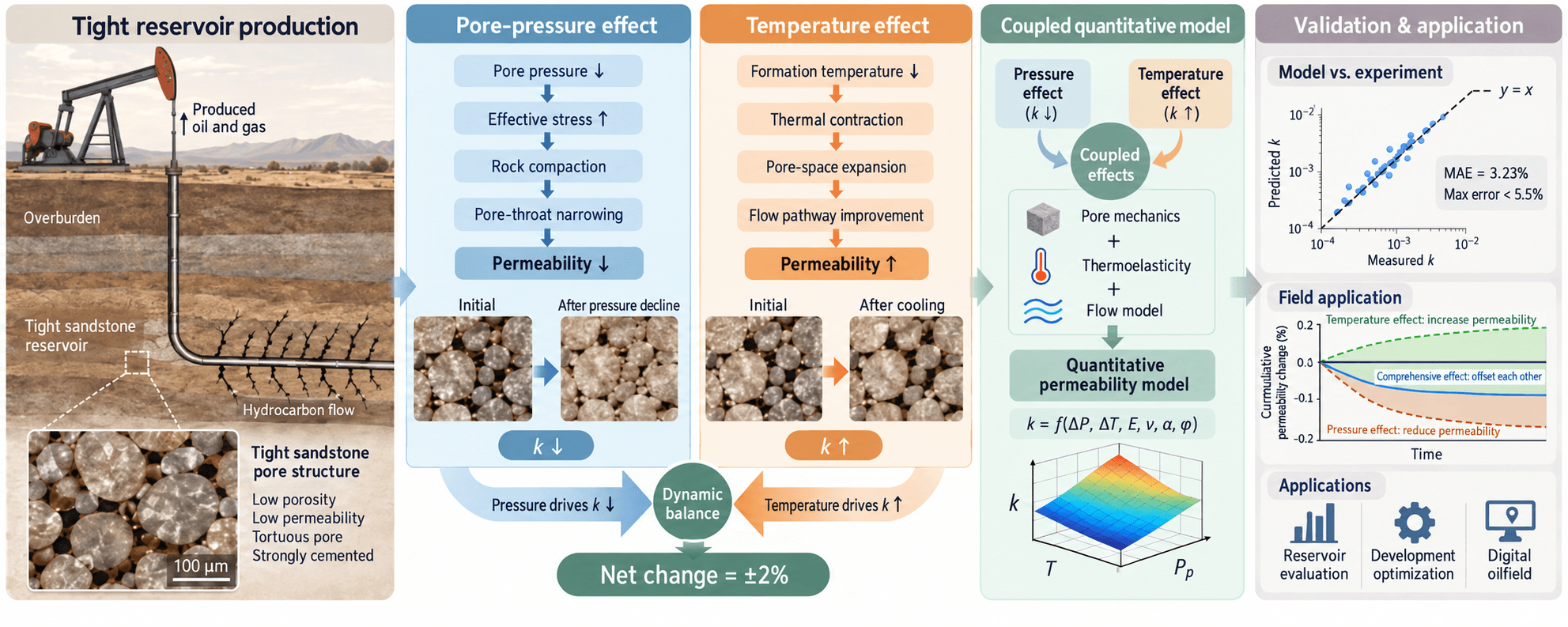
To quantitatively evaluate the changes in reservoir permeability induced by variations in temperature and pore pressure during the oil and gas exploitation process, this study proposes a novel quantitative evaluation model. This model innovatively integrates thermoelastic and poroelastic effects to predict the evolution of permeability in tight reservoirs. The study assumes that rocks undergo only elastic deformation, and the stress–strain relationships governing pore volume and pore size were derived based on the theory of elasticity for porous media. A capillary flow model was employed to simulate the fluid flow process, and in combination with the Kozeny-Carman equation, a quantitative model was developed to describe permeability changes as functions of temperature and pore pressure. To address the limitations of conventional permeability testing methods, the experimental setup was modified to replicate actual reservoir temperature and pressure conditions, allowing for simultaneous measurements of rock mechanics and permeability. The results show that the permeability reduction predicted by the model is in strong agreement with experimental data, thereby validating the reliability of the proposed model. It is observed that during the oil and gas exploitation process, a decline in pore pressure leads to a reduction in permeability, whereas a decrease in reservoir temperature enhances permeability. These two effects tend to offset each other, resulting in a relatively small net change in permeability, typically within ±2%. The proposed model is suitable for quantitatively estimating permeability in tight rocks with poorly developed fractures under conditions of elastic deformation, and can provide theoretical guidance for digital oilfield applications and development optimization.Graphic Abstract
Keywords
Cite This Article
 Copyright © 2026 The Author(s). Published by Tech Science Press.
This work is licensed under a Creative Commons Attribution 4.0 International License , which permits unrestricted use, distribution, and reproduction in any medium, provided the original work is properly cited.
 Downloads
 Citation Tools
