
 Login
Login Register
 Submit a Paper
 Propose a Special lssue
 Open Access
ARTICLE
Look-Ahead Vehicle-to-Grid-Aware Distribution Optimal Power Flow Approach Considering Enhanced C-ADMM-Based Electric Vehicle Aggregation Scheduling
1 School of Electrical Engineering and Computer Science, KTH Royal Institute of Technology, Stockholm, Sweden
2 School of Electrical and Information Engineering, Xihua University, Chengdu, China
3 Department of Electrical and Computer Engineering, The University of British Columbia, Vancouver, BC, Canada
* Corresponding Author: Yiyao Zhou. Email:
(This article belongs to the Special Issue: Operation and Control of Grid-connected New Energy and Emerging Loads)
Energy Engineering 2026, 123(11), 12 https://doi.org/10.32604/ee.2026.084834
Received 30 April 2026; Accepted 02 July 2026; Issue published 24 September 2026
 View Full Text
 Download PDF
Abstract
To address the impact of electric vehicle (EV) aggregation services on distribution network operation, this paper proposes a look-ahead vehicle-to-grid (V2G)-aware distribution optimal power flow (DOPF) approach that explicitly incorporates the time-varying V2G control errors arising from EV battery dispatch into real-time DOPF decisions. The V2G dispatch model is reformulated into a decomposable structure comprising one master problem and multiple subproblems, where the master problem updates the Lagrange multipliers and each subproblem optimizes the charging and discharging schedule of an individual EV. An enhanced consensus alternating direction method of multipliers algorithm is further developed by incorporating a tailored warm-start strategy to improve computational efficiency. Numerical simulations are performed on distribution networks with a fleet of EVs managed by a real-world EV aggregator. The results demonstrate that the proposed method can effectively account for time-varying V2G control errors and improve the performance of real-time DOPF operation.Keywords
With the continuous development of vehicle-to-grid (V2G) and fast charging technologies [1], the aggregated scheduling of numerous electric vehicles (EVs) effectively creates large-scale, virtual energy storage within urban load centers, enabling participation in grid dispatch [2]. Consequently, EVs can supply power back to the grid during peak hours, providing load response regulation and offering sufficient capacity to accommodate the ongoing integration of renewable energy. From a technical and economic perspective, an EV aggregation control system that coordinates with distribution optimal power flow (DOPF) provides essential regulation resources for flexible distribution network (DN) operation [3,4], and can be deployed in load centers without occupying additional land, offering long-term benefits. The EV aggregator, as an intermediary operator, interfaces between the DN and end users—including distributed generation, flexible loads, battery storage, and EVs—to support reliable and efficient DN operation [5–7]. For simplicity, we assume an aggregator coordinates only EVs with V2G contracts and performs day-ahead battery dispatch optimization (BDO) to schedule charging and discharging power following an aggregate signal prescribed by the distribution system operator (DSO) [8]. In most cases, the V2G control error is inherent from the uncertainty of EVs’ availability for an aggregator [9]. However, the traditional DOPF approaches did not consider the V2G control error inherent in practical V2G services, which may lead to inefficient DOPF solutions.
For a DSO, the DOPF approaches have considered the integration of EV aggregation services in distribution systems. Early centralized frameworks treated EV aggregators as controllable nodal injections using second-order cone relaxation for efficient computation [10]. To address computational challenges for the DOPF and V2G scheduling together, decentralized optimization using the alternating direction method of multipliers (ADMM) has emerged as a particularly promising approach [11]. With multi-layer ADMM frameworks, decentralized V2G optimization can enable autonomous EV coordination for ancillary services, while maintaining voltage regulation across distribution buses [12]. Market-based coordination mechanisms have also been developed, including a two-stage optimization mechanism for managing energy and ancillary service markets at the transmission-distribution interface, where EV and demand response aggregators provide regulation capacity alongside conventional resources, reducing system costs by approximately 10% [13]. Game-theoretic approaches have further extended this literature, where DSOs request flexibility from EV aggregators based on DOPF solutions, and aggregators recruit EVs through non-cooperative game-based price coordination that explicitly accounts for transportation system constraints [14]. Recent work has conceptualized EV-centric technical virtual power plants that synthesize physical-economic bidirectional mapping incorporating nonlinear power flow constraints and node voltage limits, multi-market coupling mechanisms evolving from unilateral energy bidding to coordinated participation in carbon trading and ancillary services, and real-time control strategies evaluating trade-offs between optimization and artificial intelligence approaches [15]. However, from the perspective of the DSO, these works fail to consider the impact of V2G control errors on DOPF for efficient distribution system operation.
For an EV aggregator, the optimal control problem of clustered EV battery charging and discharging is performed in the battery dispatch optimization problems. Most existing literature adopts battery charging/discharging models based on mixed-integer linear programming (MILP) to satisfy the mutual exclusivity constraint that batteries cannot charge and discharge simultaneously [8]. However, EV aggregators typically need to manage hundreds of EV batteries, which inevitably introduces a large number of integer variables in the clustered battery scheduling model. Moreover, the clustered EV battery scheduling model adopts a quadratic function [16]. These two aspects make the clustered battery scheduling model essentially a mixed-integer quadratic programming (MIQP) problem [17], posing significant computational challenges for fast solution. Currently, two main approaches are adopted to accelerate the solution: (1) relaxing the integer variables to transform the clustered EV battery optimization scheduling problem into a continuous quadratic programming problem [18]; (2) adopting decentralized optimization methods to solve the clustered EV battery optimization scheduling problem using decentralized algorithms [17]. For modelling approaches using integer variable relaxation, existing studies usually adopt approximate solution methods with relaxed integer variables to solve the clustered EV battery optimization scheduling problem. In [19], the H-representation convex hull-linear programming (HCH-LP) method is used to establish approximate linear constraints that avoid simultaneous charging and discharging results, allowing all integer variables to be relaxed. Reference [18] proposed a physically realizable battery optimization scheduling model with relaxed integer variables, which can obtain an approximately global optimal solution. Apart from optimal dispatch calculations from computing perspective, reference [20] proposed an optimal energy dispatch model for grid-connected EV that incorporates a lithium battery electrochemical model to improve the accuracy of state estimation and scheduling decisions in smart grid operations. In reference [21], Porras et al. develop a computationally efficient robust optimization approach for the day-ahead operation of an EV aggregator, enabling reliable bidding strategies under uncertainty in electricity prices and driving behavior. This indicates that the uncertainty via robust optimization can be well aligned with optimal V2G frameworks for EV aggregators. However, the approximation methods adopted in the existing literature suffer from two major shortcomings: first, they lack rigorous theoretical justification for replacing the charging–discharging complementary constraints; second, they fail to incorporate uncertainties, thereby restricting their practical applicability.
In terms of decentralized optimization solutions for the V2G dispatch problem, the EV aggregator can distribute the scheduling power target to each EV charging pile at the system level, and then each EV charging pile independently completes the battery optimization scheduling task. In reference [8], the disjunctive convex hull relaxation (DCHR) approach is developed for solving the BDO problem with the high scalability of EV scheduling. By dividing the feasibility space of the BDO problem, the search space without resorting to binary variable relaxation can be reduced, thereby reducing the dimension of integer variables and total computation time. Ref. [22] proposed a decentralized iterative algorithm to manage the battery charging/discharging scheduling of EV aggregators. Ref. [23] used Benders decomposition to design the decomposition of the distribution system optimization model for EV aggregators. However, the battery charging/discharging models adopted in these references are all linear models, which may lead to simultaneous charging and discharging solutions. The Lagrangian relaxation method used in reference [24] can distribute the charging power target signals of different EVs but fails to consider the V2G discharging function of batteries; therefore, the corresponding battery scheduling model is oversimplified and cannot be directly used for clustered EV battery optimization scheduling problems. In addition, some heuristic distributed algorithms, such as the water-filling algorithm [25] and the whale optimization algorithm [26], have also been reported for solving clustered EV battery optimization scheduling problems. However, the whale optimization algorithm is a heuristic method whose optimality depends on how the hyperparameters are set. For the water-filling algorithm, the optimal charging/discharging power targets of different EVs must be determined in advance, but such prior information may not be available to the EV aggregator. Therefore, unlike existing decentralized optimization methods mentioned above, this paper proposes a more robust decentralized algorithm that significantly reduces both the total computational burden and computation time, thereby better supporting look-ahead DOPF solutions.
To address this gap, this paper proposes a look-ahead V2G-aware DOPF approach that explicitly considers minimizing time-varying V2G control errors of EV aggregators in real-time DOPF control, enabling large-scale mobile EV batteries to function as flexible and large-capacity energy storage devices in DOPF dispatch through efficient V2G aggregation services. Our main contributions are summarized as follows:
(1) We develop a look-ahead V2G-aware DOPF approach that considers the time-varying V2G control error of EV battery dispatch optimization in the real-time DOPF control. This proposed DOPF approach interacts with the optimal V2G dispatch model using the V2G control signal as the intermediate variable for efficient DOPF solutions. This intermediate variable bridges the gap between the DOPF and the aggregator-level distributed control in the look-ahead time window, ensuring that the final dispatch solution is both economically optimal for the distribution system and physically realizable by the heterogeneous EV fleet.
(2) For optimal V2G dispatch model of aggregators, we reformulate the optimal V2G dispatch model in the decomposable form, which can be solved with one master problem and multiple sub-problems for higher computational efficiency. In this decomposable model, the master problem updates the Lagrange multipliers and each sub-problem corresponds to the charging/discharging optimization of an individual EV. Subsequently, the enhanced consensus alternating direction method of multipliers (C-ADMM) algorithm is developed with the designed warm-start strategy. Compared with existing algorithms, our proposed enhanced C-ADMM algorithm guarantees global optimality, reduces computational time from exponential to linear growth with respect to the number of EVs, and minimizes communication overhead between the aggregator and individual EVs.
The remainder of this paper is organized as follows (see summary in Fig. 1). Section 2 presents the look-ahead V2G-aware DOPF model. Section 3 develops the C-ADMM-based battery dispatch optimization of an EV Aggregator. Section 4 presents case studies. Finally, Section 5 draws the paper’s conclusions.
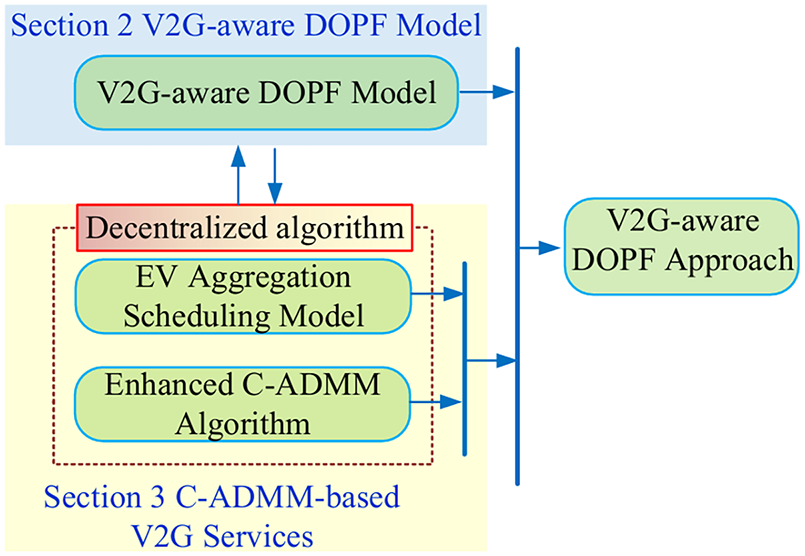
Figure 1: Paper organization with main contributions in look-ahead V2G-aware DOPF approach.
2 Look-Ahead V2G-Aware DOPF Model
Large-scale mobile EV batteries can function as flexible, large-capacity energy storage devices in DOPF dispatch through efficient V2G aggregation services. However, the power control target is set by the distribution network dispatch control center based on a day-ahead assumption of EV battery capacity, which may become infeasible if the actual battery capacity is insufficient on the next day. In other words, the traditional DOPF approach did not consider the control error from prescribed reference power vectors from EV aggregation services, which may lead to the inefficient DOPF solutions. Thus, this paper proposes a V2G-aware DOPF approach that accounts for EV aggregation scheduling in the real-time control.
For a DSO, if the dispatched power reference from the V2G aggregation service cannot be fully delivered due to insufficient real-time battery power support, the distribution network may experience voltage violations, line overloads, or increased power losses. Consequently, the DSO cannot rely solely on day-ahead assumptions when designing optimal power flow strategies but instead requires a more robust and adaptive framework that integrates real-time feedback from EV aggregators, accounting for actual battery availability and response capabilities. Due to the multiple-time-step dispatch horizon, the EV aggregator first solves its own optimization problem based on the signals received from the DSO within a dispatch period ∆TA. The DSO subsequently solves the DOPF to obtain network reference signals for a dispatch period ∆TD, where ∆TA > ∆TD, and these signals are then sent back to the aggregator. By embedding V2G awareness into the look-ahead DOPF approach, the DSO can enhance grid reliability, reduce control errors, and ensure that dispatch solutions remain feasible under practical operating conditions, as illustrated in Fig. 2. In this figure, the look-ahead DOPF model operates with a dispatch period ∆TD, whereas the V2G-based battery dispatch optimization model uses a dispatch period ∆TA, while the V2G control signals Pt ref are updated within the look-ahead time window t ∈ T.
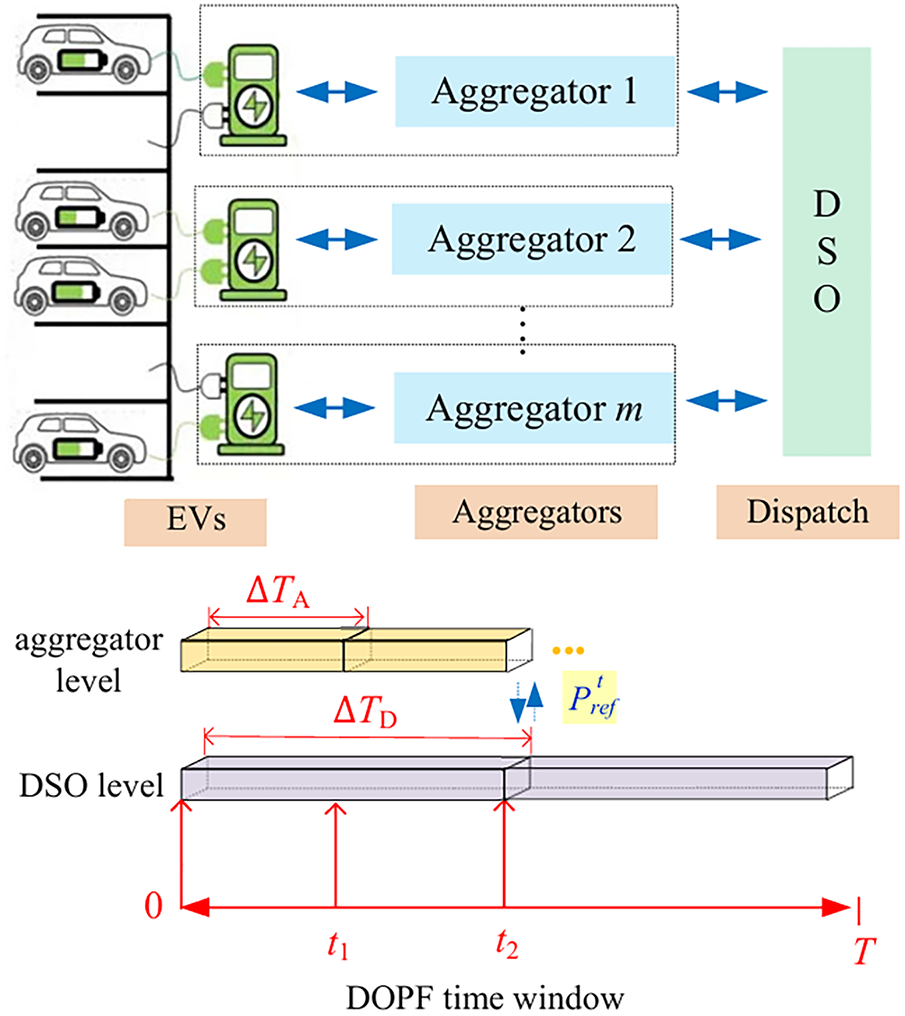
Figure 2: Look-ahead V2G-aware DOPF dispatch framework.
In the look-ahead V2G-aware DOPF model, the second-order cone relaxation-based branch flow model is adopted below. The optimization variables vector for this DOPF includes the V2G control target Pt ref, vectors of sending-end active and reactive power flows Pl and Ql, nodal active and reactive power injections Pg, Qg, vector of squared current on branches ll, and vector of squared voltage profiles 𝒗. Define 𝛼t and βt denote the cost coefficients for the generation cost and EV aggregation cost, and
where || ||2 refers to the Euclidean norm. Pl and Ql refer to the vectors of sending-end active and reactive power flows with the moduli equal to |Pl| and |Ql|. Pg, Qg, P>d and Qd indicate the vectors of given nodal active and reactive power injections and active and reactive loads at nodes. Qcr is the vector of nodal reactive power compensation. ll is the vector of squared current on branches. Dr and Dx indicate the diagonal matrices whose diagonal elements are the resistance vector and the reactance vector, respectively. |zl| is a diagonal matrix subject to |zl|2 = |Dr|2 + |Dx|2.
3 C-ADMM-Based Battery Dispatch Optimization of an EV Aggregator
3.1 Optimal EV Aggregation Scheduling Model
As shown in Fig. 3 for an EV aggregator framework, the EV aggregator acts as an intermediary operator between the distribution system and EVs. It integrates distributed generation, responsive loads, and energy storage devices through aggregation control, and then participates in the optimal operation and market trading of distribution networks.
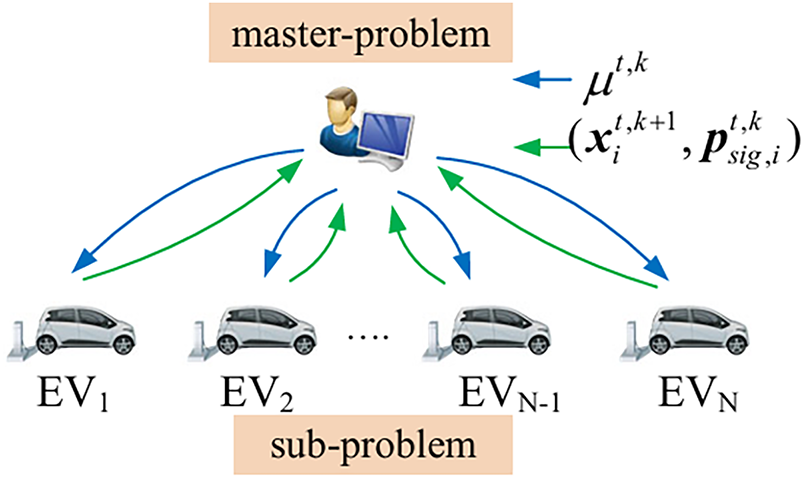
Figure 3: Decentralized dispatch framework for an EV aggregator.
For the j-th EV aggregator, we examine the charging and discharging scheduling of EV battery i ∈ Ej in time period t ∈ T, where Ej represents the j-th EV aggregator’s set of EVs. The charging power and discharging power are denoted respectively by Pt,ch j,i and Pt,dis j,i, using the mixed-integer linear programming battery model in (2b)–(2e). With the initial energy level e0 j,i [p.u.] of EV i and a given V2G control signal Pt j,ref for the j-th EV aggregator, the battery dispatch optimization model is expressed as follows:
where ∆TA [h] denotes a single scheduling period; Ej represents the j-th aggregator’s set of EVs;
Observing the battery dispatch optimization model (2a)–(2e), if the objective function (2a) can be decomposed, then the battery optimization scheduling model can be rewritten in a separable form, providing a prerequisite for subsequently using C-ADMM to decompose the centralized optimization model (2a)–(2e) into master and subproblems. For convenience, we denote cT xj,i = Pt,ch j,t + Pt,dis j,t for the j-th EV aggregator, where c is a constant vector, and the optimization variable is xj,i = [Pt,ch j,i; Pt,dis j,i; et j,i], i.e., xj,i ∈
Suppose the optimal power control target of each EV is
where
According to the C-ADMM algorithm, when the Lagrange multiplier vector is fixed, the augmented Lagrangian function L can be decomposed into NE subproblems and one master problem. In other words, each subproblem corresponds to the optimal scheduling task of a single EV battery, and the NE EV battery scheduling tasks can be executed simultaneously. In the master problem, the Lagrange multiplier vector is updatedsolelybasedontheoptimalresultsobtainedfromeachEVbatteryschedulingtask. Basedonthis principle, a distributed optimal scheduling model using ADMM is proposed below. At the k-th iteration, the subproblem corresponding to the i-th EV can be expressed as:
where
At the k-th iteration, after all subproblems have completed the irrespective optimization tasks, we
According to the above C-ADMM algorithm, the NE,j subproblems are solved simultaneously, and the update of the Lagrange multiplier vector in the master problem involves only a simple calculation. The complexity of controlling all batteries after aggregating large-scale EVs is significantly reduced, the computational efficiency is greatly improved, and the computation time is substantially decreased. Based on this computational advantage, the convergence condition for the proposed C-ADMM algorithm for the j-th EV aggregator is given as:
where ε1 and ε2 are prescribed thresholds.
3.2 Enhanced C-ADMM Algorithm with Warm-Start Strategy
The enhanced C-ADMMis a key algorithm for decomposable convex optimization, particularly effective for large-scale EV aggregation problems. For an individual EV aggregator, the battery dispatch optimization model (2a)–(2e) decomposes the original objective function into several parallel solvable subproblems, then coordinates their solutions to obtain the global optimum. The application of C-ADMM algorithm has extended from convex to non-convex optimization, especially for distributed computation of mixed-integer models. Considering that the enhanced C-ADMM algorithm requires a given initial search point, a better initial value will accelerate the convergence of the enhanced C-ADMM algorithm. Therefore, a warm-start strategy for the proposed algorithm mispresented below. After relaxing the charging and discharging integer variables ut,ch j,t and ut,dis j,t, the battery dispatch optimization (2a)–(2e) is transformed into a quadratic programming problem. Since it is a convex optimization model, a commercial solver can quickly obtain a solution, although the optimal result may involve simultaneous charging and discharging. To this end, this optimal solution is used as the warm-start initial solution for the C-ADMM algorithm. For the j-th EV aggregator, the integer-relaxed optimal aggregation scheduling model (8a)–(8d) is formulated as follows:
Assume that the optimal solution of this integer-relaxed optimal scheduling model is xt j and its objective function value is Fj. Suppose xt* j is the global optimal solution obtained from the optimal scheduling model (2a)–(2e), and F* j is its optimal objective function value. Clearly, Fj ≤ F* j must hold, and xt j may equal xt* j, or may be another optimal solution, or maybe an infeasible solution.
Two conclusions can be drawn: the battery dispatch optimization model (2a)–(2e) has multiple global optimal solutions xt* j, and the objective function values F* j of all global optimal solutions are equal. Furthermore, the integer-relaxed EV battery aggregation optimal scheduling model (8a)–(8d) can obtain a reasonable xt+ j as an initial solution, which accelerates the convergence of the C-ADMM algorithm. The reason is that the solution xt+ j obtained from the integer-relaxed model may exhibit simultaneous charging and discharging, in which case F+ j is close to the optimal solution xt* j. Therefore, this information can be fully utilized, and the C-ADMM algorithm can be used to correct xt+ j, thereby obtaining the exact global optimal solution xt* j. To this end, assuming the maximum number of iterations is kmax, the pseudo-code framework of the C-ADMM-based battery dispatch optimization algorithm for the j-th EV aggregator is presented below (Algorithm 1).
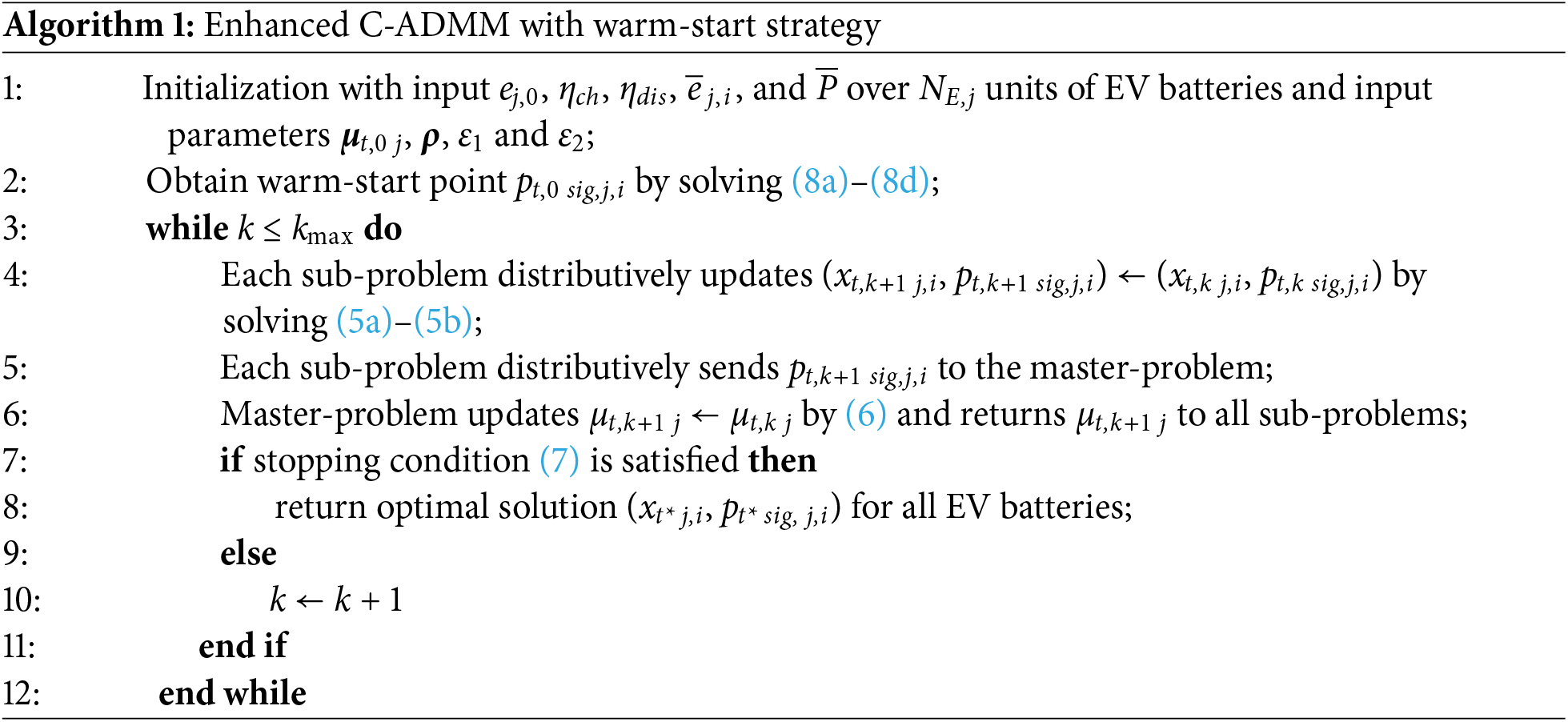
We discuss our enhanced C-ADMM in Algorithm 1 and compare it with conventional ADMM and consensus ADMM algorithms. For the optimal V2G problems, conventional ADMM or consensus ADMM algorithms may yield multiple optimal solutions that share the same objective function value F* j. Since the MIQP-based V2G battery dispatch optimization model (2a)–(2e) differs from the upper-boundary V2G-based battery dispatch optimization model (4) only in the objective function, the MIQP-based model may also admit multiple optimal solutions. Moreover, the integer-relaxed battery dispatch optimization model (8a)–(8d) provides an optimal point pt,+ sig,j,i, which can be used to initialize pt,0 sig,j,i. A near-optimal initial point pt,0 sig,j,i enables the proposed Algorithm 1 to converge quickly. Moreover, the warm start leads to fewer switches between charging and discharging actions. This is because {pt,0 sig,j,i} ≥ 0 allows all EVs to operate in charging mode as long as Pt j,ref ≥ 0, while {pt,0 sig,j,i} ≤ 0 directs all EVs to discharging mode when Pt j,ref ≤ 0. Consequently, Pt,0 j,ref enables all EVs to either charge or discharge simultaneously, thereby resulting in fewer switching actions.
In summary, the look-ahead V2G-aware DOPF approach has two time scales, i.e., the DOPF model for ∆TD, and the V2G-based battery dispatch optimization model for ∆TA, with ∆TD ≥ ∆TA. For instance, ∆TD = 1 h and ∆TA = 0.25 h. With efficient C-ADMM-based computation forV2Gservices, the look-ahead DOPF model can deliver more accurate and robust optimal DOPF solutions within the look-ahead time window t ∈ T.
We show case the computational performance of the proposed look-ahead DOPF solutions with 4 EV 292 aggregators in the large-scale distribution network. Fig. 4 shows a schematic diagram of the IEEE 123-bus 293 test system, where the EV aggregators are connected at bus 118, bus 122, bus 22 and bus 61. Micro diesel 294 generators are connected at buses 50, 59, and 95. Bus 1 is the slack bus (substation). The time-of-use 295 cost coefficient for the generation cost αt is $0.25/p.u. from 00:00 to 08:00 and $0.5/p.u. for the remaining periods. The cost coefficient for the EV aggregation cost βt is $0.1/p.u. The look-ahead time window T is 4 h, and ∆TD = 1 h, ∆TA = 0.25 h.
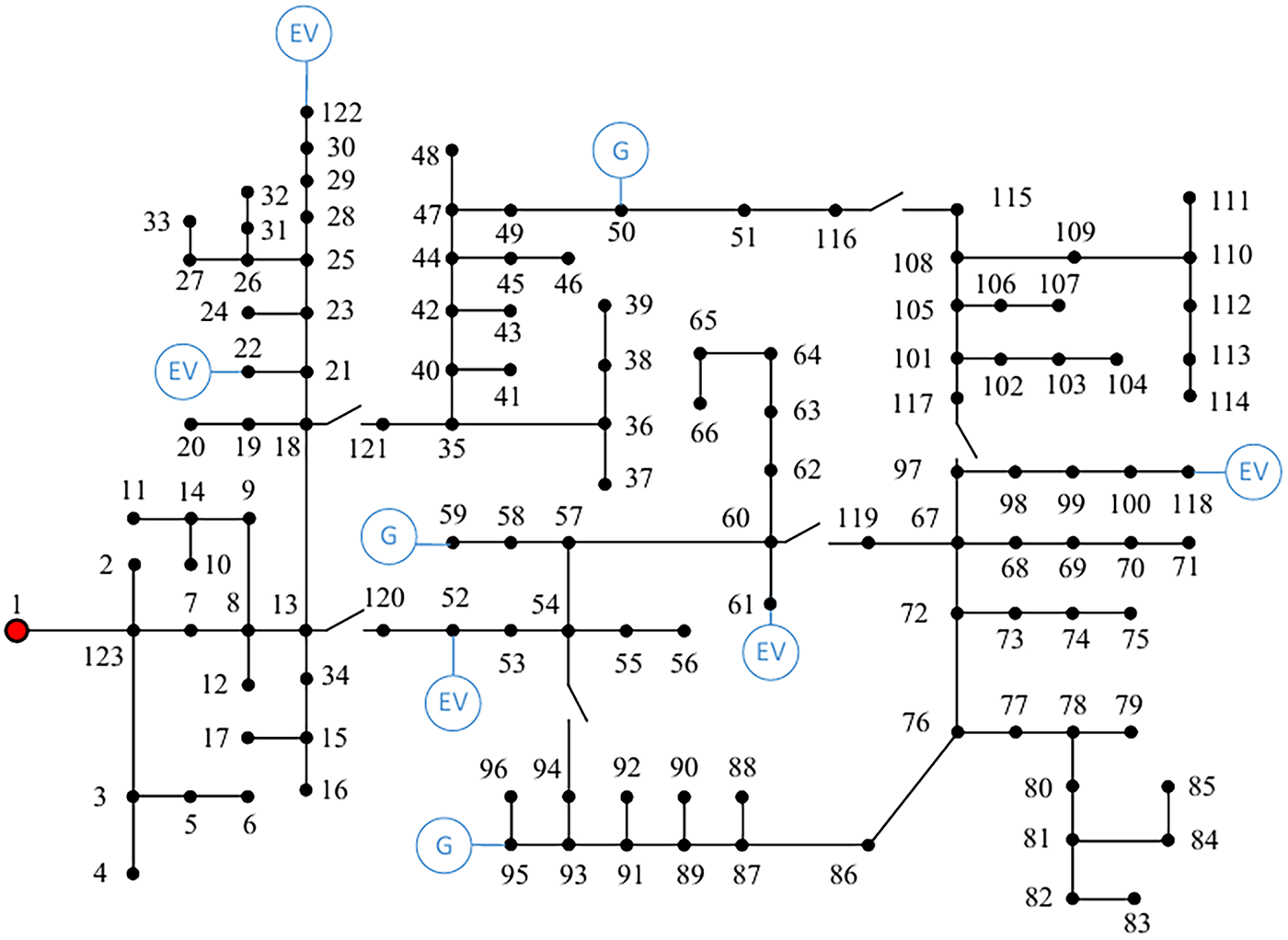
Figure 4: Schematic diagram of the IEEE 123-bus test system.
To verify the computational performance of the proposed enhanced C-ADMM with warm-start strategy, all simulations were conducted on a workstation equipped with an Intel Corei7-12700Kprocessor (2.5 GHz) and 32 GB of RAM, running the Windows 11 operating system. The optimization models were implemented in MATLAB R2024a using the YALMIP toolbox as the modeling interface, with Gurobi 11.0 employed as the core solver to handle all mixed-integer linear programming problems; the relative 303 optimality gap was set to 1% to balance computational efficiency and solution accuracy, and the maximum 304 iteration limit was capped at 100 for large-scale cases. A hierarchical communication framework was 305 adopted in which the aggregator exchanges dispatch signals and state information with individual EVs 306 under the idealizing assumptions of zero latency and no data loss. The initial state of charge e1,0 of the EV aggregator for the first EV is randomly defined, and the 24-h power control target curve of the EV load aggregator is given. The battery parameters of each EV are assumed to be ηch = 0.9, ηdis = 0.95,
4.1 V2G-Aware DOPF Vs. Traditional DOPF Solutions
The traditional DOPF approach is performed on the IEEE 123-bus system with the fixed V2G signal vector. For 24 h, Fig. 5 displays the error curve between the V2G-aware V2G signal vector Pt* ref by the proposed V2G-aware DOPF approach and the fixed V2G signal vector Pt ref used by the traditional DOPF approach.
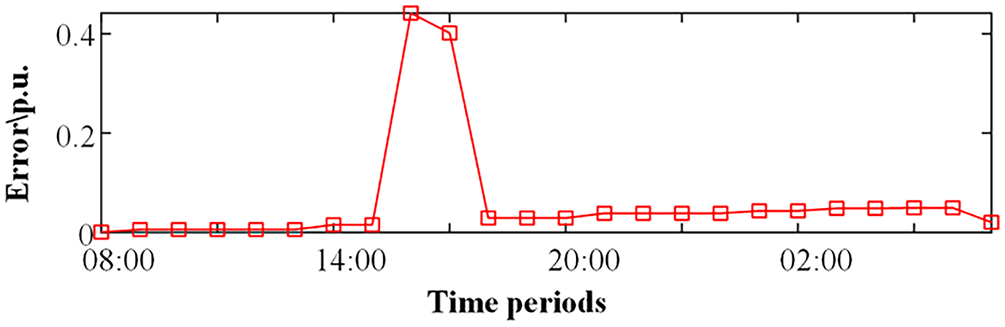
Figure 5: Error curve between Pt* ref and Pt ref.
As shown in Fig. 5, the V2G-aware signal vector Pt* ref exhibits significant variations during the period from 14:00 to 07:00, particularly at 15:00 and 16:00. This indicates that the day-ahead fixed V2G signal vector Pt ref may be unreasonable for V2G control due to the uncertainty of EV availability. In contrast, our proposed rolling V2G-aware signal vector Pt* ref is capable of tracking the uncertain EV availability and dynamically adjusting Pt* ref accordingly, thereby providing more accurate aggregator-specific operational support for the DOPF. Moreover, Fig. 6a shows the minimum cost function G of the distribution grid by proposed and traditional DOPF methods, and Fig. 6b shows the corresponding optimal dispatch power solutions.
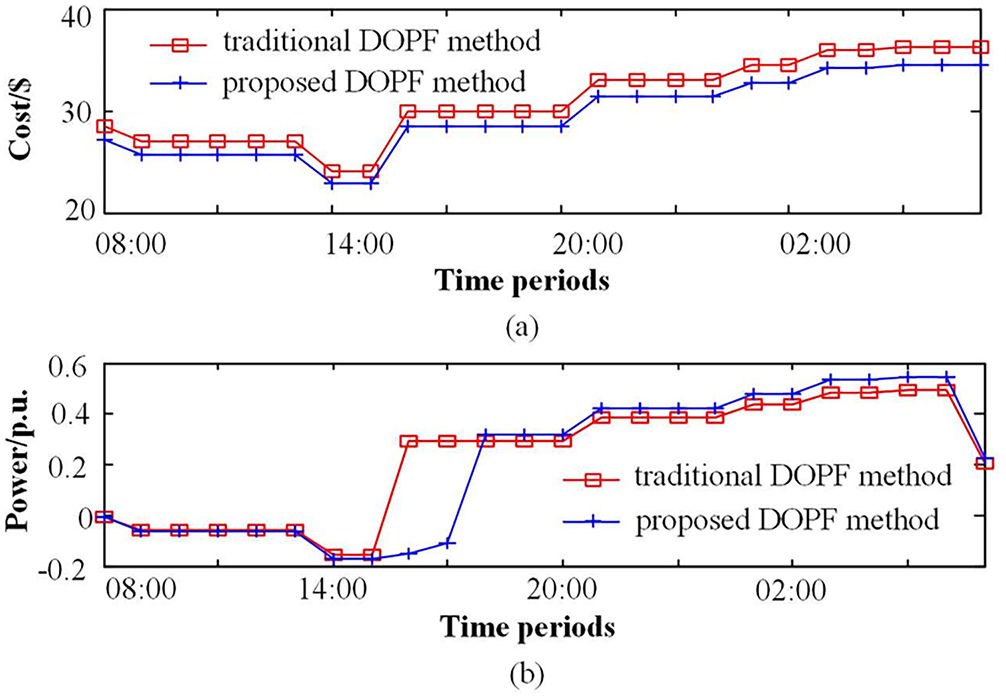
Figure 6: (a) Minimum cost function G of the distribution grid by proposed and traditional DOPF methods; (b) Optimal charge-discharge power solutions by proposed and traditional DOPF methods.
On one hand, as shown in Fig. 6a,b, a clear discrepancy is observed between the red and blue profiles. After coordinated V2G-aware optimization using the proposed DOPF method, the blue line exhibits a distinct pattern: compared with the traditional DOPF method, the minimum cost function G of the distribution grid is significantly lower, and the optimal charge/discharge power solutions are adjusted accordingly. This improvement is attributed to the V2G-aware optimization, which dynamically adjusts the V2G signal vector Pt ref and reduces the total generation cost for the distribution grid. Consequently, the proposed DOPF method not only reduces the total generation cost G, but also achieves optimal overall operational efficiency of the DN.
In summary, compared to traditional DOPF with a fixed V2G signal, the proposed V2G-aware DOPF framework dynamically adapts to time-varying grid conditions and EV availability, exploits the full flexibility of EV aggregators, and yields a lower total cost G with more efficient network operation.
4.2 Enhanced C-ADMM-Based V2G Vs. Traditional V2G Solutionss
The proposed method is compared with existing centralized optimization methods to verify its advantages in computational accuracy, efficiency, and time. The existing centralized methods include the HCH-LP method (M1) [19] and the mixed-integer quadratic programming method (M2) [17], while the proposed method is denoted as M3. Fig. 7a shows the computation time curves of these three methods for different numbers of EVs, ranging from NE = 5, 10, 20, 50, 100 to 500. Fig. 7b shows the corresponding total number of discharge-charge switching events over 24 h.
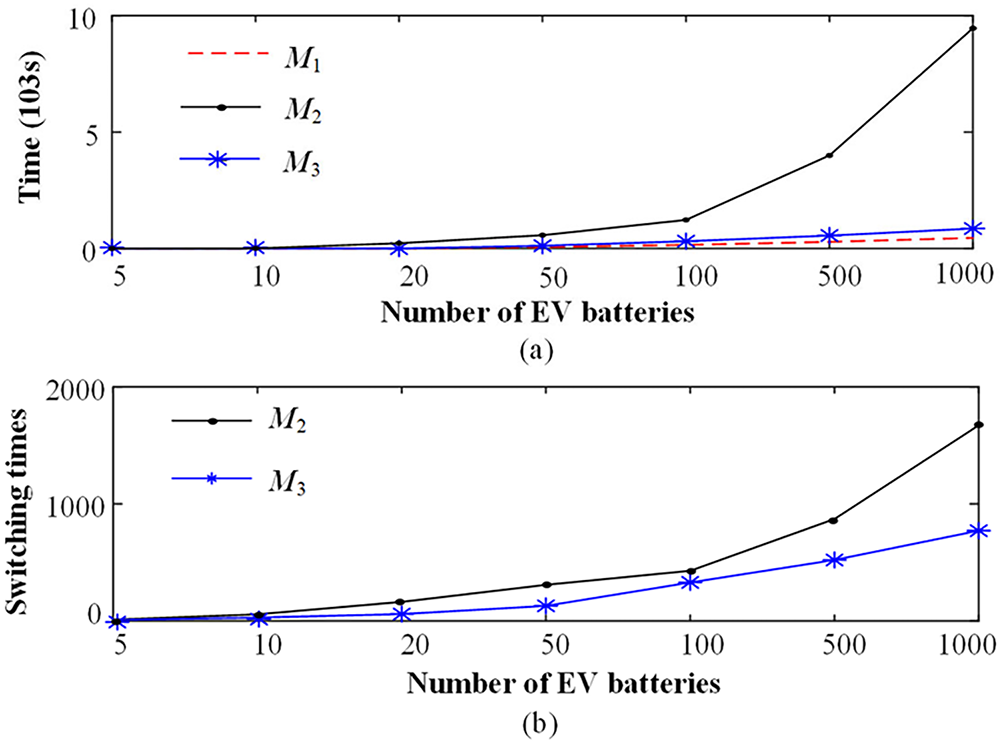
Figure 7: (a) Computation time comparison of three methods; (b) Total number of discharge-charge switching events comparison.
As shown in Fig. 7a, M1 has the lowest computation time because it relaxes all integer variables, but this may lead to infeasible solutions with simultaneous charging and discharging. Although M2 can obtain the exact optimal solution, its computation time increases exponentially with the number of EVs, making it impractical for large-scale real-world applications. While M3 has a slightly higher computation time than M1, its time cost increases significantly more slowly than that of M2. With 500 EVs connected, M3canstill complete the computation within 600 s. As shown in Fig. 7b, regardless of the number of EVs, M3 maintains a small number of charge-discharge switching events. In contrast, M2 exhibits frequent charge-discharge switching, resulting in an excessively high total number of switches. Frequent charge-discharge switching significantly reduces the remaining cycle life of EV batteries, accelerates battery aging, and shortens battery service life. To support this conclusion, Fig. 8a,b shows the charging and discharging results for the case with NE = 10 EVs using M2 and M3, respectively.

Figure 8: Optimal charging-discharging results: (a) M2; (b) M3.
As shown in Fig. 8a, the M2 optimal solution exhibits frequent charging and discharging operations among different EVs. However, in Fig. 8b, the M3 optimal solution provides relatively smooth and evenly distributed charging/discharging commands for each EV. This is attributed to the warm-start strategy, which provides a good initial solution that distributes power control tasks more evenly across EVs, thereby reducing unnecessary switching events. In summary, M3 significantly outperforms existing centralized methods in both computation time and solution accuracy.
This paper proposes a look-ahead V2G-aware DOPF approach that explicitly accounts for the time-varying V2G control error in the real-time DOPF dispatch optimization of EV batteries. Case study simulations demonstrate that the proposed DOPF method, byminimizingtheV2Gcontrolerrorinpractical V2G services, enables efficient DOPF solutions characterized by global optimality, low computational 3 time, and reduced communication costs. Specifically, the proposed approach converges to the optimal solution with a least-square control error of only 43% of that from traditional V2G methods. For optimal V2G dispatch, the proposed method achieves a computational time as low as 14% of that required by the benchmark centralized approach for the case of N = 1000 EVs, and yields optimal charge-discharge solutions with fewer switching actions compared to existing methods. In future work, the modeling of time-varying V2G control will involve battery degradation, communication delays, cyber-security risks, and heterogeneous charging infrastructure. And the proposed DOPF approach will actively enable low-cost EV energy storage optimization amid large-scale renewable energy integration into distribution systems, enhance distribution network operational flexibility for sustainable energy development.
Acknowledgement: This work was supported by the Marie Curie Grant through HORIZON-MSCA-2025 Program under Grant Agreement Project 101280626.
Funding Statement: The author(s) received funding from the Marie Curie Grant through HORIZON-MSCA-2025 Program under Grant Agreement Project 101280626.
Author Contributions: Chao Lei: conceptualization, methodology, software, validation, formal analysis, investigation, writing—original draft preparation, writing—review and editing, visualization. Yiyao Zhou: conceptualization, methodology, supervision, project administration, funding acquisition. Bo Chen: software, validation, data curation, writing—review and editing. All authors reviewed and approved the final version of the manuscript.
Availability of Data and Materials: The data that support the findings of this study are available from the corresponding author upon reasonable request.
Ethics Approval: Not applicable.
Conflicts of Interest: The authors declare no conflicts of interest.
References
1. Rivera S, Goetz SM, Kouro S, Lehn PW, Pathmanathan M, Bauer P, et al. Charging infrastructure and grid integration for electromobility. Proc IEEE. 2023;111(4):371–96. doi:10.1109/JPROC.2022.3216362. [Google Scholar] [CrossRef]
2. Wolinetz M, Axsen J, Peters J, Crawford C. Simulating the value of electric-vehicle–grid integration using a behaviourally realistic model. Nat Energy. 2018;3(2):132–9. doi:10.1038/s41560-017-0077-9. [Google Scholar] [CrossRef]
3. Lei C, Bu S, Zhong J, Chen Q, Wang Q. Distribution network reconfiguration: a disjunctive convex hull approach. IEEE Trans Power Syst. 2023;38(6):5926–9. doi:10.1109/TPWRS.2023.3304132. [Google Scholar] [CrossRef]
4. Soderman C, Kim SY, Yip J, Shirgaokar M. Electric vehicles as grid resources: barriers to vehicle-to-grid (V2G) in the United States. Util Policy. 2026;101:102175. doi:10.1016/j.jup.2026.102175. [Google Scholar] [CrossRef]
5. Thrän J, Mareček J, Shorten RN, Green TC. Reserve provision from electric vehicles: aggregate boundaries and stochastic model predictive control. IEEE Trans Power Syst. 2025;40(5):4081–92. doi:10.1109/TPWRS.2025.3539863. [Google Scholar] [CrossRef]
6. Acharige SSG, Haque ME, Arif MT, Hosseinzadeh N, Hasan KN, Hossain MJ, et al. Grid integration of electric vehicles—impact assessment and remedial measures. J Power Sources. 2025;650(6):236697. doi:10.1016/j.jpowsour.2025.236697. [Google Scholar] [CrossRef]
7. Türkoğlu AS, Güldorum HC, Sengor I, Çiçek A, Erdinç O, Hayes BP. Maximizing EV profit and grid stability through virtual power plant considering V2G. Energy Rep. 2024;11(6):3509–20. doi:10.1016/j.egyr.2024.03.013. [Google Scholar] [CrossRef]
8. Lei C, Chen YC, Bu S, Li S, Wang Q, Goel L. Battery dispatch optimization for electric vehicle aggregators: a decentralized mixed-integer least-squares approach with disjunctive cuts. In: Proceedings of the 2025 IEEE Power & Energy Society General Meeting (PESGM); 2025 Jul 27–31; Austin, TX, USA. p. 1–5. doi:10.1109/PESGM52009.2025.11225629. [Google Scholar] [CrossRef]
9. Clairand JM, Rodríguez-García J, Álvarez-Bel C. Assessment of technical and economic impacts of EV user behavior on EV aggregator smart charging. J Mod Power Syst Clean Energy. 2019;8(2):356–66. doi:10.35833/MPCE.2018.000840. [Google Scholar] [CrossRef]
10. Du M, Zhang X, Zhang J, Zhang R, Zhao J. Robust resilience enhancement strategy against uncertain cyber-physical coordinated attacks considering power-communication network interdependence. IEEE Trans Power Syst. 2026;41(4):2879–94. doi:10.1109/TPWRS.2026.3657804. [Google Scholar] [CrossRef]
11. Farivar M, Low SH. Branch flow model: relaxations and convexification: part I. IEEE Trans Power Syst. 2013;28(3):2554–64. doi:10.1109/tpwrs.2013.2255317. [Google Scholar] [CrossRef]
12. Kilthau M, Henkel V, Wagner LP, Gehlhoff F, Fay A. A decentralized optimization approach for scalable agent-based energy dispatch and congestion management. Appl Energy. 2025;377(4):124606. doi:10.1016/j.apenergy.2024.124606. [Google Scholar] [CrossRef]
13. Su C, Wang Y, Strbac G. Coordinated electric vehicles dispatch for multi-service provisions: a comprehensive review of modelling and coordination approaches. Renew Sustain Energy Rev. 2025;223(2):115977. doi:10.1016/j.rser.2025.115977. [Google Scholar] [CrossRef]
14. Jiang T, Wu C, Huang T, Zhang R, Li X. Optimal market participation of VPPs in TSO-DSO coordinated energy and flexibility markets. Appl Energy. 2024;360(3):122730. doi:10.1016/j.apenergy.2024.122730. [Google Scholar] [CrossRef]
15. Han D, Lee J, Won D. Game theory-based EV aggregator operation framework to provide flexibility considering transportation conditions. In: Proceedings of the 2024 IEEE Texas Power and Energy Conference (TPEC); 2024 Feb 12–13; College Station, TX, USA. p. 1–6. doi:10.1109/TPEC60005.2024.10472213. [Google Scholar] [CrossRef]
16. Esfahani M, Alizadeh A, Cao B, Kamwa I, Xu M. Bridging theory and practice: a comprehensive review of virtual power plant technologies and their real-world applications. Renew Sustain Energy Rev. 2025;222(2):115929. doi:10.1016/j.rser.2025.115929. [Google Scholar] [CrossRef]
17. Khodayar ME, Wu L, Shahidehpour M. Hourly coordination of electric vehicle operation and volatile wind power generation in SCUC. IEEE Trans Smart Grid. 2012;3(3):1271–9. doi:10.1109/TSG.2012.2186642. [Google Scholar] [CrossRef]
18. Afshar S, Wasti S, Disfani V. An ADMM-based MIQP platform for the EV aggregation management. arXiv:2010.03475. 2020. [Google Scholar]
19. Pozo D. Convex hull formulations for linear modeling of energy storage systems. IEEE Trans Power Syst. 2023;38(6):5934–6. doi:10.1109/TPWRS.2023.3304131. [Google Scholar] [CrossRef]
20. Chen Y, Zheng K, Gu Y, Wang J, Chen Q. Optimal energy dispatch of grid-connected electric vehicle considering lithium battery electrochemical model. IEEE Trans Smart Grid. 2024;15(3):3000–15. doi:10.1109/TSG.2023.3317590. [Google Scholar] [CrossRef]
21. Porras Á, Fernández-Blanco R, Morales JM, Pineda S. An efficient robust approach to the day-ahead operation of an aggregator of electric vehicles. IEEE Trans Smart Grid. 2020;11(6):4960–70. doi:10.1109/TSG.2020.3004268. [Google Scholar] [CrossRef]
22. He Y, Venkatesh B, Guan L. Optimal scheduling for charging and discharging of electric vehicles. IEEE Trans Smart Grid. 2012;3(3):1095–105. doi:10.1109/TSG.2011.2173507. [Google Scholar] [CrossRef]
23. Boyd S, Parikh N, Chu E, Peleato B, Eckstein J. Distributed optimization and statistical learning via the alternating direction method of multipliers. Found Trends® Mach Learn. 2011;3(1):1–22. doi:10.1561/2200000016. [Google Scholar] [CrossRef]
24. Arslan O, Karaşan OE. A Benders decomposition approach for the charging station location problem with plug-in hybrid electric vehicles. Transp Res Part B Methodol. 2016;93:670–95. doi:10.1016/j.trb.2016.09.001. [Google Scholar] [CrossRef]
25. Shinwari M, Youssef A, Hamouda W. A water-filling based scheduling algorithm for the smart grid. IEEE Trans Smart Grid. 2012;3(2):710–9. doi:10.1109/TSG.2011.2177103. [Google Scholar] [CrossRef]
26. Mirjalili S, Lewis A. The whale optimization algorithm. Adv Eng Softw. 2016;95(12):51–67. doi:10.1016/j.advengsoft.2016.01.008. [Google Scholar] [CrossRef]
Cite This Article
 Copyright © 2026 The Author(s). Published by Tech Science Press.
This work is licensed under a Creative Commons Attribution 4.0 International License , which permits unrestricted use, distribution, and reproduction in any medium, provided the original work is properly cited.
 Downloads
 Citation Tools
