
 Login
Login Register
 Submit a Paper
 Propose a Special lssue
 Open Access
ARTICLE
Modelling and Simulation of Partial Shading Impacts on Grid-Tied Photovoltaic Chains
1 Laboratory of Sciences and Technologies of Information and Communication (STIC), Physics Department, Faculty of Sciences, Chouaib Doukkali University, El Jadida, Morocco
2 Instrumentation and Control Laboratory, CREATE, Department of Mechatronics Engineering, University of Évora, Évora, Portugal
* Corresponding Author: Said Dlimi. Email:
(This article belongs to the Special Issue: Advances in Clean Energy Technologies for a Sustainable Future)
Energy Engineering 2026, 123(11), 9 https://doi.org/10.32604/ee.2026.085033
Received 04 May 2026; Accepted 12 June 2026; Issue published 24 September 2026
 View Full Text
 Download PDF
Abstract
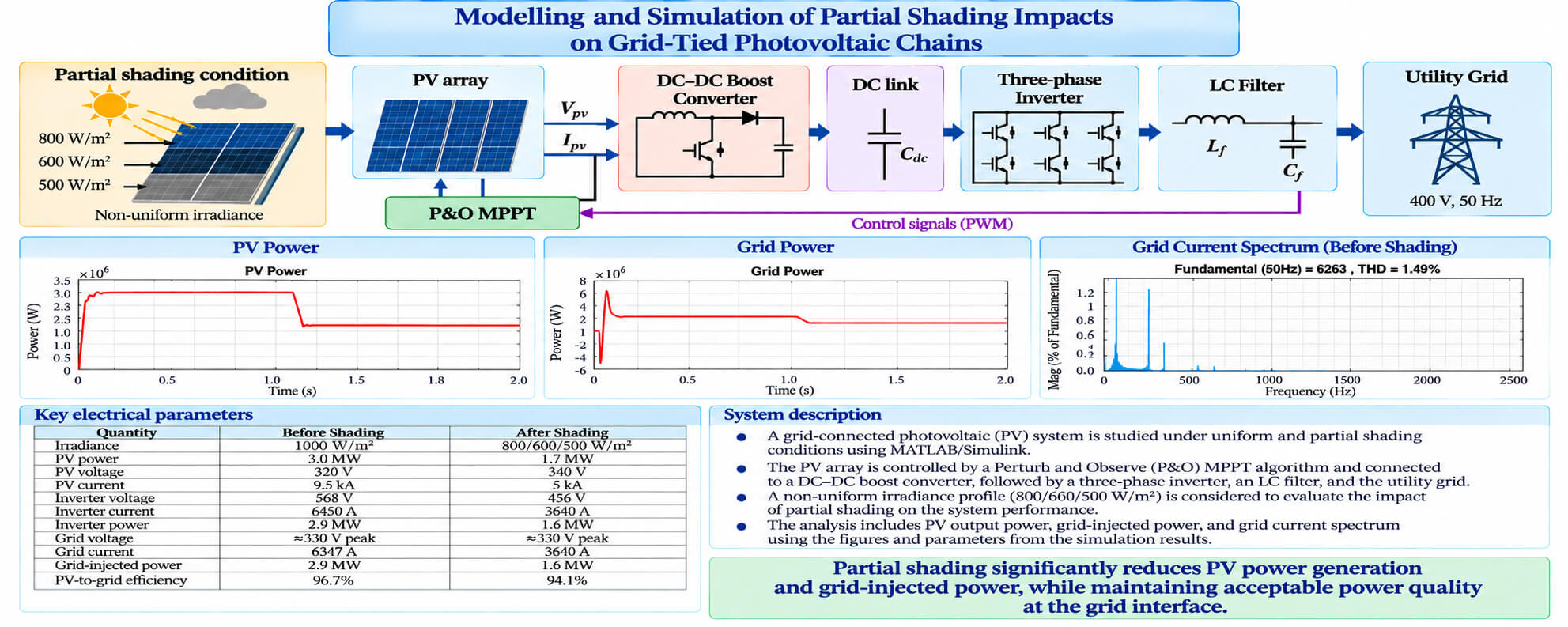
The increasing deployment of grid-connected photovoltaic (PV) systems has made solar energy one of the most promising renewable energy sources for achieving a sustainable and low-carbon energy future. However, the performance of PV systems is strongly influenced by environmental conditions, particularly partial shading caused by clouds, nearby buildings, trees, or other obstacles. Partial shading can lead to significant power losses, reduced energy yield, and potential degradation of system performance. Therefore, evaluating the behavior of PV systems under such operating conditions is essential for improving their reliability and efficiency. This paper presents an analysis of the performance of a grid-connected photovoltaic (PV) system under partial shading conditions using MATLAB/Simulink. The studied system consists of a PV array, a Perturb and Observe (P&O) maximum power point tracking (MPPT) controller, a DC–DC boost converter, a three-phase inverter, a grid-side filter, and the utility grid. The system is first simulated under uniform irradiance conditions of 1000 W/m2 and then under a multi-zone partial shading scenario with irradiance levels of 800, 600, and 500 W/m2. The simulation results indicate that the PV output power decreases from approximately 3.0 to 1.7 MW, representing a reduction of about 43.3%. Similarly, the power injected into the grid decreases from 2.9 to 1.6 MW, while the overall PV-to-grid efficiency drops from 96.7% to 94.1%. Furthermore, the total harmonic distortion (THD) of the grid current remains low, decreasing from 1.49% to 0.45%, which is well below the 5% limit specified by the IEEE 519 standard. These findings confirm that partial shading significantly reduces PV power generation and grid-injected power while maintaining acceptable power quality at the grid interface.Graphic Abstract
Keywords
Cite This Article
 Copyright © 2026 The Author(s). Published by Tech Science Press.
This work is licensed under a Creative Commons Attribution 4.0 International License , which permits unrestricted use, distribution, and reproduction in any medium, provided the original work is properly cited.
 Downloads
 Citation Tools
