
 Login
Login Register
 Submit a Paper
 Propose a Special lssue
 Open Access
ARTICLE
Predefined-Time Adaptive Sliding Mode Speed Control of PMSM Drives Using a Switchable Power Exponent and Dual-Gain Surface
1 Energy and Renewable Energy Department, Electromechanical Engineering College, University of Technology, Baghdad, Iraq
2 Electronic Engineering Department, Electrical Engineering College, University of Technology, Baghdad, Iraq
* Corresponding Author: Ali H. Numan. Email:
Energy Engineering 2026, 123(11), 6 https://doi.org/10.32604/ee.2026.086355
Received 28 May 2026; Accepted 16 July 2026; Issue published 24 September 2026
 View Full Text
 Download PDF
Abstract
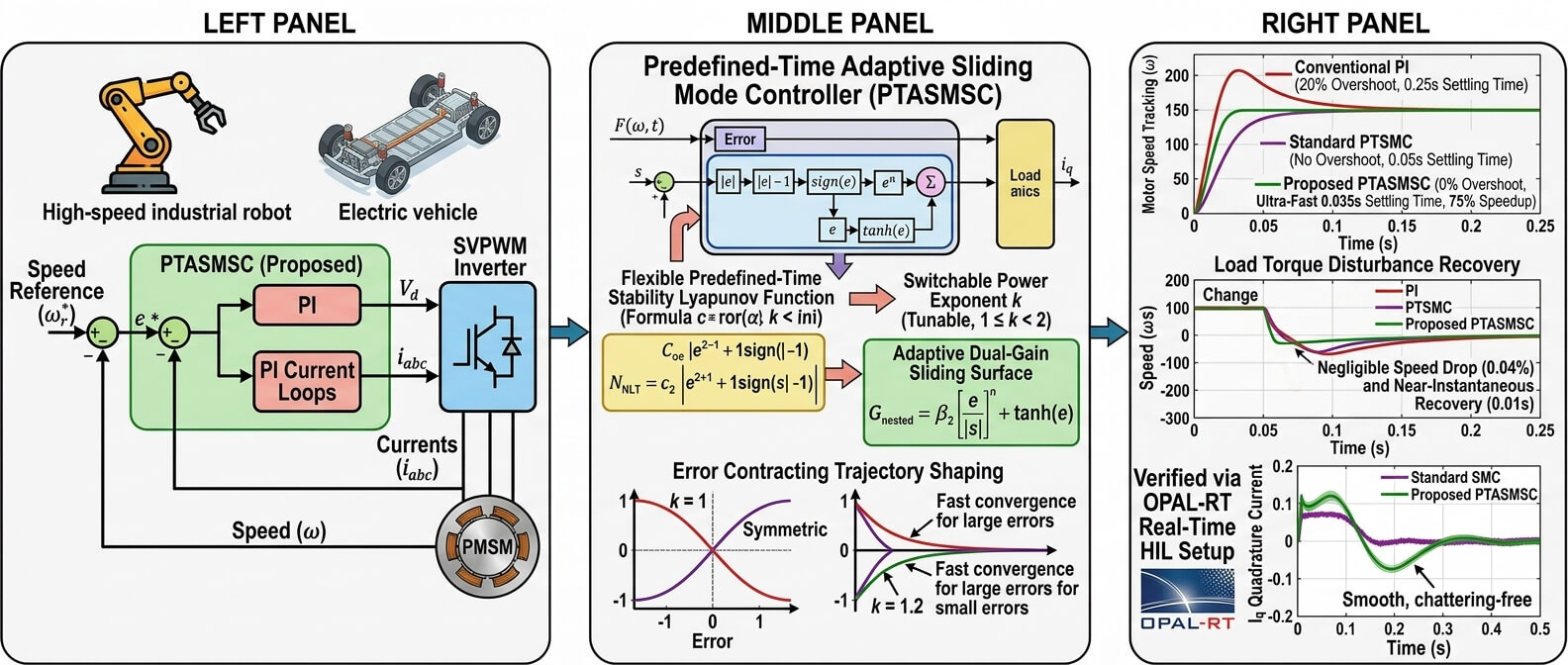
Accurate and rapid speed response during different operating conditions of permanent magnet synchronous motor (PMSM) drives is a critical requirement in industrial automation, robotics, CNC, and electric vehicle applications. This paper proposes a new predefined-time adaptive sliding mode speed control (PTASMSC) strategy for high-performance surface-mounted permanent magnet synchronous motor (SMPMSM) drives. The proposed PTASMSC controller is designed to overcome the well-known trade-off between fast convergence and chattering by combining a switchable power exponent and a dual-gain surface. This architecture will accelerate the speed error convergence during large transient deviations while effectively suppressing high-frequency chattering at steady-state conditions. The control algorithm is verified using MATLAB simulations and hardware-in-the-loop (HIL) on the OPAL-RT real-time platform. The simulation and experimental results of seven case studies conducted under different speed profiles and four disturbance scenarios demonstrated enhanced motor speed tracking accuracy and reduced transient duration of the proposed PTASMSC over conventional proportional integral (PI) and standard predefined-time sliding mode control (PTSMC) methods. Quantitative analysis confirms that the proposed method eliminates maximum overshoot 0% and minimizes the transient settling time to just 0.035 s—representing a 75% speedup compared to the conventional PI baseline. Furthermore, the adaptive dual-gain mechanism restricts the maximum speed drop ratio to a negligible 0.04% with a near-instantaneous recovery time of 0.01 s while maintaining a smooth quadrature current profile. The real-time HIL implementation validates the robustness and practical feasibility of the proposed PTASMSC for industrial PMSM speed regulation.Graphic Abstract
Keywords
Predefined-time adaptive sliding mode speed control; PMSM; HIL; anti-disturbance; chattering suppression; switchable power exponent; dual-gain; PI; predefined-time sliding mode control
Cite This Article
APA Style
Numan, A.H., Hameed, A.Q. (2026). Predefined-Time Adaptive Sliding Mode Speed Control of PMSM Drives Using a Switchable Power Exponent and Dual-Gain Surface. Energy Engineering, 123(11), 6. https://doi.org/10.32604/ee.2026.086355
Vancouver Style
Numan AH, Hameed AQ. Predefined-Time Adaptive Sliding Mode Speed Control of PMSM Drives Using a Switchable Power Exponent and Dual-Gain Surface. Energ Eng. 2026;123(11):6. https://doi.org/10.32604/ee.2026.086355
IEEE Style
A. H. Numan and A. Q. Hameed, “Predefined-Time Adaptive Sliding Mode Speed Control of PMSM Drives Using a Switchable Power Exponent and Dual-Gain Surface,” Energ. Eng., vol. 123, no. 11, pp. 6, 2026. https://doi.org/10.32604/ee.2026.086355
 Copyright © 2026 The Author(s). Published by Tech Science Press.
This work is licensed under a Creative Commons Attribution 4.0 International License , which permits unrestricted use, distribution, and reproduction in any medium, provided the original work is properly cited.
 Downloads
 Citation Tools
