
 Login
Login Register
 Submit a Paper
 Propose a Special lssue
 Open Access
ARTICLE

A Composite Multi-Port Hybrid DC Circuit Breaker with DC Power Flow and Fault Current Limitation Abilities
1 College of Electrical Engineering, Guizhou University, Guiyang, 550025, China
2 Electric Power Research Institute, Guizhou Power Grid Company Ltd., Guiyang, 550005, China
* Corresponding Author: Chao Zhang. Email:
Energy Engineering 2026, 123(3), 15 https://doi.org/10.32604/ee.2025.070996
Received 29 July 2025; Accepted 25 September 2025; Issue published 27 February 2026
 View Full Text
 Download PDF
Abstract
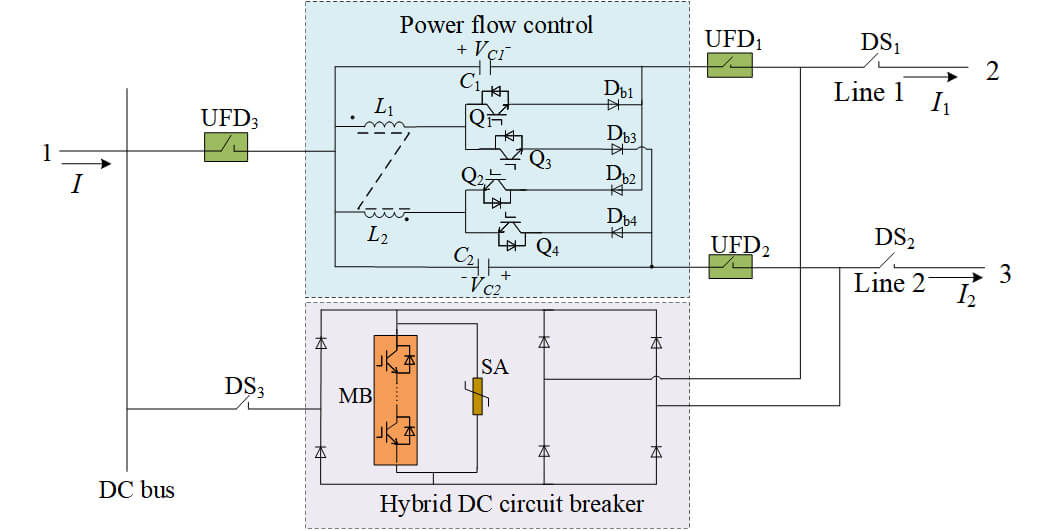
To address the issues of high costs and low component utilization caused by the independent configuration of hybrid DC circuit breakers (HCBs) and DC power flow controllers (DCPFCs) at each port in existing DC distribution networks, this paper adopts a component sharing mechanism to propose a composite multi-port hybrid DC circuit breaker (CM-HCB) with DC power flow and fault current limitation abilities, as well as reduced component costs. The proposed CM-HCB topology enables the sharing of the main breaker branch (MB) and the energy dissipation branch, while the load commutation switches (LCSs) in the main branch are reused as power flow control components, enabling flexible regulation of power flow in multiple lines. Meanwhile, by reconstructing the current path during the fault process, the proposed CM-HCB can utilize the internal coupled inductor to limit the current rise rate at the initial stage of the fault, significantly reducing the requirement for breaking current. A detailed study on the topological structure, steady-state power flow regulation mechanism, transient fault isolation mechanism, control strategy and characteristic analysis of the proposed CM-HCB is presented. Then, a Matlab/Simulink-based meshed three-terminal DC grid simulation platform with the proposed CM-HCB is built. The results indicate that the proposed CM-HCB can not only achieve flexible power flow control during steady-state operation, but also obtain current rise limitation and fault isolation abilities under short-circuit fault conditions, verifying its correctness and effectiveness. Finally, a comparative economic analysis is conducted between the proposed CM-HCB and the other two existing solutions, confirming that its component sharing mechanism can significantly reduce the number of components, lower system costs, and improve component utilization.Graphic Abstract
Keywords
DC power grid; DC power flow control; fault current limiting; fault isolation; hybrid DC circuit breaker
Cite This Article
APA Style
Chen, X., Zhang, C., Yuan, X., Xiong, W., Lu, Z. et al. (2026). A Composite Multi-Port Hybrid DC Circuit Breaker with DC Power Flow and Fault Current Limitation Abilities. Energy Engineering, 123(3), 15. https://doi.org/10.32604/ee.2025.070996
Vancouver Style
Chen X, Zhang C, Yuan X, Xiong W, Lu Z, Zheng H, et al. A Composite Multi-Port Hybrid DC Circuit Breaker with DC Power Flow and Fault Current Limitation Abilities. Energ Eng. 2026;123(3):15. https://doi.org/10.32604/ee.2025.070996
IEEE Style
X. Chen et al., “A Composite Multi-Port Hybrid DC Circuit Breaker with DC Power Flow and Fault Current Limitation Abilities,” Energ. Eng., vol. 123, no. 3, pp. 15, 2026. https://doi.org/10.32604/ee.2025.070996
 Copyright © 2026 The Author(s). Published by Tech Science Press.
This work is licensed under a Creative Commons Attribution 4.0 International License , which permits unrestricted use, distribution, and reproduction in any medium, provided the original work is properly cited.
 Downloads
 Citation Tools
