
 Login
Login Register
 Submit a Paper
 Propose a Special lssue
 Open Access
ARTICLE

Multi-Timescale Coordinated Optimal Dispatch of Active Distribution Networks Incorporating Thermal Storage Electric Heating Clusters
School of Electrical Engineering, Northeast Electric Power University, Jilin, 132012, China
* Corresponding Author: Yang Yu. Email:
(This article belongs to the Special Issue: Grid Integration of Intermittent Renewable Energy Resources: Technologies, Policies, and Operational Strategies)
Energy Engineering 2026, 123(3), 21 https://doi.org/10.32604/ee.2025.072333
Received 24 August 2025; Accepted 09 October 2025; Issue published 27 February 2026
 View Full Text
 Download PDF
Abstract
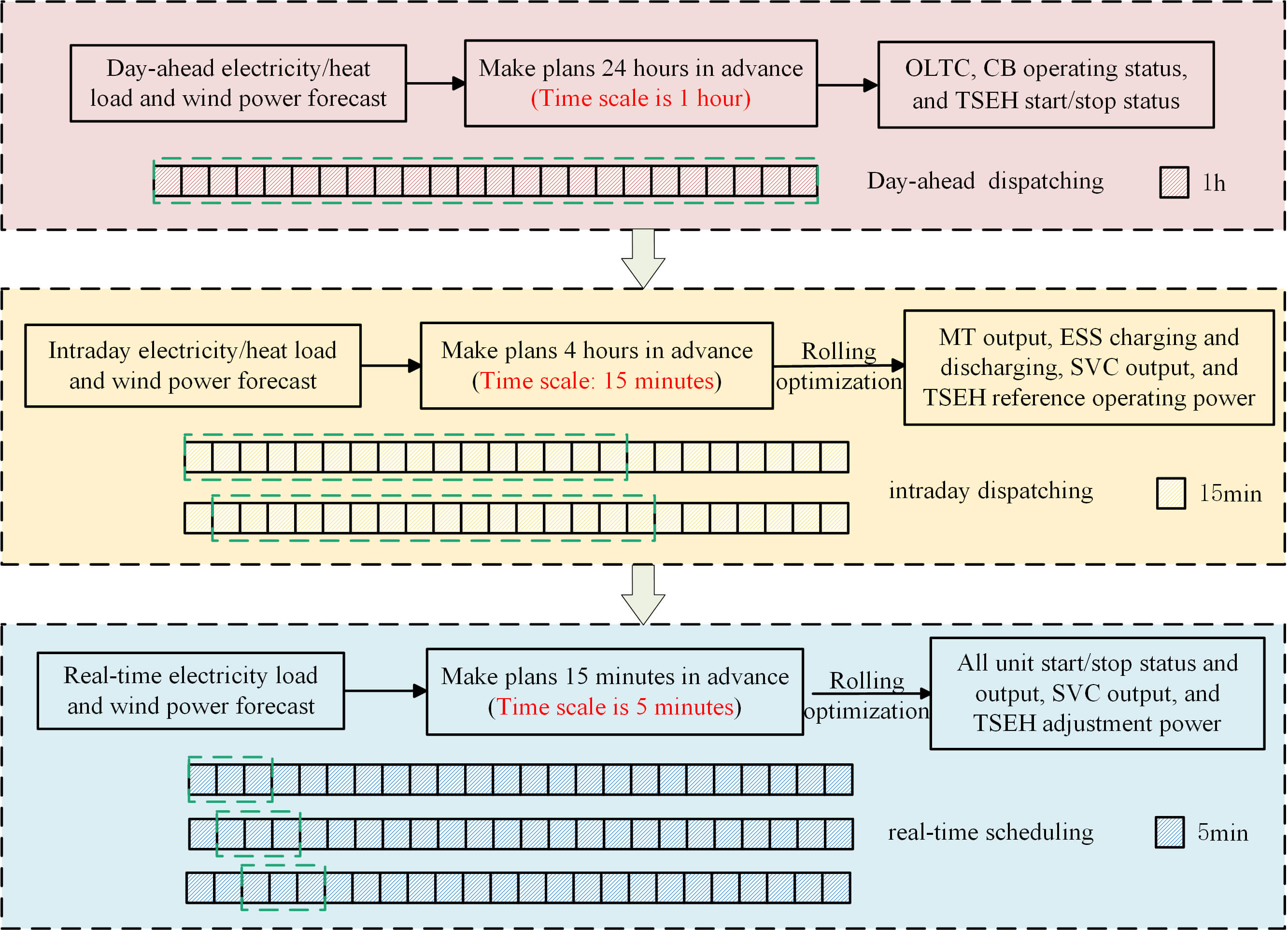
Thermal storage electric heating (TSEH), as a prevalent variable load resource, offers significant potential for enhancing system flexibility when aggregated into a cluster. To address the uncertainties of renewable energy and load forecasting in active distribution networks (ADN), this paper proposes a multi-timescale coordinated optimal dispatch strategy that incorporates TSEH clusters. It utilizes the thermal storage characteristics and short-term regulation capabilities of TSEH, along with the rapid and gradual response characteristics of resources in active distribution grids, to develop a coordinated optimization dispatch mechanism for day-ahead, intraday, and real-time stages. It provides a coordinated optimized dispatch technique across several timescales for active distribution grids, taking into account the integration of TSEH clusters. The proposed method is validated on a modified IEEE 33-node system. Simulation results demonstrate that the participation of TSEH in collaborative optimization significantly reduces the total system operating cost by 8.71% compared to the scenario without TSEH. This cost reduction is attributed to a 10.84% decrease in interaction costs with the main grid and a 47.41% reduction in network loss costs, validating effective peak shaving and valley filling. The multi-timescale framework further enhances economic efficiency, with overall operating costs progressively decreasing by 3.91% (intraday) and 4.59% (real-time), and interaction costs further reduced by 5.34% and 9.25%, respectively. Moreover, the approach enhances system stability by effectively suppressing node voltage fluctuations and ensuring all voltages remain within safe operating limits during real-time operation. Therefore, the proposed approach achieves rational coordination of diverse resources, significantly improving the economic efficiency and stability of ADNs.Graphic Abstract
Keywords
Cite This Article
 Copyright © 2026 The Author(s). Published by Tech Science Press.
This work is licensed under a Creative Commons Attribution 4.0 International License , which permits unrestricted use, distribution, and reproduction in any medium, provided the original work is properly cited.
 Downloads
 Citation Tools
