
 Login
Login Register
 Submit a Paper
 Propose a Special lssue
 Open Access
REVIEW

A Review of Optimization and Solution Methods for New Power Systems with Uncertainty
Energy and Electricity Research Center, Jinan University, Zhuhai, 519070, China
* Corresponding Author: Qi Yao. Email:
Energy Engineering 2026, 123(4), 2 https://doi.org/10.32604/ee.2025.072877
Received 05 September 2025; Accepted 25 November 2025; Issue published 27 March 2026
 View Full Text
 Download PDF
Abstract
For mixed-integer programming (MIP) problems in new power systems with uncertainties, existing studies tend to address uncertainty modeling or MIP solution methods in isolation. They overlook core bottlenecks arising from their coupling, such as variable dimension explosion, disrupted constraint separability, and conflicts in solution logic. To address this gap, this paper focuses on the coupling effects between the two and systematically conducts three aspects of work: first, the paper summarizes the uncertainty optimization methods suitable for addressing uncertainty-related issues in power systems, along with their respective advantages and disadvantages. It also clarifies the specific forms and operational mechanisms through which these uncertainty optimization methods are integrated into MIP models. Meanwhile, based on the application scenarios of new power systems, the paper delineates the applicable boundaries of different optimization methods; second, the paper organizes three categories of solution methods, which are exact solution methods, decomposition-based methods, and meta-heuristic algorithms. It focuses on analyzing the improvement paths of various solution methods for resolving coupling bottlenecks, as well as their applicability in different types of power system optimization problems; finally, providing a summary and presenting an outlook on future directions: artificial intelligence-enabled optimization, development of dedicated solvers for extreme scenarios, and dynamic modeling of multi-source uncertainties. This study aims to help researchers in the field of new power systems quickly grasp uncertainty optimization methods and core solution methods, bridge existing research gaps, and promote the development of this field.Keywords
The new power system faces dual challenges: reliable model solving and the growing impact of uncertain factors. On one hand, power systems generally confront complex decision-making requirements in optimal scheduling problems such as unit commitment (UC) and topological operation optimization [1]. Since these problems typically involve discrete decision variables and nonlinear constraints, they are often formulated as Mixed Integer Programming (MIP) models for solving [2]. Notably, MIP problems themselves fall into the category of Non-deterministic Polynomial-time Hard (NP-hard) problems [3]; as the problem scale expands, algorithms inevitably encounter the “curse of dimensionality”. On the other hand, with the continuous increase in the proportion of renewable energy in the new power system, various uncertain factors, such as fluctuations in renewable energy output [4], fluctuations in load demand [5], and changes in equipment efficiency [6], have become increasingly prominent in the power system, exerting a significant impact on the stability and economy of system operation. Available Load Supply Capability (ALSC) can be used to assess the security and stability of power systems. Zhang et al. [7] demonstrated through experiment that when the penetration rate of renewable energy increases from 15% to 30%, the mean value of ALSC in the power system will decrease by nearly 50%. Kaewpasuk et al. [8] found when addressing the unit commitment problem that, compared with deterministic optimization, the adoption of uncertainty-aware optimization methods can reduce Loss of Load Probability-related metrics by 10.87% to 61.76%.
To address these challenges, in terms of uncertainty modeling, methods such as Stochastic Optimization (SO) [4,9,10], Robust Optimization (RO) [11–13], Chance-Constrained Optimization (CCO) [14–16], Fuzzy Optimization (FO) [17–20], and Information Gap Decision Theory (IGDT) [21–23] have been introduced; in terms of MIP solving, algorithms like Benders decomposition (BD) and Column-and-Constraint Generation (C&CG) decomposition have been developed to reduce the computational complexity of large-scale problems.
More importantly, existing studies overlook that the coupling effect between uncertainty handling and MIP solving has become a core bottleneck for the practical application of optimization. This coupling effect manifests in three key aspects: first, variable dimension explosion: uncertainties must be quantified through multi-scenario and interval constraints, resulting in a substantial increase in the number of MIP decision variables and constraints compared to deterministic scenarios; second, disrupted constraint separability: the classic decomposition methods for MIP rely on the separation of constraints between discrete and continuous variables, yet coupling effects undermine this property, rendering the solving basis of decomposition methods invalid; third, conflicts in solving logic: addressing uncertainties requires covering extreme scenarios to ensure feasibility, whereas MIP solving demands model simplification to control solving time. Overcoming this bottleneck requires the collaborative design of these two components.
While recent review papers have focused on uncertain optimization or MIP modeling for new power systems, to date, no literature has examined their synergistic effects in power system optimal scheduling. Afzali et al. [24] present a systematic review of the research progress on mainstream uncertainty and risk modeling methods in power systems, and quantifies and compares the performance differences of these methods in reliability assessment via case studies. However, it fails to elaborate on formulating related problems as MIP models and their subsequent solution. Building on this, Du et al. [25] include a brief introduction to MIP models but fail to elaborate on the specific methods for transforming uncertain optimization models into MIP models, nor does it cover MIP solution methods. Bragin et al. [2] summarize the basic framework for Mixed Integer Linear Programming (MILP) models and propose solution acceleration approaches. However, it does not consider the impact of uncertain factors, nor does it address the transformation into and solution of Mixed Integer Nonlinear Programming (MINLP) problems.
Thus, there is an urgent need for a review that systematically integrates uncertainty handling methods with MIP solving strategies for new power system optimization problems. The main content framework reviewed in this paper is shown in Fig. 1.
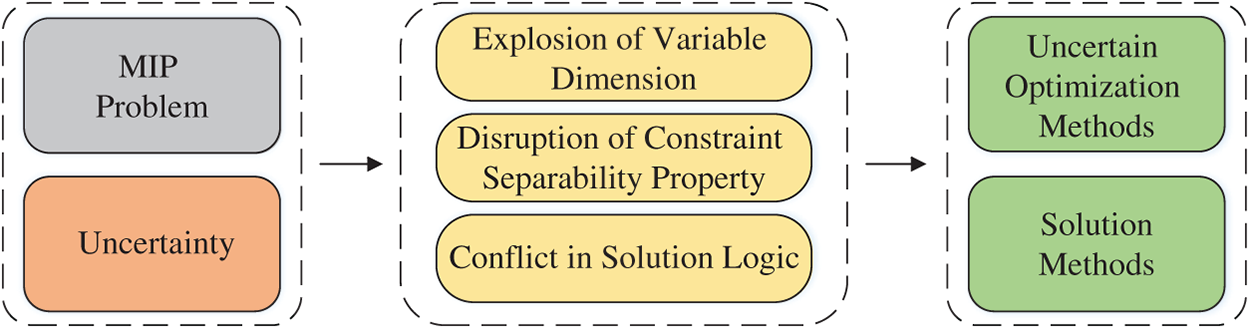
Figure 1: Framework of coupling bottlenecks and countermeasures between uncertainty and MIP problem
This paper, focusing on the current research status of MIP problems in new power systems with uncertainties, makes two core contributions compared to previous reviews: on one hand, it clarifies the embedding mechanisms of common uncertainty methods such as SO and RO, and other methods into MIP models, and elucidates the applicable scenarios, development status, and key technologies for converting them into deterministic models; on the other hand, it outlines three categories of solving strategies—exact methods, decomposition methods, and meta-heuristic algorithms(MA)—with a focus on analyzing the optimization paths of BD, C&CG decomposition, and other methods to address coupling bottlenecks, and explicitly identifies the applicable scenarios of each method. Finally, it provides an outlook on future research directions. The paper aims to help researchers in the field of power system optimization quickly develop a comprehensive understanding of uncertainty embedding and adaptive solving approaches, bridge existing research gaps, and advance the development of this field.
2 Representation of MIP with Uncertainty
Since the power system optimization problem is a complex optimization problem involving both continuous variables (e.g., generator output and energy storage charge/discharge quantity) and discrete variables (e.g., UC status and switching actions), it can be modeled as an MIP model, whose general form can be expressed as follows:
where, xj denotes a decision variable, and Sj represents the value set of xj. When
2.2 MIP Model with Uncertainty
The basic formulation of the above MIP model provides a framework for modeling a wide range of complex problems. To address the challenges caused by increased uncertainties in new power systems, uncertain factors need to be integrated into the modeling process. The integrated model framework is presented below:
where, x denotes the integer variable vector, y denotes the continuous variable vector, f(·) is the objective function, h(·) and g(·) are the inequality and equality constraint functions, and
3 Uncertain Optimization Methods for New Power Systems
In the field of uncertainty optimization for new power systems, existing research methods fall into five categories: SO, RO, CCO, FO and IGDT. The requirements of various uncertainty optimization methods for random variables are shown in Fig. 2. These methods exhibit distinct model characteristics and applicable scopes. Among them, both SO and CCO rely on known probability distributions, and CCO can also be regarded as a special case of SO. RO relies on known fluctuation intervals, so it is more suitable for power grid dispatching with strict security constraints. FO/IGDT have significant advantages in scenarios with scarce data or fuzzy boundaries.
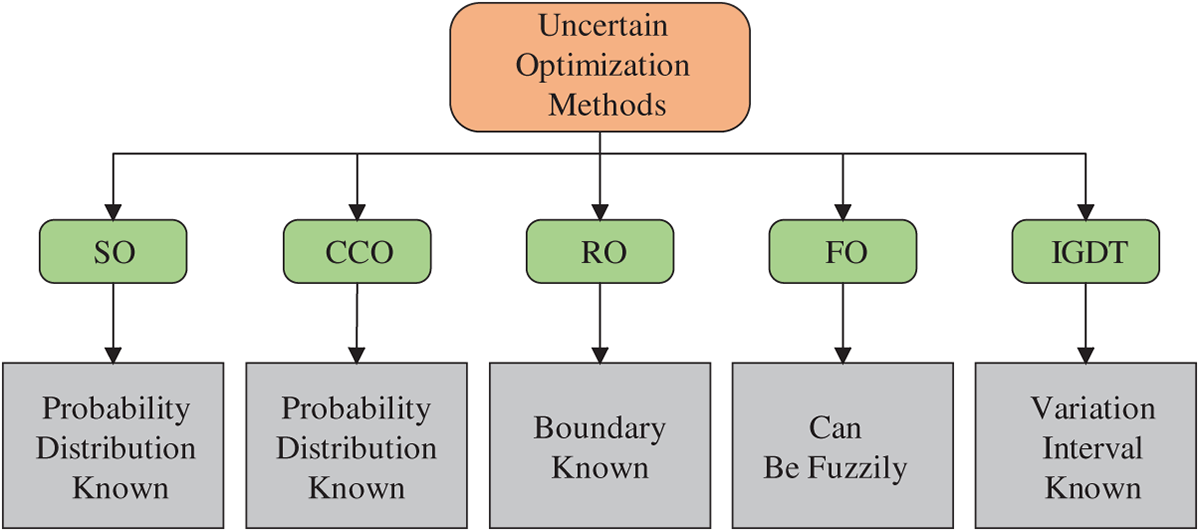
Figure 2: Various uncertain optimization methods and their requirements for random variables
SO applies to power system optimization scenarios where random variables have known probability distributions. These variables are typically assumed to follow specific probability distributions: for instance, wind power follows a Weibull distribution, photovoltaic power a Beta distribution [26], and loads a normal distribution [27].
SO generally incorporates uncertainty into the model through the objective function and constraints [28]. The SO model framework is as follows:
where,
The model described in Eq. (3) is an expected value model, the scenario method [29,30] converts the probabilistic expectation in Eq. (3) into a weighted sum of individual scenarios, and requires the model to satisfy deterministic constraints under every discrete scenario. Ultimately, it transforms the original stochastic optimization model into a directly solvable MIP model. In new power systems, SO is mainly applied to planning problems [31], scheduling problems [4], and line expansion problems [32] of new power systems. Hemmati et al. [31] introduced the SO method into system planning and operation to deal with multi-source uncertainties, thereby enhancing the stability of system operation and improving system economy. In addition, decision optimization in electricity markets is a major application direction of SO [33,34].
SO can make full use of the statistical laws in historical data [31–34], with high decision-making reliability. However, it is also dependent on data quality and probability distribution assumptions, and is not applicable to data-scarce scenarios. Moreover, this does not mean that the more scenarios, the better—an excessive number of scenarios will lead to a surge in discrete variables. To address this issue, existing solution strategies mainly fall into two categories:
The first is scenario reduction, which uses methods such as forward selection, backward reduction [35], improved forward selection [32–36], K-means clustering [37], K-medoids clustering [38], MILP-based reduction [39], and LP-based reduction [40] to reduce the scale of MIP problems.
The second focuses on solution approaches, mainly using decomposition-based methods to solve large-scale MIP problems. This is elaborated in Section 4.
3.2 Chance-Constrained Optimization
Like SO, CCO is applicable to power system optimization scenarios where random variables have known probability distributions. The primary difference is that the chance-constrained approach allows decisions to violate certain constraints, with only the probability of such violations limited. This method ignores some extreme scenarios and balances economy and reliability [41]. In power system models, power balance constraints [42,43] and spinning reserve constraints [42,44,45] are typically formulated as chance constraints to address uncertainties in wind power, photovoltaic (PV) generation, and loads.
The general form of the CCO method, consisting of an objective function, deterministic constraints, and chance constraints [46], is as follows. The model framework is presented below:
where, P represents a probability measure, and
To solve chance-constrained models, two common approaches exist: one involves deterministic transformation of the model prior to solution [14,44,47,48], and the other combines MA with online Monte Carlo simulation for solution [49].
Deterministic transformation methods primarily include two types. One is based on the analytical expression of the cumulative distribution function (CDF) [15,16]. This method is relatively simple but struggles to accurately describe the cumulative probability distribution of uncertain variables in practical applications. For example, in specific scenarios, when random variables are assumed to follow a normal distribution, this analytical expression-based method can be used for deterministic transformation [15]. However, the normal distribution assumption fails to accurately model the randomness and spatial correlation of wind power output, and more complex modeling methods (e.g., Gaussian mixture models) can mitigate this issue [16].
Another approach converts chance constraints into deterministic mixed-integer constraints using methods such as Sample Average Approximation (SAA) [42,45] and the Big-M method [15], thereby forming an MIP model. Such methods are also based on the scenario approach. Taking the Big-M method as an example, First, a 0-1 integer variable is introduced to identify the satisfaction status of the chance constraint. Then, a sufficiently large constant is selected to construct linear constraints. Finally, the values of the 0-1 variables in all scenarios are weighted and summed according to the occurrence probability of each scenario, and the weighted sum is required to be no less than
where,
The characteristic of CCO that allows constraint violations with a certain probability can avoid the problem of excessively high economic costs caused by overly conservative deterministic constraints. However, on the other hand, there is also the problem that the selection of confidence level lacks a unified standard. In addition, SAA and Big-M generate a large number of binary variables, increasing computational complexity. To reduce computational costs and shorten computation time, Jiang et al. [50] proposed a new partial SAA method that uses partial sampling to reduce computational difficulty and improve solution quality. Addressing the low computational efficiency of the Big-M method, Zhang et al. [43] proposed a more efficient chance-constrained mixed-integer bilinear reformulation. Compared to the Big-M method, the bilinear method [51,52] better approximates the nonlinear behavior of chance-constrained reformulations and is more suitable for large-scale MIP problems [53].
The essence of RO lies in characterizing stochastic parameters using an uncertainty set with known bounds, requiring only the specification of fluctuation intervals and extreme value boundaries [11]—thus making it particularly suitable for renewable-rich scenarios with scarce historical data. However, its core assumption—that the optimization objective must still achieve good performance even under the worst-case scenarios of parameter fluctuations—renders its solutions conservative [13]. To address this, Ben-Tal et al. [12] extended the robust decision-making process to multi-stage frameworks. Taking single-stage and two-stage RO [54] as examples, their model formulations are presented below, respectively:
Single-stage RO:
Two-stage RO:
where, f1(·) and f2(·) are the objective functions for the first and second stages, respectively. g1(·) and g2(·) are the constraint conditions for the first and second stages, respectively.
The application of RO in new power systems mainly focuses on addressing two core issues: the first involves modeling multi-level decision coupling and multi-time-scale correlations; the second focuses on the accurate characterization of complex uncertainties. For the first challenge, multi-level or multi-stage models have been constructed: Zhang et al. [55] established a multi-time scale robust scheduling model for integrated multi-energy systems incorporating photovoltaic battery swapping-charging-storage stations (PBSCSS). This model characterizes the multi-level decision coupling relationship of the internal battery module in PBSCSS—between “meeting users’ battery swapping demands” and “responding to the system’s global scheduling”. Through a collaborative framework of day-ahead scheduling, intra-day scheduling, and real-time adjustment, it resolves multi-level decision conflicts and bridges multi-time scale scheduling, thereby ensuring scheduling adaptability in “transportation-energy” coupling scenarios of complex systems.
For the second challenge, uncertainty characterization methods have been optimized based on the characteristics of uncertainties: Microgrids [56] constructed a decision-dependent uncertainty set to capture the dynamic coupling between hydrogen refueling station investment decisions and induced refueling demand. This significantly improves the adaptability of investment decisions to uncertainties, and offers a new “decision-demand interaction” paradigm for characterizing uncertainties in hydrogen-electrical collaborative systems. Zhang et al. [57] adopted a two-stage robust optimization framework to dynamically adjust uncertainty boundaries by integrating the heat recovery of power-to-hydrogen-and-heat units and the ladder-type carbon trading mechanism. This framework injects a low-carbon dimension into uncertainty characterization of multi-energy complementary systems, cuts system carbon emissions by 21.79%, and provides technical support for multi-energy coordination and low-carbon operation of new power systems.
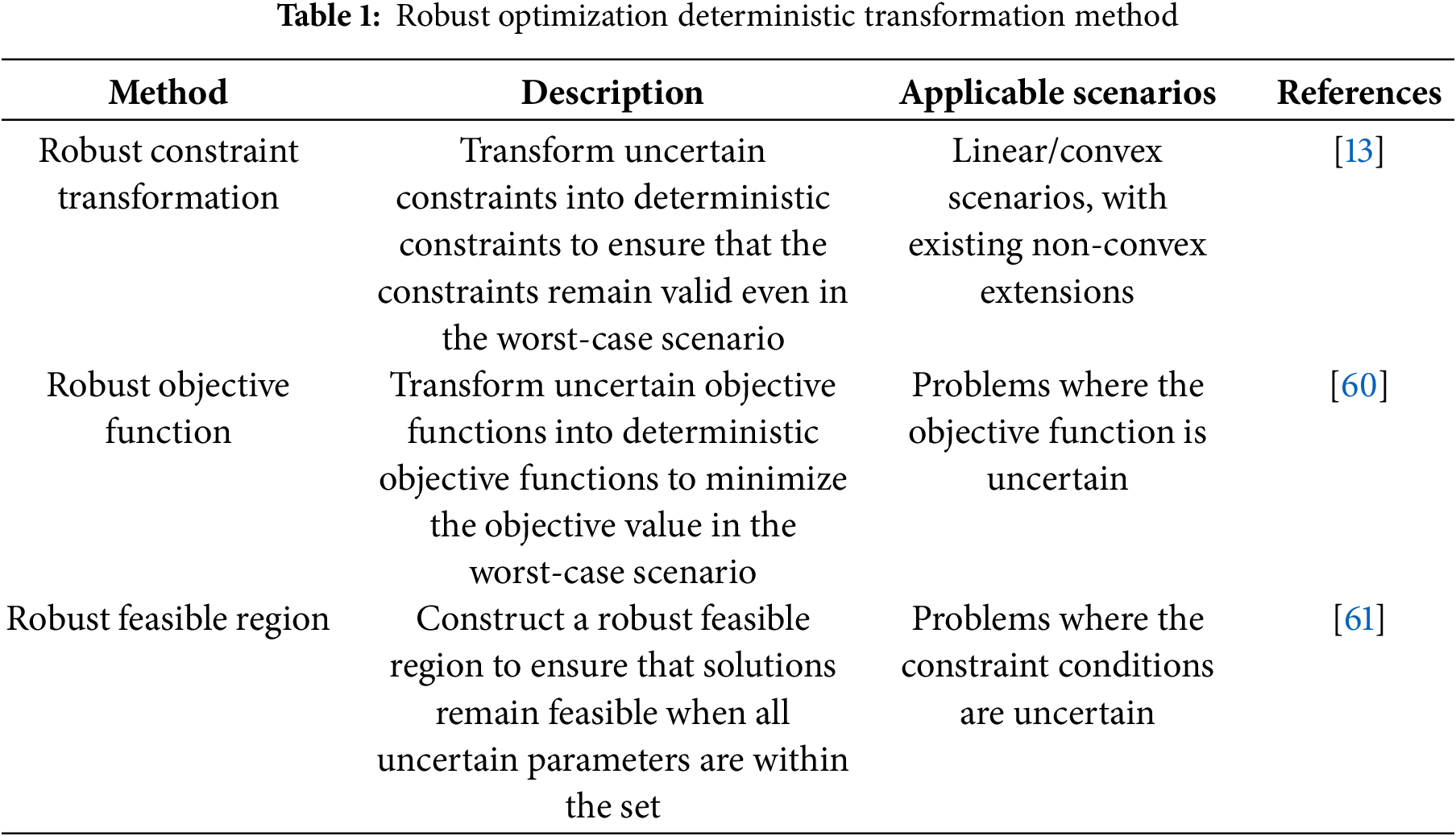
In solving RO problems, the deterministic transformation of uncertain problems is one of the core steps; common transformation pathways are shown in Table 1. The solution method for the transformed model must take into account both its scale and structural characteristics: if the scale is limited with strong nonlinearity or non-convexity, heuristic algorithms can be directly deployed [58]; if the scale is large, decomposition methods or duality theory can be used to convert it into a single-level easily solvable form [59]; if the model itself contains both discrete and continuous variables and fits the MIP framework, treating it as an MIP model and leveraging established mature methods is the most efficient approach.
However, complex models such as multi-level and multi-stage ones exhibit structural characteristics including nested multi-level variables and temporal nonlinear coupling. Therefore, they require preprocessing and transformation to be compatible with the MIP framework, and this step has become a focal point of research. For multi-level optimization, the mainstream strategy is to convert the problem into a single-level optimization problem by means of methods such as the Karush-Kuhn-Tucker (KKT) conditions and duality theory [62]. However, these methods have significant limitations: on one hand, the simplification process can easily introduce new binary variables or bilinear terms, which instead increases model complexity. To address this, El-Meligy et al. [59] propose a solution method that replaces the lower-level problem with its dual problem. On the other hand, if each optimization level contains binary variables, the KKT conditions and duality principle lose their validity due to their reliance on continuity assumptions. El-Meligy et al. [63] employ a method based on the idea of multi-parametric programming, which transforms the problems corresponding to different critical region combinations into single-level MILP problems.
For multi-stage scenarios, Qiu et al. [64] propose a dedicated reconstruction algorithm, which leverages the implicit affine strategy and dual Fourier-Motzkin elimination to reformulate the original problem into a directly solvable MILP. However, Fourier-Motzkin elimination is only applicable to convex feasibility-checking problems without recourse objectives; therefore, Qiu et al. [65] further propose an MILP solution framework for scheduling problems that include recourse objectives to meet more general engineering requirements.
Fuzzy optimization, an optimization method that uses membership functions to handle uncertainties, is typically applied to specific power system optimization scenarios where boundaries are ill-defined. The framework of the fuzzy optimization model is presented as follows:
where,
In the application of fuzzy optimization to MIP problems in power systems with uncertainties, there are typically two scenarios. One involves modeling uncertain variables (e.g., wind power and PV generation) to enhance model robustness [17,18,20,66,67]. The other involves converting multi-objective optimization problems into single-objective ones [19,68,69] to reduce problem complexity. When multi-objective optimization problems involve conflicting objectives, traditional algorithms struggle to solve them, whereas fuzzy optimization provides an effective approach to address such problems. Huang et al. (2021), Gholizadeh-Roshanagh et al. (2020), Nojavan et al. (2017a), Nojavan et al. (2017b), Javadi et al. (2020) [68,70–73] use the epsilon-constraint method to form the Pareto optimal frontier, and then adopt the Max-Min operator to synthesize the impacts of each objective, yielding the optimal compromise solution. However, the Max-Min operator cannot guarantee Pareto optimality [74]. To address this deficiency, operators such as the weighted additive operator [75], weighted average operator, and ordered weighted average operator have been proposed [4].
Fuzzy models with fuzzy variables cannot be solved directly and thus require deterministic transformation first, a process also known as defuzzification. Common methods include the maximum membership method [68], centroid method [76], and weighted average method [69]. Furthermore, beyond standalone use, fuzzy optimization can be combined with other methods when the probability density function of uncertain parameters is known [77,78].
The advantage of FO lies in that it does not rely on accurate probability distributions or intervals, nor does it require a large amount of data for training, and can efficiently handle multi-objective optimization conflicts to simplify decision-making; however, its membership function definition depends on subjective experience and its computational complexity is relatively high, which have also become unavoidable shortcomings of FO.
3.5 Information Gap Decision Theory
IGDT, first proposed by Yakov Ben-Haim et al., quantifies the unknown extent of uncertainty using an information gap, delineates the trend-oriented variation intervals of uncertain parameters, making it suitable for power system optimization scenarios where data scarcity exists and uncertainty is hard to quantify accurately [21]. A key strength of IGDT lies in its ability to facilitate an explicit trade-off between robustness—immunity against unfavorable deviations—and opportuneness—the potential to exploit favorable outcomes. This dual-assessment framework provides a more comprehensive risk profile for decision-making under deep uncertainty. The IGDT model framework is given below:
where,
However, practical applications of IGDT have certain limitations: on one hand, it requires predicting the relationship between uncertain variables and objective function values, thereby increasing the workload and error probability; on the other hand, its lack of consideration for the probability distribution of uncertain variables may cause errors in computational results. To address these issues, existing studies have proceeded in two main directions: on the one hand, by integrating IGDT with classical frameworks (e.g., FO, SO, or RO), or by incorporating auxiliary mechanisms such as risk-aversion strategies [79] and model predictive control [80] into specific scenarios; on the other hand, by improving the IGDT methodology itself to adapt to specific application scenarios. He et al. [21] developed a probability-integrated IGDT model, significantly enhancing its operability and robustness. Yin et al. [81] introduced the entropy weight method and, by combining it with the Non-dominated Sorting Genetic Algorithm II, proposed the EWNS-IGDT model. This model reduces the total cost by 19.98% and significantly cuts the carbon trading cost by 321.90% compared with traditional IGDT, thereby improving the objectivity and rationality of uncertainty weight setting in both risk-averse strategies and risk-seeking strategies. Eslahi et al. [82] proposed a MILP-based time-varying weighted IGDT for multi-period wind uncertainty in large power grids, achieving computational efficiency 10–11 times higher than Monte Carlo simulation while ensuring accuracy. This overcomes the limitation of traditional IGDT’s fixed uncertainty radius.
After IGDT converts the original problem into a deterministic equivalent model, the solution strategy must be tailored to the model’s scale and structure: if the model is small-scale and its nonlinear components can be smoothed, it can be solved directly via nonlinear solvers [83]; for large-scale models, decomposition methods such as BD and C&CG can be used to solve the problem iteratively by decomposing it into master and subproblems; when the model contains non-convex constraints and traditional methods struggle to converge, heuristic algorithms can be used for solution; similarly, when the conditions are satisfied, the problem can be treated as an MIP model and efficiently solved using established mature solution methods [84].
4 Solution Methods for Uncertain Optimization
For problems such as the optimal dispatching of new power systems with multiple uncertainties, after introducing various methods for handling uncertainties in optimal dispatching in the previous section, further efforts are still required to address them. Currently, the solution methods for MIP problems involving uncertainties fall into three categories: exact solution methods, decomposition-based methods, and MA. Next, we will review the current development of key technologies for each of these three approaches.
Exact solution methods primarily include the branch and bound (B&B) method and its improved algorithms. The B&B method solves MIP problems via implicit enumeration, and its specific process is shown in Fig. 3. Its core steps are as follows: relaxing integer constraints to generate a linear programming (LP) model, performing branching to form subproblems, constructing a search tree and pruning subproblems that do not contain the global optimal solution, and finally enumerating feasible solutions of subproblems to obtain the global optimal solution [85]. LP model is typically solved using the simplex method or interior-point method [85]. Currently, most commercial solvers such as CPLEX, GUROBI, and YALMIP employ the B&B method as their core solution algorithm [86]. Table 2 presents the B&B and its improved algorithms applied in solving MIP problems in current power systems. These methods are categorized into basic branch and bound (BB&B), hybrid branch and bound (HB&B), and improved branch and bound (IB&B).
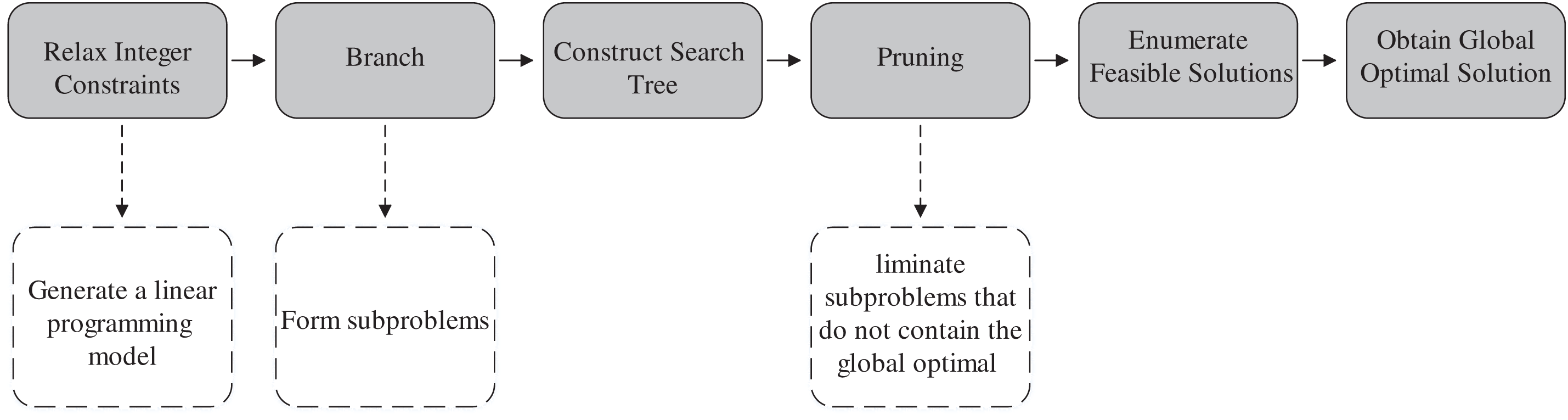
Figure 3: Flowchart of the B&B method
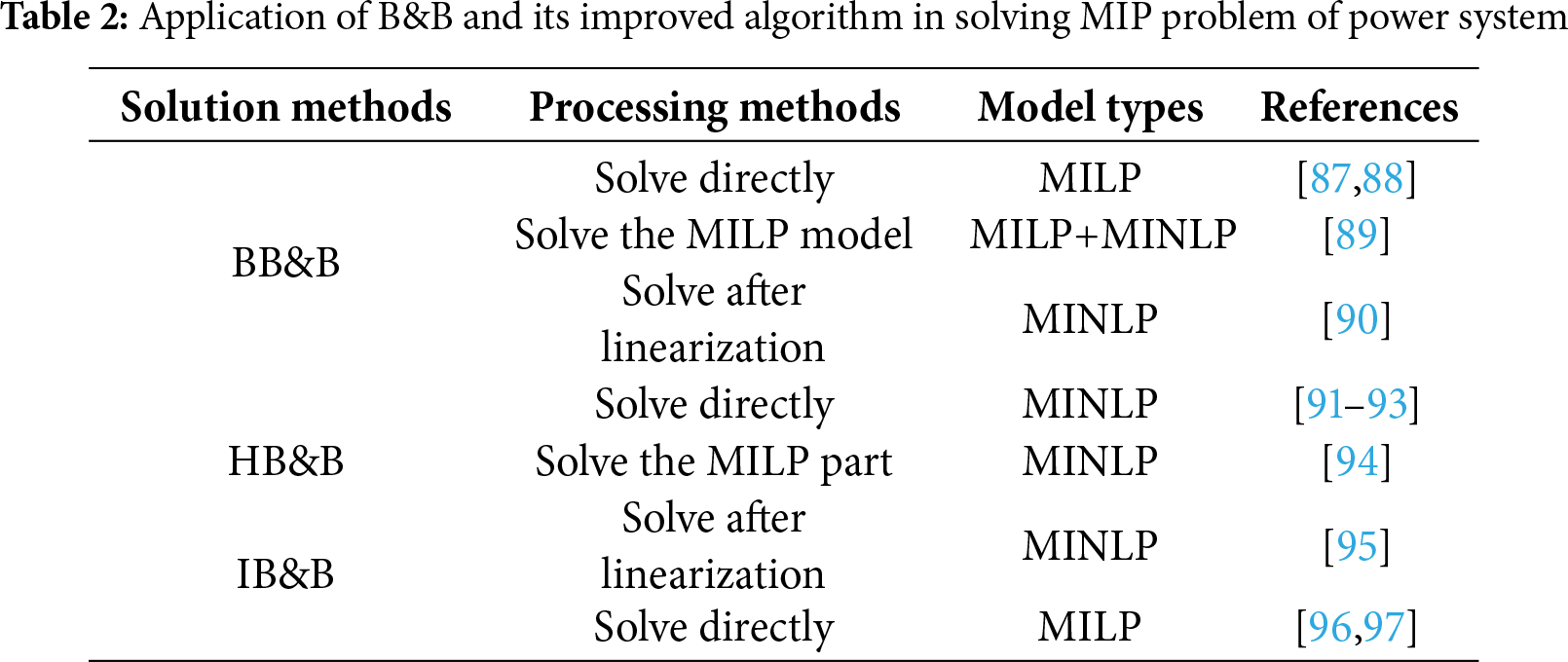
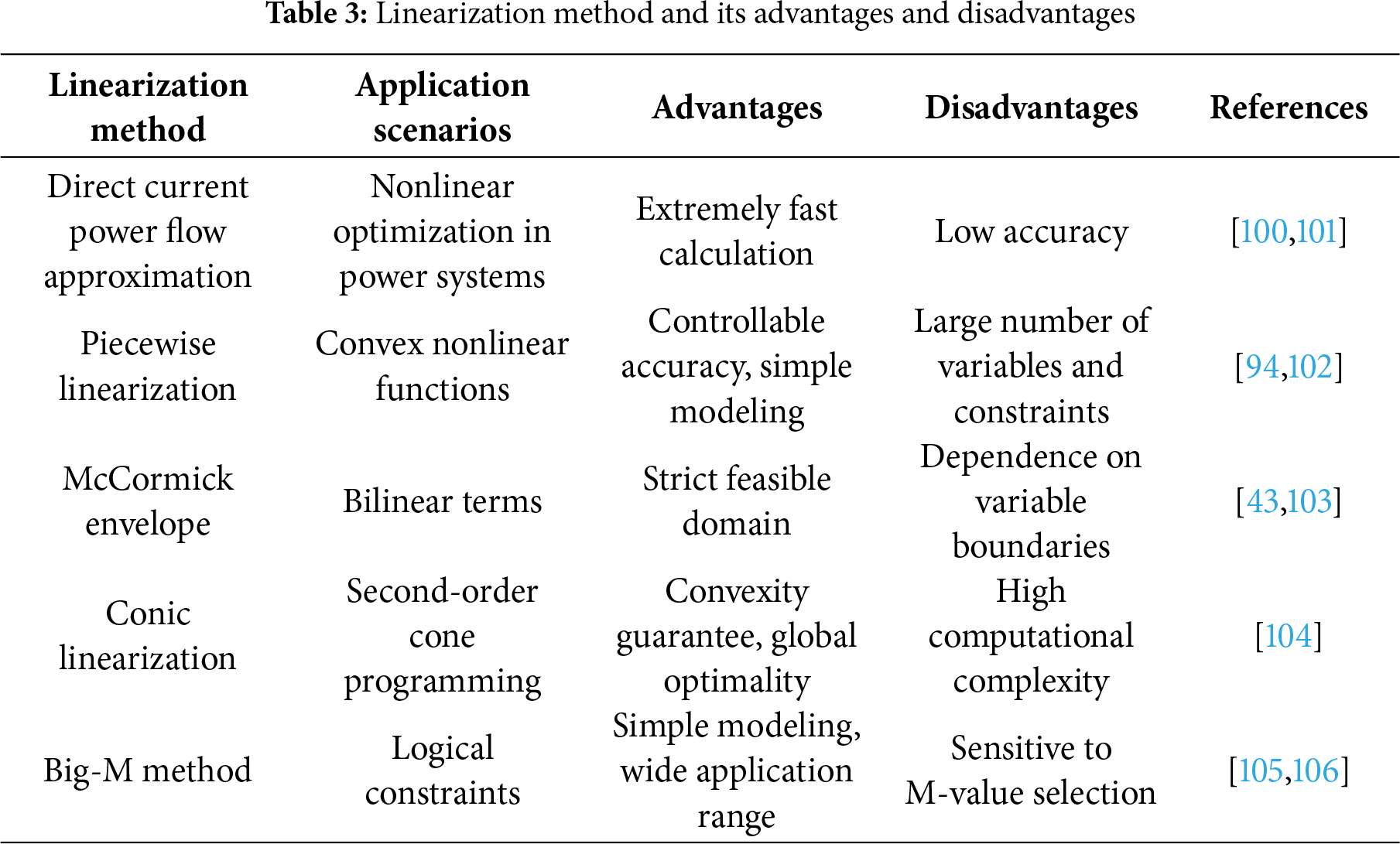
Typically, the B&B algorithm is employed to solve MILP problems or linear problems in multi-level problems [89,98]. Bai et al. [89] applied the B&B algorithm to solve the lower-level MILP model within the bi-level programming model for user-side interconnected integrated energy systems, which contributed to the reduction of annual operating costs. For MINLP problems, the simplex-based B&B algorithm cannot guarantee the optimality of the obtained solution, especially when the problem is non-convex [2]. MINLP problems can be solved via decomposition methods such as the outer approximation method and generalized BD, as well as heuristic algorithms [99]; alternatively, the interior-point method can replace the simplex method for solving nonlinear programming subproblems. Zhao et al. [93] applied this method to solve the nonlinear programming subproblems in the optimal scheduling model of active distribution networks with battery energy storage systems. Additionally, MINLP problem can be linearized first before being solved by the B&B algorithm, with commonly used linearization methods listed in Table 3.
It is noteworthy that, depending on the model structure, the B&B method can be applied directly if discrete variables are decoupled from nonlinear terms [91,92]. Furthermore, the B&B algorithm can handle the linear part of the problem, while the nonlinear part is solved via MA [107].
Large-scale MIP problems in new power systems impose higher demands on the solution time and convergence of B&B algorithms. Optimizing the branching variable selection strategy of B&B algorithms through machine learning methods such as support vector machines [95], graph convolutional neural networks [96], and Bayesian optimization [97] has emerged as a key research direction for IB&B algorithms.
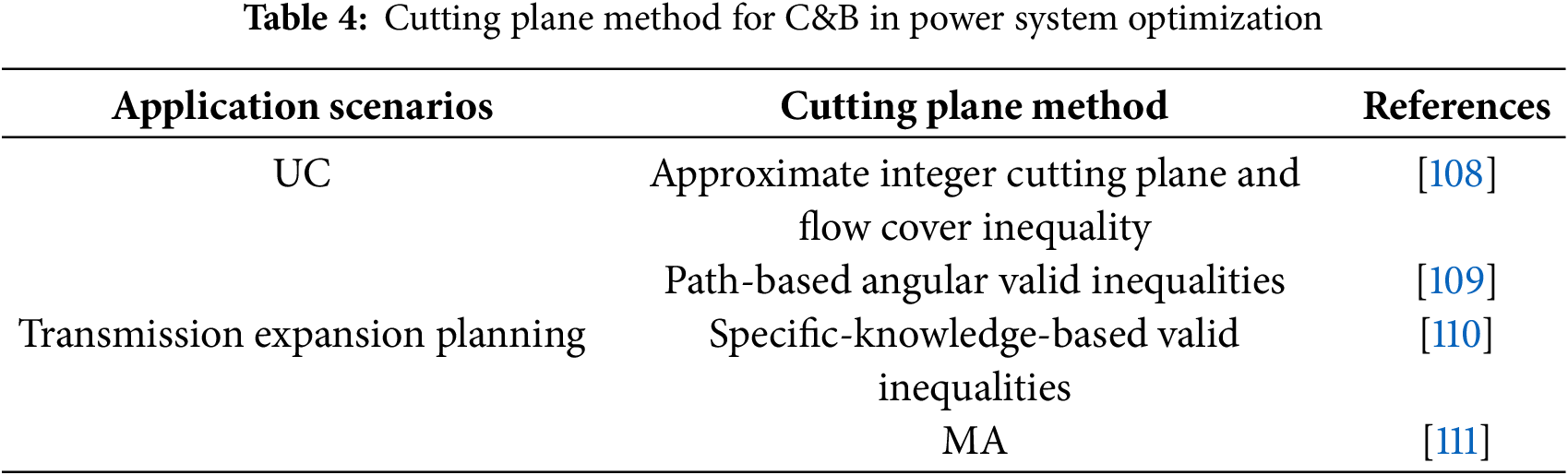
In addition, Cut and Branch (C&B) and Branch and Cut (B&C) are other research directions of IB&B and are also applicable to large-scale MIP problems. Among them, C&B integrates the cutting plane method into the B&B method, reducing invalid searches and thus achieving significantly higher computational efficiency than the traditional B&B method. However, C&B relies on the design of problem-specific cutting planes for the target problem. Table 4 presents the C&B methods commonly used in power system optimization problems.
Unlike the C&B approach, which adds cutting planes at the root node, the B&C algorithm integrates the cutting plane method into solving subproblems during the branch-and-bound process. This accelerates the branching process, improves the efficiency of the B&B method, but also increases computational complexity. Comparative experiments in literatures [112,113] indicate that the B&B and B&C algorithms yield similarly optimal results, but B&C requires less computation time. Gao et al. [114] formulate an induced MIP based on congestion management information; solving this induced MIP can guide the search process and avoids unnecessary exploration. The results demonstrate that the computational speed has increased to more than twice its original rate before modification.
4.2 Decomposition-Based Methods
The scale of MIP problems in new power systems is growing increasingly large, and the difficulty of solving them due to the need to account for uncertainties is further increasing. Researchers have begun to apply decomposition methods to MIP problems considering uncertainties to reduce computational complexity.
Lagrangian Relaxation (LR) is an effective method for solving large-scale MIP problems [115,116], as it reduces computational complexity and is also applicable to handling MINLP problems [117,118]. Unlike the B&B method, LR does not solve MIP problems directly; instead, it decomposes the original problem and then solves it using algorithms such as B&B. Solving MIP problems via LR can be implemented through an iterative framework, comprising two steps: solving relaxed subproblem and updating Lagrange multipliers, as illustrated in Fig. 4. The applications of LR and its improved algorithms in power system optimization are summarized in Table 5.
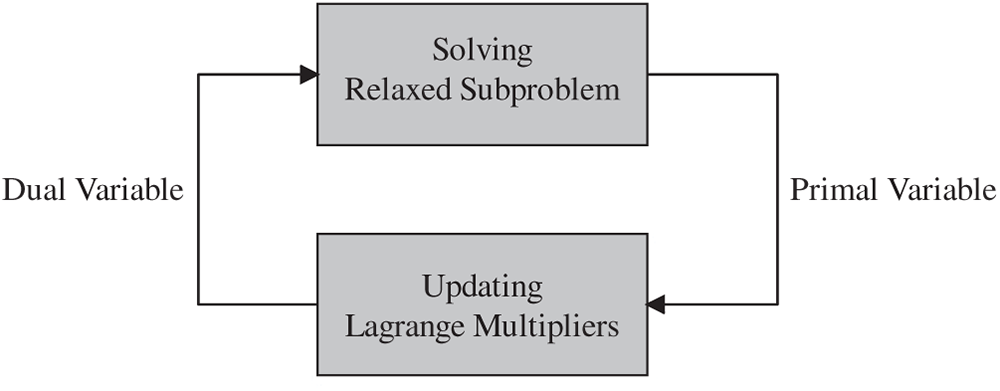
Figure 4: The iterative framework of LR
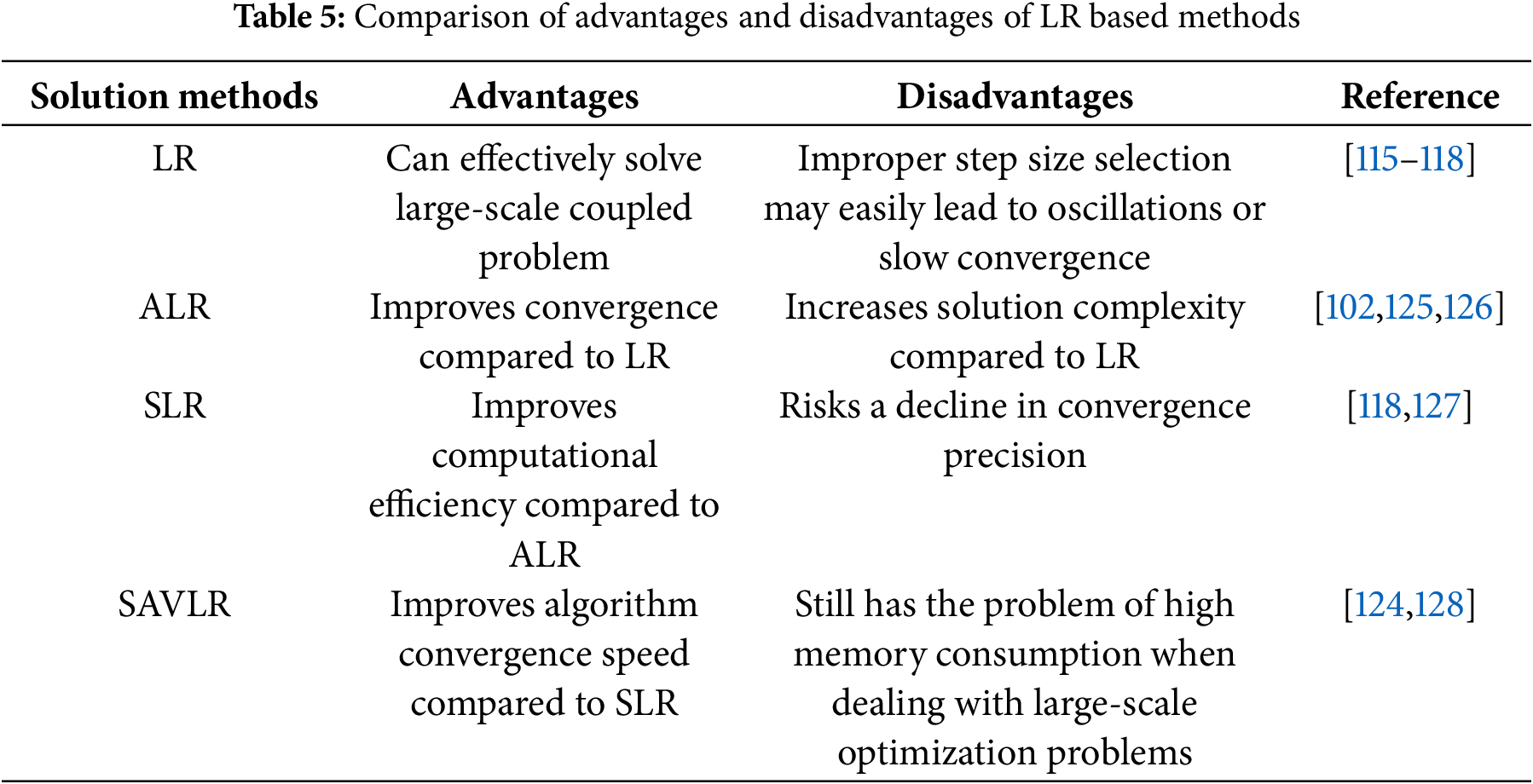
Traditional LR uses the subgradient method to update multipliers. Improper step size selection may easily lead to oscillations or slow convergence, making it harder to balance the “feasibility of uncertain scenarios” and “solution efficiency of MIP problems”. In response to these issues, researchers have proposed a series of improved algorithms: Augmented Lagrangian Relaxation (ALR) [119,120], Surrogate Lagrangian Relaxation (SLR) [121], Surrogate Absolute Value Lagrangian Relaxation (SAVLR) [122] with their specific advantages and disadvantages summarized in Table 5. When choosing among these algorithms for new power system optimization tasks, if the priority is to enhance solution efficiency in the face of strong uncertainties, ALR can be considered; Khaligh et al. [118] combined ALR with the alternating direction method of multipliers for the cooperative scheduling optimization of multi-vector microgrids. While addressing uncertainties such as wind turbine output, photovoltaic output, and hydrogen load and enhancing the capability to cope with uncertainties, this method also improved the efficiency of model solution. if computational efficiency is more critical for large-scale but relatively stable new power system optimization problems, SLR might be a better choice; Sun et al. [123] applied SLR to the optimization of large-scale UC problems. Experimental results show that the B&C algorithm requires 3600 s to obtain a near-optimal solution, while SLR only takes 1800 s, which significantly improves computational efficiency. And for scenarios requiring both fast convergence and capability to handle large-scale cases, SAVLR is applicable [124].
The BD algorithm employs a “divide-and-conquer” strategy, iteratively solving a complex MIP problem by decomposing it into a master problem and a subproblem, as illustrated in Fig. 5. A key strength of BD lies in its mathematical rigor: unlike methods such as LR which may converge to suboptimal solutions, BD is guaranteed to converge to the global optimum of the original problem by progressively adding cuts [129]. This makes it particularly valuable for power system applications demanding high solution accuracy, such as unit commitment and transmission expansion planning.
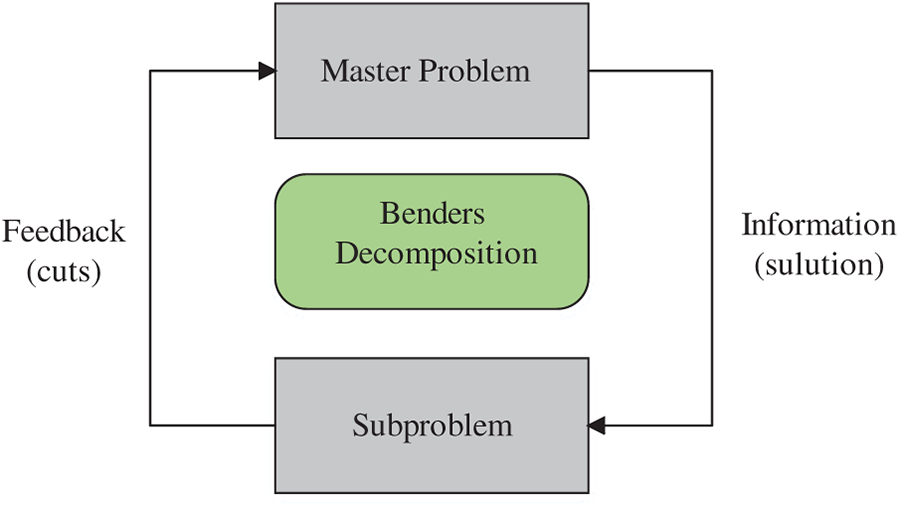
Figure 5: Schematic diagram of BD
However, the performance of the BD algorithm involves a fundamental trade-off. On one hand, its master-subproblem iterative framework effectively separates discrete and continuous variables to reduce computational complexity, making it a natural fit for two-stage decision-making problems commonly encountered in engineering [130]. On the other hand, its convergence rate can be severely hampered in practice. Solving subproblems and generating cutting planes becomes highly time-consuming for large-scale problems or those with numerous discrete variables. Moreover, the convergence efficiency is highly sensitive to the quality of the initial cuts, where poor cuts inevitably lead to slow iteration progress.
To address these challenges, Nielsen et al. [131] proposed a parallel BD algorithm, which achieves near-perfect scalability by solving scenario subproblems in parallel with a data-parallel interior-point method, enabling efficient solutions to very large-scale stochastic programs. To address the pain point in power system planning where climate uncertainty causes exponential growth in the number of scenarios and computational time explosion of Benders Decomposition (BD), Göke et al. [132] incorporated stabilization techniques into the BD framework, avoiding the efficiency degradation of traditional BD caused by increasing scenarios. Case studies demonstrate that when parallelized, its computational efficiency is 100 times higher than that of traditional BD, and the computational time remains constant as the number of scenarios increases, providing technical support for cross-regional new energy base planning.
Du et al. [133] proposed a scenario-oriented generalized Benders decomposition algorithm for the planning of integrated electric and heating systems considering the seasonal reconfiguration of district heating networks. This algorithm enables parallel computation of subproblems and unifies cuts into penalty-driven cuts to avoid slow convergence. Practical case studies demonstrate that it reduces the total planning cost by 13.15% while enhancing wind power penetration, providing a key tool for the planning of large-scale heating systems.
4.2.3 Column-and-Constraint Generation Decomposition
The core mechanism of the C&CG algorithm lies in its iterative “master-subproblem” framework that dynamically refines the problem model. The master problem provides a candidate solution, while the subproblem identifies the worst-case scenario realization under that decision. The key decision variables and constraints corresponding to this identified worst-case scenario are then fed back to the master problem as new “columns” and “constraints”. This process of progressively incorporating critical elements allows the algorithm to converge toward a global optimum without solving the full-scale original problem directly.
Compared with BD, C&CG significantly reduces the number of convergence iterations by preserving the master problem structure and employing a rigorous scenario identification mechanism. This approach avoids computational inefficiencies caused by redundant cutting planes, making it particularly suitable for multi-scenario RO problems. Moreover, the hierarchical iterative logic of C&CG aligns well with tightly coupled two-stage problems, where first-stage decisions and second-stage scenario responses are highly interdependent. It effectively handles the separation requirements between discrete and continuous variables, as well as deterministic decisions and uncertain responses [134].
However, the performance of the C&CG algorithm is highly dependent on the strategies for generating columns and constraints and the selection of the relaxation method. In practical applications, various improved variants have been developed, such as Parallel C&CG [135] and Nesting C&CG [136]. In uncertain scenarios, C&CG needs to cover extreme cases to ensure decision feasibility. However, this increases model complexity, which conflicts with the need to control MIP solution time costs. To balance this conflict, Tsang et al. [134] proposed an inexact C&CG method, which improves solution speed at the expense of solution accuracy. For prosumers’ two-stage robust optimization involving wind power and load uncertainties, Zhou et al. [137] extended the Nesting C&CG algorithm to solve the non-convex bi-level subproblem with 0–1 variables, achieving convergence in only 4 iterations and a solving time of 9.75 s under 10−6 accuracy, which ensures the timeliness of day-ahead scheduling while promoting local wind power accommodation. For coupled transportation-power systems under hurricanes, Yang et al. [138] proposed a customized parametric Nesting C&CG algorithm to handle hybrid endogenous-exogenous uncertainties, reducing solving time by 9.7% (IEEE RTS-79 system) and 55.2% (IEEE RTS-96 system) compared with traditional Nesting C&CG, providing efficient decision support for resilience enhancement under extreme weather.
4.2.4 Dantzig-Wolfe Decomposition
Another widely used approach for decomposing large-scale MILP is Dantzig-Wolfe (DW) decomposition. Its core idea is to leverage the block-angular structure of the constraint matrix to decompose the original complex optimization problem into multiple subproblems and a master problem with coupling constraints [139]. Solutions from solving the master problem guide the solution of subproblems, while optimal solutions (typically marginal costs) from subproblems are fed back to the master problem, serving as part of its constraints or objective function. Wirtz et al. [139] solved the large-scale district energy supply planning problem through DW decomposition, reducing the computational time by an average of 94%. To address the challenges posed by uncertainty and large-scale MILP in low-carbon power system expansion planning, Apablaza et al. [140] proposed a multi-stage stochastic expansion planning model and decomposed the problem using DW decomposition, enabling efficient solution of the model.
DW decomposition can reduce problem complexity and improve computational efficiency. However, it is primarily designed for linear problems. For nonlinear problems especially non-convex ones this method is not fully applicable. In uncertain scenarios involving nonlinear coupling, the nonlinearity of uncertain parameters undermines the fundamental basis that traditional MIP models rely on for solving problems [141], rendering DW decomposition inapplicable. Modifications such as linearization [141] or integration with other algorithms (e.g., Reinforcement Learning (RL) [142]) are required for solving such problems. After applying DW decomposition to the original problem, the branch-and-price (B&P) method [143] is typically used for solution. Unlike B&B, which directly solves node relaxation problems, B&P usually adopts column generation for solution. Additionally, DW decomposition enhances data privacy, as each subproblem can be solved locally, thereby reducing the exposure of sensitive information.
Traditional optimization methods typically rely on mathematical modeling and exact solution techniques. Theoretically, they have a rigorous mathematical basis and can produce optimal or near-optimal solutions. However, their computational complexity is relatively high—especially when uncertainties are considered, the problem scale expands further, significantly increasing solution time. By contrast, MA rely on specific heuristic rules derived from natural events and social behaviors. This intuition-based approach helps find solutions to large-scale complex optimization problems with lower computational costs [90,143] and is more suitable for nonlinear problems [144,145]. Nevertheless, they suffer from the drawback that their solutions cannot guarantee global optimality [90,145,146]. The application of MA in solving power system MIP problems is shown in Table 6, where the MA used are classified as Basic Meta-heuristic Algorithms (BMA), Hybrid Meta-heuristic Algorithms (HMA), and Improved Meta-Heuristic Algorithms (IMA).
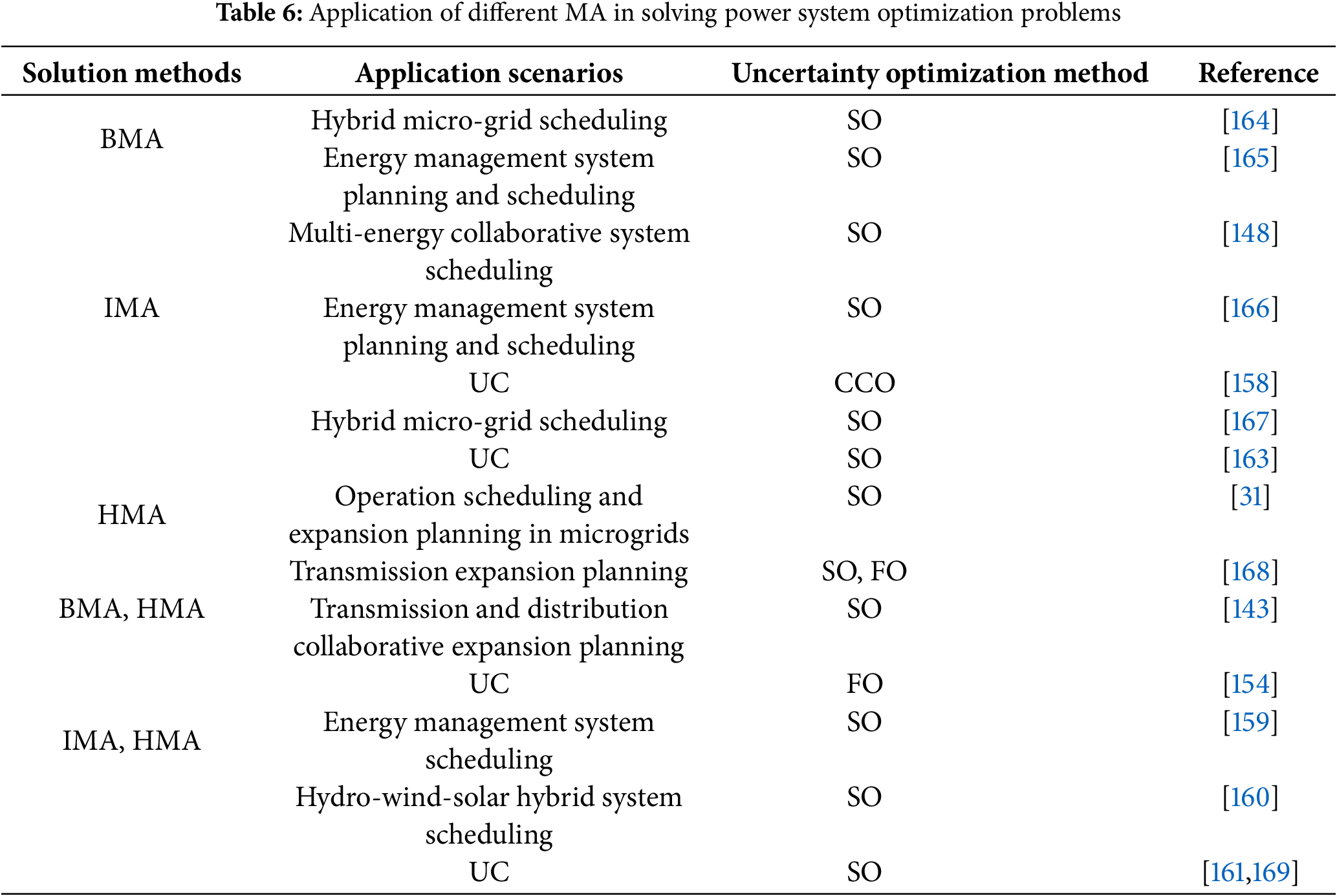
Most optimization problems in new power systems can be modeled as MIP problems, which requires solution algorithms to handle discrete variables. Among MA, genetic algorithms possess inherent adaptability to MIP problems [147], while most other MAs struggle to handle discrete decision variables. A common improvement strategy is to develop binary variants of MAs [148–157]. When addressing power system MIP problems, these algorithms can simulate discrete decision variables (e.g., on-off variables), thereby enabling problem solving [148,154,158–161]. In addition, using HMAs for solving is also an effective method, where algorithms handle discrete and continuous variables separately based on the characteristics of each MA [155,159,160,162]. Rahim and Ahmad [159] applied hybrid meta-heuristic algorithms to solve the MIP problem of household power scheduling, in which the GA is used to handle discrete variables, achieving a reduction in electricity cost. In addition to combining multiple MA, integrating MAs with RL [163] or using RL to handle discrete variables is another effective approach.
For complex new power system optimization scenarios involving high proportions of renewable energy, electric vehicles, and energy storage systems, the problem’s search space is large and highly complex. Using HMAs to leverage complementary advantages across algorithms improves search efficiency and avoids local optimal [161,168]. Al-Dhaifallah et al. [168] applied HMA to solve the transmission expansion planning problem, leveraging multi-mechanism collaborative search to improve efficiency, with the computational time reduced by more than 92%. Beyond integrating MAs with their improved variants, combining MAs with machine learning has emerged as a key research direction. Fitting the objective function through neural networks accelerates its calculation of the objective function [170,171], thus increasing algorithm speed. Liu et al. [172] propose a fusion scheme of Q-learning and particle swarm optimization (PSO), where optimal actions derived from the Q-table guide particle exploration and exploitation, thereby enhancing PSO performance. However, when solving large-scale optimization problems, integration with RL further increases computational resource requirements.
5 Research Progress and Future Prospects
5.1 Current Research Frontiers and Technical Progress
This paper centers on MIP problems in new power systems with uncertainties, presenting a systematic review that focuses on cutting-edge technical advancements across two core dimensions: uncertainty optimization methods and solution methods.
In terms of uncertainty optimization, each currently available method has distinct advantages and applicable scenarios: SO and CCO rely on probability distributions, making them suitable for scenarios with sufficient data; RO addresses extreme cases through uncertainty sets, thus making it more suitable for scenarios with strict security constraints; FO and IGDT offer greater advantages in scenarios involving fuzzy boundaries or scarce data.
However, a single method struggles to cope with the “multi-source uncertainty coupling” characteristic of current new power systems. Therefore, current cutting-edge research increasingly focuses on the hybrid application of optimization methods [21,77–79]. However, the increased complexity resulting from this also places higher requirements on the solution of the model.
In terms of solution strategies, the B&B method and its improved algorithms remain core for solving MILP problems. Nevertheless, when dealing with MINLP and large-scale problems, relying on decomposition strategies and MAs is necessary. However, decomposition-based methods face efficiency bottlenecks when dealing with high-dimensional uncertainty, requiring a balance between the contradiction of solution accuracy and solution efficiency. Current cutting-edge research trends indicate that integrating artificial intelligence (AI) with solution methods has become a prominent hotspot. By optimizing branch variable selection, fitting objective functions, or dynamically adjusting algorithm parameters through AI technologies (e.g., machine learning and RL), the solution process can be effectively accelerated and its efficiency improved [95–97,168,162,170,171].
5.2 Future Technical Prospects
5.2.1 Application of Artificial Intelligence in Solving Uncertain Optimization Problems
The integration of AI technology with methods such as SO and RO has demonstrated considerable potential in current research on the optimal dispatch of new power systems. AI can enhance the modeling capability for the uncertainties associated with wind and solar output, thereby improving the adaptability and robustness of optimization strategies. At the level of solution methods, AI has been preliminarily applied to exact solution methods (e.g., improving MILP solving efficiency), decomposition-based algorithms (e.g., subproblem learning in BD), and MAs (e.g., RL to guide the search process). However, existing research mainly focuses on the auxiliary application of single methods and has not yet achieved deep coupling between AI and optimization models. Further exploration is needed for joint modeling and collaborative optimization mechanisms embedded with AI to comprehensively enhance the performance and computational efficiency of optimization problems in complex power systems.
5.2.2 Bottlenecks in Solution Engines and Development of Novel Solvers
As new power systems develop along two key directions: high renewable energy penetration and complex, diversified structure—their optimization problems present challenges such as high dimensionality, nonlinearity, and extreme uncertainty. Existing mainstream commercial solvers (e.g., CPLEX, Gurobi) are gradually encountering bottlenecks in solution efficiency and scalability. In recent years, novel solvers (represented by Alibaba’s MindOpt) have made significant progress in underlying algorithm architecture, integer programming processing, and parallel computing, demonstrating superior numerical stability and capability to solve large-scale problems. Future research urgently needs to further develop specialized solution tools for extreme scenarios and enhance the solution reliability and computational performance of optimization models by deeply integrating algorithm innovation with hardware adaptation, thereby supporting the secure and economic operation of new power systems.
5.2.3 Research on Dynamic Modeling of Multi-Source Uncertainties
With the increasing penetration of renewable energy, uncertainties in new power systems exhibit strongly time-varying, multi-source coupled non-stationarity characteristics [173], making traditional uncertainty sets based on static boundaries inadequate for accurately characterizing their dynamic evolution patterns and spatiotemporal correlation features. Therefore, it is imperative to develop more advanced uncertainty modeling methods, such as constructing dynamic uncertainty sets with time-varying dependencies, or combining data-driven techniques with deep reinforcement learning, to achieve adaptive characterization and real-time perception of multi-source uncertainties (e.g., wind and solar output, load fluctuations). Such methods can effectively quantify coupling risks under extreme scenarios, enhance the robustness and adaptability of optimization decisions, and provide crucial theoretical support for the secure and stable operation of power systems with high renewable energy penetration. However, data-driven methods also have issues that need to be addressed, including reliance on training datasets and model mismatches with actual physical laws [174].
This paper focuses on MIP problems in new power systems with uncertainties, systematically sorting out the coupling relationship between uncertainty optimization methods and solution strategies, and filling the gap of isolated modeling and isolated solving in existing studies. The main research conclusions and contributions are as follows:
(1) Aiming at the theoretical gap caused by the coupling of uncertainty and MIP models in new power systems, this paper constructs for the first time a systematic framework for embedding five uncertainty methods—SO, RO, CCO, FO, and IGDT—into MIP. By clarifying the core characteristics and embedding logic of each method, this paper defines the applicable scenario boundaries of each method, while sorting out the key technologies for converting different methods into deterministic MIP models, thus providing a standardized modeling paradigm for subsequent similar studies.
(2) To address the three engineering bottlenecks—variable dimension explosion, disrupted constraint separability, and conflicts in solution logic—caused by the coupling of uncertainty and MIP solution, this paper combs through the advantages, disadvantages, applicable scenarios, and improvement directions of exact solution methods, decomposition-based methods, and meta-heuristic algorithms, and provides an operable technical solution for the engineering implementation of large-scale MIP problems with uncertainties.
(3) Combined with the trends of high-proportion renewable energy integration and diversified structure of new power systems, and based on the previous research foundation, this paper outlines three future research directions: AI-enabled collaborative optimization, development of dedicated solvers for extreme scenarios, and dynamic modeling of multi-source uncertainties. These directions not only align with the core demand of high-proportion renewable energy integration in new power systems but also continue the coupling analysis idea of uncertainty and MIP solution, providing a clear technical direction for subsequent studies and offering references for the safe and economic operation of new power systems.
Acknowledgement: None.
Funding Statement: This paper is supported by National Key R&D Program of China under Grant 2022YFB2403500.
Author Contributions: Zemin Liang: Writing—original draft, Writing—review & editing, Conceptualization. Songyu Gao: Writing—original draft, Formal analysis. Qi Yao: Supervision, Funding acquisition. All authors reviewed the results and approved the final version of the manuscript.
Availability of Data and Materials: Not applicable.
Ethics Approval: Not applicable.
Conflicts of Interest: The authors declare no conflicts of interest to report regarding the present study.
References
1. Carvajal G, Carrión D, Jaramillo M. Planning scheme for optimal PMU location considering power system expansion. Energies. 2025;18(13):3283. doi:10.3390/en18133283. [Google Scholar] [CrossRef]
2. Bragin MA. Survey on Lagrangian relaxation for MILP: importance, challenges, historical review, recent advancements, and opportunities. Ann Oper Res. 2024;333(1):29–45. doi:10.1007/s10479-023-05499-9. [Google Scholar] [CrossRef]
3. Zhang C, Qin Z, Sun Y. Learning-based branching acceleration for unit commitment with few training samples. Appl Sci. 2025;15(6):3366. doi:10.3390/app15063366. [Google Scholar] [CrossRef]
4. Li H, Rezvani A, Hu J, Ohshima K. Optimal day-ahead scheduling of microgrid with hybrid electric vehicles using MSFLA algorithm considering control strategies. Sustain Cities Soc. 2021;66:102681. doi:10.1016/j.scs.2020.102681. [Google Scholar] [CrossRef]
5. Ma G, Li J, Zhang XP. Energy storage capacity optimization for improving the autonomy of grid-connected microgrid. IEEE Trans Smart Grid. 2023;14(4):2921–33. doi:10.1109/TSG.2022.3233910. [Google Scholar] [CrossRef]
6. Feng S, Lu Y, Wang Y, Liu P, Qi S, Lv X. Planning for improving the flexibility of regional comprehensive energy system considering uncertainty. In: Proceedings of the 3rd International Symposium on New Energy and Electrical Technology; 2022 Aug 25–27; Anyang, China. Singapore: Springer Nature Singapore; 2023. p. 558–64. doi:10.1007/978-981-99-0553-9_58. [Google Scholar] [CrossRef]
7. Zhang J, Fu K, Huang W, Zhang Y, Sun Q, Chi Y, et al. Efficient probabilistic evaluation and sensitivity analysis of load supply capability for renewable-energy-based power systems. Appl Sci. 2025;15(9):5169. doi:10.3390/app15095169. [Google Scholar] [CrossRef]
8. Kaewpasuk S, Intiyot B, Jeenanunta C. A fuzzy unit commitment model for enhancing stability and sustainability in renewable energy-integrated power systems. Sustainability. 2025;17(15):6800. doi:10.3390/su17156800. [Google Scholar] [CrossRef]
9. Su W, Blumsack S, Webster M. A stochastic optimization framework to planing for geographically correlated failures in coupled natural gas and electric power systems. Reliab Eng Syst Saf. 2024;246:110049. doi:10.1016/j.ress.2024.110049. [Google Scholar] [CrossRef]
10. Bahrami M, Vakilian M, Farzin H, Lehtonen M. A CVaR-based stochastic framework for storm-resilient grid, including bus charging stations. Sustain Energy Grids Netw. 2023;35:101082. doi:10.1016/j.segan.2023.101082. [Google Scholar] [CrossRef]
11. Soyster AL. Technical note—convex programming with set-inclusive constraints and applications to inexact linear programming. Oper Res. 1973;21(5):1154–7. doi:10.1287/opre.21.5.1154. [Google Scholar] [CrossRef]
12. Ben-Tal A, Goryashko A, Guslitzer E, Nemirovski A. Adjustable robust solutions of uncertain linear programs. Math Program. 2004;99(2):351–76. doi:10.1007/s10107-003-0454-y. [Google Scholar] [CrossRef]
13. Bertsimas D, Sim M. The price of robustness. Oper Res. 2004;52(1):35–53. doi:10.1287/opre.1030.0065. [Google Scholar] [CrossRef]
14. Huo D, Gu C, Greenwood D, Wang Z, Zhao P, Li J. Chance-constrained optimization for integrated local energy systems operation considering correlated wind generation. Int J Electr Power Energy Syst. 2021;132:107153. doi:10.1016/j.ijepes.2021.107153. [Google Scholar] [CrossRef]
15. Han L, Wang D, Liu Y. Bridging chance-constrained and stochastic optimization for risk estimation of virtual energy hubs dominated by hybrid vehicles under diverse uncertainties: to improve economic sustainability. Sustain Cities Soc. 2024;111:105542. doi:10.1016/j.scs.2024.105542. [Google Scholar] [CrossRef]
16. Qi N, Pinson P, Almassalkhi MR, Cheng L, Zhuang Y. Chance-constrained generic energy storage operations under decision-dependent uncertainty. IEEE Trans Sustain Energy. 2023;14(4):2234–48. doi:10.1109/TSTE.2023.3262135. [Google Scholar] [CrossRef]
17. Moshaver Shoja Z, Bohluli Oskouei A, Nazari-Heris M. Optimal scheduling of a community Multi-Energy system in energy and flexible ramp markets considering Vector-Coupling storage Devices: a hybrid Fuzzy-IGDT/Stochastic/Robust optimization framework. Energy Build. 2024;318:114465. doi:10.1016/j.enbuild.2024.114465. [Google Scholar] [CrossRef]
18. Truong HQ, Jeenanunta C. Fuzzy mixed integer linear programming model for national level monthly unit commitment under price-based uncertainty: a case study in Thailand. Electr Power Syst Res. 2022;209:107963. doi:10.1016/j.epsr.2022.107963. [Google Scholar] [CrossRef]
19. Chen J, Zhang W, Li J, Zhang W, Liu Y, Zhao B, et al. Optimal sizing for grid-tied microgrids with consideration of joint optimization of planning and operation. IEEE Trans Sustain Energy. 2018;9(1):237–48. doi:10.1109/TSTE.2017.2724583. [Google Scholar] [CrossRef]
20. Ny D, Jeenanunta C. Optimizing power system reliability and carbon emissions with a fuzzy unit commitment model incorporating renewable energy, load forecast errors, EV charging, and energy storage system. IEEE Access. 2024;12:164412–26. doi:10.1109/ACCESS.2024.3489596. [Google Scholar] [CrossRef]
21. He Y, Lyu Y, Che Y. Operational optimization of combined cooling, heat and power system based on information gap decision theory method considering probability distribution. Sustain Energy Technol Assess. 2022;51:101977. doi:10.1016/j.seta.2022.101977. [Google Scholar] [CrossRef]
22. Maulik A. A hybrid probabilistic information gap decision theory based energy management of an active distribution network. Sustain Energy Technol Assess. 2022;53:102756. doi:10.1016/j.seta.2022.102756. [Google Scholar] [CrossRef]
23. Nayak A, Maulik A, Das D. An integrated optimal operating strategy for a grid-connected AC microgrid under load and renewable generation uncertainty considering demand response. Sustain Energy Technol Assess. 2021;45:101169. doi:10.1016/j.seta.2021.101169. [Google Scholar] [CrossRef]
24. Afzali P, Hosseini SA, Peyghami S. A comprehensive review on uncertainty and risk modeling techniques and their applications in power systems. Appl Sci. 2024;14(24):12042. doi:10.3390/app142412042. [Google Scholar] [CrossRef]
25. Du G, Zhao DM, Liu X. Research review on optimal scheduling considering wind power uncertainty. Proc CSEE. 2023;43(7):2608–27. (In Chinese). doi:10.13334/j.0258-8013.pcsee.212711. [Google Scholar] [CrossRef]
26. Shouman N, Hegazy YG, Omran WA. Optimal power dispatch for power systems under high penetration of renewable energy sources. In: Proceedings of the IEEE EUROCON 2021—19th International Conference on Smart Technologies; 2021 Jul 6–8; Lviv, Ukraine. p. 390–6. doi:10.1109/eurocon52738.2021.9535611. [Google Scholar] [CrossRef]
27. Mohammadi S, Soleymani S, Mozafari B. Scenario-based stochastic operation management of MicroGrid including wind, photovoltaic, micro-turbine, fuel cell and energy storage devices. Int J Electr Power Energy Syst. 2014;54:525–35. doi:10.1016/j.ijepes.2013.08.004. [Google Scholar] [CrossRef]
28. Hannah LA. Stochastic optimization. In: International encyclopedia of the social & behavioral sciences. Amsterdam, The Netherlands: Elsevier; 2015. p. 473–81. doi:10.1016/b978-0-08-097086-8.42010-6. [Google Scholar] [CrossRef]
29. Xiao D, Peng Z, Lin Z, Zhong X, Wei C, Dong Z, et al. Incorporating financial entities into spot electricity market with renewable energy via holistic risk-aware bilevel optimization. Appl Energy. 2025;398:126449. doi:10.1016/j.apenergy.2025.126449. [Google Scholar] [CrossRef]
30. Xiao D, Lin Z, Wu Q, Meng A, Yin H, Lin Z. Risk-factor-oriented stochastic dominance approach for industrial integrated energy system operation leveraging physical and financial flexible resources. Appl Energy. 2025;377:124347. doi:10.1016/j.apenergy.2024.124347. [Google Scholar] [CrossRef]
31. Hemmati R, Saboori H, Siano P. Coordinated short-term scheduling and long-term expansion planning in microgrids incorporating renewable energy resources and energy storage systems. Energy. 2017;134:699–708. doi:10.1016/j.energy.2017.06.081. [Google Scholar] [CrossRef]
32. Zhan J, Chung CY, Zare A. A fast solution method for stochastic transmission expansion planning. IEEE Trans Power Syst. 2017;32(6):4684–95. doi:10.1109/TPWRS.2017.2665695. [Google Scholar] [CrossRef]
33. Sohrabi F, Rohaninejad M, Reza Hesamzadeh M, Bemš J. Optimal trading of a charging-station company in auction markets for electricity. IEEE Trans Intell Transp Syst. 2025;26(5):6545–55. doi:10.1109/TITS.2024.3524790. [Google Scholar] [CrossRef]
34. Miskiw KK, Kraft E, Fleten SE. Coordinated bidding in sequential electricity markets: effects of price-making. Energy Econ. 2025;144(1):108316. doi:10.1016/j.eneco.2025.108316. [Google Scholar] [CrossRef]
35. Römisch W. Scenario reduction techniques in stochastic programming. In: Stochastic algorithms: foundations and applications; 2009 Oct 22–28; Sapporo, Japan. Berlin/Heidelberg, Germany: Springer; 2009. p. 1–14. doi:10.1007/978-3-642-04944-6_1. [Google Scholar] [CrossRef]
36. Herding R, Ross E, Jones WR, Endler E, Charitopoulos VM, Papageorgiou LG. Risk-aware microgrid operation and participation in the day-ahead electricity market. Adv Appl Energy. 2024;15(1):100180. doi:10.1016/j.adapen.2024.100180. [Google Scholar] [CrossRef]
37. Sannigrahi S, Ghatak SR, Acharjee P. Multi-scenario based bi-level coordinated planning of active distribution system under uncertain environment. IEEE Trans Ind Appl. 2020;56(1):850–63. doi:10.1109/TIA.2019.2951118. [Google Scholar] [CrossRef]
38. Luo F, Ranzi G, Wang S, Dong ZY. Hierarchical energy management system for home microgrids. IEEE Trans Smart Grid. 2019;10(5):5536–46. doi:10.1109/TSG.2018.2884323. [Google Scholar] [CrossRef]
39. Li Z, Floudas CA. Optimal scenario reduction framework based on distance of uncertainty distribution and output performance: I. Single reduction via mixed integer linear optimization. Comput Chem Eng. 2014;70(1):50–66. doi:10.1016/j.compchemeng.2014.03.019. [Google Scholar] [CrossRef]
40. Li Z, Li Z. Linear programming-based scenario reduction using transportation distance. Comput Chem Eng. 2016;88:50–8. doi:10.1016/j.compchemeng.2016.02.005. [Google Scholar] [CrossRef]
41. Wei J, Zhang Y, Wang J, Wu L, Li Q. Chance-constrained two-stage energy hub cluster configuration for integrated demand response considering multi-energy load uncertainty. In: Proceedings of the 2020 IEEE Power & Energy Society General Meeting (PESGM); 2020 Aug 2–6; Montreal, QC, Canada. p. 1–5. doi:10.1109/pesgm41954.2020.9282018. [Google Scholar] [CrossRef]
42. Zheng H, Huang L, Quan R. Mixed-integer conic formulation of unit commitment with stochastic wind power. Mathematics. 2023;11(2):346. doi:10.3390/math11020346. [Google Scholar] [CrossRef]
43. Zhang Y, Wang J, Zeng B, Hu Z. Chance-constrained two-stage unit commitment under uncertain load and wind power output using bilinear benders decomposition. IEEE Trans Power Syst. 2017;32(5):3637–47. doi:10.1109/TPWRS.2017.2655078. [Google Scholar] [CrossRef]
44. Han O, Ding T, Ma Z. A coordinated scheduling model for wind power integrated systems with data centers based on chance constrained goal programming. In: Proceedings of the 2022 IEEE/IAS Industrial and Commercial Power System Asia (I&CPS Asia); 2022 Jul 8–11; Shanghai, China. p. 910–5. doi:10.1109/ICPSAsia55496.2022.9949652. [Google Scholar] [CrossRef]
45. Wang C, Li X, Zhang Y, Dong Y, Dong X, Wang M. Two stage unit commitment considering multiple correlations of wind power forecast errors. IET Renew Power Gener. 2021;15(3):574–85. doi:10.1049/rpg2.12037. [Google Scholar] [CrossRef]
46. Jasinski M, Najafi A, Homaee O, Kermani M, Tsaousoglou G, Leonowicz Z, et al. Operation and planning of energy hubs under uncertainty—a review of mathematical optimization approaches. IEEE Access. 2023;11:7208–28. doi:10.1109/ACCESS.2023.3237649. [Google Scholar] [CrossRef]
47. Xia B, Chen Y, Yang W, Chen Q, Wang X, Min K. Stochastic optimal power flow for power systems considering wind farms based on the stochastic collocation method. IEEE Access. 2022;10:44023–32. doi:10.1109/ACCESS.2022.3169600. [Google Scholar] [CrossRef]
48. Zhang X, Wei H, Su X, Gao W, Chen D, Hu F. Optimal dispatch of hydropower stations based on chance-constrained programming. In: Proceedings of the 2021 Power System and Green Energy Conference (PSGEC); 2021 Aug 20–22; Shanghai, China. p. 420–4. doi:10.1109/psgec51302.2021.9542506. [Google Scholar] [CrossRef]
49. Liu Z, Wen F, Ledwich G. Optimal siting and sizing of distributed generators in distribution systems considering uncertainties. IEEE Trans Power Deliv. 2011;26(4):2541–51. doi:10.1109/TPWRD.2011.2165972. [Google Scholar] [CrossRef]
50. Jiang S, Cheng J, Pan K, Qiu F, Yang B. Data-driven chance-constrained planning for distributed generation: a partial sampling approach. IEEE Trans Power Syst. 2023;38(6):5228–44. doi:10.1109/TPWRS.2022.3230676. [Google Scholar] [CrossRef]
51. Wu H, Yuan Y, Zhu J, Xu Y. Assessment model for distributed wind generation hosting capacity considering complex spatial correlations. J Mod Power Syst Clean Energy. 2022;8(5):1194–206. doi:10.35833/mpce.2020.000889. [Google Scholar] [CrossRef]
52. Chen Z, Li Z, Guo C, Ding Y, He Y. Two-stage chance-constrained unit commitment based on optimal wind power consumption point considering battery energy storage. IET Gener Transm Distrib. 2020;14(18):3738–49. doi:10.1049/iet-gtd.2019.1492. [Google Scholar] [CrossRef]
53. Soares T, Bessa RJ. Proactive management of distribution grids with chance-constrained linearized AC OPF. Int J Electr Power Energy Syst. 2019;109:332–42. doi:10.1016/j.ijepes.2019.02.002. [Google Scholar] [CrossRef]
54. Qiu H, Gu W, Liu P, Sun Q, Wu Z, Lu X. Application of two-stage robust optimization theory in power system scheduling under uncertainties: a review and perspective. Energy. 2022;251:123942. doi:10.1016/j.energy.2022.123942. [Google Scholar] [CrossRef]
55. Zhang J, Li X, Tan Q, Zhong Z, Zhao Q. Multi-time scale robust optimization for integrated multi-energy system considering the internal coupling relationship of photovoltaic battery swapping-charging-storage station. J Energy Storage. 2025;109:115109. doi:10.1016/j.est.2024.115109. [Google Scholar] [CrossRef]
56. Microgrids NHE. Stochastic-robust planning of networked hydrogen-electrical microgrids: a study on induced refueling demand. arXiv:2404.00568. 2024. [Google Scholar]
57. Zhang R, Chen Y, Li Z, Jiang T, Li X. Two-stage robust operation of electricity-gas-heat integrated multi-energy microgrids considering heterogeneous uncertainties. Appl Energy. 2024;371:123690. doi:10.1016/j.apenergy.2024.123690. [Google Scholar] [CrossRef]
58. Zhao L, Zhou M. A robust power allocation algorithm for cognitive radio networks based on hybrid PSO. Sensors. 2022;22(18):6796. doi:10.3390/s22186796. [Google Scholar] [PubMed] [CrossRef]
59. El-Meligy MA, El-Sherbeeny AM, Soliman ATA, Elgawad AEEA, Naser EA. On the solution of robust transmission expansion planning using duality theorem under polyhedral uncertainty set. Electr Power Syst Res. 2022;206:107785. doi:10.1016/j.epsr.2022.107785. [Google Scholar] [CrossRef]
60. Bertsimas D, Brown DB, Caramanis C. Theory and applications of robust optimization. SIAM Rev. 2011;53(3):464–501. doi:10.1137/080734510. [Google Scholar] [CrossRef]
61. Gabrel V, Murat C, Thiele A. Recent advances in robust optimization: an overview. Eur J Oper Res. 2014;235(3):471–83. doi:10.1016/j.ejor.2013.09.036. [Google Scholar] [CrossRef]
62. Li R, Wang MQ, Yang M, Han XS, Wu QW, Wang WL. A distributionally robust model for reserve optimization considering contingency probability uncertainty. Int J Electr Power Energy Syst. 2022;134:107174. doi:10.1016/j.ijepes.2021.107174. [Google Scholar] [CrossRef]
63. El-Meligy MA, Sharaf M, Soliman AT. A coordinated scheme for transmission and distribution expansion planning: a Tri-level approach. Electr Power Syst Res. 2021;196:107274. doi:10.1016/j.epsr.2021.107274. [Google Scholar] [CrossRef]
64. Qiu H, Gu W, Ning C, Lu X, Liu P, Wu Z. Multistage mixed-integer robust optimization for power grid scheduling: an efficient reformulation algorithm. IEEE Trans Sustain Energy. 2023;14(1):254–71. doi:10.1109/TSTE.2022.3210214. [Google Scholar] [CrossRef]
65. Qiu H, Gooi HB. A unified MILP solution framework for adaptive robust scheduling problems with mixed-integer recourse objective. IEEE Trans Power Syst. 2023;38(1):952–5. doi:10.1109/TPWRS.2022.3207067. [Google Scholar] [CrossRef]
66. Popovic ZN, Knezevic SD, Popović DS. Risk-based allocation of automation devices in distribution networks with performance-based regulation of continuity of supply. IEEE Trans Power Syst. 2019;34(1):171–81. doi:10.1109/TPWRS.2018.2857412. [Google Scholar] [CrossRef]
67. Liang RH, Liao JH. A fuzzy-optimization approach for generation scheduling with wind and solar energy systems. IEEE Trans Power Syst. 2007;22(4):1665–74. doi:10.1109/TPWRS.2007.907527. [Google Scholar] [CrossRef]
68. Huang Y, Pang H, Ding P, Zhang B, Lee KY, Wang B. Multi-objective optimization of steam power system under demand uncertainty. IEEE Access. 2021;9:113130–42. doi:10.1109/ACCESS.2021.3104110. [Google Scholar] [CrossRef]
69. Esmaeili M, Sedighizadeh M, Esmaili M. Multi-objective optimal reconfiguration and DG (Distributed Generation) power allocation in distribution networks using Big Bang-Big Crunch algorithm considering load uncertainty. Energy. 2016;103:86–99. doi:10.1016/j.energy.2016.02.152. [Google Scholar] [CrossRef]
70. Gholizadeh-Roshanagh R, Zare K, Marzband M. An A-posteriori multi-objective optimization method for MILP-based distribution expansion planning. IEEE Access. 2020;8:60279–92. doi:10.1109/ACCESS.2020.2981943. [Google Scholar] [CrossRef]
71. Nojavan S, Majidi M, Esfetanaj NN. An efficient cost-reliability optimization model for optimal siting and sizing of energy storage system in a microgrid in the presence of responsible load management. Energy. 2017;139:89–97. doi:10.1016/j.energy.2017.07.148. [Google Scholar] [CrossRef]
72. Nojavan S, Majidi M, Najafi-Ghalelou A, Ghahramani M, Zare K. A cost-emission model for fuel cell/PV/battery hybrid energy system in the presence of demand response program: ε-constraint method and fuzzy satisfying approach. Energy Convers Manag. 2017;138:383–92. doi:10.1016/j.enconman.2017.02.003. [Google Scholar] [CrossRef]
73. Javadi M, Lotfi M, Osorio GJ, Ashraf A, Nezhad AE, Gough M, et al. A multi-objective model for home energy management system self-scheduling using the epsilon-constraint method. In: Proceedings of the 2020 IEEE 14th International Conference on Compatibility, Power Electronics and Power Engineering (CPE-POWERENG); 2020 Jul 8–10; Setubal, Portugal. p. 175–80. doi:10.1109/cpe-powereng48600.2020.9161526. [Google Scholar] [CrossRef]
74. Topaloglu S, Selim H. Nurse scheduling using fuzzy modeling approach. Fuzzy Sets Syst. 2010;161(11):1543–63. doi:10.1016/j.fss.2009.10.003. [Google Scholar] [CrossRef]
75. Tiwari RN, Dharmar S, Rao JR. Fuzzy goal programming—an additive model. Fuzzy Sets Syst. 1987;24(1):27–34. doi:10.1016/0165-0114(87)90111-4. [Google Scholar] [CrossRef]
76. Li X, Wen H, Hu Y, Jiang L. A novel beta parameter based fuzzy-logic controller for photovoltaic MPPT application. Renew Energy. 2019;130(1):416–27. doi:10.1016/j.renene.2018.06.071. [Google Scholar] [CrossRef]
77. Zhang XY, Huang GH, Zhu H, Li YP. A fuzzy-stochastic power system planning model: reflection of dual objectives and dual uncertainties. Energy. 2017;123(1):664–76. doi:10.1016/j.energy.2017.01.072. [Google Scholar] [CrossRef]
78. Zhou C, Huang G, Chen J. A type-2 fuzzy chance-constrained fractional integrated modeling method for energy system management of uncertainties and risks. Energies. 2019;12(13):2472. doi:10.3390/en12132472. [Google Scholar] [CrossRef]
79. Arabahmadi N, Ebrahimi R, Ghanbari M. Robust allocation and scheduling of electric parkings and wind resources in distribution networks using information gap decision theory and improved flow direction algorithm. Int J Energy Res. 2024;2024(1):7446796. doi:10.1155/er/7446796. [Google Scholar] [CrossRef]
80. Zhang J, Kong D, He Y, Fu X, Zhao X, Yao G, et al. Bi-layer energy optimal scheduling of regional integrated energy system considering variable correlations. Int J Electr Power Energy Syst. 2023;148:108840. doi:10.1016/j.ijepes.2022.108840. [Google Scholar] [CrossRef]
81. Yin Z, Zhang Z, Zhu R, Zhang Y, Wang J, Tang W. Optimized multi-unit coordinated scheduling based on improved IGDT: low-carbon scheduling research for the electric-heat-oxygen integrated energy system. Int J Electr Power Energy Syst. 2025;167:110629. doi:10.1016/j.ijepes.2025.110629. [Google Scholar] [CrossRef]
82. Eslahi M, Vahidi B, Siano P. Novel time-varying risk-averse and risk-seeker frameworks for uncertain wind energy generation in electric power systems. IEEE Access. 2024;12:179039–49. doi:10.1109/ACCESS.2024.3505258. [Google Scholar] [CrossRef]
83. Wächter A, Biegler LT. On the implementation of an interior-point filter line-search algorithm for large-scale nonlinear programming. Math Program. 2006;106(1):25–57. doi:10.1007/s10107-004-0559-y. [Google Scholar] [CrossRef]
84. Rezaee Jordehi A. Information gap decision theory for operation of combined cooling, heat and power microgrids with battery charging stations. Sustain Cities Soc. 2021;74:103164. doi:10.1016/j.scs.2021.103164. [Google Scholar] [CrossRef]
85. Huang MY, Huang LY, Zhong YX, Yang HW, Chen XM, Huo W, et al. MILP acceleration: a survey from perspectives of simplex initialization and learning-based branch and bound. J Oper Res Soc China. 2025;13(1):1–55. doi:10.1007/s40305-023-00493-1. [Google Scholar] [CrossRef]
86. Toufani P, Karakoyun EC, Nadar E, Fosso OB, Kocaman AS. Optimization of pumped hydro energy storage systems under uncertainty: a review. J Energy Storage. 2023;73:109306. doi:10.1016/j.est.2023.109306. [Google Scholar] [CrossRef]
87. Zhang Y, Zhang P, Du S, Dong H. Economic optimal scheduling of integrated energy system considering wind-solar uncertainty and power to gas and carbon capture and storage. Energies. 2024;17(11):2770. doi:10.3390/en17112770. [Google Scholar] [CrossRef]
88. Khojasteh M, Faria P, Vale Z. A robust model for aggregated bidding of energy storages and wind resources in the joint energy and reserve markets. Energy. 2022;238:121735. doi:10.1016/j.energy.2021.121735. [Google Scholar] [CrossRef]
89. Bai M, Sheng W, Hu X, Zhang L, Liu K. Optimal planning of interconnected integrated energy system at user side based on chance constrained programming. In: Proceedings of the 2018 China International Conference on Electricity Distribution (CICED); 2018 Sep 17–19; Tianjin, China. p. 2158–63. doi:10.1109/CICED.2018.8592075. [Google Scholar] [CrossRef]
90. Fu J, Núñez A, De Schutter B. A short-term preventive maintenance scheduling method for distribution networks with distributed generators and batteries. IEEE Trans Power Syst. 2021;36(3):2516–31. doi:10.1109/TPWRS.2020.3037558. [Google Scholar] [CrossRef]
91. Yuan G, Gao Y, Ye B, Huang R. Real-time pricing for smart grid with multi-energy microgrids and uncertain loads: a bilevel programming method. Int J Electr Power Energy Syst. 2020;123:106206. doi:10.1016/j.ijepes.2020.106206. [Google Scholar] [CrossRef]
92. Xia S, Chan KW, Luo X, Bu S, Ding Z, Zhou B. Optimal sizing of energy storage system and its cost-benefit analysis for power grid planning with intermittent wind generation. Renew Energy. 2018;122:472–86. doi:10.1016/j.renene.2018.02.010. [Google Scholar] [CrossRef]
93. Zhao J, Zhu Z, Yu Y, Lin C, Wei W. Optimal charging/discharging scheme of battery storage systems in active distribution network. In: Proceedings of the 2016 IEEE Power and Energy Society General Meeting (PESGM); 2016 Jul 17–21; Boston, MA, USA. p. 1–5. doi:10.1109/PESGM.2016.7741805. [Google Scholar] [CrossRef]
94. Wu X, Fang J, Chen Z. Distributionally robust unit commitment of integrated electricity and heat system under bi-directional variable mass flow. Appl Energy. 2022;326:119788. doi:10.1016/j.apenergy.2022.119788. [Google Scholar] [CrossRef]
95. Mei J, Hu J, Wan Z, Qi D. Learning to branch in the generation maintenance scheduling problem. Glob Energy Interconnect. 2022;5(4):409–17. doi:10.1016/j.gloei.2022.08.007. [Google Scholar] [CrossRef]
96. Sun Y, Wu J, Zhang G, Zhang L, Li R. An ultra-fast optimization algorithm for unit commitment based on neural branching. Energy Rep. 2023;9:1112–20. doi:10.1016/j.egyr.2023.04.210. [Google Scholar] [CrossRef]
97. Mei J, Zhang G, Qi D, Zhang J. Accelerated solution of the transmission maintenance schedule problem: a Bayesian optimization approach. Glob Energy Interconnect. 2021;4(5):493–500. doi:10.1016/j.gloei.2021.11.001. [Google Scholar] [CrossRef]
98. Rasheed MB, R-Moreno MD, Gamage KAA. Artificial intelligence-enabled probabilistic load demand scheduling with dynamic pricing involving renewable resource. Energy Rep. 2022;8:14034–47. doi:10.1016/j.egyr.2022.10.020. [Google Scholar] [CrossRef]
99. Su L, Tang L, Grossmann IE. Computational strategies for improved MINLP algorithms. Comput Chem Eng. 2015;75:40–8. doi:10.1016/j.compchemeng.2015.01.015. [Google Scholar] [CrossRef]
100. Duguet A, Artigues C, Houssin L, Ngueveu SU. Properties, extensions and application of piecewise linearization for euclidean norm optimization in R2. J Optim Theory Appl. 2022;195(2):418–48. doi:10.1007/s10957-022-02083-2. [Google Scholar] [CrossRef]
101. Peña-Ordieres A, Molzahn DK, Roald LA, Wächter A. DC optimal power flow with joint chance constraints. IEEE Trans Power Syst. 2021;36(1):147–58. doi:10.1109/TPWRS.2020.3004023. [Google Scholar] [CrossRef]
102. Faridpak B, Farrokhifar M, Murzakhanov I, Safari A. A series multi-step approach for operation co-optimization of integrated power and natural gas systems. Energy. 2020;204(1):117897. doi:10.1016/j.energy.2020.117897. [Google Scholar] [CrossRef]
103. Yang Y, Yeh HG, Nguyen R. A robust model predictive control-based scheduling approach for electric vehicle charging with photovoltaic systems. IEEE Syst J. 2023;17(1):111–21. doi:10.1109/JSYST.2022.3183626. [Google Scholar] [CrossRef]
104. Ge X, Zhu X, Ju X, Fu Y, Lo KL, Mi Y. Optimal day-ahead scheduling for active distribution network based on improved information gap decision theory. IET Renew Power Gener. 2021;15(5):952–63. doi:10.1049/rpg2.12045. [Google Scholar] [CrossRef]
105. Ghadimi AA, Ahmadi A, Miveh MR. Multiobjective stochastic power system expansion planning considering wind farms and demand response. Int J Energy Res. 2024;2024(1):9962745. doi:10.1155/2024/9962745. [Google Scholar] [CrossRef]
106. Ahmadi A, Mavalizadeh H, Zobaa AF, Ali Shayanfar H. Reliability-based model for generation and transmission expansion planning. IET Gener Transm Dis. 2017;11(2):504–11. doi:10.1049/iet-gtd.2016.1058. [Google Scholar] [CrossRef]
107. Huang C, Zhang H, Song Y, Wang L, Ahmad T, Luo X. Demand response for industrial micro-grid considering photovoltaic power uncertainty and battery operational cost. IEEE Trans Smart Grid. 2021;12(4):3043–55. doi:10.1109/TSG.2021.3052515. [Google Scholar] [CrossRef]
108. Zheng H, Jian J, Yang L, Quan R. A deterministic method for the unit commitment problem in power systems. Comput Oper Res. 2016;66:241–7. doi:10.1016/j.cor.2015.01.012. [Google Scholar] [CrossRef]
109. Skolfield JK, Escobar LM, Escobedo AR. Derivation and generation of path-based valid inequalities for transmission expansion planning. Ann Oper Res. 2022;312(2):1031–49. doi:10.1007/s10479-022-04643-1. [Google Scholar] [CrossRef]
110. Ghaddar B, Jabr RA. Power transmission network expansion planning: a semidefinite programming branch-and-bound approach. Eur J Oper Res. 2019;274(3):837–44. doi:10.1016/j.ejor.2018.10.035. [Google Scholar] [CrossRef]
111. de Oliveira LE, Saraiva JT, Gomes PV, Freitas FD. A three-stage multi-year transmission expansion planning using heuristic, metaheuristic and decomposition techniques. In: Proceedings of the 2019 IEEE Milan PowerTech; 2019 Jun 23–27; Milan, Italy. p. 1–6. doi:10.1109/ptc.2019.8810478. [Google Scholar] [CrossRef]
112. Matos L, Silva D, Soler E. An analysis of the branch-and-bound method in solving the reactive optimal power flow problem. In: Proceedings of the 2017 IEEE XXIV International Conference on Electronics, Electrical Engineering and Computing (INTERCON); 2017 Aug 15–18; Cusco, Peru. p. 1–4. doi:10.1109/INTERCON.2017.8079708. [Google Scholar] [CrossRef]
113. Hascuri M, Rami MA, Derrhi M. PV system sizing with storage management: a comparative study based on Mixed Integer Linear Programming. In: Proceedings of the 2019 6th International Conference on Control, Decision and Information Technologies (CoDIT); 2019 Apr 23–26; Paris, France. p. 545–50. doi:10.1109/codit.2019.8820463. [Google Scholar] [CrossRef]
114. Gao Q, Yang Z, Yin W, Li W, Yu J. Internally induced branch-and-cut acceleration for unit commitment based on improvement of upper bound. IEEE Trans Power Syst. 2022;37(3):2455–8. doi:10.1109/TPWRS.2022.3146772. [Google Scholar] [CrossRef]
115. Li X, Zhai Q, Zhou J, Guan X. A variable reduction method for large-scale unit commitment. IEEE Trans Power Syst. 2020;35(1):261–72. doi:10.1109/TPWRS.2019.2930571. [Google Scholar] [CrossRef]
116. Li Z, Wu W, Zhang B, Sun H, Guo Q. Dynamic economic dispatch using Lagrangian relaxation with multiplier updates based on a quasi-Newton method. IEEE Trans Power Syst. 2013;28(4):4516–27. doi:10.1109/TPWRS.2013.2267057. [Google Scholar] [CrossRef]
117. Yang Z, Long K, You P, Chow MY. Joint scheduling of large-scale appliances and batteries via distributed mixed optimization. IEEE Trans Power Syst. 2015;30(4):2031–40. doi:10.1109/TPWRS.2014.2354071. [Google Scholar] [CrossRef]
118. Khaligh V, Ghezelbash A, Mazidi M, Liu J, Ryu JH, Na J. A stochastic agent-based cooperative scheduling model of a multi-vector microgrid including electricity, hydrogen, and gas sectors. J Power Sources. 2022;546:231989. doi:10.1016/j.jpowsour.2022.231989. [Google Scholar] [CrossRef]
119. Hestenes MR. Multiplier and gradient methods. J Optim Theory Appl. 1969;4(5):303–20. doi:10.1007/BF00927673. [Google Scholar] [CrossRef]
120. PowellMJD. A method for nonlinear constraints in minimization problems. In: Optimization. New York, NY, USA: Academic Press; 1969. p. 283–98. [Google Scholar]
121. Zhao X, Luh PB, Wang J. Surrogate gradient algorithm for Lagrangian relaxation. J Optim Theory Appl. 1999;100(3):699–712. doi:10.1023/A:1022646725208. [Google Scholar] [CrossRef]
122. Bragin MA, Luh PB, Yan B, Sun X. A scalable solution methodology for mixed-integer linear programming problems arising in automation. IEEE Trans Autom Sci Eng. 2019;16(2):531–41. doi:10.1109/TASE.2018.2835298. [Google Scholar] [CrossRef]
123. Sun X, Luh PB, Bragin MA, Chen Y, Wan J, Wang F. A novel decomposition and coordination approach for large day-ahead unit commitment with combined cycle units. IEEE Trans Power Syst. 2018;33(5):5297–308. doi:10.1109/TPWRS.2018.2808272. [Google Scholar] [CrossRef]
124. Zhao T, Raghunathan N, Yogarathnam A, Yue M, Luh PB. A scalable planning framework of energy storage systems under frequency dynamics constraints. Int J Electr Power Energy Syst. 2023;145:108693. doi:10.1016/j.ijepes.2022.108693. [Google Scholar] [CrossRef]
125. Yu Y, Luh PB, Litvinov E, Zheng T, Zhao J, Zhao F, et al. Transmission contingency-constrained unit commitment with high penetration of renewables via interval optimization. IEEE Trans Power Syst. 2017;32(2):1410–21. doi:10.1109/TPWRS.2016.2585521. [Google Scholar] [CrossRef]
126. Wang L, Zhang Y, Song W, Li Q. Stochastic cooperative bidding strategy for multiple microgrids with peer-to-peer energy trading. IEEE Trans Ind Inform. 2022;18(3):1447–57. doi:10.1109/TII.2021.3094274. [Google Scholar] [CrossRef]
127. Feng F, Zhang P, Bragin MA, Zhou Y. Novel resolution of unit commitment problems through quantum surrogate Lagrangian relaxation. IEEE Trans Power Syst. 2023;38(3):2460–71. doi:10.1109/TPWRS.2022.3181221. [Google Scholar] [CrossRef]
128. Wu R, Sansavini G. Active distribution networks or microgrids? Optimal design of resilient and flexible distribution grids with energy service provision. Sustain Energy Grids Netw. 2021;26:100461. doi:10.1016/j.segan.2021.100461. [Google Scholar] [CrossRef]
129. Rahmaniani R, Crainic TG, Gendreau M, Rei W. The Benders decomposition algorithm: a literature review. Eur J Oper Res. 2017;259(3):801–17. doi:10.1016/j.ejor.2016.12.005. [Google Scholar] [CrossRef]
130. Aryani M, Ahmadian M, Sheikh-El-Eslami MK. A two-stage robust investment model for a risk-averse price-maker power producer. Energy. 2018;143:980–94. doi:10.1016/j.energy.2017.10.119. [Google Scholar] [CrossRef]
131. Nielsen SS, Zenios SA. Scalable parallel Benders decomposition for stochastic linear programming. Parallel Comput. 1997;23(8):1069–88. doi:10.1016/S0167-8191(97)00044-6. [Google Scholar] [CrossRef]
132. Göke L, Schmidt F, Kendziorski M. Stabilized Benders decomposition for energy planning under climate uncertainty. Eur J Oper Res. 2024;316(1):183–99. doi:10.1016/j.ejor.2024.01.016. [Google Scholar] [CrossRef]
133. Du Y, Xue Y, Wu W, Shahidehpour M, Shen X, Wang B, et al. Coordinated planning of integrated electric and heating system considering the optimal reconfiguration of district heating network. IEEE Trans Power Syst. 2024;39(1):794–808. doi:10.1109/TPWRS.2023.3242652. [Google Scholar] [CrossRef]
134. Tsang MY, Shehadeh KS, Curtis FE. An inexact column-and-constraint generation method to solve two-stage robust optimization problems. Oper Res Lett. 2023;51(1):92–8. doi:10.1016/j.orl.2022.12.002. [Google Scholar] [CrossRef]
135. Pan J, Liu X, Huang J. Multi-level games optimal scheduling strategy of multiple virtual power plants considering carbon emission flow and carbon trade. Electr Power Syst Res. 2023;223:109669. doi:10.1016/j.epsr.2023.109669. [Google Scholar] [CrossRef]
136. Alnowibet KA, Alrasheedi AF, Alshamrani AM. An efficient four-level programming model for optimizing tri-stage adaptive robust transmission expansion planning. Electr Power Syst Res. 2024;228:110066. doi:10.1016/j.epsr.2023.110066. [Google Scholar] [CrossRef]
137. Zhou Q, Zhang J, Gao P, Zhang R, Liu L, Wang S, et al. Two-stage robust optimization for prosumers considering uncertainties from sustainable energy of wind power generation and load demand based on nested C&CG algorithm. Sustainability. 2023;15(12):9769. doi:10.3390/su15129769. [Google Scholar] [CrossRef]
138. Yang X, Liu X, Li Z, Xiao G, Wang P. Resilience-oriented proactive operation strategy of coupled transportation power systems under exogenous and endogenous uncertainties. Reliab Eng Syst Saf. 2025;262:111161. doi:10.1016/j.ress.2025.111161. [Google Scholar] [CrossRef]
139. Wirtz M, Heleno M, Moreira A, Schreiber T, Müller D. 5th generation district heating and cooling network planning: a Dantzig-Wolfe decomposition approach. Energy Convers Manag. 2023;276:116593. doi:10.1016/j.enconman.2022.116593. [Google Scholar] [CrossRef]
140. Apablaza P, Püschel-Løvengreen S, Moreno R, Mhanna S, Mancarella P. Assessing the impact of DER on the expansion of low-carbon power systems under deep uncertainty. Electr Power Syst Res. 2024;235:110824. doi:10.1016/j.epsr.2024.110824. [Google Scholar] [CrossRef]
141. Hu B, Gong Y, Chung CY, Noble BF, Poelzer G. Price-maker bidding and offering strategies for networked microgrids in day-ahead electricity markets. IEEE Trans Smart Grid. 2021;12(6):5201–11. doi:10.1109/TSG.2021.3109111. [Google Scholar] [CrossRef]
142. Zhong Z, Fan N, Wu L. A hybrid robust-stochastic optimization approach for day-ahead scheduling of cascaded hydroelectric system in restructured electricity market. Eur J Oper Res. 2023;306(2):909–26. doi:10.1016/j.ejor.2022.06.061. [Google Scholar] [CrossRef]
143. Jünger M, Naddef D. Computational combinatorial optimization: optimal or provably near-optimal solutions. Berlin/Heidelberg, Germany: Springer-Verlag; 2001. doi:10.1007/3-540-45586-8. [Google Scholar] [CrossRef]
144. Ali Bagherian M, Mehranzamir K, Pour AB, Rezania S, Taghavi E, Nabipour-Afrouzi H, et al. Classification and analysis of optimization techniques for integrated energy systems utilizing renewable energy sources: a review for CHP and CCHP systems. Processes. 2021;9(2):339. doi:10.3390/pr9020339. [Google Scholar] [CrossRef]
145. Mavromatidis G, Orehounig K, Carmeliet J. Design of distributed energy systems under uncertainty: a two-stage stochastic programming approach. Appl Energy. 2018;222:932–50. doi:10.1016/j.apenergy.2018.04.019. [Google Scholar] [CrossRef]
146. Pesaran HAM, Huy PD, Ramachandaramurthy VK. A review of the optimal allocation of distributed generation: objectives, constraints, methods, and algorithms. Renew Sustain Energy Rev. 2017;75:293–312. doi:10.1016/j.rser.2016.10.071. [Google Scholar] [CrossRef]
147. Ponciroli R, Stauff NE, Ramsey J, Ganda F, Vilim RB. An improved genetic algorithm approach to the unit commitment/economic dispatch problem. IEEE Trans Power Syst. 2020;35(5):4005–13. doi:10.1109/TPWRS.2020.2986710. [Google Scholar] [CrossRef]
148. Zhang L, Yang Z, Xiao Q, Guo Y, Ying Z, Hu T, et al. Distributed scheduling for multi-energy synergy system considering renewable energy generations and plug-in electric vehicles: a level-based coupled optimization method. Energy AI. 2024;16:100340. doi:10.1016/j.egyai.2024.100340. [Google Scholar] [CrossRef]
149. Kennedy J, Eberhart RC. A discrete binary version of the particle swarm algorithm. In: Proceedings of the 1997 IEEE International Conference on Systems, Man, and Cybernetics. Computational Cybernetics and Simulation; 1997 Oct 12–15; Orlando, FL, USA. p. 4104–8. doi:10.1109/ICSMC.1997.637339. [Google Scholar] [CrossRef]
150. Reddy KS, Panwar L, Panigrahi BK, Kumar R. Binary whale optimization algorithm: a new metaheuristic approach for profit-based unit commitment problems in competitive electricity markets. Eng Optim. 2019;51(3):369–89. doi:10.1080/0305215X.2018.1463527. [Google Scholar] [CrossRef]
151. Reddy KS, Panwar LK, Panigrahi BK, Kumar R, Alsumaiti A. Binary grey wolf optimizer models for profit based unit commitment of price-taking GENCO in electricity market. Swarm Evol Comput. 2019;44:957–71. doi:10.1016/j.swevo.2018.10.008. [Google Scholar] [CrossRef]
152. Shahid M, Malik TN, Said A. Heuristic based binary grasshopper optimization algorithm to solve unit commitment problem. Turk J Electr Eng Comput Sci. 2021;29(2):944–61. doi:10.3906/elk-2004-144. [Google Scholar] [CrossRef]
153. Barati M, Farsangi MM. Solving unit commitment problem by a binary shuffled frog leaping algorithm. IET Gener Transm Distrib. 2014;8(6):1050–60. doi:10.1049/iet-gtd.2013.0436. [Google Scholar] [CrossRef]
154. Chandrasekaran K, Simon SP. Optimal deviation based firefly algorithm tuned fuzzy design for multi-objective UCP. IEEE Trans Power Syst. 2013;28(1):460–71. doi:10.1109/TPWRS.2012.2201963. [Google Scholar] [CrossRef]
155. Patra S, Goswami SK, Goswami B. Differential evolution algorithm for solving unit commitment with ramp constraints. Electr Power Compon Syst. 2008;36(8):771–87. doi:10.1080/15325000801911377. [Google Scholar] [CrossRef]
156. Abuelrub A, Awwad B. An improved binary African vultures optimization approach to solve the UC problem for power systems. Results Eng. 2023;19:101354. doi:10.1016/j.rineng.2023.101354. [Google Scholar] [CrossRef]
157. Pan JS, Hu P, Chu SC. Binary fish migration optimization for solving unit commitment. Energy. 2021;226:120329. doi:10.1016/j.energy.2021.120329. [Google Scholar] [CrossRef]
158. Darvishan A, Mollashahi H, Ghaffari V, Janghorban Lariche M. Unit commitment-based load uncertainties based on improved particle swarm optimisation. Int J Ambient Energy. 2019;40(6):594–9. doi:10.1080/01430750.2017.1423384. [Google Scholar] [CrossRef]
159. Rahim S, Ahmad H. Data-driven multi-layered intelligent energy management system for domestic decentralized power distribution systems. J Build Eng. 2023;68:106113. doi:10.1016/j.jobe.2023.106113. [Google Scholar] [CrossRef]
160. Lei K, Chang J, Wang X, Guo A, Wang Y, Ren C. Peak shaving and short-term economic operation of hydro-wind-PV hybrid system considering the uncertainty of wind and PV power. Renew Energy. 2023;215:118903. doi:10.1016/j.renene.2023.118903. [Google Scholar] [CrossRef]
161. Yang Z, Li K, Niu Q, Xue Y. A comprehensive study of economic unit commitment of power systems integrating various renewable generations and plug-in electric vehicles. Energy Convers Manag. 2017;132:460–81. doi:10.1016/j.enconman.2016.11.050. [Google Scholar] [CrossRef]
162. Moradi MH, Abedini M. A combination of genetic algorithm and particle swarm optimization for optimal DG location and sizing in distribution systems. Int J Electr Power Energy Syst. 2012;34(1):66–74. doi:10.1016/j.ijepes.2011.08.023. [Google Scholar] [CrossRef]
163. Liang H, Lin C, Pang A. Expert knowledge data-driven based actor-critic reinforcement learning framework to solve computationally expensive unit commitment problems with uncertain wind energy. Int J Electr Power Energy Syst. 2024;159:110033. doi:10.1016/j.ijepes.2024.110033. [Google Scholar] [CrossRef]
164. Ibrahim MM, Hasanien HM, Farag HEZ, Omran WA. Energy management of multi-area islanded hybrid microgrids: a stochastic approach. IEEE Access. 2023;11:101409–24. doi:10.1109/ACCESS.2023.3313259. [Google Scholar] [CrossRef]
165. Hemmati R. Technical and economic analysis of home energy management system incorporating small-scale wind turbine and battery energy storage system. J Clean Prod. 2017;159:106–18. doi:10.1016/j.jclepro.2017.04.174. [Google Scholar] [CrossRef]
166. Hemmati R, Saboori H. Stochastic optimal battery storage sizing and scheduling in home energy management systems equipped with solar photovoltaic panels. Energy Build. 2017;152:290–300. doi:10.1016/j.enbuild.2017.07.043. [Google Scholar] [CrossRef]
167. Krishna R, Hemamalini S. Improved TLBO algorithm for optimal energy management in a hybrid microgrid with support vector machine-based forecasting of uncertain parameters. Results Eng. 2024;24:102992. doi:10.1016/j.rineng.2024.102992. [Google Scholar] [CrossRef]
168. Al-Dhaifallah M, Refaat MM, Alaas Z, Abdel Aleem SHE, El-kholy EE, Ali ZM. Multi-objectives transmission expansion planning considering energy storage systems and high penetration of renewables and electric vehicles under uncertain conditions. Energy Rep. 2024;11:4143–64. doi:10.1016/j.egyr.2024.03.060. [Google Scholar] [CrossRef]
169. Abdelhakeem NS, Hasaneen MM, Helmy S, Salama MMM, Kamh MZ. Mitigating wind energy uncertainties and operational constraints in solving the unit commitment problem in power systems through enhanced arithmetic optimization techniques. Energy Rep. 2024;11:2450–72. doi:10.1016/j.egyr.2024.02.005. [Google Scholar] [CrossRef]
170. Pang A, Liang H, Lin C, Yao L. A surrogate-assisted adaptive bat algorithm for large-scale economic dispatch. Energies. 2023;16(2):1011. doi:10.3390/en16021011. [Google Scholar] [CrossRef]
171. Song Z, Wang H, He C, Jin Y. A Kriging-assisted two-archive evolutionary algorithm for expensive many-objective optimization. IEEE Trans Evol Comput. 2021;25(6):1013–27. doi:10.1109/TEVC.2021.3073648. [Google Scholar] [CrossRef]
172. Liu Y, Lu H, Cheng S, Shi Y. An adaptive online parameter control algorithm for particle swarm optimization based on reinforcement learning. In: Proceedings of the 2019 IEEE Congress on Evolutionary Computation (CEC); 2019 Jun 10–13; Wellington, New Zealand. p. 815–22. doi:10.1109/cec.2019.8790035. [Google Scholar] [CrossRef]
173. İnci M, Çelik Ö. Repetitive control strategy for grid integration of vehicular fuel cells to enhance system stability and robustness. J Power Sources. 2025;642:236992. doi:10.1016/j.jpowsour.2025.236992. [Google Scholar] [CrossRef]
174. Raghuvamsi Y, Teeparthi K. A review on distribution system state estimation uncertainty issues using deep learning approaches. Renew Sustain Energy Rev. 2023;187:113752. doi:10.1016/j.rser.2023.113752. [Google Scholar] [CrossRef]
Cite This Article
 Copyright © 2026 The Author(s). Published by Tech Science Press.
This work is licensed under a Creative Commons Attribution 4.0 International License , which permits unrestricted use, distribution, and reproduction in any medium, provided the original work is properly cited.
 Downloads
 Citation Tools
