
 Login
Login Register
 Submit a Paper
 Propose a Special lssue
 Open Access
ARTICLE

Development of a Diffusion Core Calculation Scheme for the GCMR
China Nuclear Power Engineering Co., Ltd., Beijing, China
* Corresponding Author: Peng Zhang. Email:
(This article belongs to the Special Issue: Neutronic and Thermal-Hydraulic Analysis of Advanced Nuclear Reactors)
Energy Engineering 2026, 123(5), 7 https://doi.org/10.32604/ee.2026.073741
Received 24 September 2025; Accepted 04 November 2025; Issue published 27 April 2026
 View Full Text
 Download PDF
Abstract
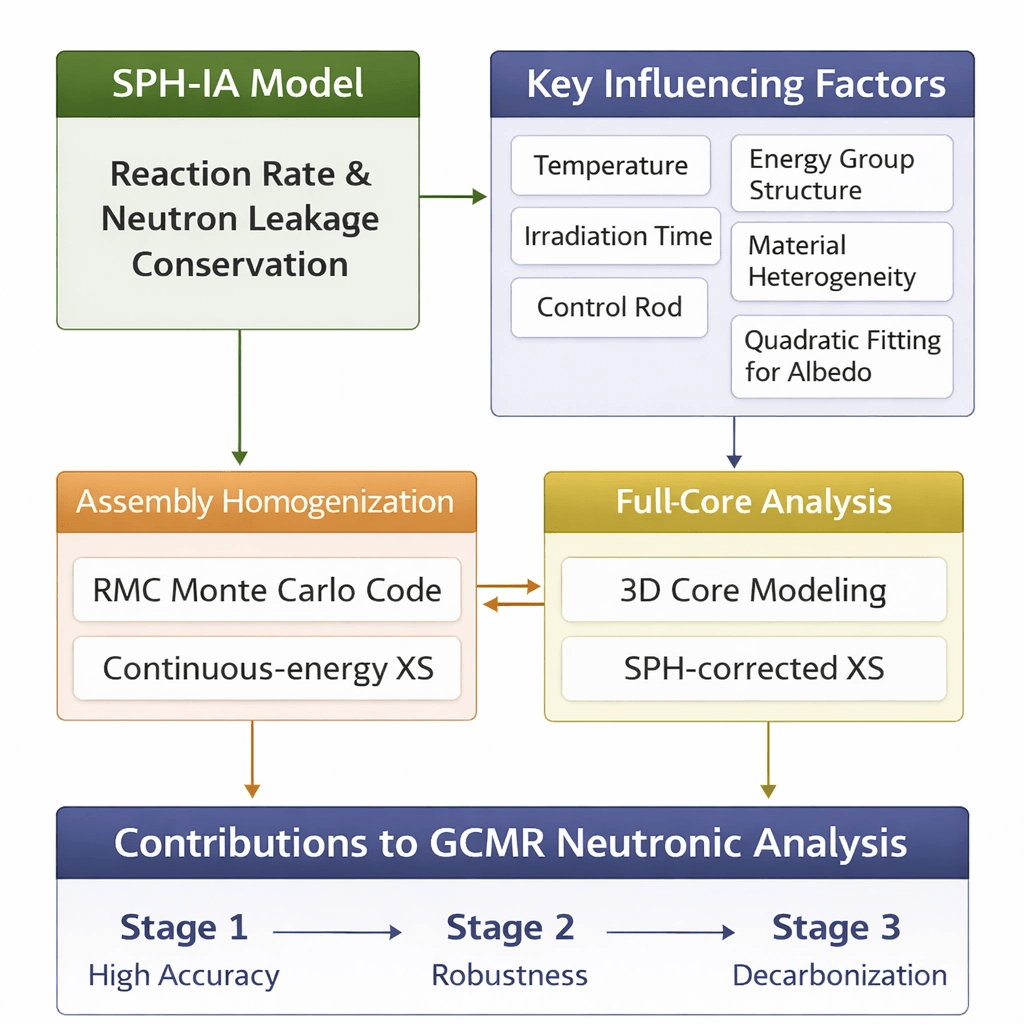
As a promising solution to the challenges of future clean and reliable energy supply, the Gas-Cooled Micro-Reactor (GCMR) has attracted increasing attention due to its potential for decentralized power generation, carbon-free operation, and flexible deployment in remote or extreme environments. As a novel reactor concept, the GCMR offers advantages such as compact size, inherent safety, and high thermal efficiency. However, conventional core calculation methods face significant challenges due to the complex geometric configurations, heterogeneous material distribution, and pronounced neutron leakage characteristics of the GCMR. This study proposes a diffusion-based homogenization method for GCMR analysis. First, the Monte Carlo code RMC is employed to perform assembly-level homogenization and tally the few-group cross sections of representative assemblies. These cross sections are then corrected using the Super Homogenization (SPH) method to preserve reaction rate consistency. Subsequently, the Iterative Albedo (IA) procedure is applied to obtain accurate albedo values, thereby ensuring conservation of neutron leakage. Finally, the diffusion code, incorporating the SPH-IA method, is utilized to perform full-core GCMR analysis. Numerical results demonstrate that employing a 25-group energy structure with the SPH-IA method produces results in good agreement with reference Monte Carlo values, while maintaining high computational efficiency across a range of conditions—including varying energy group structures, temperatures, irradiation time, and control rod insertion ratios. Furthermore, a quadratic fitting function for albedo as a function of operational parameters is developed, providing a feasible and accurate approach for the core design and neutronic analysis of GCMR.Graphic Abstract
Keywords
Currently, research on Gas-Cooled Micro-Reactor (GCMR) worldwide remains predominantly at the conceptual design stage [1,2]. In the field of GCMR core physics analysis, Monte Carlo codes are primarily employed for one-step full-core simulations due to their high computational accuracy and the capability to model complex geometries with high fidelity. However, as research advances, there is an increasing demand for extensive core design evaluations and state condition analyses. The inherently low computational efficiency of one-step Monte Carlo simulations limits their practicality for such large-scale parametric studies. Consequently, developing a high-accuracy, computationally efficient methodology tailored to GCMR systems is of significant importance. Unlike conventional Pressurized Water Reactor (PWR), GCMR exhibit distinct neutronic characteristics. Their compact core size, use of graphite as moderator, and employment of TRISO fuel result in pronounced anisotropic scattering and increased neutron leakage. Furthermore, the wide-spectrum neutron energy distribution intrinsic to GCMR designs introduces additional complexity in modeling resonance self-shielding and environmental effects [3]. These factors render the traditional “two-step” approach, commonly used for PWR analysis [4], inadequate in meeting the required computational accuracy for GCMR applications.
In recent years, the Super Homogenization (SPH) method has been integrated into the conventional “two-step” approach, originally proposed by Kavenoky in the 1970s [5]. Subsequently, Hebert introduced a novel correction strategy to reformulate the SPH algorithm in the DRAGON5 code [6]. Results demonstrate that the SPH method achieves high accuracy in core calculations by preserving reaction rate conservation and mitigating spatial homogenization errors [7]. Consequently, it has been widely adopted for generating few-group cross sections used in core simulation codes. For example, Tatsumi applied the SPH method to optimize homogenized few-group cross sections in PWR calculations using the AEGIS/SCOPE2 code [8]. Furthermore, several notable investigations [9] have successfully employed Monte Carlo codes to generate SPH-corrected few-group cross sections for PWR core analyses, offering improved computational accuracy and enhanced geometric fidelity. Recently, the SPH method continues to be widely adopted in the analysis of emerging reactor types, such as Sodium-cooled Fast Reactor (SFR) [10], Small Modular Reactor (SMR) [11], and Heat Pipe Micro-Reactor (HPMR) [12]. However, certain limitations have been identified in the application of the SPH method. The traditional SPH approach neglects the conservation of neutron leakage. Under vacuum boundary conditions, the iterative process for determining SPH factors may fail to converge, leading to significant errors in the calculation of effective multiplication factor. To address this issue, Yamamoto proposed an improved SPH method that incorporates assembly discontinuity factors to adjust the SPH factors [13]. Zhang et al. further enhanced the method by integrating the update of assembly boundary albedo into the SPH calculation process, enabling the computation of leakage-dependent SPH factors [14]. Building upon the Albedo-corrected Parameterized Equivalence Constants (APEC) method introduced by Jang and Kim [15], Jeong et al. developed a novel leakage correction technique termed Generalized Equivalence Theory Plus SPH (GPS) [16]. The GPS method introduces a cross-section-dependent SPH factor parameterized by pin-wise leakage information. More recently, Wang et al. proposed the Leakage Corrected SPH (LC-SPH) method, which corrects neutron leakage by adjusting the few-group absorption cross sections [17].
In summary, most of the above improvements effectively enhance the accuracy of SPH-based methods but remain primarily focused on PWR systems with simplified two-group energy structures. These approaches, while successful in conventional reactors, are not directly applicable to GCMR due to their distinct neutronic characteristics and broader neutron energy spectrum. Therefore, this paper proposes a Monte Carlo-diffusion “two-step” method alongside an optimized energy group structure specifically tailored for GCMR analysis. By employing Monte Carlo codes to generate homogenized assembly cross sections under various energy group structures, the SPH-corrected cross sections, albedo, and optimized energy group structures for GCMR are obtained through an iterative process within the diffusion code.
The structure of this paper is organized as follows. Section 2 presents the theoretical model of the SPH method. Section 3 provides the numerical results and analysis of the SPH method applied to GCMR. Finally, the conclusions are summarized in Section 4.
2.1 Assembly Homogenization and Group Condensation
The conventional two-step reactor analysis involves two distinct procedures: a two-dimensional lattice transport calculation and a three-dimensional global core diffusion calculation. In the first step, heterogeneous fuel assemblies are analyzed using a high-fidelity multi-group neutron transport method. In the second step, the resulting homogenized few-group cross sections are applied to the full-core three-dimensional neutron diffusion calculation. The accuracy of the global 3-D reactor analysis thus critically depends on the fidelity of the few-group cross section generation process, including both assembly homogenization and energy group condensation.
The steady-state neutron transport equation is given in Eq. (1):
where
Currently, Eq. (1) is primarily solved using either Monte Carlo methods or deterministic approaches. Among the key challenges affecting the accuracy of deterministic solutions is the treatment of the resonance self-shielding effect. While extensive research has been conducted on resonance self-shielding in PWR, studies focused on GCMR remain limited. To address this, the present study employs a Monte Carlo method with continuous-energy cross sections and high-fidelity geometric modeling to solve Eq. (1). This approach enables the accurate determination of heterogeneous nodal cross sections for GCMR, thereby improving the reliability of subsequent diffusion-based analyses.
Once the transport solution is obtained for each heterogeneous nodes, the few-group cross sections for heterogeneous nodes are determined in the following way:
where x is the type of cross section, including transport, absorption, neutron production, kappa-fission cross sections, fission spectrum, and scattering matrix; g is the few energy group number.
In general, the flux-volume weighted homogenization method is a traditional way to generate the homogenized assembly cross sections. The homogenized assembly cross sections of the target region are calculated by the following equation:
where i is the homogenized assembly region.
However, Eq. (3) involves several approximations. First, it only considers the preservation of reaction rates, while neglecting the effects of neutron leakage. This omission can introduce significant errors, particularly in small reactors with strong leakage characteristics, such as those with inserted control rods. Second, it assumes that the integral value of the neutron flux within the target region remains unchanged before and after homogenization:
In conventional two-step reactor analysis, the homogenized cross sections generated by Monte Carlo codes are directly applied in the diffusion core calculation. However, when only the homogenized cross sections and diffusion coefficients are used in the diffusion code, Eq. (4) cannot be preserved. To address this issue and improve computational accuracy, the SPH method has been developed, as expressed in the following equation:
where
Inserting Eqs. (6) in (5), we obtaining the following:
Eq. (7) demonstrates that the reaction rate in assembly region i, obtained from a heterogeneous calculation using a Monte Carlo code, can be preserved in the corresponding homogeneous calculation performed with a diffusion code. However, the traditional SPH method neglects the conservation of neutron leakage, which may cause non-convergent solutions under certain conditions—such as varying energy group structures and strong neutron leakage—particularly when vacuum boundary conditions are applied, as commonly encountered in SMR analyses. Moreover, even if convergence is achieved under these circumstances, the lack of neutron leakage preservation can introduce substantial relative errors in the calculated eigenvalue.
2.3 SPH-Based Iterative Albedo Method
To address the limitations of the traditional SPH method—specifically, its neglect of neutron leakage and the resulting non-convergence of SPH factors under vacuum boundary conditions—this paper proposes the SPH-based Iterative Albedo (SPH-IA) method. The core concept of the SPH-IA method comprises two key steps: (1) The traditional SPH method is first applied to preserve reaction rates, generating SPH-corrected few-group cross sections for homogenized assemblies. (2) Using these SPH-corrected cross sections along with a reference eigenvalue, a diffusion code iteratively searches for an accurate albedo, thereby ensuring conservation of neutron leakage.
The effect of neutron leakage on assembly homogenization is incorporated through albedo information at assembly surfaces. Notably, the albedo can be explicitly derived using the diffusion approximation. The albedo equation is presented below:
where
However, accurately obtaining neutron current using Monte Carlo methods remains challenging [18], and research on neutron current calculations specifically for GCMR systems is limited. Even when an accurate albedo is derived from Monte Carlo simulations, inconsistencies arise when applying it within diffusion codes due to fundamental differences in how neutron current is represented in these two approaches. Consequently, albedo values obtained from Monte Carlo codes cannot be directly applied in diffusion codes.
To obtain the accurate albedo for the diffusion code, the SPH-IA method is employed, which is rooted in the Nelder-Mead method. The Nelder-Mead method, an algorithm designed to locate the minimum value of a function, is particularly advantageous for functions that are non-differentiable or involve complex derivative calculations. The core objective of SPH-IA is to determine an albedo that minimizes the discrepancy between the keff values from the diffusion code and the Monte Carlo code. The detailed steps of the SPH-IA method are given as followed:
(1) Obtaining the SPH-corrected few-group cross sections
(1.1) Initialize SPH factors
All the SPH factors are set to 1 for all of the assemblies in GCMR:
(1.2) Flux normalization
Because the flux unit is different between the Monte Carlo code and diffusion code, the flux of diffusion code should be normalized, which is shown in the following:
(1.3) SPH factor calculation and few-group cross section correction
Once the normalized flux of diffusion code is given, the SPH factor for different energy groups and assemblies are generated:
Then, the few-group cross section for different energy groups and assemblies can be corrected:
(1.4) Determining the convergence of SPH factor
Calculate the relative error between the SPH factor obtained from the previous iteration and the current SPH factor using Eq. (17):
where n is the iteration number; ε is the convergence tolerance.
If Eq. (17) does not converge, the Eq. (18) is used to update SPH factor and returning to Step 1.2 for iterative computation until Eq. (17) converges:
(2) Iterative albedo calculation based on the Nelder-Mead method
(2.1) Formulate implicit function
The implicit function is defined by Eq. (19), where the accurate albedo corresponds to the minimum of
where
(2.2) Initialize albedo value
Define the initial albedo:
Run diffusion code in initial albedo to generate keff value and objective function
(2.3) Sorting and reflecting albedo point
Sort α values by
(2.4) Expansion or contraction
If
If
Then, replace the
(2.5) Convergence check
There are three convergence criterion:
(a) Maximum iteration number = 100;
(b)
(c)
where n is the iteration number.
Stop the iteration once any of the three convergence criteria mentioned above is satisfied. Otherwise, return to Step (2.3) for further iterative computations. Furthermore, the Nelder-Mead method can be achieved by Python function (from scipy.optimize import minimize).
In general, the whole calculation scheme for SPH-IA method is given in Fig. 1, and the summary of the iterative procedure of the SPH-IA method is given in Table 1.

Figure 1: The whole calculation scheme for SPH-IA method.

The selected GCMR in this study adopts an integrated and compact design, using helium as the coolant. The reactor core employs dispersed TRISO-coated particle fuel with a SiC matrix, which offers excellent high-temperature resistance, strong radionuclide retention, and a high level of inherent safety. The core is designed as a horizontal, small-scale, modular prismatic high-temperature gas-cooled reactor. Six control rods are arranged around the outermost layer of the core, as illustrated in Fig. 2.

Figure 2: The geometry structure of GCMR.
This study employs the Nodal Expansion Method (NEM) [19,20] with assembly-level homogenized geometry for core diffusion calculations. To evaluate the accuracy and applicability of the SPH-IA method, this study conducts tests with respect to four key parameters: energy group structure, temperature, irradiation time, and control rod insertion ratio. The detailed description of these parameters is provided in Table 2. Furthermore, the Monte Carlo simulation results are obtained using the RMC [21] code, while the diffusion calculation results are generated using the in-house diffusion code. For the Monte Carlo simulations, the calculation conditions are as follows: 100,000 particle histories per cycle, 50 inactive cycles, and 500 active cycles. The average statistical uncertainty of the assembly power distribution and cross sections is less than 0.003, which is considered acceptable for this study. Moreover, there are three different types of few-group cross section libraries used in diffusion code: (1) w/o SPH: The few-group cross section is directly developed by the assembly homogenization cross section from RMC; (2) SPH: The few-group cross section is only corrected by the SPH factors; (3) SPH-IA: The few-group cross section is corrected by the SPH factors, and the albedo is generated by the Nelder-Mead method in Section 2.3. Furthermore, the albedo of 0.5 is used in w/o SPH and SPH methods.

3.2 Energy Group Structure Verification
To investigate the influence of different energy group structures, the detailed parameters of the energy group structures are provided in Reference [22]. In this section, the operational conditions are set as follows: a temperature of 900 K, a irradiation time of 0 days, and a control rod insertion ratio of 0%. The energy group structures used in the calculations are summarized in Ref [11]. The primary objective of this study is to achieve rapid simulation of GCMR. Given the high computational efficiency of neutron diffusion code, this work focuses on investigating energy group structures suitable for core diffusion calculation in GCMR, aiming to balance computational accuracy and efficiency. Moreover, the expression of RMSE (Root Mean Square Error) is derived below:
where N is the total number of fuel assemblies; Pcalc is the power distribution of diffusion code; Pref is the power distribution of RMC code.
Tables 3–5 present the results obtained from different energy group structures using various methods. Fig. 3 illustrates the relative errors in power distribution for different energy group structures across these methods. The results indicate that as the number of energy groups increases, the calculation outcomes progressively converge toward the reference values; however, the number of iterations and computational time also increase correspondingly. By comprehensively analyzing the relative deviations in power distribution alongside the trends in keff deviations across methods, the 25-group structure is identified to offer an optimal balance of high calculation accuracy and computational efficiency. Compared to the 69-group structure, the relative deviations of keff values for the 25-group structure across the three methods remain within 100 pcm, while the relative deviations in power distribution are within 0.5%. Notably, the computational time for the 25-group structure is reduced by a factor of 7.6 times compared to the 69-group structure.


Figure 3: Relative error of power at different energy group structures for various methods: (a) w/o SPH; (b) SPH; (c) SPH-IA.
Furthermore, when the influence of the SPH factor is neglected, the relative deviation of the keff value for the 25-group structure reaches 863 pcm, and the relative deviation of the power distribution exceeds −2%. By applying the traditional SPH method, which accounts for reaction rate conservation, the relative deviation of keff for the 25-group structure reduces significantly to −3 pcm, and the relative deviations in power distribution remain within 1%. With the SPH-IA method, which incorporates both reaction rate and neutron leakage conservation, the keff deviations across 4 to 69-group structures are all within 1 pcm, the power distribution deviations for the 25-group structure remain within 1%, and the computational efficiency is comparable to that of the traditional SPH method, demonstrating both high accuracy and efficiency.
To validate the effect of temperature across different methods, the analysis employs a 25-group energy structure, a irradiation time of 0 day, a control rod insertion ratio of 0%, and temperatures selected from Table 1. Figs. 4 and 5 show the results and relative error of keff and power at different temperatures for various methods. The results demonstrate that neglecting the SPH factor can induce an overestimation of over 800 pcm in keff and a discrepancy exceeding −2% in power distribution. For the SPH and SPH-IA methods, the relative deviations in power distribution are both within 0.5% due to the realization of reactivity conservation. Notably, SPH-IA achieves leakage conservation, resulting in a relative deviation of the keff value within 1 pcm, whereas the keff of the SPH method remains within 200 pcm.

Figure 4: Results and relative error of keff at different temperatures for various methods: (a) keff; (b) Error.

Figure 5: Relative error of power at different temperatures for various methods: (a) w/o SPH; (b) SPH; (c) SPH-IA.
3.4 Irradiation Time Verification
To validate the effect of temperature across different methods, the analysis utilizes a 25-group energy structure, a temperature of 1000 K, a control rod insertion ratio of 0%, and irradiation time selected from Table 1. Figs. 6 and 7 present the results and relative errors of keff and power at different irradiation time for various methods. The results indicate that neglecting the influence of the SPH factor can introduce a relative error exceeding 800 pcm for keff and over −3% for power. For the SPH and SPH-IA methods, the relative deviations in power distribution are both within 0.5%, due to the realization of reactivity conservation. However, the SPH method disregards neutron leakage conservation, which can introduce an error of over −150 pcm for keff. This suggests that the albedo in the GMCR model differs in the burnup calculation. By adopting the albedo of the SPH-IA method, the relative error in keff is reduced to within 1 pcm.

Figure 6: Results and relative errors of keff at different irradiation time for various methods: (a) keff; (b) Error.


Figure 7: Relative error of power at different irradiation time for various methods: (a) w/o SPH; (b) SPH; (c) SPH-IA.
3.5 Control Rod Insertion Ratio Verification
To evaluate the impact of control rod insertion ratios across different methodologies, the analysis employs a 25-group energy structure, a temperature of 1000 K, a irradiation time of 0 days, and control rod insertion ratios selected from Table 1. Figs. 8 and 9 present the keff and power distribution results, along with their relative errors, for each method at varying control rod insertion ratios.

Figure 8: Results and relative errors of keff at different control rod insertion ratios for various methods: (a) keff; (b) Error.

Figure 9: Relative error of power at different control rod insertion ratios for various methods: (a) w/o SPH; (b) SPH; (c) SPH-IA.
The results reveal that ignoring the SPH factor introduces substantial errors, exceeding 1700 pcm in keff and −45% in power. This demonstrates that control rod insertion significantly affects the accuracy of keff and power calculations in the GMCR.
Both the SPH and SPH-IA methods maintain power distribution deviations within 1%, as they preserve reactivity conservation. However, the SPH method fails to account for neutron leakage conservation, leading to an additional error surpassing −300 pcm in keff at a 33.34% control rod insertion ratio. This discrepancy arises because the GMCR model applies different albedo conditions in control rod simulations, with the keff error following a quadratic trend. By adopting the SPH-IA albedo correction, the relative error in keff is reduced to within 1 pcm.
3.6 Albedo Analysis in SPH-IA Method
Fig. 10 illustrates the albedo for the SPH-IA method in various cases based on 25-groups structure. The calculation results show that the albedo exhibits minimal variation with irradiation time, while following a quadratic function relationship with both increasing temperature and control rod insertion fraction. Consequently, the albedo at irradiation time is selected as the albedo at 0 day. The albedo as a function of temperature and control rod insertion ratio is represented by a quadratic function, with R2 values of 0.935 and 0.982, respectively. Eq. (8) demonstrates that the albedo is closely related to the neutron leakage rate at the core boundary. Regarding temperature effects, a temperature increase causes doppler broadening of the neutron absorption cross section, leading to increased neutron leakage at the boundary and consequently a decrease in albedo. In terms of irradiation time, since irradiation time variation primarily affects the neutron flux within the core while having minimal impact on the neutron flux at the reflector boundary, the change in albedo with irradiation time remains limited. As for control rod insertion fraction, when control rods are fully inserted into the core, the number of neutrons absorbed at the boundary increases, reducing leakage and thus increasing albedo. Conversely, when control rods are partially inserted at intermediate positions, significant axial heterogeneity occurs in the core, resulting in increased leakage at the axial boundaries without control rods and a corresponding decrease in albedo, collectively exhibiting a quadratic variation trend.

Figure 10: Albedo of SPH-IA method in different cases: (a) Temperature; (b) Irradiation time; (c) Control rod insertion ratio.
The SPH-FIT method, a modified version of the traditional SPH method with an albedo fitting function, is verified in this section. Compared to the SPH-IA method based on albedo algorithm search, the SPH-FIT method utilizes two quadratic fitting functions (incorporating temperature and control rod insertion fraction) to characterize the albedo. Its principal advantage lies in the capability to instantaneously obtain albedo data under any operational condition, thereby effectively enhancing the computational efficiency of GCMR simulation workflows. Figs. 11 and 12 display the relative errors of keff and power across different cases for the SPH-FIT method. The results show that the relative error in power remains within 1% for all cases. The relative error in keff stays within 50 pcm for most cases, though there is an error of 124.6 pcm at a control rod insertion ratio of 16.67%. This point corresponds to the interface between the reflector and fuel assembly, where heterogeneous effects can have a significant influence. Additionally, compared to the results from temperature and irradiation time cases, the relatively small difference in albedo for control rod insertion cases can cause a large error in keff.

Figure 11: Relative error of keff at different cases for the SPH-FIT method: (a) Temperature; (b) Irradiation time; (c) Control rod insertion ratio.

Figure 12: Relative error of power at different cases for the SPH-FIT method: (a) Temperature; (b) Irradiation Time; (c) Control rod insertion ratio.
In general, the albedo for GMCR differs significantly from that for PWR and exhibits substantial variation across different temperature and control rod insertion ratio cases, which can be represented by a quadratic function. The SPH-FIT method yields improved accuracy in keff and power calculations across various temperature, irradiation time, and control rod insertion ratio cases.
In this study, a diffusion-based core calculation scheme incorporating the Super Homogenization and Iterative Albedo (SPH-IA) method was developed and applied to the Gas-Cooled Micro-Reactor (GCMR). The methodology leverages high-fidelity Monte Carlo method to generate few-group cross sections, which are subsequently corrected using SPH factors to ensure reaction rate conservation. To address the limitation of traditional SPH methods in handling neutron leakage, an iterative albedo optimization based on the Nelder-Mead algorithm was introduced, enabling accurate boundary current representation in the diffusion model. Comprehensive numerical tests under varying energy group structures, temperatures, irradiation time, and control rod insertion ratios confirm the high accuracy and robustness of the SPH-IA method. Notably, the 25-group energy structure strikes an optimal balance between computational efficiency and solution precision, with keff deviations within 1 pcm and power distribution errors below 1%. Furthermore, a quadratic fitting function was established to parameterize albedo variations, facilitating rapid and reliable core design analysis. The proposed SPH-IA approach demonstrates strong potential for efficient and accurate neutronic analysis of GCMR systems, offering a practical alternative to full-core Monte Carlo simulations in reactor design and safety evaluations. The SPH-IA method serves as the foundation of the GCMR simulation code, capable of providing accurate cross section data under any operational condition. However, its online iterative process incurs significant computational costs when handling core states with multiple varying parameters. To address this limitation, a cross section parameterization method shall be developed based on the sample cross sections generated by the SPH-IA method, enabling rapid interpolation of multi-parameter GCMR cross sections. Beyond methodological contributions, this work also highlights the broader value of GCMR technology: by providing safe, compact, and carbon-free nuclear energy with flexible deployment potential, GCMR can play a pivotal role in enhancing energy security, supporting decarbonization goals, and enabling sustainable power supply in remote or extreme environments.
Acknowledgement: Not applicable.
Funding Statement: This research was supported by the China National Nuclear Corporation Concentrated R&D Project KY19105.
Author Contributions: The authors confirm their contribution to the paper as follows: study conception and design: Xiang Xiao, Peng Zhang; data collection: Zhiyuan Feng, Yuan Yuan; analysis and interpretation of results: Xiang Xiao, Kui Hu, Yuan Xu; draft manuscript preparation: Xiang Xiao; final revision and proofreading: Xiang Xiao, Yunhuang Zhang, Guoming Liu. All authors reviewed and approved the final version of the manuscript.
Availability of Data and Materials: The data that support the findings of this study are available from the corresponding author upon reasonable request.
Ethics Approval: Not applicable.
Conflicts of Interest: The authors declare no conflicts of interest.
References
1. Han WB, Lu Q, Deng J, Huang SF. Generative design of a gas-cooled micro reactor based on multi-physics analysis. In: Proceedings of the 2024 31st International Conference on Nuclear Engineering; 2024 Aug 4–8; Prague, Czech Republic. doi:10.1115/ICONE31-135237. [Google Scholar] [CrossRef]
2. Zhang H, Li Y, Zhao Y, Wang J, Du S, Ma W. Modeling and simulation of a micro gas-cooled nuclear reactor using Modelica. Front Energy Res. 2023;11:1206755. doi:10.3389/fenrg.2023.1206755. [Google Scholar] [CrossRef]
3. Williams ML, Choi S, Lee D. A new equivalence theory method for treating doubly heterogeneous fuel—I: theory. Nucl Sci Eng. 2015;180(1):30–40. doi:10.13182/nse14-68. [Google Scholar] [CrossRef]
4. Galia A, Sanchez R, Zmijarevic I. A dynamic homogenization method for 3D core calculations. Ann Nucl Energy. 2021;160(1):108360. doi:10.1016/j.anucene.2021.108360. [Google Scholar] [CrossRef]
5. Kavenoky A. The SPH homogenization method. Vienna, Austria: International Atomic Energy Agency (IAEA); 1980. No. IAEA-TECDOC-231. [Google Scholar]
6. Ali A, Bacha M, Ali U, Ahmed G, Khan R, Shaukat N. Validation of DRAGON5 and DONJON5 computer codes with CNPGS Unit-3 cycle-1 design calculations. Prog Nucl Energy. 2023;159:104655. doi:10.1016/j.pnucene.2023.104655. [Google Scholar] [CrossRef]
7. Hébert A, Taforeau J, Ingremeau JJ. Application of the sph equivalence technique to the cabri full core in non-fundamental mode. EPJ Web Conf. 2021;247(1):03019. doi:10.1051/epjconf/202124703019. [Google Scholar] [CrossRef]
8. Tatsumi M, Ohoka Y, Endo T, Sugimura N, Tabuchi M, Hyoudou H, et al. Verification and validation of AEGIS/SCOPE2: the state-of-the-art in-core fuel management system for PWRs. In: Proceedings of the 18th International Conference on Nuclear Engineering; 2010 May 17–21; Xi’an, China. p. 9–15. doi:10.1115/ICONE18-29154. [Google Scholar] [CrossRef]
9. Wu Y, Song Q, Feng K, Vidal JF, Gu H, Guo H. Multigroup cross-sections generated using Monte-Carlo method with flux-moment homogenization technique for fast reactor analysis. Nucl Eng Technol. 2023;55(7):2474–82. doi:10.1016/j.net.2023.04.011. [Google Scholar] [CrossRef]
10. Zhang L, Yang W, Shen G, Sun S, Sun S, Jin S, et al. Neutronics comparative analysis of SFR core with Dragon/Donjon and Serpent codes. Prog Nucl Energy. 2026;190(3):105964. doi:10.1016/j.pnucene.2025.105964. [Google Scholar] [CrossRef]
11. Yuan Y, Liu GM, Huo XD. Implementation and comparison of super homogenization method based on Monte Carlo and deterministic codes. In: Proceedings of the 2022 29th International Conference on Nuclear Engineering; 2022 Aug 8–12; Online. doi:10.1115/ICONE29-92520. [Google Scholar] [CrossRef]
12. Xiao P, Luo Q, Xia B, Yao D, Zhou Y, Fang C, et al. Research on few-group cross section generation method for heat pipe microreactor based on monte Carlo code. Nucl Power Eng. 2023;44:266–74. (In Chinese). doi:10.13832/j.jnpe.2023.S2.0017. [Google Scholar] [CrossRef]
13. Yamamoto A, Tatsumi M, Kitamura Y, Yamane Y. Improvement of the SPH method for pin-by-pin core calculations. J Nucl Sci Technol. 2004;41(12):1155–65. doi:10.1080/18811248.2004.9726344. [Google Scholar] [CrossRef]
14. Zhang B, Li Y, Wu H, Zhao W, Fang C, Gong Z, et al. PWR core calculation based on pin-cell homogenization in three-dimensional pin-by-pin geometry. Nucl Eng Technol. 2024;56(6):1950–8. doi:10.1016/j.net.2024.01.002. [Google Scholar] [CrossRef]
15. Jang S, Kim Y. A study of leakage-corrected two-step method based on the nodal equivalence theory for fast reactor analysis. EPJ Web Conf. 2021;247(3):02026. doi:10.1051/epjconf/202124702026. [Google Scholar] [CrossRef]
16. Jeong HS, Oh T, Kim Y. A leakage correction with burnup-dependent GPS method in two-step core depletion analysis. Ann Nucl Energy. 2023;183(3):109624. doi:10.1016/j.anucene.2022.109624. [Google Scholar] [CrossRef]
17. Wang X, Zhuang K, Qiu Z, Wang L, Lu D, Zhang B, et al. Research on reactor core pin-by-pin calculation based on new leakage corrected SPH method. Ann Nucl Energy. 2025;213(2):111150. doi:10.1016/j.anucene.2024.111150. [Google Scholar] [CrossRef]
18. Xiao X, Wang K, Yang TR, Chen YX. Application of homogenization techniques for inflow transport approximation on light water reactor analysis. Nucl Sci Tech. 2022;33(1):7. doi:10.1007/s41365-022-00993-4. [Google Scholar] [CrossRef]
19. Bandini BR. A three-dimensional transient neutronics routine for the TRAC-PF1 reactor thermal hydraulic computer code [dissertation]. University Park, PA, USA: The Pennsylvania State University; 1990. [Google Scholar]
20. Lawrence RD. Progress in nodal methods for the solution of the neutron diffusion and transport equations. Prog Nucl Energy. 1986;17(3):271–301. doi:10.1016/0149-1970(86)90034-X. [Google Scholar] [CrossRef]
21. Wang K, Li Z, She D, Liang J, Xu Q, Qiu Y, et al. RMC-a monte Carlo code for reactor core analysis. Ann Nucl Energy. 2015;82:121–9. doi:10.1016/j.anucene.2014.08.048. [Google Scholar] [CrossRef]
22. Edenius M, Ahlin A. CASMO-3: new features, benchmarking, and advanced applications. Nucl Sci Eng. 1988;100(3):342–51. doi:10.13182/NSE88-A29048. [Google Scholar] [CrossRef]
Cite This Article
 Copyright © 2026 The Author(s). Published by Tech Science Press.
This work is licensed under a Creative Commons Attribution 4.0 International License , which permits unrestricted use, distribution, and reproduction in any medium, provided the original work is properly cited.
 Downloads
 Citation Tools
