
 Login
Login Register
 Submit a Paper
 Propose a Special lssue
 Open Access
ARTICLE

Examining the Sustainable Development Mechanism of Green Growth, Renewable Energy, Information and Communication Technology, and Population in OECD Countries: A Panel Data Analysis
1 School of Economics, Bahauddin Zakariya University, Multan, Pakistan
2 Research Institute for Geo-Hydrological Protection (IRPI), National Research Council (CNR), Perugia, Italy
3 Department of Management, Finance and Technology, LUM University “Giuseppe Degennaro”, Casamassima, Italy
4 ARUCAD Research Centre, Arkin University of Creative Arts and Design, Kyrenia, Northern Cyprus, Turkey
5 Economic Research Center, Western Caspian University, Baku, Azerbaijan
* Corresponding Author: Cosimo Magazzino. Email:
Energy Engineering 2026, 123(5), 22 https://doi.org/10.32604/ee.2026.076916
Received 28 November 2025; Accepted 21 January 2026; Issue published 27 April 2026
 View Full Text
 Download PDF
Abstract
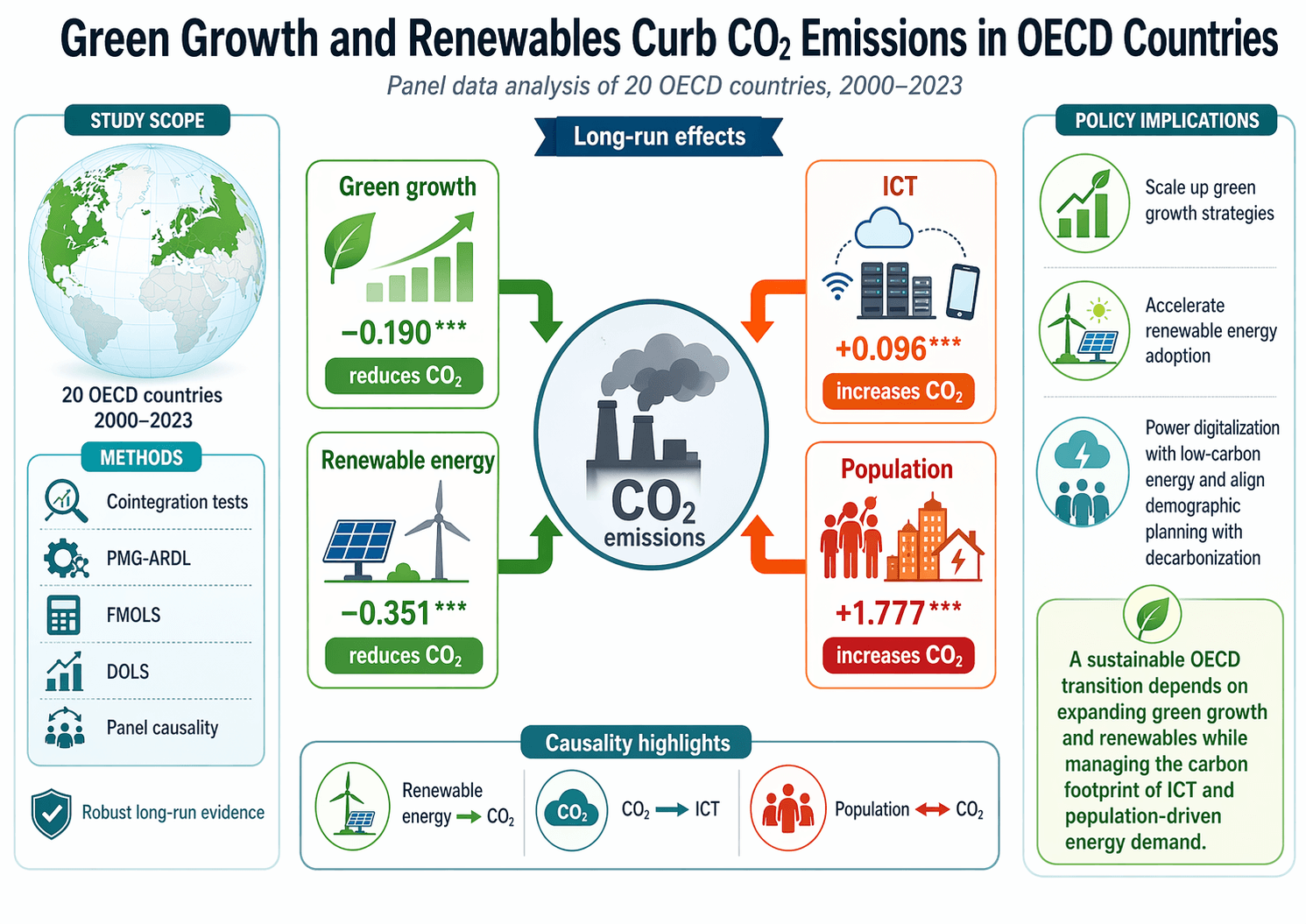
Green growth has revolutionized society by reducing carbon dioxide (CO2) emissions, intensifying energy efficiency, and promoting environmentally friendly technologies and energy utilization, eventually leading to sustainable economic development. However, research on the intricate relationship between green growth and CO2 emissions is limited. This study aims to evaluate the impact of green growth, Information and Communication Technology (ICT), renewable energy, and population on environmental sustainability for a panel of 20 OECD countries from 2000 to 2023. Cointegration regression methods (Fully Modified Ordinary Least Squares, Dynamic Ordinary Least Squares, and Pooled Mean Group-AutoRegressive Distributed Lags) and pairwise panel causality tests are applied. The empirical findings reveal that green growth and renewable energy significantly reduce CO2 emissions, whereas ICT and population growth have a positive impact on CO2 emissions. The study offers significant insights into the long-term relationships among green growth, renewable energy, ICT, and population in shaping CO2 emissions. The study helps policymakers formulate specific strategies to achieve a sustainable environment.Graphic Abstract
Keywords
In recent decades, the frequency of extreme climate events has captured the attention of international organizations, such as the World Meteorological Organization (WMO) and the Organization for Economic Co-operation and Development (OECD), which considered the issue a global risk. These organizations have urged the immediate implementation of environmental strategies to combat ecological destruction [1,2]. Carbon emissions are one of the major contributors to environmental degradation, contributing to 75% of greenhouse gases (GHGs) [3]. In 2020, OECD countries were observed to contribute one-third of global carbon dioxide (CO2) to the atmosphere [4]. Moreover, in the same year, CO2 emissions per person in OECD countries were 8.1 metric tons, accounting for nearly double the global average of 4.5 metric tons per capita [5]. According to the World Health Organization (WHO), it is projected that 250,000 deaths will be caused by climate change annually between 2030 and 2050. Presently, researchers focus on understanding the key drivers of GHGs and CO2 emissions and determining solutions to tackle the harmful impacts on the environment and human life [6].
In 2013, 5.5 million unexpected deaths, or approximately 1 in 10 deaths, were attributed to air pollution, underscoring the severe impact of environmental degradation on human health [7]. To address the harmful consequences of CO2 emissions, the international community proposed multiple charters like the Kyoto Protocol (1997), the Paris Agreement (2015), and the UNFCCC (1992). Many countries are encouraging organizations to achieve carbon neutrality [8]. The continual rise in CO2 emissions and environmental deterioration will become increasingly detrimental to human health and economic sustainability [9]. The UN warns that the disastrous impact of climate change will be significantly more grievous than the COVID-19 pandemic “if the world does not act now” [10].
OECD countries play a significant role in the global economy, making substantial contributions to the world’s economic growth. Most OECD countries contribute significantly to GHG emissions. In particular, CO2 arises from fossil fuel consumption and industrialization. Although OECD countries are highly developed, their level of green growth varies from country to country. Although emissions from high-consumption lifestyles remain a great challenge, OECD countries need to integrate green growth into their development plans.
Green growth refers to promoting economic prosperity while safeguarding natural resources, ensuring a sustainable delivery of resources essential for human well-being. To achieve this goal, countries must catalyze investments and innovations to boost growth and new economic opportunities [11]. Green growth is a quite new phenomenon with various definitions. The United Nations Economic and Social Commission for Asia and the Pacific (UNESCAP) endorsed this concept in 2005, enabling fast-developing Asian countries to explore opportunities for introducing low-carbon sustainable development [12]. The concept of green growth has been endorsed by numerous international organizations, including the UN, as it is viewed as a pillar for sustainable economic growth and environmentally friendly development. Green growth is pivotal in enhancing economic growth by mitigating the hazardous effects of CO2 and preserving the environment for descendants [13,14]. Green growth is considered a pillar of sustainable development, so governments worldwide focus on achieving it. In this regard, environmental taxes provide financial incentives for consumers and businesses, which help reduce demand-based emissions through innovations in the supply chain [15]. While countries around the globe are striving for sustainable and environmentally friendly growth, they must adopt green growth strategies along with eco-friendly technologies. This adoption will lead to cleaner and more sustainable futures (Saleem et al., 2022). Recent global policy changes aimed at reducing CO2. Green growth strategies stimulate economic growth by curbing the threats posed by resource depletion [16].
Recently, Information and Communication Technology (ICT) has become a cornerstone in improving the quality of life and shaping modern society. It plays a significant role in stimulating economic growth across various sectors. However, it has a considerable impact on CO2. Although ICT benefits economic growth, its environmental implications regarding CO2 emissions are addressable. So, it is imperative to acknowledge the role of ICT in reducing environmental damage associated with economic growth [17]. Information and communication technology has affected every aspect of the social and economic sectors. However, it affected consumers, industry, and macroeconomic levels differently. It directly affects electricity consumption, increases CO2 emissions, and indicates a significant advantageous link between ICT and environmental damage [18]. ICT affects the environment in two ways: usage and replacement, which have positive and negative impacts. The manufacturing of ICT equipment and the exploitation of natural resources are outcomes that incorporate usage effects, while energy consumption and e-waste disposal indicate replacement effects. The usage effect gives rise to 2% to 3% of global pollution. The boom in energy use for mobile data circulation and data centers triggers CO2 emissions and threatens future generations [19]. Besides these threats, ICT can also have divergent effects. Traffic surveillance cameras, GPS, and intelligent transportation systems are beneficial in mitigating CO2, as they reduce the need for physical activities [19].
Over the last few decades, environmental pollution has become a great menace to the world. To address the issue of environmental challenges, countries worldwide have a consensus on reducing GHG and CO2 emissions. Fossil fuel consumption significantly contributes to surging temperatures and CO2 emissions levels, eventually leading to the warmest years in history. The world leaders have agreed that they need urgent energy reforms. Meanwhile, solar, wind, and hydro energy sources are becoming increasingly popular and practical solutions for reducing CO2 emissions [20]. The surge in economic prosperity and increased demand for energy are interconnected, leading to heightened competition for natural resources and rising CO2 emissions. The major source of environmental degradation is the manufacturing sector. According to the IPCC, energy-related CO2 emissions are projected to rise by 41% to 109% by 2030 [21]. IEA stated a significant breakthrough: global CO2 emissions from energy consumption remain stable at about 33 billion tons. This was an exceptional achievement, as CO2 emissions have risen for the last two years [22]. Renewable energy is the most effective alternative to fossil fuels and is crucial in achieving sustainability. Investing in renewable sources, such as solar and wind power, can significantly reduce CO2 emissions and contribute to achieving sustainable progress. Moreover, renewable energy is a powerful opportunity to secure a greener future and carbon neutrality [23].
The conversion to renewable sources is a cornerstone in curbing CO2 emissions. The International Energy Agency (IEA) reported that a reduction in coal usage in 2019 resulted in nearly 200 million tons of cuts in global CO2 emissions compared to 2018. Developed countries, such as those in Europe, Japan, and the United States, have achieved extraordinary success in reducing CO2 emissions while maintaining an average Gross Domestic Product (GDP) growth rate of 1.7%. The emission of CO2 reached its lowest level in 2019, although electricity consumption surged three times higher than in 1980 [22]. According to the IEA’s prediction, renewable energy usage is expected to expand from 11% to 15% between 2008 and 2035, ultimately reducing CO2 emissions due to the clean and sustainable nature of renewable energy sources. It is also projected that 70% of global electricity production growth will be based on hydro, solar, wind, and bioenergy [24,25].
Economic development has enhanced life expectancy by improving local healthcare standards and pension systems worldwide. However, the acceleration in the elderly population has greatly challenged many nations, including Japan, Italy, and Portugal. Japan shared an intensive rise in the elderly population, 28% of the total population, and Italy and Portugal shared 23% and 22%, respectively [26]. The growing elderly population affects carbon emissions because age sizes influence economic activities and lead to energy-intensive industries. The Sustainable Development Goals (SDGs), particularly SDG 8, emphasize employment, while SDG 10 focuses on eradicating age-related barriers. Both goals support these demographic changes. Numerous earlier studies have focused on the relationship between the aging population and economic progress; however, recent research is now examining how other aspects of aging, such as health and social care, impact carbon emissions. They focus on the repercussions of population size, age distribution, and household relationships on CO2, consequently predicting future CO2 emissions. Aging is a crucial component in economic and environmental models nowadays [27]. Moreover, it is essential to understand the intricate relationship between population dynamics and environmental sustainability. Many factors, along with economic output, influence environmental challenges and demand a deeper understanding of population-driven impacts [28].
The study aims to analyze the impact of green growth and renewable energy on CO2 emissions in 20 OECD countries from 2000 to 2023. CO2 emissions are the dependent variable, while green growth, renewable energy, ICT, and population are the independent variables. Although OECD countries are developed and advanced, their high levels of industry, heavy energy use, and urbanization pose significant environmental challenges. OECD countries significantly contribute to CO2 emissions and highly depend on conventional energy sources. Although OECD countries have adopted advanced renewable sources, the transition is not even across all OECD countries. Moreover, the adoption level of green energy projects varies from country to country. The OECD launched the Green Growth Declaration in 2009 and the Green Growth Strategy in 2011, both of which aimed to motivate countries to adopt policies that promote green growth investment and sustainable resource management practices. The Green Growth Strategy 2011 identified several key sectors that could significantly reduce GHG emissions. Furthermore, the OECD is determined to accelerate clean energy investments. The OECD’s government Budget allocations for Research and Development (R&D) exhibit a strong commitment by OECD countries to encourage innovation in the energy sector.
Several studies analyzed the relationship between green growth and CO2, demonstrating how green growth may combat environmental challenges, i.e., Hao et al. [29], Wei et al. [30], Sadiq et al. [31], Khan et al. [15], and Dam et al. [14]. Several studies have investigated the role of green growth and renewable energy in promoting environmental sustainability in OECD countries. Further studies are required to understand the effect of green growth, renewable energy, population, and ICT on environmental sustainability in OECD countries.
The study aims to fill this research gap by evaluating the impact of green growth and ICT on environmental sustainability in OECD countries. It also examines the effects of green growth, renewable energy, ICT, and population on CO2 emissions in OECD countries. The study contains impactful and multifaceted contributions. Firstly, this research provides an in-depth analysis of the relationship between green growth and CO2 emissions in OECD countries. Research exploring this affinity is often overlooked, especially within OECD countries. Previous studies either focused on a small group of countries or a single country. This research’s observations are crucial in formulating plans to enhance environmental sustainability. Secondly, the use of robust datasets and the application of advanced statistical methodologies make this research superior to previous work. These methodologies significantly boost the reliability of findings when formulating policies. Thirdly, it integrates the mediating part of ICT, demonstrating how digital advancements help reduce environmental degradation. These contributions show how green growth can reduce CO2 in OECD economies.
Moreover, this work translates macroeconomic relationships into actionable guidance for energy engineers and system planners. The results highlight that scaling renewable generation and embedding green growth policies are associated with measurable CO2 reductions, underscoring the importance of coupling variable renewables with storage, grid flexibility measures, and demand-side management to realize their full emissions benefits. Conversely, the positive association between ICT diffusion and emissions in some contexts signals the need for energy-aware ICT design, more efficient data centers, and ICT-enabled optimization (e.g., smart metering and demand response) to avoid rebound effects. Population dynamics further indicate where capacity planning and targeted efficiency retrofits will be most effective. Framing green growth as a portfolio of engineering interventions–renewable integration, energy conversion efficiency, storage deployment, and ICT-driven control strategies–bridges policy and technology, providing a clear roadmap for engineers to design resilient, low-carbon energy systems informed by long-run empirical evidence.
The rest of the paper proceeds with a literature Review and the theoretical framework (Section 2), the materials and methods (Section 3), the results and discussion (Section 4), and finally, the conclusions, policy recommendations, limitations, and suggestions for future studies (Section 5).
The study elucidates how progress in green growth, renewable energy, ICT, and population affects environmental sustainability. Experts have long emphasized the importance of studying established literature to inform and guide better decision-making in the present and future. The world today is struggling to combat the pressing problem of climate change. GHG and CO2 are the key contributors to the climate emergency [32]. Numerous studies have reviewed the various aspects of CO2. Different studies have used various macroeconomic and environmental variables to determine CO2 emissions. Under this heading, we attempted to summarize the existing literature on CO2 causal factors among farmers.
The theoretical framework also plays a significant role in data analysis and adequate decision-making in this study. To explain the subject comprehensively, this study invoked Sustainable Finance and Sustainable Development theories. The study’s ambitious objective was to examine how these theories elucidate the relationship between green growth and a sustainable environment. Fig. 1 illustrates the theoretical framework of this investigation.

Figure 1: Theoretical framework.
The concept of green growth was introduced in South Korea in 2005, prioritizing sustainable development by protecting the environment and reducing CO2 emissions [33]. GG can combat CO2 by implementing renewable energy sources, enhancing energy efficiency, and adopting low-carbon technologies [14]. Moreover, it encourages investment in R&D and innovations. Adopting green growth can facilitate countries’ addressing climate issues as it actively reduces CO2 emissions. The OECD proposed GG as a policy strategy for executing the UN SDGs [34].
Firstly, this study selected Sustainable Finance Theory due to its effective role in achieving a healthy environment in the current era of development and financial transformation. Achieving economic growth without compromising the environment or leaving anyone behind has become crucial [35]. Sustainable Finance Theory considers economic, social, and environmental aspects. It emphasizes long-term and sustainable development and prosperity by practicing green growth strategies [36]. Sustainable Finance Theory promotes investments that align with environmental, social, and governance (ESG) principles. It directs governments to adopt strategies and projects to help improve the environment and the future [37]. This theory supports the 2030 SDGs due to the importance of ESG aspects in informing financial decisions. Secondly, considering the sustainable development theory, this study focuses on adopting renewable energy and supports SDG 7. It advocates for using less imported fossil fuels and switching to renewable energy projects to make the countries more energy-independent. Moreover, this study supports the specific sustainable goals that concentrate on protecting the environment and economic development. It also embodies the concept of green growth, such as utilizing renewable energy, which can help mitigate the harms of CO2 emissions and reduce dependence on fossil fuels. Adopting renewable energy projects in the power sector can also enrich economic growth and stimulate green growth [38].
Sustainable Development Theory provides the overarching normative framework for this study, emphasizing that economic progress should be pursued within ecological limits and with intergenerational equity. The concept is commonly operationalized through the “triple bottom line” (economic, social, and environmental pillars) and the broader sustainable development agenda, which calls for growth pathways that reduce environmental pressures while maintaining welfare and resilience [39–41]. In this perspective, climate mitigation and emissions reduction are not ancillary outcomes but core conditions of development. Accordingly, our IPAT-inspired specification treats CO2 emissions as the environmental “impact” dimension and models how demographic scale (population) and technological/structural factors (green growth, renewable energy, and ICT) shape that impact, consistent with the sustainable development objective of decoupling economic activity from environmental degradation.
Jevons [42] introduced the rebound effect theory in his book The Coal Question, observing that coal efficiency resulted in higher overall consumption rather than preservation. Later, Hilty & Aebischer [43] linked this theory to ICT and presented it in their work on sustainability in the digital economy. They claimed that the higher energy demand in ICT is due to improved energy efficiency. The reverberation of ICT in the environment also depends on the rebound effects of ICT. The rebound effect theory claims that the positive impact of technology can have a reverse impact in the long run. For example, development in ICT leads to cheaper production and causes a hike in demand for these products, ultimately increasing pollution.
Yet, ICT also plays a favourable role in promoting environmental preservation by mitigating the harmful effects of human activities, addressing climate change, and promoting sustainability. ICT can create awareness regarding environmental issues and help predict environmental risks. The effects of population size, density, and urbanization on the environment are a subject for consideration. These demographic changes positively influence freight, food, clothing, shelter, and other basic prerequisites and boost their demands. According to Malthus [44], this phenomenon can lead to increased energy consumption, resource scarcity, and environmental damage. Conversely, a rise in demand for transformational services, shelter, food, and clothing may lead to technological innovations and can improve energy efficiency [45].
This study adopts an integrated theoretical framework that combines Sustainable Development Theory and Sustainable Finance Theory within an IPAT-inspired mechanism to explain cross-country variation in environmental pressure, proxied by CO2 emissions. Sustainable Development Theory provides the overarching objective: economic and social progress should be pursued within ecological constraints, implying that lower carbon intensity and reduced emissions are core components of sustainable development outcomes. The IPAT logic (Impact = Population × Affluence × Technology) offers a parsimonious structure for translating this objective into testable relationships. In line with our empirical specification, we operationalize the “Population” component directly through population size, while the “Technology” component is decomposed into three complementary channels that are central to the green transition: eco-efficiency/productivity improvements (green growth), decarbonization of the energy mix (renewable energy), and digitalization (ICT). Country and time effects absorb persistent cross-country differences and common macro-trends that would otherwise be captured by the affluence term in a fully specified IPAT formulation.
Within this structure, Sustainable Finance Theory provides the main transmission mechanism linking economic systems to environmental outcomes: a financial system that internalizes climate-related risks and reallocates capital toward low-carbon investment reduces the cost of financing green technologies, accelerates clean-energy diffusion, and supports innovation and productivity improvements consistent with green growth. Accordingly, green growth is expected to lower CO2 by improving the joint production of economic output and environmental quality through cleaner production processes, resource efficiency, and innovation (H1). Renewable energy is expected to reduce CO2 by substituting fossil fuels in the energy mix and lowering the emissions intensity of output (H2). ICT affects emissions through two competing mechanisms. The efficiency channel operates via smarter production, dematerialization, optimized logistics, and enabling technologies (e.g., smart grids), which can reduce energy use per unit of output and lower CO2. However, the rebound effect theory implies that efficiency gains and lower effective costs can stimulate additional demand (including ICT-related energy use), potentially offsetting part of the environmental benefit. Given the OECD context–where digital technologies are increasingly coupled with energy-management applications and decarbonization policies–we hypothesize that the net effect of ICT is emissions-reducing, while recognizing that rebound effects may weaken the magnitude (H3). Finally, population growth is expected to increase environmental pressure through scale effects that raise energy demand and emissions, ceteris paribus (H4).
Technological innovations have developed world economies at the cost of environmental degradation [46]. World leaders and organizations recognized the need to promote GG, and as a result. GG is crucial in attaining economic progress with reduced resource depletion [13]. Many countries are focusing on achieving a win-win situation in terms of economic growth; the most feasible solution to attain this goal is green growth.
The interconnection among green growth, population, institutional quality, and CO2 for OECD countries was analyzed by Dam et al. [14]. The outcomes showed that green growth exacerbates environmental degradation, while institutional quality and population growth harm the environment. Lin and Ullah [47] analyzed the link among green growth, energy depletion, and CO2 in Pakistan. The research revealed that green growth mitigates CO2, while energy depletion degrades ecological quality. For the BRICS countries, Wei et al. [30] explored the link among fintech, green growth, and CO2. They found that green finance and green growth reduce CO2. Sadiq et al. [31] scrutinized the affinity among environmental innovation, green growth, FD, and ecological footprint for OECD countries. They found that environmental innovation and green growth minimize the ecological footprint, while financial development enhances it. The nexus among green growth, financial inflow, renewable energy, green trade, and CO2 for the top 10 countries was scrutinized by Wei et al. [48], adopting the CS-ARDL method. The findings disclosed that all variables boost ecological quality. For China, Zhao et al. [49] established the link among green growth, green finance, GDP, energy efficiency, trade, industrial structure, income inequality, and CO2. The outcomes revealed that GDP, trade, and income inequality increase pollution, while energy efficiency, industrial structure, and green growth boost eco quality. Khan et al. [15], for 26 EU countries, asserted the interlink among eco-innovation, green growth, energy intensity, and CO2. They found that green growth and environmental taxes minimize CO2. Saleem et al. [16] studied the link between green growth and CO2 for 12 Asian economies, adopting the CS-ARDL model. The study observed that green growth supports eco-quality.
Similarly, for China, Li et al. [50] inspected the link among industry, FDI, education, and CO2 by adopting the Pooled Ordinary Least Squares (POLS) approach. The research unveiled that GG, industry, and energy efficiency exacerbate air quality; conversely, GDP, education, and urbanization decline environmental quality. Dogan et al. [51] documented the nexus among green growth, energy intensity, and CO2. They found that all variables accelerate ecological quality in 25 countries. For G-7 countries, Hao et al. [29] inspected the link among green growth, renewable energy, environmental taxes, and CO2 from 1991 to 2021. The outcomes highlight that human capital, environmental taxes, and green growth boost environmental quality; conversely, renewable energy and green growth squares deteriorate the environment.
H1: Green Growth has a significant negative relationship with CO2.
Since the 1970s oil crisis, researchers have concentrated on the transition to renewable energy, which can significantly reduce CO2 emissions. Moreover, renewable energy can potentially improve economic growth without degrading the environment. Energy transition facilitates access to energy for all people, making it more accessible, affordable, and efficient, while also improving environmental sustainability through cleaner energy [52]. A plethora of research has examined the effect of renewable energy on CO2 and observed a negative association between the two.
The interconnection among GDP, globalization, military expenditure, tourism, labor force, renewable energy, and CO2 for North African countries was reviewed by Idroes et al. [53]. The outcomes highlighted that renewable energy, globalization, and the labor force positively improve environmental quality, while GDP, tourism, and military expenditure damage the environmental quality. Employing CS-ARDL, Yadav et al. [23] for BRICS countries documented the relationship among GDP, renewable energy, energy intensity, government effectiveness, and CO2 emissions. They found that government effectiveness, green finance, and renewable energy improve air quality, whereas GDP and energy intensity deteriorate environmental quality. Sadiq et al. [31] found a correlation among renewable energy, corruption, policy uncertainty, and CO2 in BRICS countries, using the CS-ARDL method. They revealed that controlling corruption and promoting renewable energy help clean the environment, whereas GDP growth and policy uncertainty harm the environment. Liu & Han [54] documented the adverse interconnection between renewable energy and CO2 in 30 Chinese provinces. For G-7 countries, Aslan et al. [55] inspected the nexus among GDP, GDP square, patent application, renewable energy, urbanization, and CO2. They showed that GDP square increases CO2, while GDP, renewable energy, and patent applications decrease CO2 emissions.
In the same way, Khan et al. [56] asserted the link among urbanization, broad money, natural resource rent, renewable energy, and CO2 for SAARC nations. The findings concluded that renewable energy improves environmental quality, while natural resources and broad money lower it. For Turkey, over the 1990–2019 period, Mukhtarov [57] examined the correlation among renewable energy, exports, imports, income, and CO2. The ARDL outcomes revealed that renewable energy and exports enhance environmental quality, while income and imports damage it. For 27 OECD countries, Işık et al. [58] documented the link among GDP, GDP squared, mineral rents, renewable energy, internet, and CO2 emissions. They revealed that renewable energy and GDP square lessen CO2, while GDP and the internet enhance environmental pollution. Bergougui [59] employed the Quantile Autoregressive Distributed Lags (QARDL) model to examine the relationships among renewable energy, technological innovation, and CO2 emissions. The verifiable outcomes indicate that renewable energy and trade reduce CO2 emissions, while fossil fuel energy and GDP degradation compromise environmental quality. Mamkhezri & Khezri [60] studied the nexus among GDP, urbanization, trade openness, renewable energy, R&D, and CO2 for 54 countries. The results highlighted that GDP square and renewable energy ameliorate the eco quality. Magazzino et al. [61], studying the Scandinavian countries, found a correlation between renewable energy and CO2 emissions. Magazzino et al. [20] reviewed the link between renewable energy and eco degradation in India, China, and the USA. The findings confirmed that renewable energy reduces CO2.
H2: Renewable energy has a significant negative relationship with CO2.
CO2 is widely recognized as a primary contributor to climate change. There are several determinants of CO2 emissions; among them, one of the most important is ICT, which has a double-edged influence on CO2 emissions. Some scholars argue that ICT and CO2 emissions are positively connected, as the ICT application increases electricity consumption and degrades the environment, because conventional energy sources still generate electricity and emit polluted gases [62]. Conversely, other scholars argued that increased ICT usage improves energy efficiency and reduces environmental harm. Therefore, we can conclude that it is evident that ICT impacts CO2 emissions, but the direction of this impact remains unclear.
Işık et al. [58] identified the link among the internet, mineral rent, and CO2 from 2001 to 2020 for 27 OECD countries. They observed that mineral rent and GDP pollute the environment; in contrast, the internet improves the environmental quality. Ben Lahouel et al. [63] reviewed the relationship among ICT, trade, and CO2 for 16 MENA countries. They found that ICT and GDP reduce CO2 emissions, while trade, GDP, energy consumption, and Foreign Direct Investments (FDI) increase CO2 emissions. From 1980 to 2018, Yahyaoui [17] analyzed the relationship among GDP, ICT, and CO2 in Tunisia and Morocco. They showed that ICT, GDP, and trade have a detrimental impact on environmental quality. Ahmad et al. [64] focused on the link among human capital, ICT, globalization, and CO2, adopting the augmented mean group. The outcomes revealed that ICT and human capital reduce CO2 emissions, whereas globalization accelerates them. Briglauer et al. [18] examined the link among ICT, R&D, corruption, and CO2 from 2002 to 2019 for 34 OECD countries. They found that corruption, urbanization, and education increase CO2, while ICT ameliorates the environment. Islam et al. [19] scrutinized the link among energy consumption, ICT, and CO2, using the Pooled Mean Group (PMG) approach for the Gulf Cooperation Council (GCC) region. The evidence proves ICT and FD increase the eco quality, while energy increases CO2. Naseem et al. [65] studied the link among ICT, agricultural production, and CO2 for BRICS countries, applying the Dynamic Ordinary Least Squares (DOLS) estimator. The results concluded that ICT improves the eco quality; meanwhile, agriculture accelerates CO2.
In addition, Shobande & Asongu [66] examined the relationship among population, education, and CO2 emissions in South Africa and Nigeria. The empirical outcomes revealed that population increases CO2 emissions, and education, income, and life expectancy improve environmental quality in South Africa. For nine selected Asian economies, Usman et al. [67] found a favorable link between ICT and CO2. Faisal et al. [68] for fast-emerging countries, demonstrating the link among financial development, ICT, trade, GDP, and CO2. They observed that trade reduces CO2; conversely, ICT and FD enhance CO2. Raheem et al. [69] explored the nexus among ICT, trade, and CO2 for G-7 countries. The findings highlighted that urbanization and trade minimize CO2, while ICT boosts CO2. Chen et al. [70] revisited the relationship among industry, urbanization, and CO2 emissions in China. The empirical outcomes revealed that ICT and open economies improve the environment, whereas industry degrades ecological quality. From 2001 to 2014, Park et al. [71] found an association among ICT, financial development, GDP, trade, and CO2 in a sample of EU countries. They observed that financial development, GDP, and trade reduce CO2, while ICT degrades environmental quality. From 1990 to 2015, adopting the Augmented Mean Group (AMG) model, Danish et al. [72] stated that ICT enhances CO2.
H3: ICT has a significant negative relationship with environmental sustainability.
Sachan et al. [73] studied the interconnectedness among population, industrialization, and CO2 by employing the Fully Modified Ordinary Least Squares (FMOLS) approach for BRICS countries. They found that the population damages the ecological quality. Guo et al. [74] uncovered the link among population, industry, and CO2 for China. They reported that population and GDP increase CO2. Rehman et al. [75] focused on the nexus among population, food production, energy utilization, and CO2 in Pakistan. They showed that population growth, GDP, and energy damage environmental quality, while food production reduces CO2. For OECD countries, Yang et al. [27] explored the connection among population aging, economic growth, and CO2 from 1971 to 2016. FMOLS outcomes indicate that population aging, GDP per capita, and economic globalization reduce CO2. Wang & Li [28] studied the link nexus among population, urbanization, and CO2 for 154 countries. The results clarified that the population accelerates emissions. Rahman & Alam [76] for Bangladesh identified the connection among population density, technology, affluence, urbanization, trade, and CO2. The results uncovered that clean energy reduces CO2; however, trade, urbanization, and population degrade the environmental quality.
Similarly, Khan et al. [77] asserted the link among population growth, renewable energy, and CO2 for the USA from 1971 to 2016. The empirical outcomes disclosed that the population enhances CO2. de Souza Mendonça et al. [78] documented the connection among population, GDP, and CO2 for the 50 largest economies. They concluded that population degrades eco quality, while renewable energy decreases CO2 emissions. For SAARC countries from 1994 to 2013, Anser et al. [79] identified the nexus among population size, urbanization, and CO2 emissions. They found that GDP and population size deteriorate the ecological quality. Zhang et al. [80] documented the relationship among population, GDP, energy intensity, urbanization, industrialization, and CO2 emissions in China. They disclosed that the population enhances CO2. Yu et al. [81] analyzed the correlation between population and CO2 in China. The outcomes showed that energy intensity reduces CO2 emissions, while industrial structure and population aging negatively affect environmental quality.
H4: Population has a significant negative relationship with environmental health.
Table 1 reports a literature overview.

The aforementioned literature review encompasses various studies that examined the impact of green growth on CO2 emissions across multiple scopes. In light of this review, the first research gap is that no study in the literature has unveiled the effect of green growth on CO2 emissions for 20 OECD countries by applying the Pooled Mean Group-AutoRegressive Distributed Lags (PMG-ARDL) method. Another research gap is that no study has examined the impact of green development and renewable energy on CO2 emissions. The study’s outcomes are helpful for OECD countries in meeting SDG 7 and SDG 13 [82].
3.1 Data Sources and Descriptions
This study employs panel statistical methods, yielding yearly data series for green growth (GG), ICT, renewable energy (RNE), population, and CO2 emissions among OECD states from 2000 to 2023. The dependent variable is CO2, measured in kilotons (kt). Moreover, the independent variables include GG (environmentally adjusted multifactor productivity growth), ICT (fixed broadband subscriptions per 100 people), population (aged 15–64), and renewable energy consumption (% of total final energy consumption). The log-transformation of each variable has been applied. Data sources for all variables are from the World Bank Indicators [83], except for GG, which is sourced from the OECD database. The sample comprises the following 20 OECD countries: Australia, Austria, Belgium, Canada, Denmark, Finland, France, Germany, Greece, Hungary, Italy, Japan, the Netherlands, Norway, Portugal, Sweden, Switzerland, Türkiye, the United Kingdom, and the United States.
The analysis focuses on 20 OECD countries over 2000–2023 because a complete, overlapping time series for all core variables (especially the OECD environmentally adjusted multifactor productivity indicator) is not available for the full OECD membership. Therefore, a balanced panel is constructed to avoid shifts in country coverage over time that could confound cross-country comparisons and dynamic estimates. Excluded OECD members are omitted solely due to data unavailability or insufficient time coverage in one or more key variables. This choice may limit external validity to OECD countries with complete data; however, it does not reflect outcome-based selection.
The selection of variables is grounded on the following aspects. Firstly, the rationale for the link between green growth and environmental sustainability lies in how green growth enhances economic prosperity while ensuring environmental sustainability. This framework examines how economies can benefit from an economic upswing without compromising ecological health. Green growth can minimize resource depletion, saving the environment from degradation. Therefore, the relationship between green growth and CO2 emissions has been outlined by prior studies.
Secondly, the association between renewable energy and CO2 emissions is one of the most important relationships because RNE is crucial in mitigating CO2. Analyzing this relationship helps introduce how RNE sources can affect environmental sustainability. RNE sources have much lower carbon emissions than fossil fuels. Transitioning to renewable projects through greener economic models can safeguard countries from harmful environmental challenges [84]. Thirdly, numerous previous studies have examined the relationship between ICT and environmental sustainability. ICT has dual effects on environmental sustainability. ICT can significantly impact environmental health by enhancing energy efficiency and supporting digital innovations. On the other hand, it may lead to an increase in energy demand.
Lastly, the connection between population (POP) and CO2 has many facets. Substantial changes in population size and composition can negatively impact environmental health [74]. An increase in population leads to higher energy consumption, increased land use, and greater waste generation; therefore, examining this complex relationship may help in understanding how CO2 emissions function.
Environmentally Adjusted Multifactor Productivity (EAMFP) growth is adopted as the baseline proxy for green growth because it captures the productivity/eco-efficiency dimension of the green transition in a way that is conceptually aligned with “decoupling” and empirically suitable for cross-country macro-panel analysis. EAMFP is part of the OECD Green Growth headline indicator set and extends standard multifactor productivity by embedding environmental pressures directly into a growth-accounting framework: it measures the residual change in productivity in the joint production of desirable output (income/value added) and undesirable by-products (e.g., emissions), while also accounting for the use of factor inputs, including natural capital. In practical terms, positive EAMFP growth indicates that an economy is improving its capacity to generate economic output from a given bundle of inputs while reducing (or more efficiently managing) environmental burdens—i.e., an outcome-based measure of eco-efficiency improvements consistent with green growth objectives. Importantly, using the OECD EAMFP series also ensures harmonized definitions, consistent methodology, and comparability across OECD countries and over time, which is essential for the long-span panel setting of this study.
The basic econometric strategy is pivoted on the four statistical checks. Firstly, we examine the possibility of cross-sectional dependence using a test developed by Pesaran [85]. Secondly, we applied the Pesaran & Yamagata [86] test to explore the homogeneity among variables. The outcomes of these two steps determined whether the first- or second-generation unit root and cointegration tests can be applied. For stationarity, we applied second-generation unit root tests (Cross-sectionally augmented Im, Pesaran, and Shin (CIPS) and Cross-section Augmented Dickey-Fuller (CADF)). Lastly, we employed the Westerlund (2007) cointegration test to determine the long-term association between the variables. The PMG-ARDL method analyzes the long- and short-term relationships within a panel dataset. It is a flexible and reliable method for estimating mixed Panel data models. When operating the panel data, PMG-ARDL attracts attention as a strong and flexible approach.
This method was selected due to its advantages, which aligned with the study goals. First, this technique demonstrates flexibility for various short-term behaviors, extending beyond countries and organizations, as long as comparable long-term relationships are maintained. This unique property enables us to capture each group’s distinctive short-term patterns and a broader picture of long-term trends. Secondly, PMG-ARDL decouples long-term and short-term trends, unlike conventional methods that frequently combine the two. Thirdly, PMG-ARDL handles the real-life research issues of small sample sizes and unstable data. Moreover, PMG-ARDL employs appropriate lags of dependent and independent variables, thereby reducing the endogeneity problem. Additionally, it handles cross-sectional dependence. Although PMG-ARDL is an advanced and rigorous method, it is user-friendly; therefore, policymakers and researchers can easily gain the provided insights without requiring extensive technical knowledge.
Given the mixed integration orders identified by CIPS/CADF test (I(0) and I(1), with no I(2) variables), PMG-ARDL is adopted as the baseline estimator because it accommodates I(0)/I(1) mixtures within an error-correction framework and jointly delivers long-run elasticities and heterogeneous short-run dynamics (including the speed of adjustment) across OECD countries. FMOLS and DOLS are reported as complementary robustness checks for long-run coefficients, but they do not model the adjustment process and short-run heterogeneity that are central to our mechanism-based interpretation.
To start the analysis, we utilize the IPAT model, which evaluates the significance of factors that influence environmental health. Here, we consider environmental impacts by (I), variation in population by (P), affluence (A), and technology (T).
Ehrlich & Holdren [87] presented a model to describe the impact of human activities on the environment. The IPAT model considers population, affluence, and technology as the three major contributors to CO2 emissions (see Fig. 2). They claim that increasing population size, affluence, and technology influence carbon emissions, particularly in economic activities that utilize environmentally damaging technologies. Furthermore, York et al. [88] supported the same phenomenon and confirmed the fluctuating effects of population, urbanization, technology, and wealth on the environment. The expansion of urban areas indicates the share of consumer markets, urban population, and industrial structure.

Figure 2: IPAT model.
Based on the IPAT model, the econometric equation for the present study is given in Eq. (2)
Since the ARDL approach is unable to check for bias in panel dataset models due to the linkage between the white noise term and the mean-differenced independent variables, this study employed PMG and ARDL in combination to address this issue. The revised PMG-ARDL model is given in Eq. (3).
4 Empirical Results and Discussion
Table 2 displays the explanatory data analysis. The population has the highest mean, maximum, and median values, while CO2 shows the lowest values. Jarque-Bera test results confirm that all variables are normally distributed. CO2, green growth, and population are positively skewed, while renewable energy and ICT are negatively skewed. The findings of the correlation analysis are also displayed in Table 2. CO2 emissions are adversely related to renewable energy and ICT. Similarly, green growth has a negative link with renewable energy and ICT but a positive association with population. Moreover, renewable energy has a positive association with ICT but a negative association with the population.

4.2 Cross-Sectional Dependence and Unit Root Tests
The cross-sectional dependence test findings are presented in Table 3.

The findings of the CIPS test are displayed in Table 4, revealing that CO2, population, and green growth are stationary at the first difference, while RNE and ICT are level-stationary. According to CADF results, ICT, population, and green growth are stationary at the level, while CO2 and RNE are first-difference stationary.

Pesaran & Yamagata [86] slope homogeneity test evaluates whether slope coefficients are homogeneous or heterogeneous. This test is implemented because OECD countries have different economic structures and environmental policies. The Delta and adjusted Delta test results in Table 5 are found to be significant at a 1% level, which strongly rejects the null hypothesis.

A battery of cointegration techniques, such as the Pedroni [89] cointegration test, the Kao [90] cointegration test, and the Westerlund [91] cointegration test, is used to fully explore the long-term association among the studied variables. Table 6 gives the outcomes obtained. The Pedroni cointegration test accommodates pooling within and between dimensions, each following an independent intercept. The results are mixed, since 6 out of 11 tests reject the null hypothesis, indicating the presence of cointegration. This finding is reinforced by the others’ cointegration test results, which clearly indicate the rejection of the null hypothesis of no cointegration.

The PMG-ARDL findings indicate that green growth exerts a significant and inverse effect on CO2 in OECD countries. This negative association suggests the complementary investment of GG in reducing CO2. This result is significant at a 1% level, indicating a strong impact of green growth on environmental health. Lin & Ullah [47] for Pakistan and Wei et al. [30] for BRICS found the same result. As nations emphasize green growth investment via RNE sources, eco-friendly technologies, and eco-safe practices, CO2 emissions tend to decrease, improving environmental sustainability.
The results for RNE demonstrate an adverse and significant link between RNE and CO2, implying that a one-unit growth in RNE induces a 0.351% decline in CO2 in sampled countries (see Table 7). A similar relationship was reported by Idroes et al. [53] for North African countries and Yadav et al. [23] for BRICS countries. The negative impact of RNE on CO2 demonstrates the beneficial role of RNE in improving environmental sustainability.

In terms of ICT, the coefficient shows a slightly significant positive effect. The positive association indicates that ICT deteriorates environmental quality. Our findings are aligned with Raheem et al. [69], who observed that ICT enhances CO2 in G-7 countries. Regarding the population variable, the outcomes highlight a positive and significant connection with CO2 emissions, in line with Sachan et al. [73] for BRICS countries and Guo et al. [74] for China, who found the same nexus between population and CO2 emissions. This positive estimated sign shows the destructive role of population on environmental quality. A rise in population size positively influences residential energy consumption, which enhances carbon emissions.
This positive ICT–CO2 association should be interpreted as reflecting ICT’s well-documented environmental duality rather than a purely “dirty” effect. On the one hand, digitalisation can raise emissions through higher electricity demand from data centres, cloud services, networks, and connected devices, as well as through embodied emissions in ICT hardware and rapid equipment turnover. On the other hand, ICT can reduce emissions by enabling efficiency gains (e.g., process optimisation, smart metering, and real-time energy management) and by substituting for carbon-intensive activities (e.g., telecommuting, virtual meetings, and digital delivery of services). A positive net coefficient is therefore consistent with rebound mechanisms: efficiency improvements and lower transaction costs may stimulate additional consumption and data use, potentially offsetting efficiency gains—particularly in phases of rapid diffusion when usage expands faster than efficiency improvements (“early adoption” dynamics). In OECD countries, the net effect of ICT is likely to be conditional on the extent to which digital infrastructure is powered by low-carbon electricity and on whether ICT is deployed in emissions-reducing applications (e.g., smart grids and demand-response) rather than primarily expanding energy-intensive digital services.
The study also applied FMOLS and DOLS methods to inspect the long-run relationship between CO2 and the independent variables (see Table 8). The findings reveal that green growth and renewable energy are significant and negatively associated with CO2 emissions. Both green growth and renewable energy show a highly significant relationship with CO2 emissions in both FMOLS and DOLS. These findings are consistent with those of Lin & Ullah [47] for Pakistan and Bergougui [59] for Algeria. Moreover, higher levels of ICT lead to higher CO2 emissions. As ICT increases, CO2 also rises. ICT displays a statistically significant (p < 0.001) positive coefficient in both models. These findings are aligned with Naseem et al. [65] for BRICS. The association between population and CO2 emissions shows a positive coefficient, which is statistically significant.

Finally, the pairwise Dumitrescu & Hurlin [92] panel causality test is applied to examine the causality direction among variables. The results in Table 9 reveal that green growth does not show a significant homogeneous causal effect on carbon emissions. Similarly, CO2 also does not affect green growth. However, renewable energy significantly causes CO2 emissions, but CO2 does not cause renewable energy. In the case of the relationship between ICT and CO2, ICT does not directly cause CO2, as it fails to affect CO2 uniformly. However, CO2 causes ICT, recommending feedback from environmental issues to digital adoption.

Population and CO2 emissions reveal a bidirectional causality, identifying a strong causal relationship between population and carbon emissions. Besides, the findings also reveal a bidirectional relationship between renewable energy and green growth as well as between renewable energy and population, highlighting a strong mutual effect. Moreover, ICT does not significantly affect green growth or population; however, population growth significantly affects ICT. Overall, these findings suggest that economic, technological, and environmental factors interact with one another in distinct ways across OECD countries.
This bidirectional pattern is consistent with a scale channel (population growth raising energy demand and emissions) and feedback from environmental pressures to demographic outcomes (e.g., health impacts and migration/spatial reallocation). Accordingly, decarbonization policies should be coordinated with demographic and spatial/urban planning.
5 Conclusions and Policy Suggestions
OECD countries are the largest contributors of CO2. However, all nations should strive to mitigate CO2 emissions. This study utilizes data from 20 OECD countries from 2000 to 2023 to evaluate the connection between GDP, ICT, RNE, population, and CO2. Firstly, we examined the descriptive statistics of the sampled variables and then analyzed the correlation matrix to investigate the relationships between variables. After that, a cross-sectional dependence test and a unit root test are conducted. After confirming the presence of a long-run association between the studied variables via different co-integration tests, we employed the PM-ARDL technique to evaluate the long- and short-term impacts of the independent variables on the dependent variable, CO2. For robustness, we applied FMOLS and DOLS. We performed the Dumitrescu & Hurlin panel causality test to determine a causal relationship among variables. Based on the findings of PMG-ARDL, we conclude as follows:
GG showed an inverse effect on CO2 in the studied countries, indicating a constructive role of GG in mitigating CO2 in the sampled OECD countries. These results were found to be significant at a 1% level, which implies a strong effect of GG on CO2. In OECD countries, green growth has gained substantial momentum in reducing CO2 emissions. The OECD Report 2024 shows a rise in green budgeting measures. Two-thirds of OECD countries have implemented green growth strategies to minimize environmental challenges. Green growth has promoted cleaner energy and improved energy efficiency. Many OECD countries have decoupled their economic growth from CO2 emissions. Furthermore, RNE was found to favor environmental improvement by reducing CO2 emissions in both the long and short term. Comparable outcomes were confirmed by Magazzino et al. [61] for Scandinavian countries and Mamkhezri & Khezri [60] for 54 countries. The transition to renewable energy has led to a dramatic drop in CO2 emissions. Investment in environmentally friendly infrastructure and technology amplifies the effect of lowering CO2 emissions. These results support the notion that renewable energy has a significant and steady impact on environmental health. They emphasize the importance of renewable energy in OECD countries for a sustainable and peaceful future. OECD legislators and policymakers may progress towards environmentally friendly technologies and renewable energy sources.
The relationship between population and CO2 was found to be significantly positive. The population plays a dangerous role in enhancing CO2. The same results were reported by Rehman et al. [75] for Pakistan; conversely, Yang et al. [27] concluded that population growth has a negative impact on CO2 emissions in OECD countries. Moreover, ICT has a positive influence on CO2 emissions. According to findings, ICT enhanced CO2 levels in selected OECD countries, both in the short and long term. These outcomes are comparable to those reported by Danish et al. [72] for N-11 countries. Moreover, the Panel co-integration test confirmed a long-run relationship among the studied variables. The Dumitrescu-Hurlin causality test results also reported the bidirectional association between variables.
Our findings imply that OECD decarbonisation strategies should prioritise (1) productivity-led eco-efficiency (green growth) and (2) rapid expansion of renewable energy, but also manage the emissions risks of ICT diffusion. Since ICT is associated with higher CO2 in our estimates, policy should steer digitalisation toward net abatement by tightening energy-performance and lifecycle standards for ICT equipment and networks (green ICT standards, green public procurement), regulating data-centre carbon and energy intensity (PUE/energy-management benchmarks, waste-heat recovery where feasible, carbon-aware siting and transparent hourly emissions reporting, and clean-power sourcing requirements), and accelerating innovation in energy-efficient digitalisation (targeted R&D subsidies/tax credits for low-power computing, efficient networks, and smart-grid/demand-response applications). In parallel, linking digital expansion to a cleaner power system–via renewables, grid flexibility, and dynamic pricing–reduces the likelihood that ICT-related electricity demand translates into higher emissions and helps convert digitalisation into a complementary driver of the green transition.
The OECD countries should invest in green innovations that are more efficient than traditional energy sources. The findings suggest that sampled countries should terminate fossil fuel assistance and prop up low-carbon technology. Moreover, environmental awareness can have a positive impact, so governments should increase public awareness about climate change. Tax holidays may be one of the best options to curb CO2 emissions as they encourage investment in the RNE sector. Legislators in sampled countries should focus on implementing green ICT policies and energy-efficient measures in the telecommunications sector. Energy efficiency standards for ICT will help minimize CO2 levels in OECD countries. For sustainable and energy-efficient technologies, governments should support companies by offering financial assistance and aid for research and development in the ICT sector. Investing in ICT infrastructure will be beneficial in reducing pollution levels by lowering energy consumption.
Although this study yields interesting results, several questions remain unanswered, which prevents the provision of a complete and comprehensive understanding of the link among GG, ICT, and CO2. The first limitation of this study referred to its scope, as it concentrated on OECD countries. Therefore, the findings are not generalizable to other regions, especially developing countries with different environmental challenges. Although this study incorporates a comprehensive set of variables, it overlooks factors such as institutional quality, technological innovation, and cultural influences. Future research should expand the analysis by including developing and emerging nations, thereby contributing a more comprehensive approach to the world. For a more refined understanding of the determinants of CO2 emissions, future research should include variables such as institutional quality, technological advancements, and FD. Moreover, the effects of nitrogen oxides, methane, and fluorinated gases as environmental proxies may be explored. Future research should focus on developing advanced forecasting models and enriching analysis by providing policymakers with strategic insights for planning policies related to CO2 emissions.
Finally, we explicitly recognize that EAMFP primarily reflects an aggregate outcome (eco-efficiency/productivity) and does not, by itself, fully represent other pillars of green growth such as policy stringency, sectoral reallocation, and green innovation. For this reason, EAMFP is used as the baseline indicator, while complementary dimensions (innovation, finance/investment, and structural change) may be addressed through additional indicators in future analyses.
Acknowledgement: Not applicable.
Funding Statement: The authors received no specific funding for this study.
Author Contributions: The authors confirm contribution to the paper as follows: conceptualization, Asma Nousheen, Cosimo Magazzino; methodology, Asma Nousheen, Cosimo Magazzino; software, Asma Nousheen; validation, Cosimo Magazzino, Silvia Peruccacci; formal analysis, Asma Nousheen; investigation, Asma Nousheen, Cosimo Magazzino, Silvia Peruccacci; resources, Asma Nousheen, Cosimo Magazzino; data curation, Asma Nousheen; writing—original draft preparation, Asma Nousheen; writing—review and editing, Cosimo Magazzino, Silvia Peruccacci; visualization, Cosimo Magazzino, Silvia Peruccacci; project administration, Cosimo Magazzino, Silvia Peruccacci; funding acquisition, Cosimo Magazzino. All authors reviewed and approved the final version of the manuscript.
Availability of Data and Materials: The data that support the findings of this study are available from the Corresponding Author, Cosimo Magazzino, upon reasonable request.
Ethics Approval: Not applicable.
Conflicts of Interest: The authors declare no conflicts of interest.
Abbreviations
| The following abbreviations are used in this manuscript | |
| ADF | Augmented Dickey–Fuller |
| AMG | Augmented Mean Group |
| ARDL | Autoregressive Distributed Lags |
| BRICS | Brazil, Russia, India, China, and South Africa |
| CADF | Cross-Sectionally Augmented Dickey–Fuller |
| CIPS | Cross-Sectionally Augmented IPS |
| CO2 | Carbon Dioxide |
| CS-ARDL | Cross-Sectionally Augmented ARDL |
| DOLS | Dynamic Ordinary Least Squares |
| EAMFP | Environmentally Adjusted Multifactor Productivity |
| EU | European Union |
| FMOLS | Fully Modified Ordinary Least Squares |
| G-7 | Group of Seven |
| GCC | Gulf Cooperation Council |
| GG | Green Growth |
| GHG | Greenhouse Gases |
| GMM | Generalized Method of Moments |
| ICT | Information and Communication Technology |
| IPAT | Impact = Population × Affluence × Technology |
| MMQR | Method of Moments Quantile Regression |
| OECD | Organisation for Economic Co-Operation and Development |
| PMG | Pooled Mean Group |
| PMG-ARDL | Pooled Mean Group-Autoregressive Distributed Lags |
| POLS | Panel Ordinary Least Squares |
| POP | Population |
| PSTR | Panel Smooth Transition Regression |
| QARDL | Quantile Autoregressive Distributed Lags |
| R&D | Research and Development |
| RNE | Renewable Energy |
| SAARC | South Asian Association for Regional Cooperation |
| SDG | Sustainable Development Goals |
| STIRPAT | Stochastic Impacts by Regression on Population, Affluence and Technology |
| WDI | World Development Indicators |
References
1. OECD. Development co-operation report 2019: a fairer, greener, safer tomorrow. Paris, France: OECD Publishing; 2019. [Google Scholar]
2. WMO. State of the global climate 2021. 2021 [cited 2025 Jan 1]. Available from: https://wmo.int/publication-series/state-of-global-climate-2021. [Google Scholar]
3. Safi A, Chen Y, Wahab S, Zheng L, Rjoub H. Does environmental taxes achieve the carbon neutrality target of G7 economies? Evaluating the importance of environmental R&D. J Environ Manage. 2021;293:112908. doi:10.1016/j.jenvman.2021.112908. [Google Scholar] [PubMed] [CrossRef]
4. Ritchie H, Rosado P, Roser M. CO2 and greenhouse gas emissions [Internet]. Oxford, UK: Our World in Data; 2020 [cited 2026 Jan 13]. Available from: https://ourworldindata.org/co2-and-greenhouse-gas-emissions. [Google Scholar]
5. World Bank. CO2 emissions (metric tons per capita). 2022 [cited 2025 Jan 1]. Available from: https://databank.worldbank.org/source/world-development-indicators. [Google Scholar]
6. WHO. Quantitative risk assessment of the effects of climate change on selected causes of death, 2030–2050. 2014 [cited 2025 Jan 1]. Available from: https://apps.who.int/iris/handle/10665/134014. [Google Scholar]
7. World Bank. Institute for Health Metrics and Evaluation. The cost of air pollution: strengthening the economic case for action. 2016 [cited 2025 Jan 1]. Available from: http://hdl.handle.net/10986/25013. [Google Scholar]
8. CNCA. Carbon neutral cities alliance 2019 annual report. 2019 [cited 2025 Jan 1]. Available from: https://carbonneutralcities.org/wp-content/uploads/2020/02/CNCA-2019-Annual-Report.pdf. [Google Scholar]
9. IPCC. Summary for policymakers of IPCC special report on global warming of 1.5°C approved by governments. 2018 [cited 2025 Jan 1]. Available from: https://www.ipcc.ch/2018/10/08/summary-for-policymakers-of-ipcc-special-report-on-global-warming-of-1-5c-approved-by-governments/. [Google Scholar]
10. UN. Shared responsibility, global solidarity: responding to the socio-economic impacts of COVID-19. 2020 [cited 2025 Jan 1]. Available from: https://unsdg.un.org/sites/default/files/2020-03/SG-Report-Socio-Economic-Impact-of-Covid19.pdf. [Google Scholar]
11. OECD. Towards green growth: monitoring progress. Paris, France: OECD; 2011. [Google Scholar]
12. UNESCAP. Economic and social survey of Asia and the Pacific 2005: dealing with shocks. 2005 [cited 2025 Jan 1]. Available from: https://hdl.handle.net/20.500.12870/1633. [Google Scholar]
13. Hassan A, Yang J, Usman A, Bilal A, Ullah S. Green growth as a determinant of ecological footprint: do ICT diffusion, environmental innovation, and natural resources matter? PLoS One. 2023;18(9):e0287715. doi:10.1371/journal.pone.0287715. [Google Scholar] [PubMed] [CrossRef]
14. Dam MM, Durmaz A, Bekun FV, Tiwari AK. The role of green growth and institutional quality on environmental sustainability: a comparison of CO2 emissions, ecological footprint and inverted load capacity factor for OECD countries. J Environ Manage. 2024;365:121551. doi:10.1016/j.jenvman.2024.121551. [Google Scholar] [PubMed] [CrossRef]
15. Khan H, Dong Y, Nuţă FM, Khan I. Eco-innovations, green growth, and environmental taxes in EU countries: a panel quantile regression approach. Environ Sci Pollut Res Int. 2023;30(49):108005–22. doi:10.1007/s11356-023-29957-w. [Google Scholar] [PubMed] [CrossRef]
16. Saleem H, Khan MB, Mahdavian SM. The role of green growth, green financing, and eco-friendly technology in achieving environmental quality: evidence from selected Asian economies. Environ Sci Pollut Res Int. 2022;29(38):57720–39. doi:10.1007/s11356-022-19799-3. [Google Scholar] [PubMed] [CrossRef]
17. Yahyaoui I. Does the interaction between ICT diffusion and economic growth reduce CO2 emissions? An ARDL approach. J Knowl Econ. 2024;15(1):661–81. doi:10.1007/s13132-022-01090-y. [Google Scholar] [CrossRef]
18. Briglauer W, Köppl-Turyna M, Schwarzbauer W, Bittó V. Evaluating the effects of ICT core elements on CO2 emissions: recent evidence from OECD countries. Telecommun Policy. 2023;47(8):102581. doi:10.1016/j.telpol.2023.102581. [Google Scholar] [CrossRef]
19. Islam MS, Rahaman SH, Rehman AU, Khan I. ICT’s impact on CO2 emissions in GCC region: the relevance of energy use and financial development. Energy Strategy Rev. 2023;49:101147. doi:10.1016/j.esr.2023.101147. [Google Scholar] [CrossRef]
20. Magazzino C, Mele M, Schneider N. A machine learning approach on the relationship among solar and wind energy production, coal consumption, GDP, and CO2 emissions. Renew Energy. 2021;167:99–115. doi:10.1016/j.renene.2020.11.050. [Google Scholar] [CrossRef]
21. Adebayo TS, Ullah S, Kartal MT, Ali K, Pata UK, Ağa M. Endorsing sustainable development in BRICS: the role of technological innovation, renewable energy consumption, and natural resources in limiting carbon emission. Sci Total Environ. 2023;859(Pt 1):160181. doi:10.1016/j.scitotenv.2022.160181. [Google Scholar] [PubMed] [CrossRef]
22. IEA. Global CO2 emissions in 2019. 2020 [cited 2025 Jan 1]. Available from: https://www.iea.org/reports/global-co2-emissions-in-2019. [Google Scholar]
23. Yadav A, Gyamfi BA, Asongu SA, Behera DK. The role of green finance and governance effectiveness in the impact of renewable energy investment on CO2 emissions in BRICS economies. J Environ Manage. 2024;358:120906. doi:10.1016/j.jenvman.2024.120906. [Google Scholar] [PubMed] [CrossRef]
24. IEA. Renewables 2018—analysis and forecasts to 2023. 2018 [cited 2025 Jan 1]. Available from: https://www.iea.org/reports/renewables-2018. [Google Scholar]
25. IEA. Renewables 2021. 2021 [cited 2025 Jan 1]. Available from: https://www.iea.org/reports/renewables-2021. [Google Scholar]
26. World Bank. Population ages 65 and above (% of total population). 2020 [cited 2025 Jan 1]. Available from: https://data.worldbank.org/indicator/SP.POP.65UP.TO.ZS. [Google Scholar]
27. Yang X, Li N, Mu H, Pang J, Zhao H, Ahmad M. Study on the long-term impact of economic globalization and population aging on CO2 emissions in OECD countries. Sci Total Environ. 2021;787:147625. doi:10.1016/j.scitotenv.2021.147625. [Google Scholar] [PubMed] [CrossRef]
28. Wang Q, Li L. The effects of population aging, life expectancy, unemployment rate, population density, per capita GDP, urbanization on per capita carbon emissions. Sustain Prod Consum. 2021;28:760–74. doi:10.1016/j.spc.2021.06.029. [Google Scholar] [CrossRef]
29. Hao LN, Umar M, Khan Z, Ali W. Green growth and low carbon emission in G7 countries: how critical the network of environmental taxes, renewable energy and human capital is? Sci Total Environ. 2021;752:141853. doi:10.1016/j.scitotenv.2020.141853. [Google Scholar] [PubMed] [CrossRef]
30. Wei H, Yue G, Khan NU. Uncovering the impact of fintech, natural resources, green finance and green growth on environment sustainability in BRICS: an MMQR analysis. Resour Policy. 2024;89:104515. doi:10.1016/j.resourpol.2023.104515. [Google Scholar] [CrossRef]
31. Sadiq M, Hassan ST, Khan I, Rahman MM. Policy uncertainty, renewable energy, corruption and CO2 emissions nexus in BRICS-1 countries: a panel CS-ARDL approach. Environ Dev Sustain. 2024;26(8):21595–621. doi:10.1007/s10668-023-03546-w. [Google Scholar] [CrossRef]
32. Magazzino C, Falcone PM. Assessing the relationship among waste generation, wealth, and GHG emissions in Switzerland: some policy proposals for the optimization of the municipal solid waste in a circular economy perspective. J Clean Prod. 2022;351:131555. doi:10.1016/j.jclepro.2022.131555. [Google Scholar] [CrossRef]
33. Vazquez-Brust DA, Sarkis J. Green growth: managing the transition to sustainable economies. In: Green growth: managing the transition to a sustainable economy. Dordrecht, The Netherlands: Springer Netherlands; 2012. p. 1–25. [Google Scholar]
34. Belmonte-Ureña LJ, Plaza-Úbeda JA, Vazquez-Brust D, Yakovleva N. Circular economy, degrowth and green growth as pathways for research on sustainable development goals: a global analysis and future agenda. Ecol Econ. 2021;185:107050. doi:10.1016/j.ecolecon.2021.107050. [Google Scholar] [CrossRef]
35. Ozili PK, Iorember PT. Financial stability and sustainable development. Int J Finance Econ. 2024;29(3):2620–46. doi:10.1002/ijfe.2803. [Google Scholar] [CrossRef]
36. Sandberg J. Toward a theory of sustainable finance. In: Walker T, Kibsey SD, Crichton R, editors. Designing a sustainable financial system. Cham, Switzerland: Palgrave Macmillan; 2018. p. 329–46. doi:10.1007/978-3-319-66387-6_12. [Google Scholar] [CrossRef]
37. Schoenmaker D, Schramade W. Principles of sustainable finance. Oxford, UK: Oxford University Press; 2019. [Google Scholar]
38. Guan D, Comite U, Sial MS, Salman A, Zhang B, Gunnlaugsson SB, et al. The impact of renewable energy sources on financial development, and economic growth: the empirical evidence from an emerging economy. Energies. 2021;14(23):8033. doi:10.3390/en14238033. [Google Scholar] [CrossRef]
39. WCED. Our common future. Oxford, UK: Oxford University Press; 1987. [Google Scholar]
40. Elkington J. Cannibals with forks: the triple bottom line of 21st century business. Oxford, UK: Capstone; 1997. [Google Scholar]
41. United Nations. Transforming our world: the 2030 agenda for sustainable development. New York, NY, USA: United Nations; 2015. [Google Scholar]
42. Jevons W. The coal question; an inquiry concerning the progress of the nation, and the probable exhaustion of our coal-mines. In: British politics and the environment in the long nineteenth century. London, UK: Routledge; 2023. p. 103–11. doi:10.4324/9781003194651-18. [Google Scholar] [CrossRef]
43. Hilty LM, Aebischer B. ICT for sustainability: an emerging research field. In: ICT innovations for sustainability. Cham, Switzerland: Springer International Publishing; 2014. p. 3–36. [Google Scholar]
44. Malthus T. An essay on the principle of population (1798). In: The future of nature. New Haven, CT, USA: Yale University Press; 2017. p. 15–30. [Google Scholar]
45. Dong K, Sun R, Hochman G, Li H, Liao H. Impact of natural gas consumption on CO2 emissions: panel data evidence from BRICS countries. Energy. 2018;151:203–12. [Google Scholar]
46. Shahbaz M, Shahzad SJH, Mahalik MK, Hammoudeh S. Does globalisation worsen environmental quality in developed economies? Environ Model Assess. 2018;23(2):141–56. doi:10.1007/s10666-017-9574-2. [Google Scholar] [CrossRef]
47. Lin B, Ullah S. Effectiveness of energy depletion, green growth, and technological cooperation grants on CO2 emissions in Pakistan’s perspective. Sci Total Environ. 2024;906:167536. doi:10.1016/j.scitotenv.2023.167536. [Google Scholar] [PubMed] [CrossRef]
48. Wei S, Wen J, Saleem H. The impact of renewable energy transition, green growth, green trade and green innovation on environmental quality: evidence from top 10 green future countries. Front Environ Sci. 2023;10:1076859. doi:10.3389/fenvs.2022.1076859. [Google Scholar] [CrossRef]
49. Zhao J, Taghizadeh-Hesary F, Dong K, Dong X. How green growth affects carbon emissions in China: the role of green finance. Econ Res Ekon Istraživanja. 2023;36(1):2090–111. doi:10.1080/1331677X.2022.2095522. [Google Scholar] [CrossRef]
50. Li J, Dong K, Dong X. Green energy as a new determinant of green growth in China: the role of green technological innovation. Energy Econ. 2022;114:106260. doi:10.1016/j.eneco.2022.106260. [Google Scholar] [CrossRef]
51. Dogan E, Hodžić S, Šikić TF. A way forward in reducing carbon emissions in environmentally friendly countries: the role of green growth and environmental taxes. Econ Res Ekon Istraživanja. 2022;35(1):5879–94. doi:10.1080/1331677X.2022.2039261. [Google Scholar] [CrossRef]
52. Wang Q, Zhang S, Li R. Artificial intelligence in the renewable energy transition: the critical role of financial development. Renew Sustain Energy Rev. 2026;226:116280. doi:10.1016/j.rser.2025.116280. [Google Scholar] [CrossRef]
53. Idroes GM, Rahman H, Uddin I, Hardi I, Falcone PM. Towards sustainable environment in North African countries: the role of military expenditure, renewable energy, tourism, manufacture, and globalization on environmental degradation. J Environ Manage. 2024;368:122077. doi:10.1016/j.jenvman.2024.122077. [Google Scholar] [PubMed] [CrossRef]
54. Liu H, Han P. Renewable energy development and carbon emissions: the role of electricity exchange. J Clean Prod. 2024;439:140807. doi:10.1016/j.jclepro.2024.140807. [Google Scholar] [CrossRef]
55. Aslan A, Ilhan O, Usama AM, Savranlar B, Polat MA, Metawa N, et al. Effect of economic policy uncertainty on CO2 with the discrimination of renewable and non renewable energy consumption. Energy. 2024;291:130382. doi:10.1016/j.energy.2024.130382. [Google Scholar] [CrossRef]
56. Khan I, Muhammad I, Sharif A, Khan I, Ji X. Unlocking the potential of renewable energy and natural resources for sustainable economic growth and carbon neutrality: a novel panel quantile regression approach. Renew Energy. 2024;221:119779. doi:10.1016/j.renene.2023.119779. [Google Scholar] [CrossRef]
57. Mukhtarov S. Do renewable energy and total factor productivity eliminate CO2 emissions in Turkey? Environ Econ Policy Stud. 2024;26(2):307–24. doi:10.1007/s10018-023-00377-x. [Google Scholar] [CrossRef]
58. Işık C, Bulut U, Ongan S, Islam H, Irfan M. Exploring how economic growth, renewable energy, Internet usage, and mineral rents influence CO2 emissions: a panel quantile regression analysis for 27 OECD countries. Resour Policy. 2024;92:105025. doi:10.1016/j.resourpol.2024.105025. [Google Scholar] [CrossRef]
59. Bergougui B. Moving toward environmental mitigation in Algeria: asymmetric impact of fossil fuel energy, renewable energy and technological innovation on CO2 emissions. Energy Strategy Rev. 2024;51:101281. doi:10.1016/j.esr.2023.101281. [Google Scholar] [CrossRef]
60. Mamkhezri J, Khezri M. Assessing the spillover effects of research and development and renewable energy on CO2 emissions: international evidence. Environ Dev Sustain. 2023;26(3):7657–86. doi:10.1007/s10668-023-03026-1. [Google Scholar] [PubMed] [CrossRef]
61. Magazzino C, Toma P, Fusco G, Valente D, Petrosillo I. Renewable energy consumption, environmental degradation and economic growth: the greener the richer? Ecol Indic. 2022;139:108912. doi:10.1016/j.ecolind.2022.108912. [Google Scholar] [CrossRef]
62. Martins F, Felgueiras C, Smitkova M, Caetano N. Analysis of fossil fuel energy consumption and environmental impacts in European countries. Energies. 2019;12(6):964. doi:10.3390/en12060964. [Google Scholar] [CrossRef]
63. Ben Lahouel B, Taleb L, Managi S, Guesmi K. The threshold effects of ICT on CO2 emissions: evidence from the MENA countries. Environ Econ Policy Stud. 2024;26(2):285–305. doi:10.1007/s10018-022-00346-w. [Google Scholar] [CrossRef]
64. Ahmad M, Kuldasheva Z, Nasriddinov F, Balbaa ME, Fahlevi M. Is achieving environmental sustainability dependent on information communication technology and globalization? Evidence from selected OECD countries. Environ Technol Innov. 2023;31:103178. doi:10.1016/j.eti.2023.103178. [Google Scholar] [CrossRef]
65. Naseem S, Hu X, Shi J, Mohsin M, Jamil K. Exploring the optical impact of information communication technology and economic growth on CO2 emission in BRICS countries. Optik. 2023;273:170339. doi:10.1016/j.ijleo.2022.170339. [Google Scholar] [CrossRef]
66. Shobande OA, Asongu SA. Searching for sustainable footprints: does ICT increase CO2 emissions? Environ Model Assess. 2023;28(1):133–43. doi:10.1007/s10666-022-09859-w. [Google Scholar] [CrossRef]
67. Usman A, Ozturk I, Ullah S, Hassan A. Does ICT have symmetric or asymmetric effects on CO2 emissions? Evidence from selected Asian economies. Technol Soc. 2021;67:101692. doi:10.1016/j.techsoc.2021.101692. [Google Scholar] [CrossRef]
68. Faisal F, Azizullah, Tursoy T, Pervaiz R. Does ICT lessen CO2 emissions for fast-emerging economies? An application of the heterogeneous panel estimations. Environ Sci Pollut Res Int. 2020;27(10):10778–89. doi:10.1007/s11356-019-07582-w. [Google Scholar] [PubMed] [CrossRef]
69. Raheem ID, Tiwari AK, Balsalobre-Lorente D. The role of ICT and financial development in CO2 emissions and economic growth. Environ Sci Pollut Res Int. 2020;27(2):1912–22. doi:10.1007/s11356-019-06590-0. [Google Scholar] [PubMed] [CrossRef]
70. Chen X, Gong X, Li D, Zhang J. Can information and communication technology reduce CO2 emission? A quantile regression analysis. Environ Sci Pollut Res Int. 2019;26(32):32977–92. doi:10.1007/s11356-019-06380-8. [Google Scholar] [PubMed] [CrossRef]
71. Park Y, Meng F, Baloch MA. The effect of ICT, financial development, growth, and trade openness on CO2 emissions: an empirical analysis. Environ Sci Pollut Res Int. 2018;25(30):30708–19. doi:10.1007/s11356-018-3108-6. [Google Scholar] [PubMed] [CrossRef]
72. Danish KN, Baloch MA, Saud S, Fatima T. The effect of ICT on CO2 emissions in emerging economies: does the level of income matters? Environ Sci Pollut Res Int. 2018;25(23):22850–60. doi:10.1007/s11356-018-2379-2. [Google Scholar] [PubMed] [CrossRef]
73. Sachan A, Pradhan AK, Mohindra V. How do governance indicators, trade openness, industrialization, and population growth affect environmental degradation in BRICS nations? Discov Sustain. 2024;5(1):193. doi:10.1007/s43621-024-00406-z. [Google Scholar] [CrossRef]
74. Guo H, Jiang J, Li Y, Long X, Han J. An aging giant at the center of global warming: population dynamics and its effect on CO2 emissions in China. J Environ Manage. 2023;327:116906. doi:10.1016/j.jenvman.2022.116906. [Google Scholar] [PubMed] [CrossRef]
75. Rehman A, Ma H, Ozturk I, Ulucak R. Sustainable development and pollution: the effects of CO2 emission on population growth, food production, economic development, and energy consumption in Pakistan. Environ Sci Pollut Res Int. 2022;29(12):17319–30. doi:10.1007/s11356-021-16998-2. [Google Scholar] [PubMed] [CrossRef]
76. Rahman MM, Alam K. Clean energy, population density, urbanization and environmental pollution nexus: evidence from Bangladesh. Renew Energy. 2021;172:1063–72. doi:10.1016/j.renene.2021.03.103. [Google Scholar] [CrossRef]
77. Khan I, Hou F, Le HP. The impact of natural resources, energy consumption, and population growth on environmental quality: fresh evidence from the United States of America. Sci Total Environ. 2021;754:142222. doi:10.1016/j.scitotenv.2020.142222. [Google Scholar] [PubMed] [CrossRef]
78. de Souza Mendonça AK, de Andrade Conradi Barni G, Moro MF, Bornia AC, Kupek E, Fernandes L. Hierarchical modeling of the 50 largest economies to verify the impact of GDP, population and renewable energy generation in CO2 emissions. Sustain Prod Consum. 2020;22:58–67. doi:10.1016/j.spc.2020.02.001. [Google Scholar] [CrossRef]
79. Anser MK, Alharthi M, Aziz B, Wasim S. Impact of urbanization, economic growth, and population size on residential carbon emissions in the SAARC countries. Clean Technol Environ Policy. 2020;22(4):923–36. doi:10.1007/s10098-020-01833-y. [Google Scholar] [CrossRef]
80. Zhang G, Zhang N, Liao W. How do population and land urbanization affect CO2 emissions under gravity center change? A spatial econometric analysis. J Clean Prod. 2018;202:510–23. doi:10.1016/j.jclepro.2018.08.146. [Google Scholar] [CrossRef]
81. Yu Y, Deng YR, Chen FF. Impact of population aging and industrial structure on CO2 emissions and emissions trend prediction in China. Atmos Pollut Res. 2018;9(3):446–54. doi:10.1016/j.apr.2017.11.008. [Google Scholar] [CrossRef]
82. Wang Q, Liu T, Li R. Artificial intelligence and environmental sustainability: investigating the AI-EKC nexus for SDG 7 and SDG 13. Sustain Dev. 2025;75:70294. doi:10.1002/sd.70294. [Google Scholar] [CrossRef]
83. World Bank. World development indicators 2024. Washington, DC, USA: World Bank. 2024 [cited 2025 Jan 1]. Available from: https://databank.worldbank.org/source/world-development-indicators. [Google Scholar]
84. Sajid M, Ali Ansari MA, Tanveer A, Safdar N, Faheem M. Do financial inclusion and green growth matter for environmental sustainability? A fresh insight through nonlinear model. Clean Technol Environ Policy. 2025;27(9):4813–39. doi:10.1007/s10098-025-03141-9. [Google Scholar] [CrossRef]
85. Pesaran MH. General diagnostic tests for cross-sectional dependence in panels. Empir Econ. 2021;60(1):13–50. doi:10.1007/s00181-020-01875-7. [Google Scholar] [CrossRef]
86. Pesaran MH, Yamagata T. Testing slope homogeneity in large panels. J Econom. 2008;142(1):50–93. doi:10.1016/j.jeconom.2007.05.010. [Google Scholar] [CrossRef]
87. Ehrlich PR, Holdren JP. Impact of population growth: complacency concerning this component of man’s predicament is unjustified and counterproductive. Science. 1971;171(3977):1212–7. doi:10.1126/science.171.3977.1212. [Google Scholar] [PubMed] [CrossRef]
88. York R, Rosa EA, Dietz T. STIRPAT, IPAT and ImPACT: analytic tools for unpacking the driving forces of environmental impacts. Ecol Econ. 2003;46(3):351–65. doi:10.1016/S0921-8009(03)00188-5. [Google Scholar] [CrossRef]
89. Pedroni P. Critical values for cointegration tests in heterogeneous panels with multiple regressors. Oxf Bull Econ Stat. 1999;61(S1):653–70. doi:10.1111/1468-0084.61.s1.14. [Google Scholar] [CrossRef]
90. Kao C. Spurious regression and residual-based tests for cointegration in panel data. J Econom. 1999;90(1):1–44. doi:10.1016/S0304-4076(98)00023-2. [Google Scholar] [CrossRef]
91. Westerlund J. Testing for error correction in panel data. Oxf Bull Econ Stat. 2007;69(6):709–48. doi:10.1111/j.1468-0084.2007.00477.x. [Google Scholar] [CrossRef]
92. Dumitrescu EI, Hurlin C. Testing for Granger non-causality in heterogeneous panels. Econ Model. 2012;29(4):1450–60. doi:10.1016/j.econmod.2012.02.014. [Google Scholar] [CrossRef]
Cite This Article
 Copyright © 2026 The Author(s). Published by Tech Science Press.
This work is licensed under a Creative Commons Attribution 4.0 International License , which permits unrestricted use, distribution, and reproduction in any medium, provided the original work is properly cited.
 Downloads
 Citation Tools
