
 Login
Login Register
 Submit a Paper
 Propose a Special lssue
 Open Access
ARTICLE

A Fast Calculation Method for Dynamic Carbon Emission Factors Based on ILU Decomposition and BiCGSTABs
1 Metrology Center of Guangdong Power Grid Co., Ltd., Qingyuan, 511545, China
2 Dongguan Power Supply Bureau, Guangdong Power Grid Co., Ltd., Dongguan, 523129, China
3 Foshan Graduate School of Innovation, Northeastern University, Foshan, 528312, China
* Corresponding Author: Xiaoshun Zhang. Email:
(This article belongs to the Special Issue: Low-Carbon Situational Awareness and Dispatch Decision of New-Type Power System Operation)
Energy Engineering 2026, 123(6), 4 https://doi.org/10.32604/ee.2025.073240
Received 13 September 2025; Accepted 30 October 2025; Issue published 27 May 2026
 View Full Text
 Download PDF
Abstract
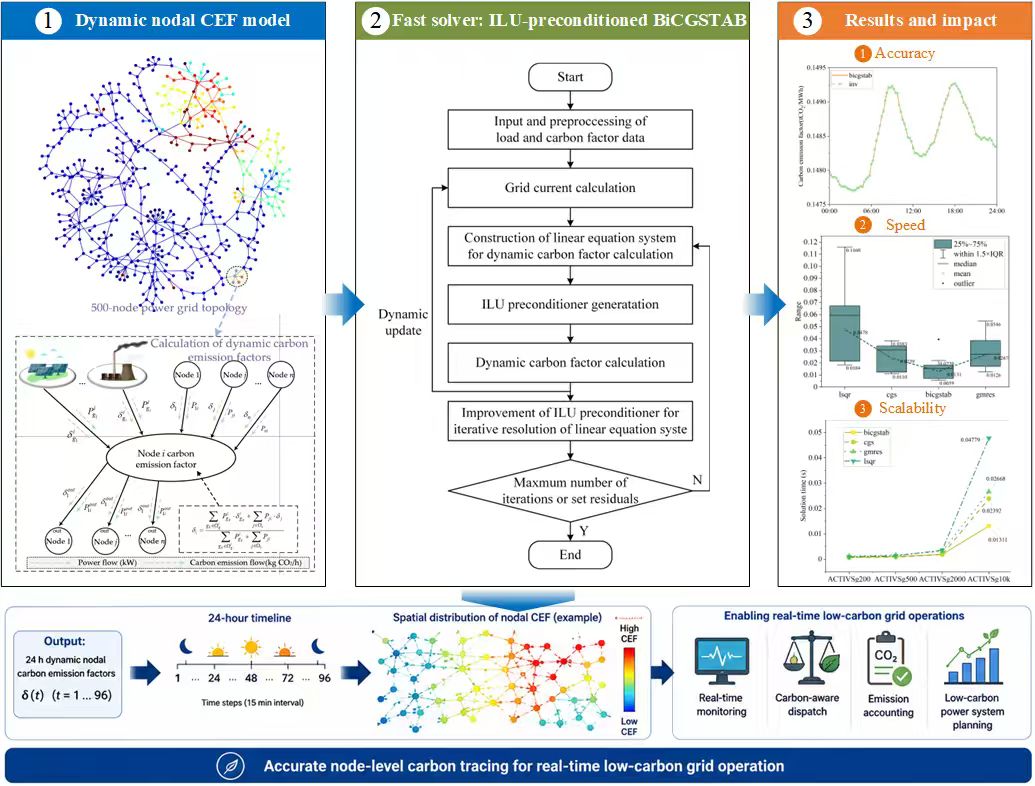
This paper addresses the challenge of efficiently calculating dynamic carbon emission factors (CEFs) in large-scale power systems. Traditional methods that rely on direct matrix inversion are computationally intensive and become impractical for networks with thousands of nodes. To overcome this limitation, a fast and scalable computational framework is proposed based on the incomplete LU (ILU) preconditioned biconjugate gradient stabilized (BiCGSTAB) iterative solver. The proposed approach formulates the nodal CEF model as a sparse linear system and employs Krylov subspace acceleration with ILU preconditioning to enhance convergence and numerical stability. The method is applied to synthetic power grid test cases ranging from 200 to 10,000 nodes to evaluate its accuracy and efficiency. Results show that the ILU-preconditioned BiCGSTAB algorithm achieves convergence within seven iterations, reducing computation time by more than two orders of magnitude compared with conventional direct matrix inversion. The method accurately tracks both local and imported carbon emissions at each node, providing fine-grained temporal and spatial emission profiles. Moreover, the ILU decomposition can be reused across time steps, further improving computational efficiency for dynamic and real-time scenarios. Overall, the proposed method demonstrates excellent scalability and robustness, making it well suited for high-frequency, real-time carbon emission monitoring in large power systems. The findings provide a computational foundation for carbon-aware dispatch, emission accounting, and policy-oriented applications in future low-carbon power grids.Graphic Abstract
Keywords
Cite This Article
 Copyright © 2026 The Author(s). Published by Tech Science Press.
This work is licensed under a Creative Commons Attribution 4.0 International License , which permits unrestricted use, distribution, and reproduction in any medium, provided the original work is properly cited.
 Downloads
 Citation Tools
