
 Login
Login Register
 Submit a Paper
 Propose a Special lssue
 Open Access
ARTICLE

A Novel Comparative Analysis of Statistical and Deep Learning Approaches for Time Series Forecasting of Solar Energy Output
1 Laboratory of Intelligent Systems, Advanced Mechanics and Renewable Energy, Faculty of Sciences and Technology, Sultan Moulay Slimane University, Beni Mellal, Morocco
2 Laboratory MIET, Faculty of Sciences and Technology, Hassan 1st University, Settat, Morocco
* Corresponding Author: Said Benkachcha. Email:
(This article belongs to the Special Issue: Advances and Emerging Trends in Photovoltaic Technologies, Energy Storage, and Green Hydrogen)
Energy Engineering 2026, 123(6), 6 https://doi.org/10.32604/ee.2026.075406
Received 31 October 2025; Accepted 04 January 2026; Issue published 27 May 2026
 View Full Text
 Download PDF
Abstract
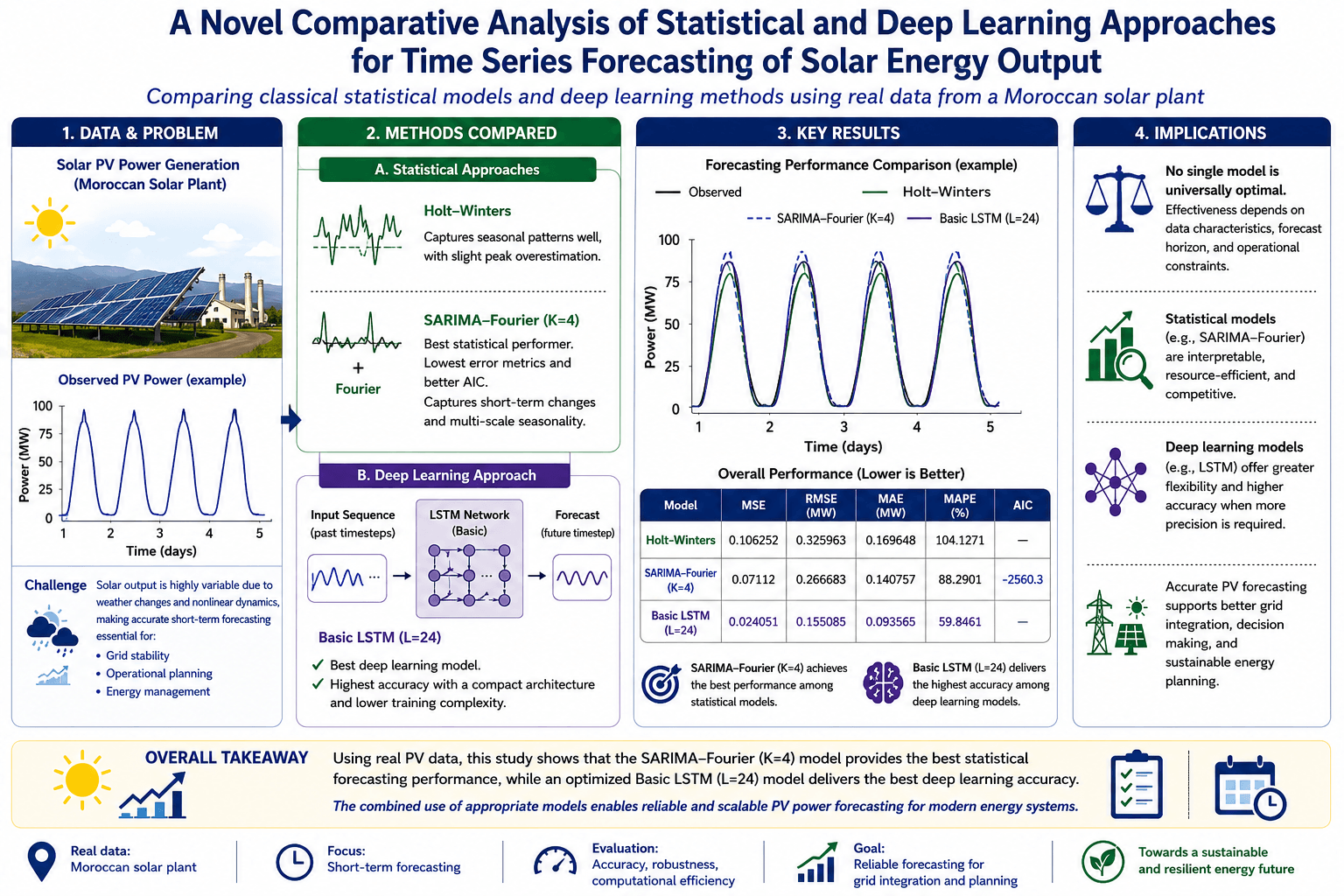
Accurate forecasting of solar photovoltaic (PV) power generation is essential for enabling reliable integration of renewable energy into modern power systems. Variability in solar production, driven by meteorological fluctuations and inherent nonlinear dynamics, presents significant challenges for grid stability, operational planning, and energy management. This study investigates and compares the performance of classical statistical forecasting techniques and advanced deep learning approaches using real PV production data from a Moroccan solar plant. The analysis focuses on accuracy, robustness, computational efficiency, and suitability for short-term operational applications. Among statistical approaches, the Holt–Winters model demonstrated strong capability in reproducing seasonal patterns, although it exhibited slight peak overestimation. The Seasonal ARIMA (SARIMA) model enhanced with Fourier terms provided the best statistical performance, achieving the lowest error metrics and an improved Akaike Information Criterion (AIC), confirming its ability to jointly capture short-term variations and multi-scale seasonality. In contrast, deep learning models offered superior representational flexibility but required higher computational cost and careful tuning. The Basic LSTM architecture, after sequence-length optimization, outperformed other neural models by delivering high predictive accuracy with a compact network structure and reduced training complexity. The results highlight that no single model is universally optimal; instead, forecasting effectiveness depends on data characteristics, horizon requirements, and operational constraints. Statistical models remain competitive for interpretable and resource-efficient applications, whereas neural models are advantageous when higher predictive precision is required. Overall, the findings contribute to the development of reliable and scalable PV forecasting strategies, supporting improved grid integration, enhanced decision making, and sustainable energy planning.Graphic Abstract
Keywords
Cite This Article
 Copyright © 2026 The Author(s). Published by Tech Science Press.
This work is licensed under a Creative Commons Attribution 4.0 International License , which permits unrestricted use, distribution, and reproduction in any medium, provided the original work is properly cited.
 Downloads
 Citation Tools
