
 Login
Login Register
 Submit a Paper
 Propose a Special lssue
 Open Access
ARTICLE

Hybrid Life Cycle Assessment of a Nano-Enhanced Phase Change Material (NEPCM) Integrated Double-Effect Single-Slope Solar Still in Nigeria
1 Department of Mechanical Engineering, Federal University of Technology Owerri, Nigeria
2 Department of Environment Management, Federal University of Technology Owerri, Nigeria
3 Centre for Energy Efficient and Sustainable Technologies, Brunel University, London, UK
* Corresponding Author: Princewill Ikpeka. Email:
Energy Engineering 2026, 123(6), 25 https://doi.org/10.32604/ee.2026.077231
Received 04 December 2025; Accepted 05 March 2026; Issue published 27 May 2026
 View Full Text
 Download PDF
Abstract
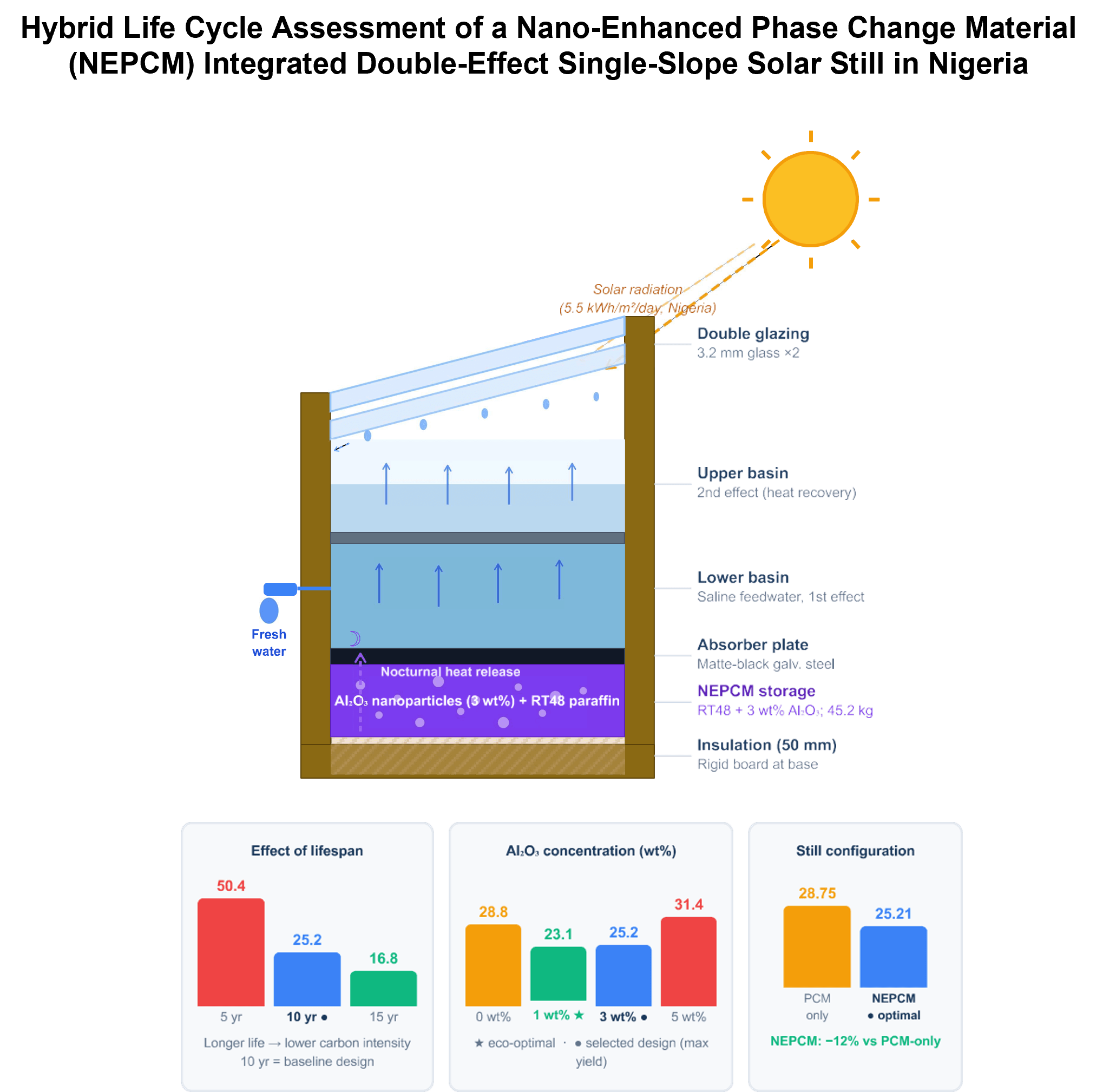
Increasing demand for freshwater and the need to reduce the carbon intensity of conventional desalination have accelerated interest in solar-driven distillation technologies. This study performs a cradle-to-grave Life-Cycle Assessment (LCA) of a nano-enhanced, double-effect single-slope Solar Still fabricated in Nigeria to quantify its embodied environmental impacts and identify material-level hotspots. Modeling was conducted in openLCA v2.4.1 using the Australian Life-Cycle Inventory (2019) database as a proxy. The functional unit was defined as the production of 1 m3 of freshwater distillate over a ten-year operational lifetime. From the analysis, the total Global Warming Potential (GWP100) of the fabricated Solar Still was 337.3 kg CO2-eq, which corresponds to a normalized carbon intensity of 25.21 kg CO2-eq m−3 for a lifetime yield of 13.38 m3. Contribution analysis revealed that Al2O3 nanoparticles (31.5%), paraffin wax PCM (22%), and galvanized steel (19%) and glass (13%) together account for more than 85% of total embodied emissions, confirming that the Solar-Still’s footprint is materials-dominated. When benchmarked against conventional desalination, the system’s carbon intensity lies above reverse osmosis but within the upper range of multi-stage flash distillation, with the advantage of zero operational emissions. Sensitivity analyses were performed to examine the influence of nano-enhanced PCM content, alumina concentration, and system lifespan on overall impacts. The novelty of this study lies in the hybrid-LCI approach adopted to provide a replicable framework for evaluating nanomaterial-enhanced renewable-energy systems in emerging regions. Key opportunities for improvement through bio-based or recyclable PCMs, low-impact nanomaterial synthesis, and design optimization to enhance productivity and material circularity were also highlighted in the study.Graphic Abstract
Keywords
Life cycle assessment; solar still; nano-enhanced PCM; embodied carbon; global warming potential; sustainable desalination; IMPACT World+
Cite This Article
APA Style
Anyanwu, E.E., Anyanwu, O.I., Ikpeka, P. (2026). Hybrid Life Cycle Assessment of a Nano-Enhanced Phase Change Material (NEPCM) Integrated Double-Effect Single-Slope Solar Still in Nigeria. Energy Engineering, 123(6), 25. https://doi.org/10.32604/ee.2026.077231
Vancouver Style
Anyanwu EE, Anyanwu OI, Ikpeka P. Hybrid Life Cycle Assessment of a Nano-Enhanced Phase Change Material (NEPCM) Integrated Double-Effect Single-Slope Solar Still in Nigeria. Energ Eng. 2026;123(6):25. https://doi.org/10.32604/ee.2026.077231
IEEE Style
E. E. Anyanwu, O. I. Anyanwu, and P. Ikpeka, “Hybrid Life Cycle Assessment of a Nano-Enhanced Phase Change Material (NEPCM) Integrated Double-Effect Single-Slope Solar Still in Nigeria,” Energ. Eng., vol. 123, no. 6, pp. 25, 2026. https://doi.org/10.32604/ee.2026.077231
 Copyright © 2026 The Author(s). Published by Tech Science Press.
This work is licensed under a Creative Commons Attribution 4.0 International License , which permits unrestricted use, distribution, and reproduction in any medium, provided the original work is properly cited.
 Downloads
 Citation Tools
