
 Login
Login Register
 Submit a Paper
 Propose a Special lssue
 Open Access
ARTICLE

Mathematical Modeling of Hydraulic Fracture Population in Shale Oil/Gas Reservoirs
Energy Institute of Louisiana, University of Louisiana at Lafayette, Lafayette, LA, USA
* Corresponding Author: Boyun Guo. Email:
(This article belongs to the Special Issue: Enhanced Oil and Gas Recovery in Unconventional ReservoirsⅡ)
Energy Engineering 2026, 123(6), 23 https://doi.org/10.32604/ee.2026.080366
Received 08 February 2026; Accepted 25 March 2026; Issue published 27 May 2026
 View Full Text
 Download PDF
Abstract
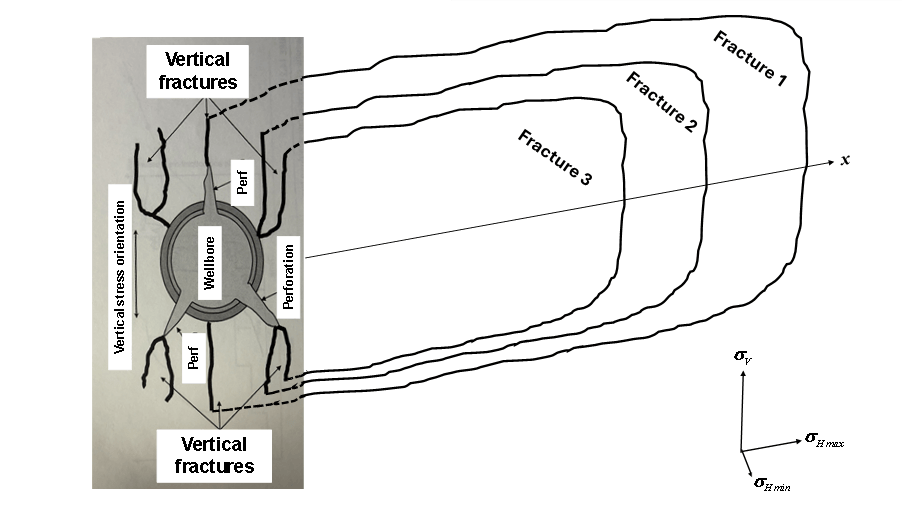
It is generally believed that the productivity of oil/gas wells in shale reservoirs increases with the population of hydraulic fractures in the stimulated reservoir volume. The objective of this work is to identify the dominant factors affecting hydraulic fracture population in shale oil/gas reservoirs. A semi-analytical model was first developed to simulate the sequential initiation and simultaneous propagation of hydraulic fractures during fracturing shale gas/oil reservoirs. The semi-analytical model was then coded in the FracPropag computer program for model validation and quick analyses. The sequential initiation and simultaneous propagation of hydraulic fractures predicted by FracPropag were compared with those inferred from the bottom-hole pressure curve for a real-case operation. A sensitivity study was performed with FracProp using data from the Tuscaloosa Marine Shale to identify key factors affecting the growing population of hydraulic fractures during hydraulic fracturing. The sequential initiation and simultaneous propagation of hydraulic fractures predicted by FracPropag were found to be remarkably consistent with those interpreted from the bottom-hole pressure curve for a real-case operation. A sensitivity study using FracProp with data from the Tuscaloosa Marine Shale identified three key factors that affect the growing population of hydraulic fractures during hydraulic fracturing. They are rheological type of fracturing fluid, rheological properties of fracturing fluid, and flow rate of hydraulic-fracturing fluid. It was found that, compared with water, the use of plastic fluids (e.g., slick water) should reduce the number of short hydraulic fractures and thus fracture network complicity, while the use of dilatant fracturing fluids (e.g., CMC solution) should increase the number of short hydraulic fractures and thus fracture network complicity. Regardless of fluid type, increasing the viscosity of fracturing fluid and slurry pumping rate will increase the number of short hydraulic fractures and thus fracture network complexity. All these effects are attributed to the fluid friction and thus fluid flow in long fractures. This work provides a useful tool for maximizing fracture population and fracture network complexity to improve well productivity in shale reservoirs.Graphic Abstract
Keywords
Shale reservoirs; hydraulic fracturing; fracture population; SRV; mathematical modeling
Cite This Article
APA Style
Guo, B. (2026). Mathematical Modeling of Hydraulic Fracture Population in Shale Oil/Gas Reservoirs. Energy Engineering, 123(6), 23. https://doi.org/10.32604/ee.2026.080366
Vancouver Style
Guo B. Mathematical Modeling of Hydraulic Fracture Population in Shale Oil/Gas Reservoirs. Energ Eng. 2026;123(6):23. https://doi.org/10.32604/ee.2026.080366
IEEE Style
B. Guo, “Mathematical Modeling of Hydraulic Fracture Population in Shale Oil/Gas Reservoirs,” Energ. Eng., vol. 123, no. 6, pp. 23, 2026. https://doi.org/10.32604/ee.2026.080366
 Copyright © 2026 The Author(s). Published by Tech Science Press.
This work is licensed under a Creative Commons Attribution 4.0 International License , which permits unrestricted use, distribution, and reproduction in any medium, provided the original work is properly cited.
 Downloads
 Citation Tools
