
 Login
Login Register
 Submit a Paper
 Propose a Special lssue
 Open Access
ARTICLE

Molecular Dynamics Study of the Wetting Behavior of Biodiesel Combustion Particles under Exhaust-Plume Conditions
1 School of Automotive and Traffic Engineering, Jiangsu University, Zhenjiang, China
2 College of Energy, Soochow University, Suzhou, China
* Corresponding Author: Dengpan Zhang. Email:
(This article belongs to the Special Issue: Climate Change, Clean Energy, and the Revolution in Energy Generation)
Energy Engineering 2026, 123(7), 12 https://doi.org/10.32604/ee.2026.083105
Received 29 March 2026; Accepted 18 May 2026; Issue published 18 June 2026
 View Full Text
 Download PDF
Abstract
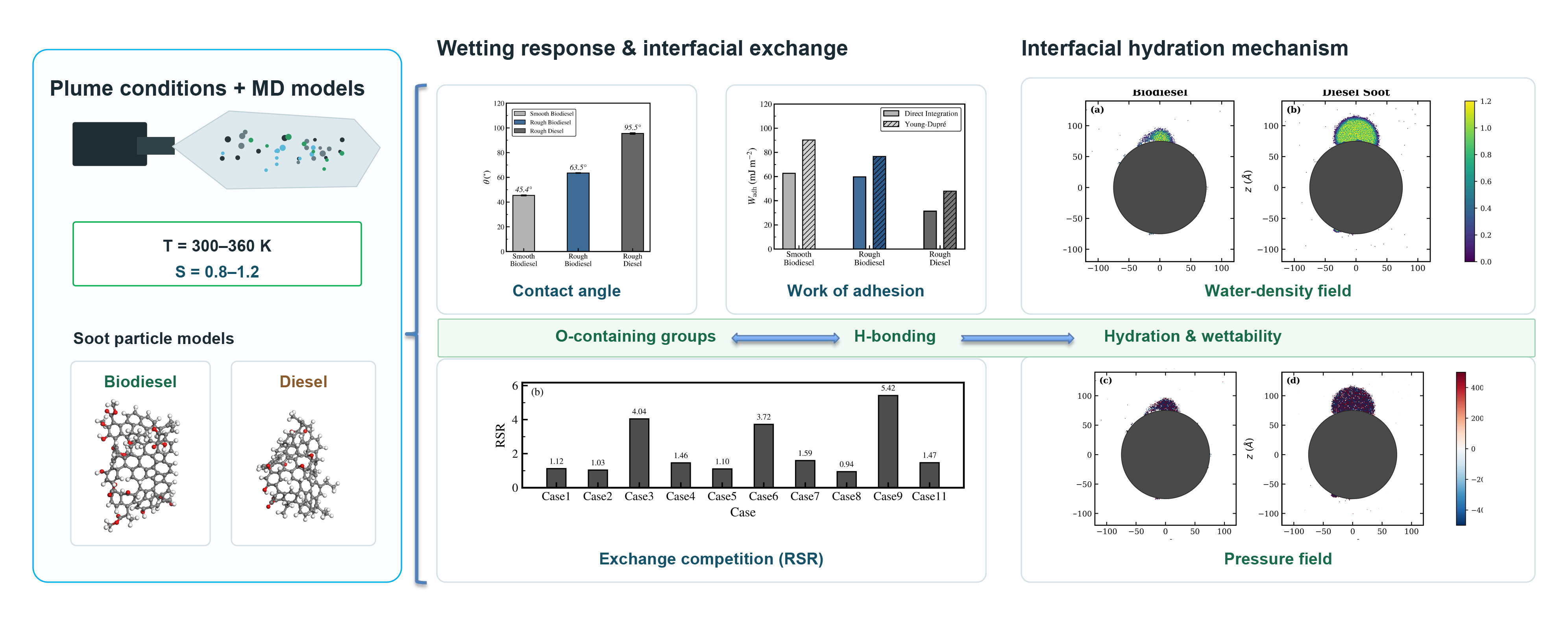
The hygroscopic growth of engine-emitted particulate matter in exhaust plumes is strongly influenced by surface wettability. In this study, molecular dynamics simulations were performed on biodiesel- and diesel-derived combustion-particle models constructed on a unified defective carbon framework to investigate wetting behavior under representative exhaust-plume temperature and humidity conditions. Under the reference condition of 333 K and a saturation ratio of 1.2, the equilibrium contact angles on smooth biodiesel, rough biodiesel, and rough diesel surfaces were 45.4°, 63.5°, and 95.5°, respectively. The trends in work of adhesion and interfacial hydrogen-bond statistics were consistent with the contact-angle results. Temperature primarily modulates interfacial water exchange and liquid-phase rearrangement, whereas the saturation ratio affects the availability of vapor-phase water and its contribution to rearrangement near the contact line and stable solid-liquid bonding. Ultimately, particle wetting behavior is governed by the competition among four interdependent processes: vapor-phase water supply, liquid-phase rearrangement, interfacial bonding, and contact-line motion. Radial distribution function (RDF) analysis, interfacial hydrogen-bond statistics, and spatially resolved profiles of interfacial density and local pressure show that, relative to diesel combustion particles, biodiesel combustion particles—with a higher density of surface oxygen functionalities—exhibit stronger interfacial water enrichment, a denser hydration layer, and more stable interfacial bonding. These differences are consistent with their smaller equilibrium contact angle and greater wetting propensity. These results provide molecular-scale insight into particle-water interactions relevant to early hygroscopic growth in exhaust-plume environments.Graphic Abstract
Keywords
Cite This Article
 Copyright © 2026 The Author(s). Published by Tech Science Press.
This work is licensed under a Creative Commons Attribution 4.0 International License , which permits unrestricted use, distribution, and reproduction in any medium, provided the original work is properly cited.
 Downloads
 Citation Tools
