
 Login
Login Register
 Submit a Paper
 Propose a Special lssue
 Open Access
REVIEW

Fault-Induced Floor Water Inrush in Confined Aquifers under Mining Stress: Mechanisms and Prevention Technologies—A State-of-the-Art Review
1 International Joint Research Laboratory of Henan Province for Underground Space Development and Disaster Prevention, School of Civil Engineering, Henan Polytechnic University, Jiaozuo, 454000, China
2 Henan Mine Water Disaster Prevention and Control and Water Resources Utilization Engineering Technology Research Center, Henan Polytechnic University, Jiaozuo, 454000, China
3 Collaborative Innovation Center of Coal Work Safety and Clean High Efficiency Utilization, Jiaozuo, 454000, China
4 School of Energy Science and Engineering, Henan Polytechnic University, Jiaozuo, 454000, China
* Corresponding Author: Wenqiang Wang. Email:
(This article belongs to the Special Issue: Fluid Dynamics and Multiphysical Coupling in Rock and Porous Media: Advances in Experimental and Computational Modeling)
Fluid Dynamics & Materials Processing 2025, 21(10), 2419-2442. https://doi.org/10.32604/fdmp.2025.070624
Received 20 July 2025; Accepted 01 September 2025; Issue published 30 October 2025
 View Full Text
 Download PDF
Abstract
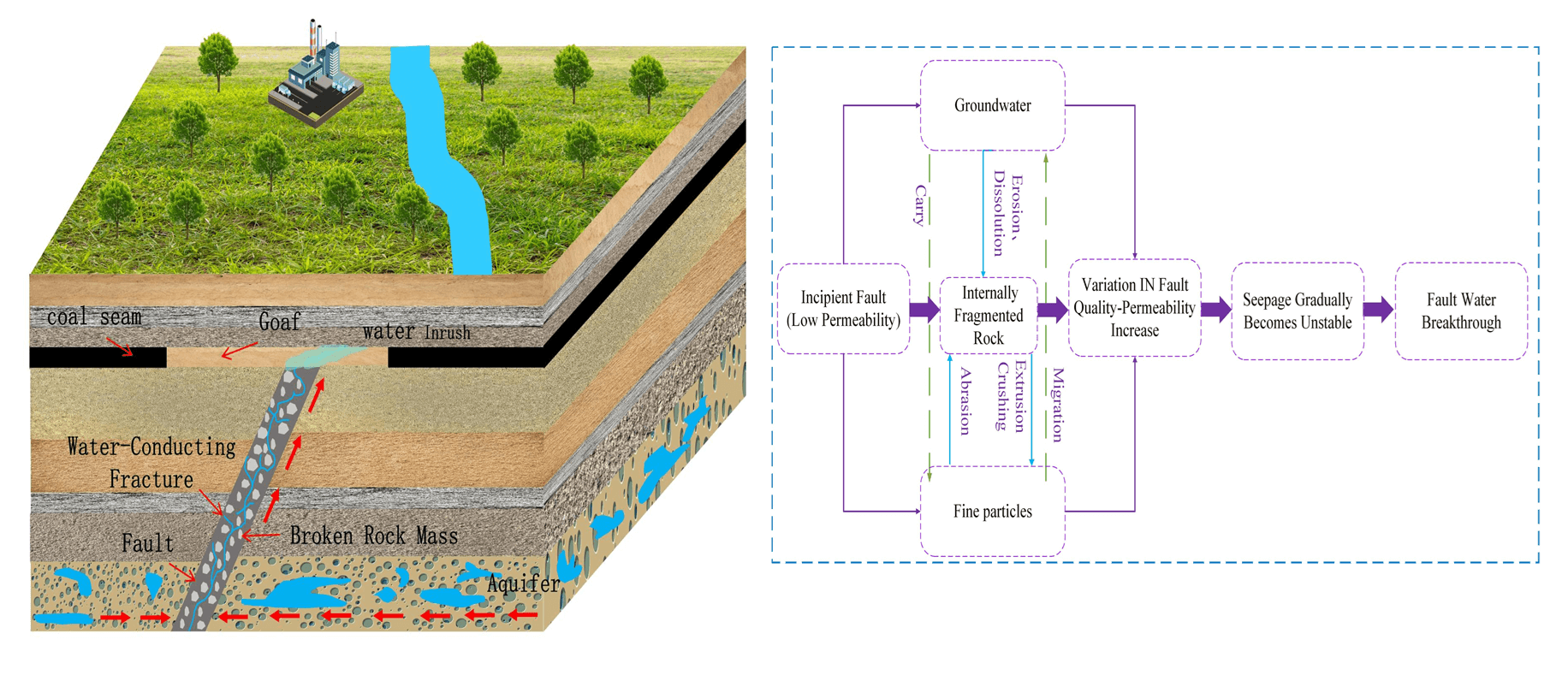
With the depletion of shallow mineral resources, mining operations are extending to greater depths and larger scales, increasing the risk of water inrush disasters, particularly from confined aquifers intersected by faults. This paper reviews the current state of research on fault-induced water inrushes in mining faces, examining the damage characteristics and permeability of fractured floor rock, the mechanical behavior of faults under mining stress, and the mechanisms driving water inrush. Advances in prevention technologies, risk assessment, and prediction methods are also summarized. Research shows that damage evolution in fractured floor rock, coupled with fluid-solid interactions, provides the primary pathways for water inrush. Stress-seepage coupling in porous media plays a decisive role in determining inrush potential. Mining-induced stress redistribution can activate faults, with parameters such as dip angle and internal friction angle controlling stress evolution and slip. Critical triggers include the hydraulic connectivity among faults, aquifers, and mining-induced fracture networks, followed by hydraulic erosion. A multi-pronged prevention framework has been developed, integrating precise fault detection, targeted grouting for water sealing, drainage to reduce water pressure, optimized waterproof coal pillar design, and dynamic risk assessment and prediction. However, gaps remain in understanding multi-physical field coupling under deep mining conditions, establishing quantitative criteria for fault activation-induced water inrush, and refining control technologies. Future work should focus on multi-scale numerical simulations, advanced active control measures, and intelligent, integrated prevention systems to clarify the mechanisms of fault-induced water inrush and enhance theoretical and technical support for mine safety.Graphic Abstract
Keywords
Cite This Article
 Copyright © 2025 The Author(s). Published by Tech Science Press.
This work is licensed under a Creative Commons Attribution 4.0 International License , which permits unrestricted use, distribution, and reproduction in any medium, provided the original work is properly cited.
 Downloads
 Citation Tools
