Home / Journals / FDMP / Vol.21, No.10, 2025
Special Issues
Table of Content
cover

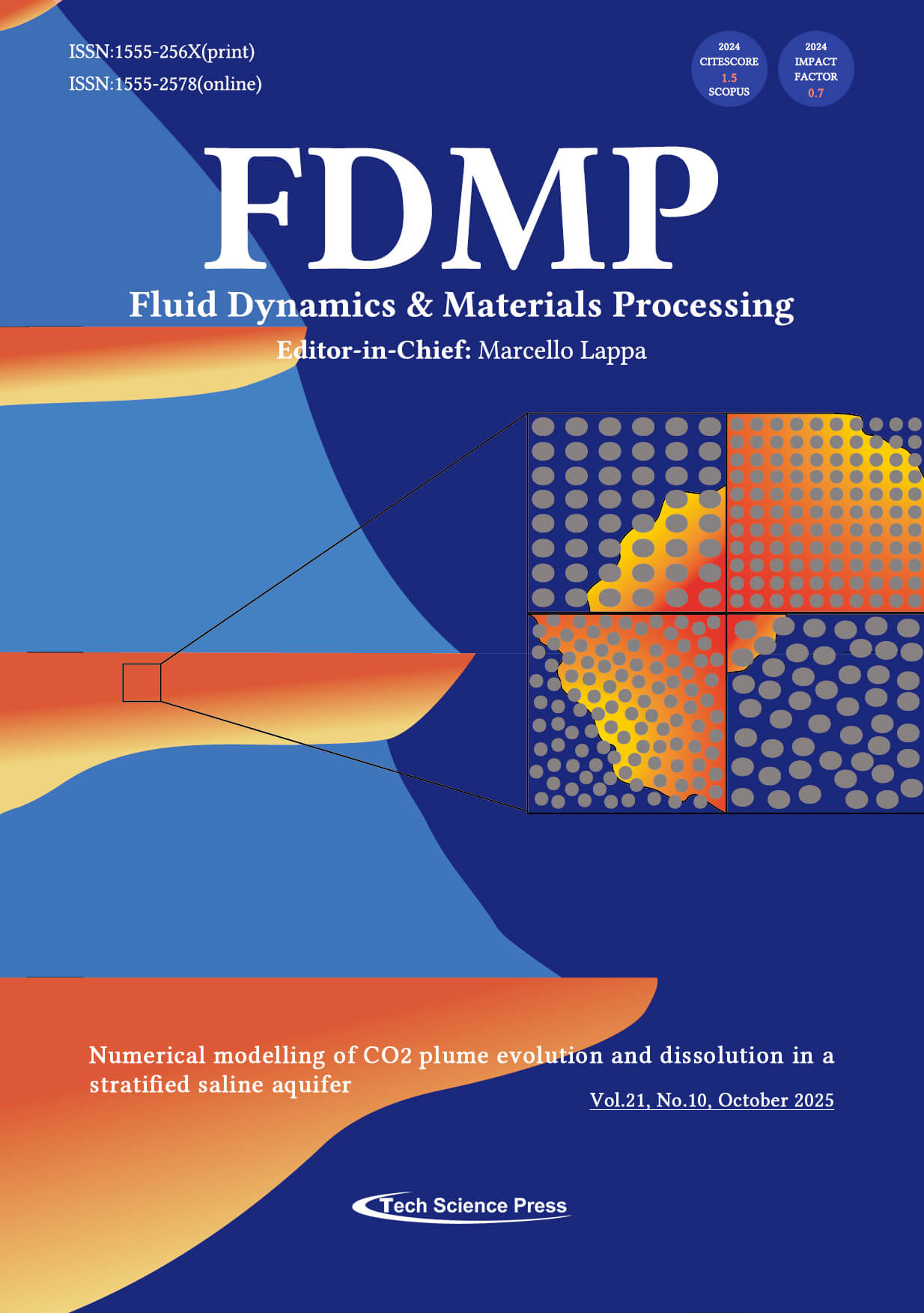
On the Cover

This study analyzes the migration and dissolution of CO2 plumes in a stratified saline aquifer, with particular emphasis on how sandstone–shale system influences CO2 diffusion and dissolution. The cover illustration depicts the lateral and vertical spreading of CO2 plumes from the injection point, the buoyant rise, and accumulation beneath low-permeability shale. The magnified view on the right highlights that porosity and heterogeneity markedly reshape saturation patterns and plume fronts. Higher porosity promotes local accumulation, but limits radial advance, whereas higher permeability tends to extend the dissolution front. Together, the results illustrate how reservoir properties govern CO2 migration and dissolution efficiency in layered aquifers.

View this paper

  • Open AccessOpen Access

    ARTICLE

    Numerical Modelling of CO2 Plume Evolution and Dissolution in a Stratified Saline Aquifer

    Bohao Wu*, Xiuqi Zhang, Haoheng Liu, Yulong Ji
    FDMP-Fluid Dynamics & Materials Processing, Vol.21, No.10, pp. 2359-2387, 2025, DOI:10.32604/fdmp.2025.067651 - 30 October 2025
    (This article belongs to the Special Issue: Multiphase Fluid Flow Behaviors in Oil, Gas, Water, and Solid Systems during CCUS Processes in Hydrocarbon Reservoirs)
    Abstract Geological sequestration of carbon dioxide (CO2) entails the long-term storage of captured emissions from CCUS (Carbon Capture, Utilization, and Storage) facilities in deep saline aquifers to mitigate greenhouse gas accumulation. Among various trapping mechanisms, dissolution trapping is particularly effective in enhancing storage security. However, the stratified structure of saline aquifers plays a crucial role in controlling the efficiency of CO2 dissolution into the resident brine. In this study, a two-dimensional numerical model of a stratified saline aquifer is developed, integrating both two-phase flow and mass transfer dynamics. The model captures the temporal evolution of gas saturation,… More >

  • Open AccessOpen Access

    REVIEW

    Solitons-Like Coherent Structures in Shear Flows

    Ning Hu, Cunbiao Lee*
    FDMP-Fluid Dynamics & Materials Processing, Vol.21, No.10, pp. 2389-2417, 2025, DOI:10.32604/fdmp.2025.067248 - 30 October 2025
    (This article belongs to the Special Issue: Traveling Waves, Impulses and Laminar-turbulent Transitions in Fluid Dynamics Equations)
    Abstract The formation, evolution, and dynamics of flow structures in wall-bounded turbulence have long been central themes in fluid-mechanics research. Over the past three decades, Soliton-like Coherent Structures (SCSs) have emerged as a ubiquitous and unifying feature across a wide range of shear flows, including K-type, O-type, N-type, and bypass transitional boundary layers, as well as fully developed turbulent boundary layers, mixing layers, and pipe flows. This paper presents a systematic review of the fundamental properties of SCSs and highlights their fundamental role in multiple transition scenarios. The analysis further explores the connection between SCSs and… More >

    Graphic Abstract

    Solitons-Like Coherent Structures in Shear Flows

  • Open AccessOpen Access

    REVIEW

    Fault-Induced Floor Water Inrush in Confined Aquifers under Mining Stress: Mechanisms and Prevention Technologies—A State-of-the-Art Review

    Zhengzheng Cao1,2,3, Fangxu Guo1, Wenqiang Wang2,3,4,*, Feng Du2,3,4, Zhenhua Li2,3,4, Shuaiyang Zhang1, Qixuan Wang1, Yongzhi Zhai1
    FDMP-Fluid Dynamics & Materials Processing, Vol.21, No.10, pp. 2419-2442, 2025, DOI:10.32604/fdmp.2025.070624 - 30 October 2025
    (This article belongs to the Special Issue: Fluid Dynamics and Multiphysical Coupling in Rock and Porous Media: Advances in Experimental and Computational Modeling)
    Abstract With the depletion of shallow mineral resources, mining operations are extending to greater depths and larger scales, increasing the risk of water inrush disasters, particularly from confined aquifers intersected by faults. This paper reviews the current state of research on fault-induced water inrushes in mining faces, examining the damage characteristics and permeability of fractured floor rock, the mechanical behavior of faults under mining stress, and the mechanisms driving water inrush. Advances in prevention technologies, risk assessment, and prediction methods are also summarized. Research shows that damage evolution in fractured floor rock, coupled with fluid-solid interactions,… More >

    Graphic Abstract

    Fault-Induced Floor Water Inrush in Confined Aquifers under Mining Stress: Mechanisms and Prevention Technologies—A State-of-the-Art Review

  • Open AccessOpen Access

    ARTICLE

    Mechanistic Scale-Up of Gas-Solid Fluidized Beds via Local Hydrodynamic Similarity

    Faraj M. Zaid1,2, Thaar M. Aljuwaya3,4,*, Muthanna H. Al-Dahhan1,3,5,*
    FDMP-Fluid Dynamics & Materials Processing, Vol.21, No.10, pp. 2443-2471, 2025, DOI:10.32604/fdmp.2025.067557 - 30 October 2025
    Abstract This study presents a detailed experimental evaluation of a newly developed mechanistic scale-up methodology for gas-solid fluidized beds. Traditional scale-up approaches typically rely on matching global dimensionless groups, which often fail to ensure local hydrodynamic similarity. In contrast, the new mechanistic method aims to achieve scale-up by matching the radial profiles of gas holdup between geometrically similar beds at corresponding dimensionless axial positions (z/Dc). This approach is based on the premise that when gas holdup profiles align, other key hydrodynamic parameters—such as solids holdup and particle velocity—also become similar. To validate this methodology, experiments were conducted More >

  • Open AccessOpen Access

    ARTICLE

    Comparative Analysis of Nano-Blood Flow in Mild to Severe Multiple Constricted Curved Arteries

    Sehrish Bibi1,*, Vincenzo Minutolo2, Obaid Ullah Mehmood3, Renato Zona2
    FDMP-Fluid Dynamics & Materials Processing, Vol.21, No.10, pp. 2473-2493, 2025, DOI:10.32604/fdmp.2025.072470 - 30 October 2025
    (This article belongs to the Special Issue: Model-Based Approaches in Fluid Mechanics: From Theory to industrial Applications)
    Abstract Arterial stenosis is a critical condition with increasing prevalence among pediatric patients and young adults, making its investigation highly significant. Despite extensive studies on blood flow dynamics, limited research addresses the combined effects of nanoparticles and arterial curvature on unsteady pulsatile flow through multiple stenoses. This study aims to analyze the influence of nanoparticles on blood flow characteristics in realistic curved arteries with mild to severe overlapped constrictions. Using curvilinear coordinates, the thermal energy and momentum equations for nanoparticle-laden blood were derived, and numerical results were obtained through an explicit finite difference method. Key findings More >

  • Open AccessOpen Access

    ARTICLE

    Optimized Pilot Hydraulic Valves for Urban Water Systems via Enhanced BP-Coati Algorithms

    Shuxun Li1,2, Xinhao Liu1,2,*, Yu Zhang1,2, Yu Zhao1,2
    FDMP-Fluid Dynamics & Materials Processing, Vol.21, No.10, pp. 2495-2526, 2025, DOI:10.32604/fdmp.2025.068674 - 30 October 2025
    Abstract Hydraulic control valves, positioned at the terminus of pipe networks, are critical for regulating flow and pressure, thereby ensuring the operational safety and efficiency of pipeline systems. However, conventional valve designs often struggle to maintain effective regulation across a wide range of system pressures. To address this limitation, this study introduces a novel Pilot hydraulic valves specifically engineered for enhanced dynamic performance and precise regulation under variable pressure conditions. Building upon prior experimental findings, the proposed design integrates a high-fidelity simulation framework and a surrogate model-based optimization strategy. The study begins by formulating a comprehensive… More >

  • Open AccessOpen Access

    ARTICLE

    Influence of Aviation Kerosene-Diesel Blending Ratios on Ignition Behavior and Spray Dynamics

    Hailong Chen1,*, Guanzhen Tao1, Daijun Wei2, Guangyao Ouyang3
    FDMP-Fluid Dynamics & Materials Processing, Vol.21, No.10, pp. 2527-2538, 2025, DOI:10.32604/fdmp.2025.069569 - 30 October 2025
    (This article belongs to the Special Issue: Model-Based Approaches in Fluid Mechanics: From Theory to industrial Applications)
    Abstract Modifications in fuel spray characteristics fundamentally influence fuel–air mixing dynamics in diesel engines, thereby significantly affecting combustion performance and emission profiles. This study explores the operational behavior of RP-5 aviation kerosene/diesel blended fuels in marine diesel engines. A spray visualization platform based on Mie scattering technology was developed to comparatively analyze the spray characteristics, ignition behavior, and soot emissions of RP-5 aviation kerosene, conventional-35# diesel, and their blends at varying mixing ratios (D100H0, D90H10, D70H30, D50H50, D30H70, D0H100). The findings demonstrate that, under constant injection pressure, aviation kerosene combustion results in a more uniform temperature More >

  • Open AccessOpen Access

    ARTICLE

    A Novel Low-Damage Viscoelastic-Surfactant Foam Fracturing Fluid for Tight Reservoirs: Development and Performance Assessment

    Yu Li1,2,3,*, Jie Bian3, Liang Zhang2,3, Xuesong Feng3, Jiachen Hu3, Ji Yu3, Chao Zhou3, Tian Lan3
    FDMP-Fluid Dynamics & Materials Processing, Vol.21, No.10, pp. 2539-2556, 2025, DOI:10.32604/fdmp.2025.067685 - 30 October 2025
    (This article belongs to the Special Issue: Fluid and Thermal Dynamics in the Development of Unconventional Resources III)
    Abstract As oil and gas development increasingly targets unconventional reservoirs, the limitations of conventional hydraulic fracturing, namely high water consumption and significant reservoir damage, have become more pronounced. This has driven growing interest in the development of clean fracturing fluids that minimize both water usage and formation impairment. In this study, a low-liquid-content viscoelastic surfactant (VES) foam fracturing fluid system was formulated and evaluated through laboratory experiments. The optimized formulation comprises 0.2% foaming agent CTAB (cetyltrimethylammonium bromide) and 2% foam stabilizer EAPB (erucamidopropyl betaine). Laboratory tests demonstrated that the VES foam system achieved a composite foam… More >

  • Open AccessOpen Access

    ARTICLE

    Deep Learning-Based Investigation of Multiphase Flow and Heat Transfer in CO2–Water Enhanced Geothermal Systems

    Feng He*, Rui Tan, Songlian Jiang, Chao Qian, Chengzhong Bu, Benqiang Wang
    FDMP-Fluid Dynamics & Materials Processing, Vol.21, No.10, pp. 2557-2577, 2025, DOI:10.32604/fdmp.2025.070186 - 30 October 2025
    (This article belongs to the Special Issue: Multiphase Fluid Flow Behaviors in Oil, Gas, Water, and Solid Systems during CCUS Processes in Hydrocarbon Reservoirs)
    Abstract This study introduces a Transformer-based multimodal fusion framework for simulating multiphase flow and heat transfer in carbon dioxide (CO2)–water enhanced geothermal systems (EGS). The model integrates geological parameters, thermal gradients, and control schedules to enable fast and accurate prediction of complex reservoir dynamics. The main contributions are: (i) development of a workflow that couples physics-based reservoir simulation with a Transformer neural network architecture, (ii) design of physics-guided loss functions to enforce conservation of mass and energy, (iii) application of the surrogate model to closed-loop optimization using a differential evolution (DE) algorithm, and (iv) incorporation of economic… More >

  • Open AccessOpen Access

    ARTICLE

    Impact of Window-to-Wall Ratio on Thermal Comfort and Energy Performance of Hybrid Cooling Systems

    Dong Liu1, Runze Zhang1, Anjie Hu1, Na Liu1, Liu Tang2,3,*, Xiaozhou Wu4, Jun Wang2,5
    FDMP-Fluid Dynamics & Materials Processing, Vol.21, No.10, pp. 2579-2612, 2025, DOI:10.32604/fdmp.2025.070407 - 30 October 2025
    (This article belongs to the Special Issue: Fluid Mechanics & Thermodynamics in Renewable Energy and HVAC Systems)
    Abstract This study compares two end-cooling systems, convective–radiant combined cooling (FR+FC) and fan coil convection (FC), through continuous experimental investigations, focusing on the impact of window-to-wall ratio (WWR) on indoor thermal comfort, temperature distribution, humidity, and energy consumption. Results show that increasing WWR amplifies indoor temperature fluctuations. While the overall predicted mean vote (PMV) remains within the Level-II comfort range (−1.0 to +1.0), the FC system exhibits pronounced local PMV gradients near west-facing windows, especially at 80% WWR, where transient PMV reaches 1.26 close to the window, 0.89 higher than at the room center. In contrast, More >

  • Open AccessOpen Access

    ARTICLE

    Impact of Proppant Embedding on Long-Term Fracture Conductivity and Shale Gas Production Decline

    Junchen Liu1, Feng Zhou1, Xiaofeng Lu1, Xiaojin Zhou2, Xianjun He1, Yurou Du3, Fuguo Xia1, Junfu Zhang4, Weiyi Luo4,*
    FDMP-Fluid Dynamics & Materials Processing, Vol.21, No.10, pp. 2613-2628, 2025, DOI:10.32604/fdmp.2025.069772 - 30 October 2025
    (This article belongs to the Special Issue: Fluid and Thermal Dynamics in the Development of Unconventional Resources III)
    Abstract In shale gas reservoir stimulation, proppants are essential for sustaining fracture conductivity. However, increasing closing stress causes proppants to embed into the rock matrix, leading to a progressive decline in fracture permeability and conductivity. Furthermore, rock creep contributes to long-term reductions in fracture performance. To elucidate the combined effects of proppant embedding and rock creep on sustained conductivity, this study conducted controlled experiments examining conductivity decay in propped fractures under varying closing stresses, explicitly accounting for both mechanisms. An embedded discrete fracture model was developed to simulate reservoir production under different conductivity decay scenarios, while… More >

  • Open AccessOpen Access

    ARTICLE

    Integrated Experimental and Numerical Analysis of Particle Migration Effects on Produced Water Reinjection in Offshore Reservoirs

    Mengna Cheng1, Hao Guo2, Feng Cao2, Jie Gong1, Fengshuang Du1,*
    FDMP-Fluid Dynamics & Materials Processing, Vol.21, No.10, pp. 2629-2650, 2025, DOI:10.32604/fdmp.2025.070344 - 30 October 2025
    (This article belongs to the Special Issue: Multiphase Fluid Flow Behaviors in Oil, Gas, Water, and Solid Systems during CCUS Processes in Hydrocarbon Reservoirs)
    Abstract Produced water reinjection is a common strategy in offshore oilfield operations, yet the presence of solid particles in produced water can lead to localized formation pressure buildup, increasing the risk of rock fracturing and leakage. In this study, we present an integrated experimental and numerical investigation to quantify the effects of particle migration on formation pressure and the spatial diffusion of injected water. Dynamic plugging experiments were performed to systematically examine the influence of injection rate and injection volume on core permeability. Results demonstrate that higher injection rates substantially reduce permeability, and the derived relationship More >

Per Page:

Share Link